FOX ESS: three-phase power from 5 to 125 kW
The P3 series: inverters for commercial and high-power sites
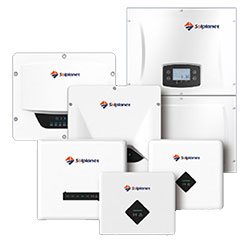
FOX ESS three-phase inverters in the P3 series are built for sites with three-phase grid connections — not just large private homes with high power consumption, but primarily commercial and light industrial property: shops, warehouses, small production sites, administrative buildings. The line spans fourteen models across an unusually wide power range — from 5 to 125 kW, letting you match an inverter to a site of nearly any scale without switching manufacturers.
The base range (5-15 kW) and P3-Pro
The base range of the P3 series (5 to 15 kW) covers the needs of country houses with three-phase connections and small commercial premises with moderate power consumption. These are hybrid inverters combining solar conversion, storage charging and grid power in one device — much like the single-phase H1 and KH models, but built for three-phase loads typical of more powerful appliances and production equipment.
The Plus series, spanning 50-125 kW, targets commercial and industrial facilities with substantially higher consumption: small production shops, shopping centers, warehouse complexes with refrigeration equipment. Having such high-power models in FOX ESS's portfolio lets a company that already runs lower-power P3 hybrid inverters at one site scale the system up to industrial scale while staying within a single product line and a single monitoring platform.
The Plus series (50-125 kW) and FoxCloud monitoring
The P3-Pro line (20 and 30 kW) occupies a distinct position — an intermediate class between the base models and the Plus series, built for sites with growing consumption where the standard 15 kW is no longer enough but the full industrial Plus series would be an oversized investment. It's a practical option for a business scaling gradually rather than jumping straight to an industrial level of power consumption, letting investment match the actual growth rate rather than a hypothetical maximum.
All P3 series models support remote monitoring through the FoxCloud platform, which matters especially for commercial sites: a business owner or management company can track energy generation and consumption across several sites at once through a single interface, without needing to visit each site to check system status.
Three-phase advantages, service and how to choose
Choosing a specific model within such a wide power range should be based on the site's three-phase load during peak operating hours, not average daily consumption — production equipment, air conditioning of large spaces, or several power-hungry loads running simultaneously create peak loads, and it's those peaks, not the figure from an average monthly bill, that determine the minimum inverter power needed.
Three-phase power itself is another advantage for commercial sites beyond higher capacity: even load distribution across three phases lowers the risk of phase imbalance, which commonly arises when powering heavy equipment from a single-phase grid and can cause unstable operation of sensitive electronics or premature wear on production equipment motors.
Warranty and service support for FOX ESS three-phase inverters in Ukraine accounts for the specifics of commercial operation: for a business that can't afford extended downtime from a power system failure, priority diagnostics through FoxCloud and on-site service focused on minimizing recovery time are available, rather than standard household service timelines.
A commercial buyer should also weigh how downtime translates into direct revenue loss, not just inconvenience: a retail refrigeration unit or a production line stopped for hours has a cost that scales with the size of the operation, which is exactly why the P3 line's remote-diagnosis-first service model matters more here than it would for a residential single-phase installation.
Compare power, series class (base, Pro or Plus), expansion capability and service support level across the FOX ESS models in the catalogue below, and pick a three-phase inverter that matches not just your current needs but your site's future power consumption as it grows, without needing to switch manufacturers as your business scales.

 m. Сміла, Незалежності, 67г. оф, 406/6