FOX ESS: the P100 line-up for every consumption profile
The "LiFePO4" category: the P100 series
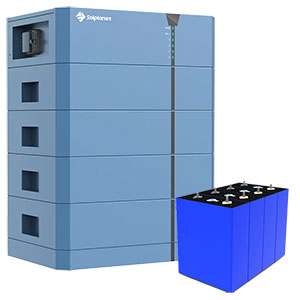
The "LiFePO4" category groups energy storage systems built on lithium iron phosphate cells — a chemistry that today stands as the standard for home and commercial energy storage precisely because it combines safety, cycle life and stable performance across a wide range of operating conditions. FOX ESS's range in this category includes three models in the P100 series: P100-6-H, P100-8-H and P100-10-H, with capacity from 6 to 10 kWh.
Capacity, autonomy and LiFePO4 chemistry
The capacity difference between models determines how many hours of off-grid runtime the system provides at typical household consumption without solar generation — at night or on an overcast day. For a home with baseline consumption (lighting, a fridge, a router, occasional pump use), the entry-level P100-6-H can cover a full night of standalone operation, while a home with electric heating or air conditioning should look at the P100-10-H for a larger reserve.
Lithium iron phosphate (LiFePO4) chemistry differs from classic lithium-ion cells (NMC, LCO) used in most consumer electronics through higher thermal stability: the cathode material doesn't release oxygen when overheated, which removes the main mechanism behind thermal runaway in other lithium chemistries. That doesn't mean zero risk under gross misuse, but it substantially lowers the chance of an emergency compared to alternative storage technologies.
Cycle life, built-in BMS and modularity
P100 systems are rated for thousands of full charge-discharge cycles before capacity drops below an acceptable level — at a daily charge-discharge cycle, that means a service life of several years even under intensive use, comparable to the rated lifespan of the solar inverter itself. That's worth factoring into a budget: the storage system won't be the "weak link" needing replacement ahead of the rest of the equipment.
Every model in the P100 series includes a built-in battery management module (BMS) that balances charge across internal cells, protects against overcharge and deep discharge, and sends diagnostic data to the FoxCloud platform for remote monitoring. An owner doesn't need to separately buy or configure a protection system — it's already integrated into every storage module, and BMS firmware updates happen remotely without physical intervention in the system.
Form factor, comparison and how to choose
The modularity of the P100 line lets you combine several units to grow total system capacity if household needs increase over time — after switching to electric heating or buying an electric vehicle, for instance. That lets you start with the minimum needed configuration and scale the system gradually, without replacing already-installed equipment.
The P100 form factor is built for wall- or floor-mounting in a utility room, garage or basement, with a compact footprint that doesn't require a dedicated room for the energy system — unlike traditional lead-acid battery systems, which at equivalent capacity need far more space and a reinforced floor due to their weight and bulk.
When comparing the P100 to storage from other manufacturers in the same capacity range, look beyond stated kWh capacity to the maximum discharge current, which determines how many power-hungry loads (an air conditioner compressor or water heater, say) the system can run simultaneously — two storage units with identical capacity can differ substantially on this spec.
Sizing also matters at installation time, not just on paper: a unit that fits through a standard doorway and up a narrow basement stairwell without professional rigging saves real labor cost on install day, and the P100's compact footprint was specifically designed with that kind of retrofit scenario in mind, rather than assuming a purpose-built plant room from the start.
Compare capacity, maximum discharge current and dimensions of the P100 models against your actual nighttime consumption profile, and pick a storage system that delivers stable autonomy for exactly the hours when solar panels aren't generating, without overpaying for reserve capacity that never gets fully used.

 m. Сміла, Незалежності, 67г. оф, 406/6