Makita: precision engineering for every task
What the "Power Tools" category means
The "Power Tools" category groups Makita equipment driven by an electric motor — corded or battery-powered — as opposed to pneumatic or manual tools. For a buyer that's a practical distinction: an electric tool doesn't depend on a compressor or the operator's physical strength, and its power and speed are defined purely by the motor and control electronics. That's why choosing within this category should start with specifications, not the badge: supply voltage, power draw in watts, RPM or impact-per-minute range — and only then match those numbers to the actual job.
Line-up by type and power
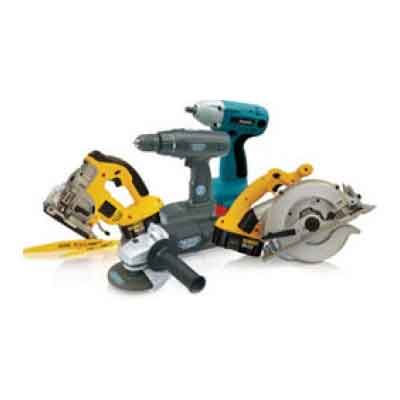
The Makita line-up here covers impact and non-impact drills from 530 W to over 1000 W, 18V drill-drivers with electronic torque control, impact screwdrivers for fast high-volume fastening, angle grinders from 720 W to 2200 W for discs between 115 and 230 mm, and rotary hammers with impact energy sized for anything from light drilling to chasing concrete walls. Each sub-category answers a distinct type of work, and they aren't interchangeable by function: a rotary hammer won't replace a drill for precision fitting, and an angle grinder isn't built for drilling.
The motor is the component that determines a power tool's lifespan, and this is exactly where Makita bet on brushless technology: development started in 2004 for the defense sector, and from 2009 brushless motors began appearing in mass-market tools for construction crews. No carbon brushes means less friction, cooler windings, and motor life that outlasts a brushed equivalent several times over — even under daily eight-hour use. Electronic soft-start and overload protection built into the controller further reduce the risk of failure when working hard materials.
Motor and reliability: brushless technology and dust protection
For corded Makita tools, one more spec matters — the housing's dust-ingress protection class, since dust on a construction site reaches motor vents far faster than in a workshop. Sealed housings and labyrinth dust paths in the GA and HR series extend the interval between services, and where carbon brushes are replaceable, that maintenance can be done without a service center visit. For cordless tools, the critical factor is temperature control of both battery and motor under load — Makita's electronics cut power before critical overheating rather than after, which preserves the life of the lithium-ion cells.
The voltage-and-power breakdown lets a buyer match a tool precisely to their workload: home repairs rarely need a tool over 900 W or a professional 5 Ah battery, while a crew on site runs tools at the edge of their rated capacity every day, where reserve power directly affects task speed and, ultimately, billable hours. Paying for capability you'll never use is just as irrational as saving money where daily loads demand industrial-grade endurance.
A concrete model comparison makes this logic tangible: the corded GA9020 angle grinder at 2200 W with a 230 mm disc is built for cutting rebar and grinding weld seams all day long, while the compact cordless DGA452Z with a 115 mm disc suits precise tile or profile cutting where running a cable is inconvenient or unsafe. The HP333DWAE impact driver, spinning up to 1500 rpm, fits high-volume fastening into timber or metal profile, while the corded FS2300 screwdriver at 2500 rpm is a different tool by design — built for fast driving without an impact function where the fastener doesn't need extra torque.
How to choose by specification
This same logic applies to rotary hammers and impact drills further up the power scale: the HR2470 delivers 780 W and an impact rate tuned for anchor holes and light chasing, while the HR2810 at 800 W and a higher impact frequency handles heavier demolition-adjacent tasks without stalling under load. Picking between them by price alone, without checking the impact energy and rated chuck capacity, is how buyers end up either underpowered on a real job site or carrying unnecessary weight and cost on a light one.
Every model in the catalogue below lists its voltage, power, speed or impact rate — compare those numbers against your actual job, not just the price tag, and pick a tool that runs out its full service life instead of needing replacement after the first hard year of use.

 m. Сміла, Незалежності, 67г. оф, 406/6