
 m. Сміла, Незалежності, 67г. оф, 406/6























REOLINK RP-PNxx-NHD (8 PoE, 240 MB/s) - IP VIDEO RECORDER

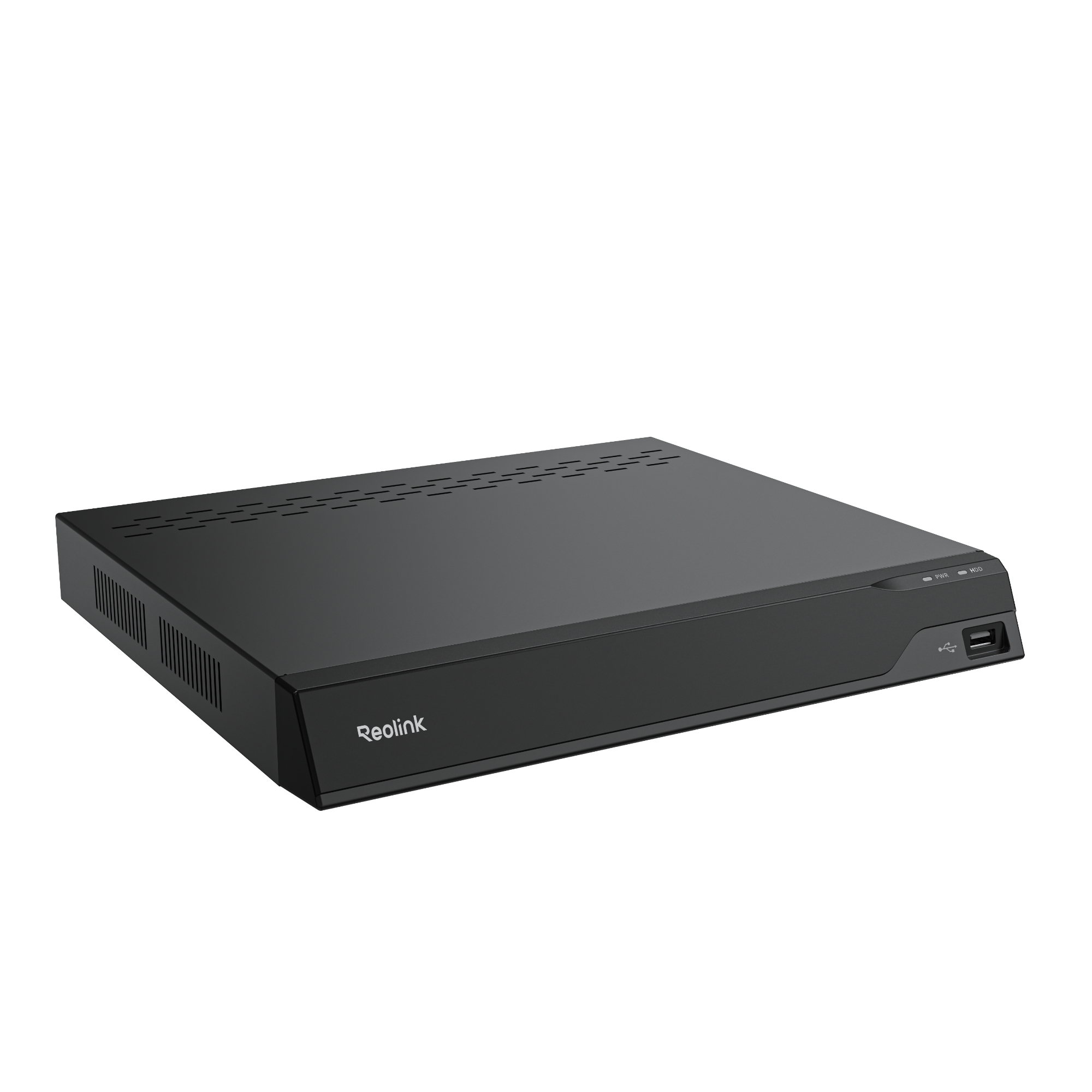
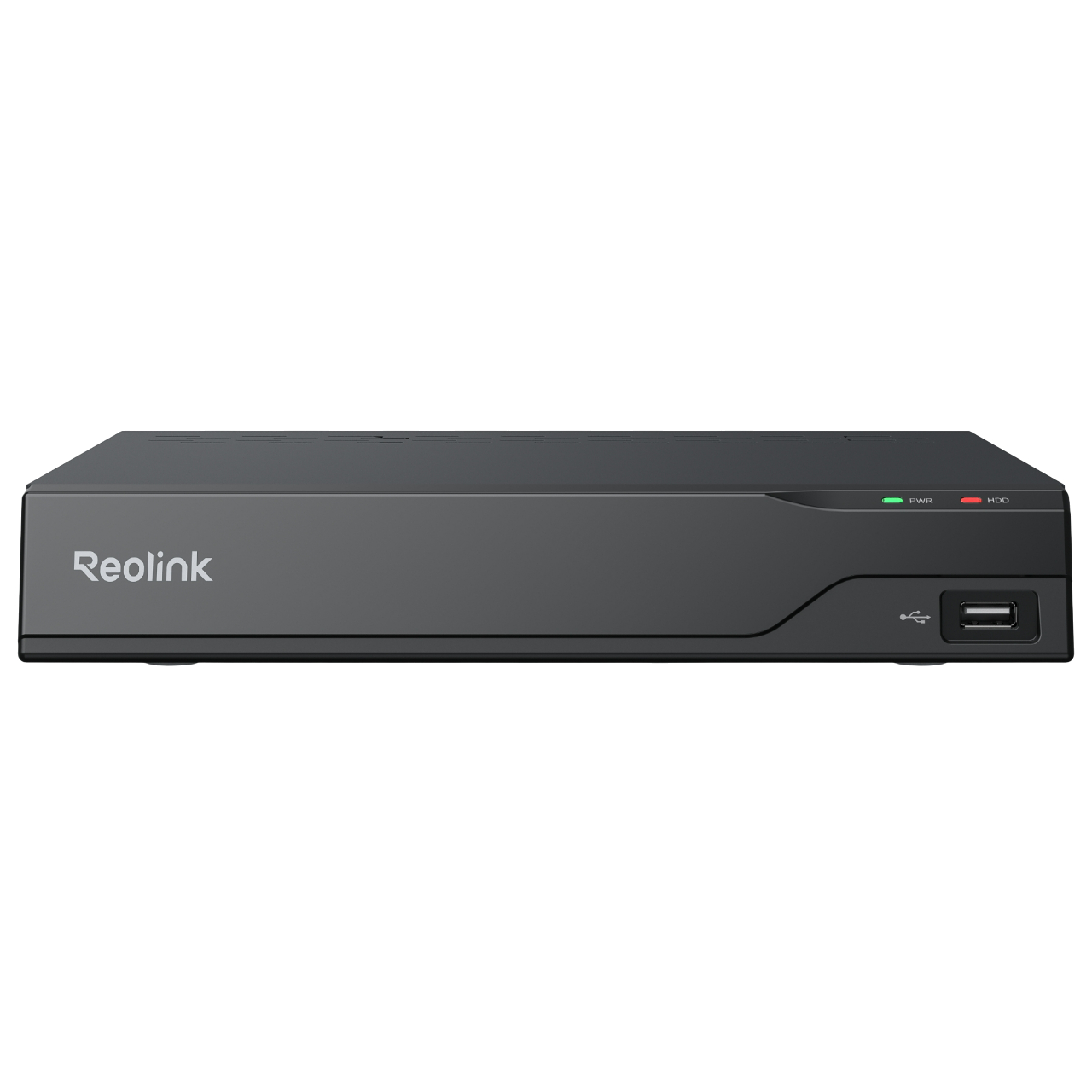
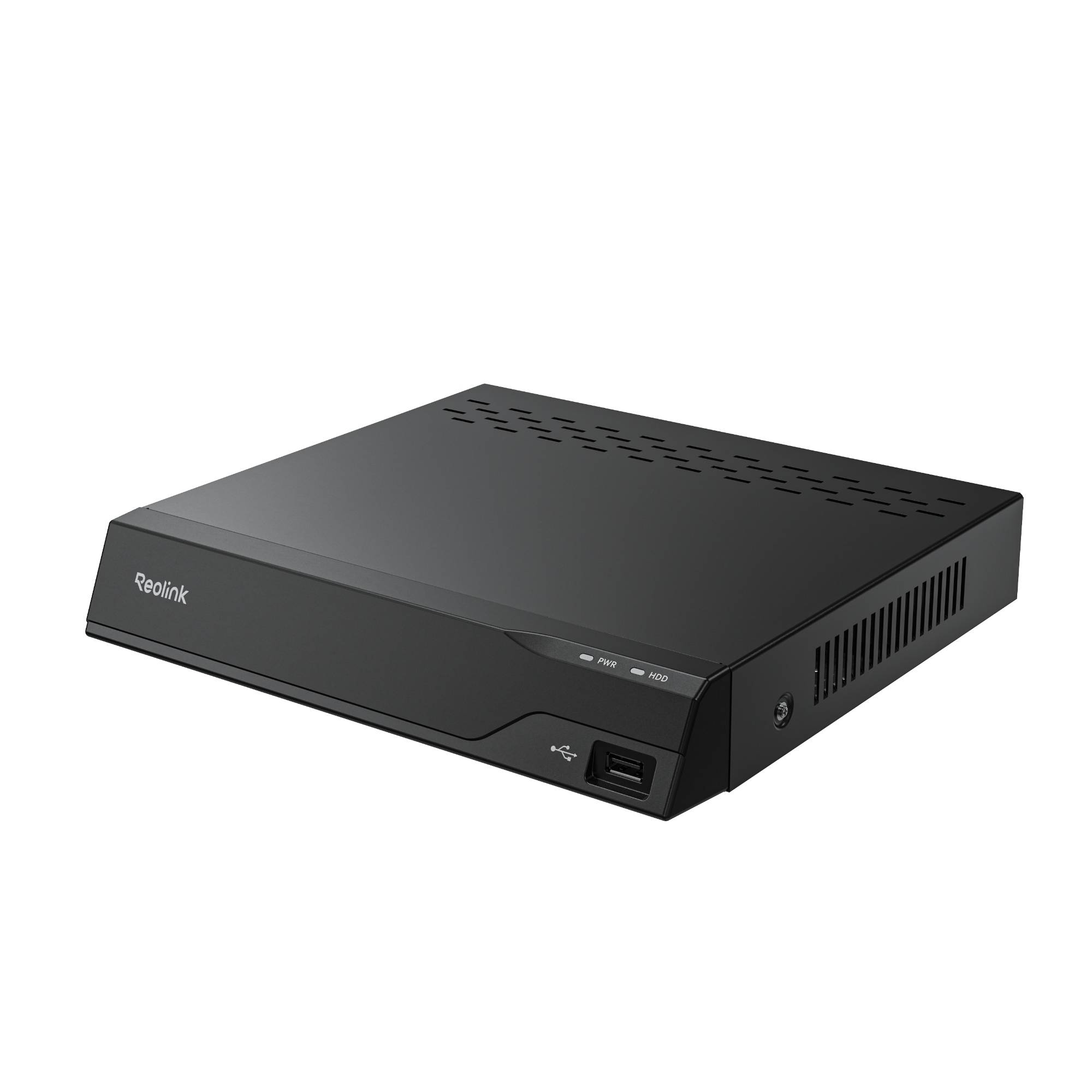
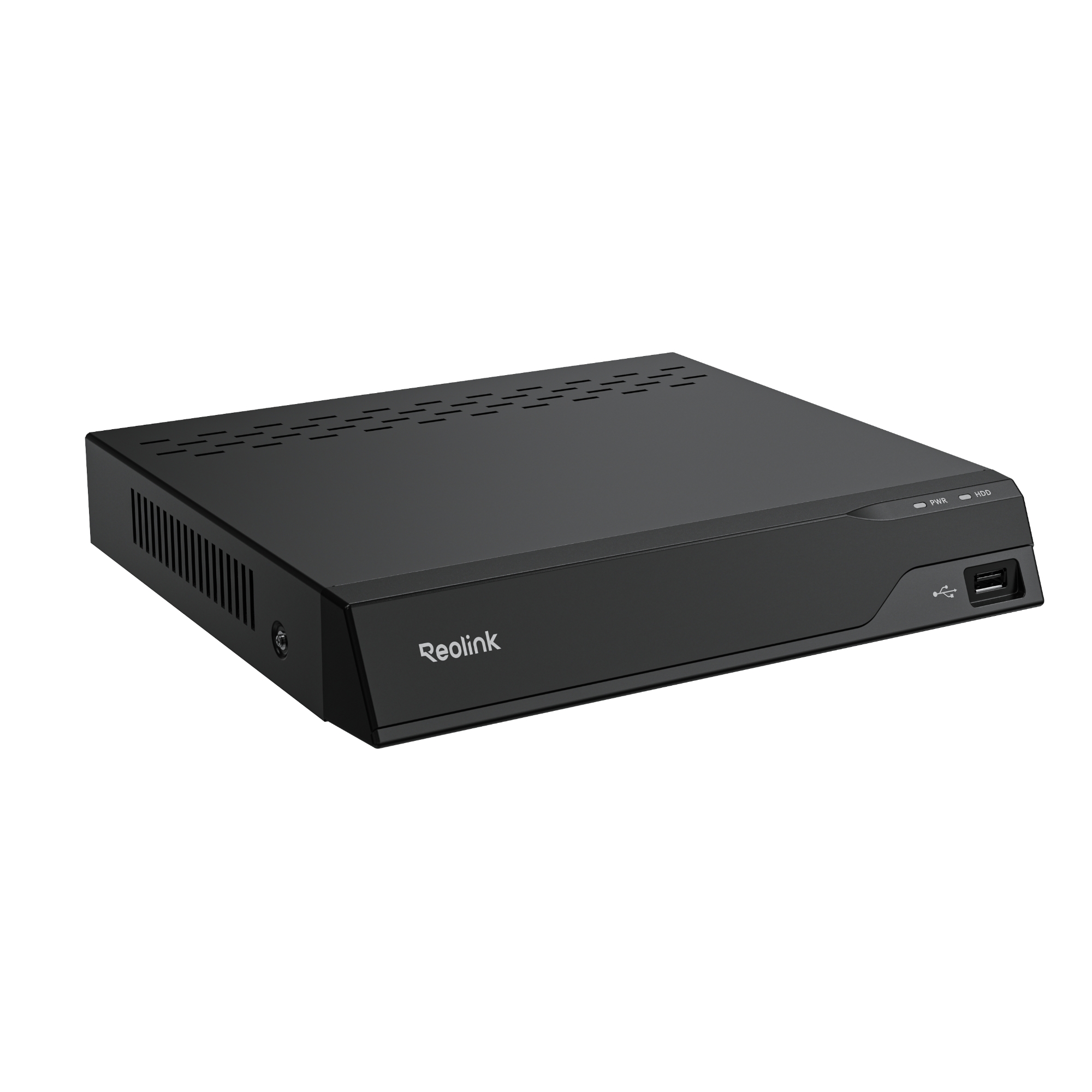


Description Reolink RP-PNxx-NHD
Twelve channels, eight of them wired: how to read that number
The RP-PN8-NHD handles up to twelve cameras at once, but no more than eight of them can be wired — exactly the number of PoE ports on the unit; the remaining four channels join over the network, typically Reolink Wi-Fi cameras running on their own power. That arithmetic matters at the design stage: if all twelve viewpoints have to be cabled, eight ports will not cover it and you either add an external switch or move up to a sixteen-port model. The recorder accepts streams up to 16 MP, so it handles not only the familiar 4 and 8 MP cameras but also the 12 MP P340 and P344 models and the dual-sensor Duo series, where two lenses are stitched into one wide panorama. Incoming and outgoing bandwidth of 240 Mbit/s leaves real headroom: even eight 8 MP cameras at maximum quality occupy roughly a third of it, so the picture does not fall apart when several people review the archive at the same time. The unit serves up to twelve simultaneous streams (ten sub and two main) across twenty accounts, so a guard, the owner and the accountant can all be logged in without getting in each other's way.
Eight PoE ports inside: one box instead of a recorder plus a switch
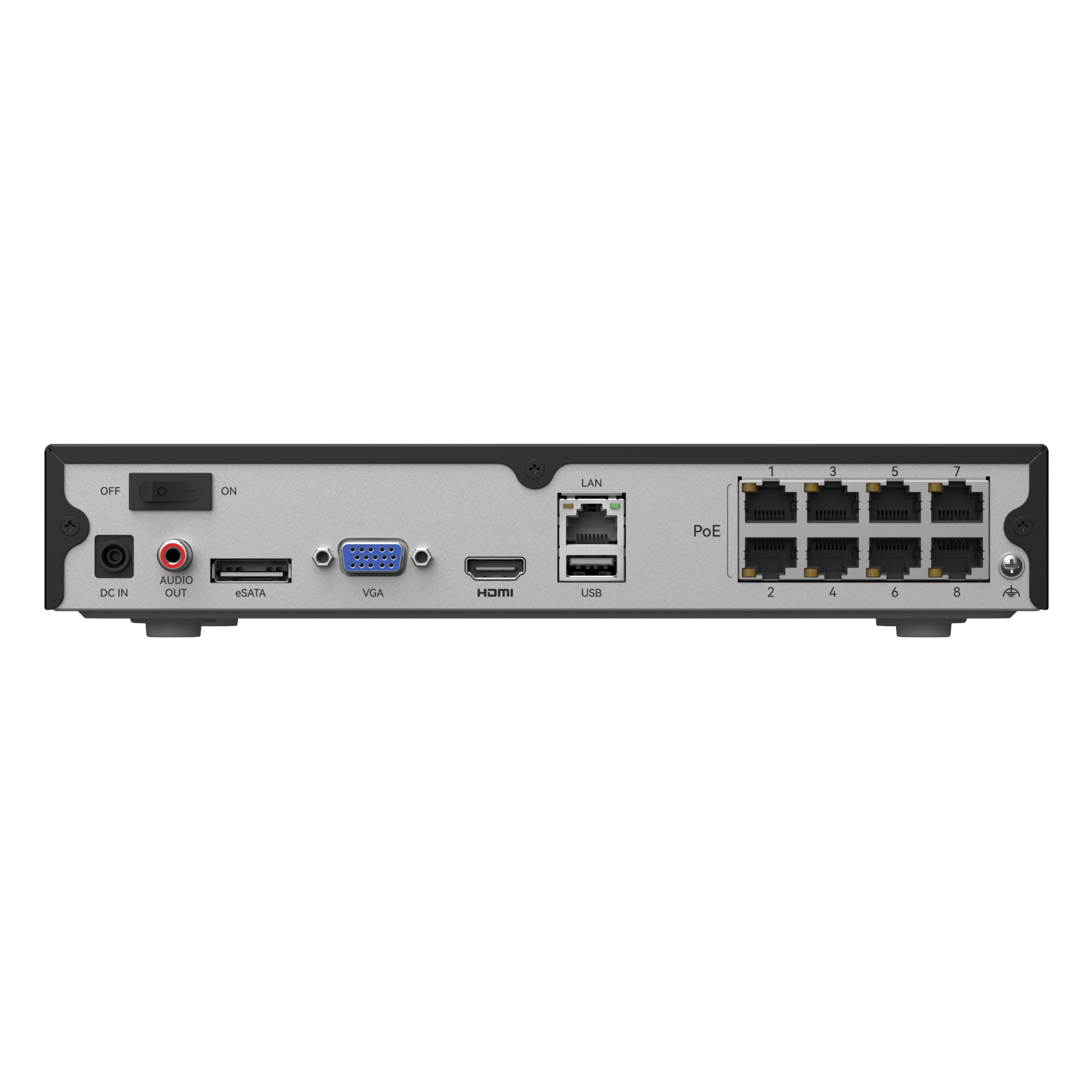
The main practical advantage of this model is integrated PoE to IEEE 802.3af/at with up to 25 W per port, meaning each camera gets network and power over a single run of twisted pair, and neither a separate switch nor injectors ever enter the budget. That 25 W headroom is not a formality: an ordinary dome draws 5 to 8 W, but a pan-tilt model with a spotlight, or a camera running strong illumination in freezing weather, can ask for 12 to 15 W, and cheap switches rated at 15 W in total start rebooting channels under that load. The recorder itself runs from an external 52 V / 2.3 A supply and draws under 10 W with no drives and no cameras attached, so the system budget is simply the cameras' consumption plus those ten watts. For installation this means one cable per camera instead of two, and the whole system sits comfortably on a single UPS, so a power cut interrupts neither the recorder nor the cameras. The limit is equally clear — a PoE run is good for about a hundred metres of cable, and anything further away needs an intermediate switch or fibre with a media converter.
No drive in the box: SATA plus eSATA, up to 32 TB together
The NHD suffix stands for No Hard Drive, so the recorder arrives empty and the disk is a separate purchase — worth ordering at the same time unless you want the system idle for an extra week. Inside there is one SATA bay for a drive of up to 16 TB, and outside an eSATA connector adds another 16 TB, so the theoretical ceiling is 32 TB, though the second volume is an external enclosure on a shelf rather than a disk inside the chassis. Choose a surveillance-line drive such as WD Purple or Seagate SkyHawk, and insist on CMR recording technology: SMR disks stall under continuous multi-channel writing and leave gaps in the archive, even though they look like better value per terabyte on the shelf. Hot swap is not available, so a planned drive change means shutting the recorder down, and the two volumes work independently of each other — there is no RAID here, and losing a disk means losing the footage stored on it. Where recording is critical, the cheapest insurance is a memory card in the Reolink cameras themselves: it survives both a drive replacement and a recorder carried off by an intruder.
How many days of archive will fit: the arithmetic
Converting terabytes into days is easy once you remember a single constant: one megabit per second of continuous stream equals roughly 10.8 GB per day. A 4 MP camera in H.265 writes about 4 Mbit/s, close to 43 GB a day, so eight of them recording around the clock produce roughly 0.35 TB daily — about six weeks on a 16 TB disk, and something like three months once the eSATA volume is added. Eight 8 MP cameras demand roughly twice that, about 0.7 TB per day, which is three weeks on 16 TB and six weeks across the full 32 TB. The heaviest case is 12 and 16 MP cameras such as the Duo series: eight of those streams consume over a terabyte every day, so even 16 TB covers only ten or eleven days. Since most systems do not actually need continuous recording on every camera, the cheapest way to extend the archive is to keep the gate and the till on 24/7 and switch the rest to person and vehicle detection — the same disk will then last three to five times longer.
AI search, perimeter rules and heat mapping: what makes it smarter than a basic NVR
Unlike plain recorders, this model does something useful with the events its cameras send: AI archive search lets you specify an object type — person, vehicle, animal or package — instead of a time range, and returns a list of clips rather than eight hours of video to scrub through. Perimeter rules are configured in the recorder itself: line crossing, zone intrusion and zone loitering, so the system can distinguish someone who simply walked past the fence from someone who stopped beside it for a minute. There is also heat mapping, which shows where in the frame movement concentrates: in a shop that informs where to place goods, while in a warehouse it reveals that staff routinely walk somewhere they should not. Understand where the data comes from, though: the person and vehicle classification happens in the camera, so the recorder's AI features only come alive with Reolink cameras that support it, and an older camera without person detection leaves you with plain motion. Third-party cameras connect over ONVIF and RTSP, but then you get exactly that — a recorded stream, without AI events, without the automatic pairing that Reolink cameras enjoy and without unified setup from the app.
Where it belongs and what it was designed for
This is a recorder for a typical finished site of six to twelve cameras: a house with a yard and a gate, a small shop or café, a car wash, a service station, a single-floor office, a modest warehouse or a production bay. At that scale integrated PoE pays off most: every cable ends in one cabinet, installation takes a day, and there is no separate switch that will eventually hang and leave you wondering why half the cameras vanished. An IP20 chassis and an operating range of -10 to +45 °C place the unit indoors or in a ventilated cabinet, never in an outdoor box or an unheated hangar; at 255×211×50 mm and 1.4 kg it sits happily on a shelf next to the router. Two situations argue against it: more than twelve cameras in total, or more than eight that must be wired — both call for a sixteen-port recorder instead. Conversely, if the system includes a dual-sensor or 12 MP camera, this model earns its place precisely because of 16 MP support, since older eight-channel units simply will not accept such a stream at full resolution.
How it differs from the neighbouring recorders in this catalogue
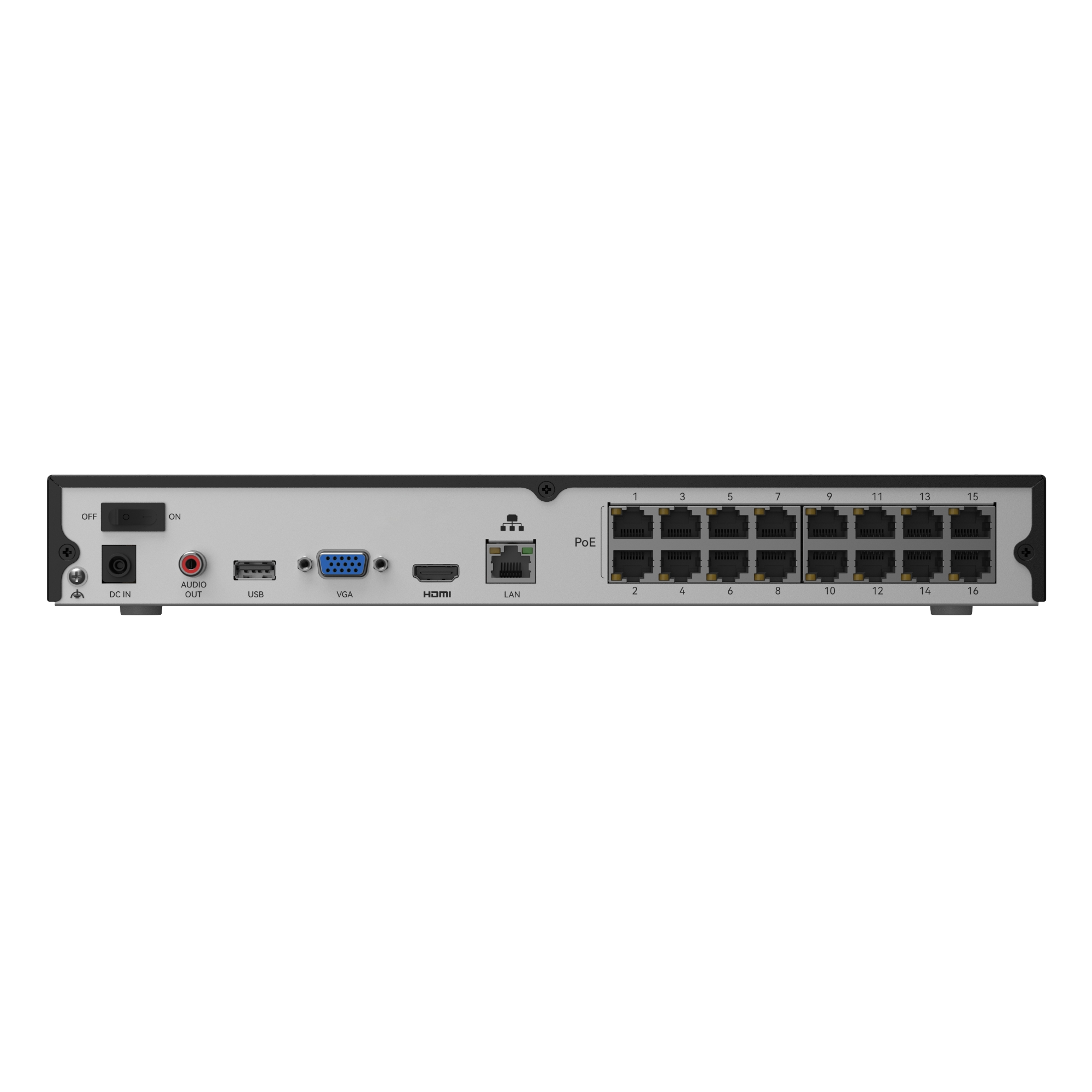
Its closest relative in the range is the Reolink NVS8 (RLN8-410), an eight-channel unit with eight PoE ports: structurally similar, but capped at 6 TB of storage and without the extended AI processing, which still makes it a perfectly sound and noticeably simpler choice for four to six mid-resolution cameras. The smaller NVS4 offers four channels and four PoE ports, the option for a flat or a small yard where no expansion is planned at all. Moving up, there is the RLN16-410 with no HDD and sixteen PoE ports (more wired cameras, but an 8 TB archive ceiling) and the thirty-six channel NVS36 with no HDD, which has no PoE whatsoever and requires external switches — a different class of task and a completely different installation. Among other brands with eight PoE ports the catalogue lists the Dahua DHI-NVR1108HS-8P-S3/H and the Hikvision DS-7108NI-Q1/8P(D): both are stronger paired with their own cameras and in integration with third-party systems, but they lose on ease of commissioning, because Reolink cameras here are picked up almost by themselves. The conclusion is simple: choose this model when the system is built on Reolink cameras, no more than eight points are wired, and you want both archive depth and fast search by object type; if the cameras come from another brand, buy the recorder from that same manufacturer.
Tell us how many cameras you plan to install, at what resolution and how deep an archive you expect. We will size the drive for you and say plainly whether eight PoE ports are enough for your particular layout.
Characteristics Reolink RP-PNxx-NHD
Reviews about Reolink RP-PNxx-NHD from real users
No reviews found







