
 m. Сміла, Незалежності, 67г. оф, 406/6























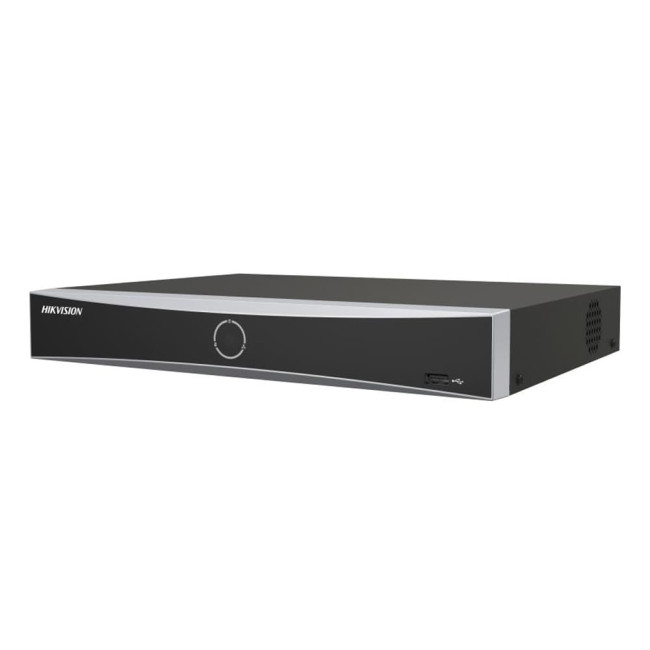
HIKVISION DS-7616NXI-K1(B) (16 CHANNELS, 12 MP) - IP VIDEO RECORDER

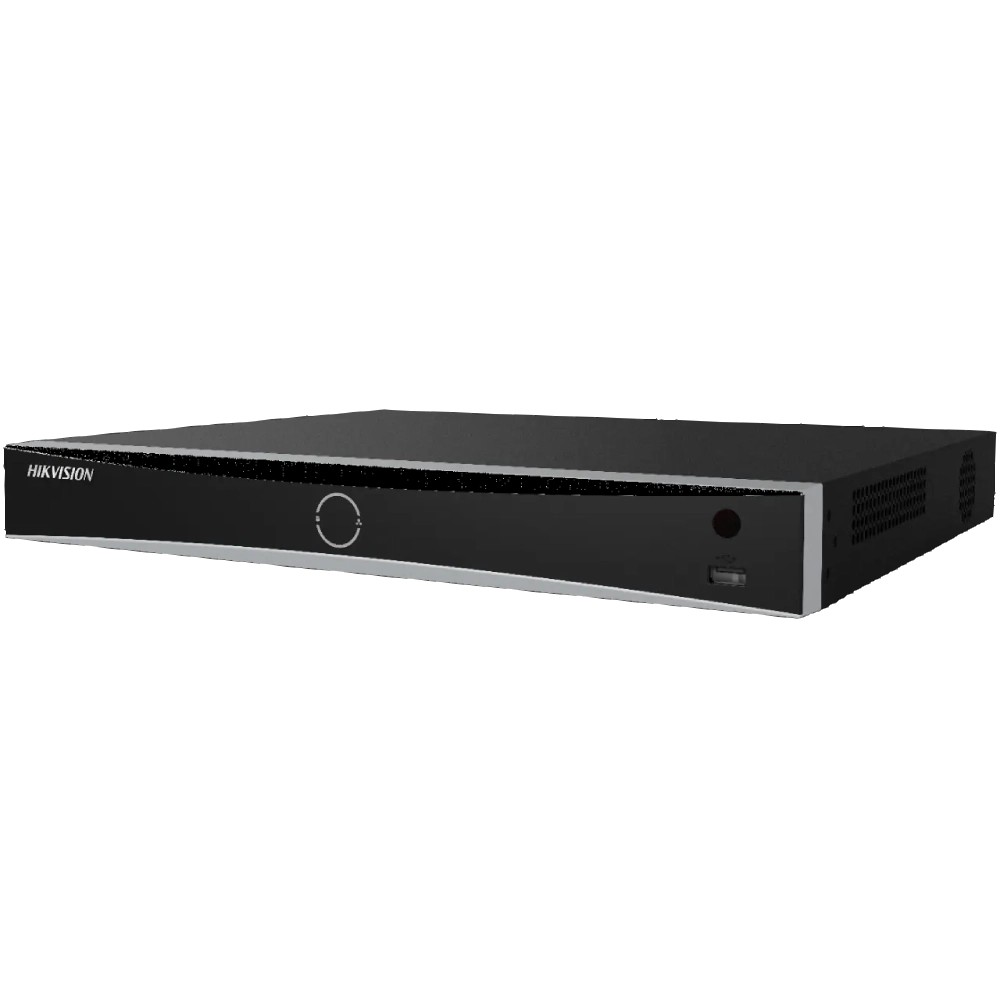
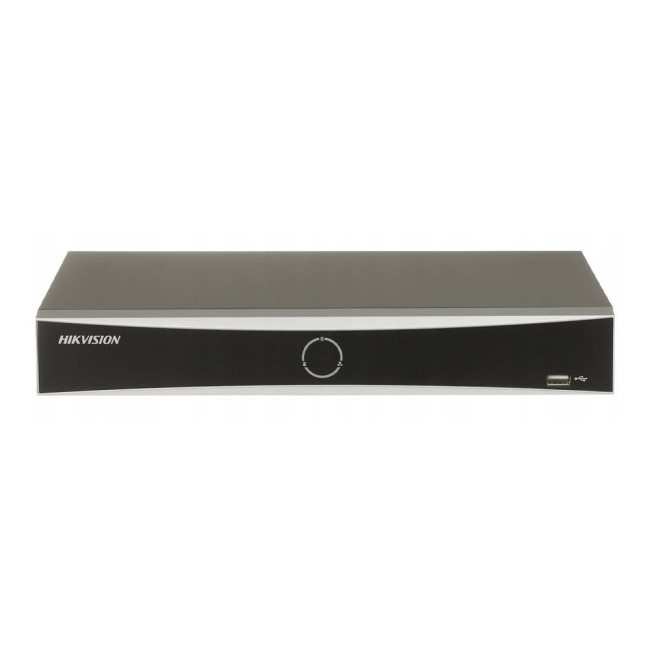
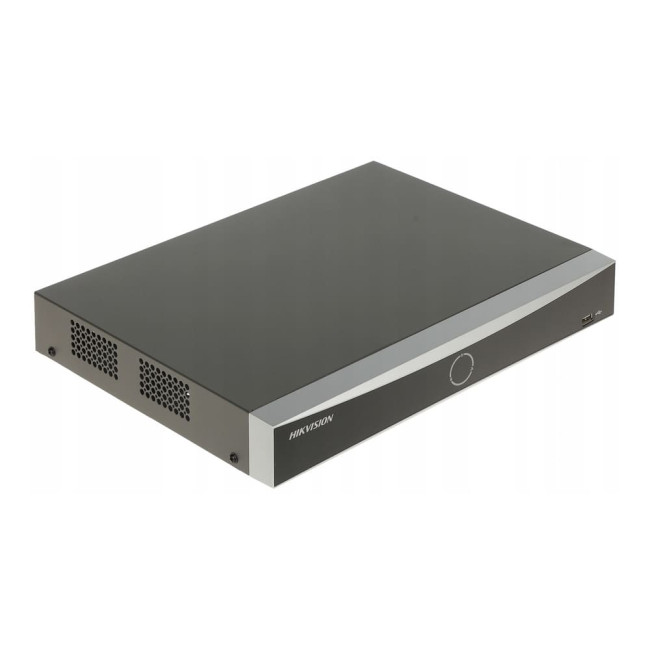


Description Hikvision DS-7616NXI-K1(B)
A pure network NVR, not a hybrid: what that means in practice
The DS-7616NXI-K1(B) is a pure network video recorder: it accepts IP cameras over the LAN and has no coaxial input for analogue cameras at all. That is the dividing line between it and the hybrid DVR and XVR units listed in this catalogue as universally compatible — if the site already has coax runs feeding HD-TVI cameras, this recorder will not see them, and you would have to re-pull twisted pair or buy a different box. Where the system is built from scratch or IP cameras are already in place, the network approach delivers what a hybrid cannot: one cable per camera carrying both video and power, a topology you can branch out with switches, and a recorder that no longer has to sit wherever all the cables happen to meet. The letter B in brackets marks a specific housing and hardware revision rather than a colour option — the manufacturer publishes separate datasheets for the B, D and E revisions, which is worth remembering when you compare figures found online. The 320×240×48 mm chassis weighs 1 kg and carries only an IP20 rating, so it belongs on a shelf or in a dry rack indoors; an outdoor cabinet or an unheated garage is out, since the operating range is just -10 to +55 °C.
K series with AcuSense against the Q series: the real difference
In Hikvision's naming the letter in a recorder's index is a feature set, not a version number: NXI-K is the K series with AcuSense support, while NI-Q — the DS-7616NI-Q1(E) in this same catalogue, for instance — is the base line without it. The working difference is classification rather than mere detection: built-in Motion Detection 2.0 discards branches, shadows, rain and animals and leaves alarms for people and vehicles, which is precisely why the owner does not switch notifications off a week after commissioning. On top of that come perimeter rules — intrusion into an area, line crossing — plus handling of face recognition events, none of which exist in the Q line. One honest caveat spares a lot of disappointment: human and vehicle classification performed by the recorder itself is not available on all sixteen channels at once but on a handful of them (between one and four, depending on revision and firmware), so large-scale analytics are built on AcuSense cameras while the recorder receives and sorts their events. Put plainly, the K series earns its place when you either install AcuSense cameras — the G2 and G3 models in this catalogue — or want smart detection at least on the directions that matter: the entrance, the gate, the till.
No PoE ports: a separate switch is mandatory
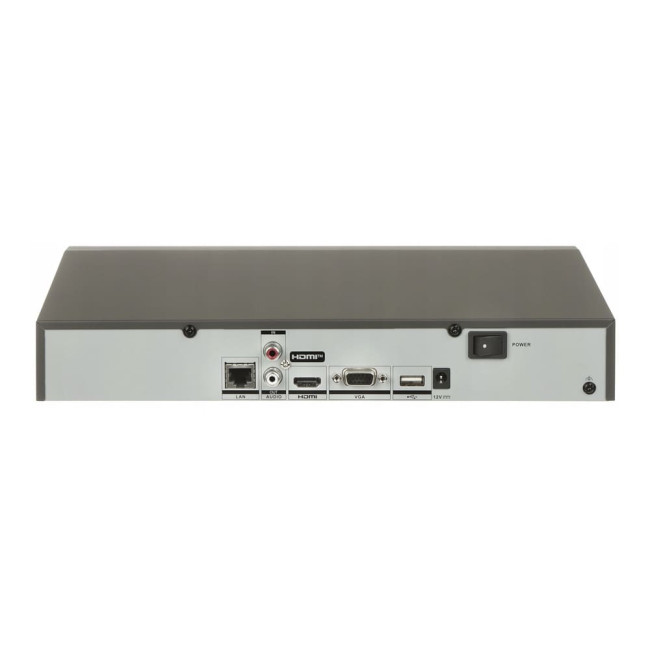
This is the point worth settling before you order: the DS-7616NXI-K1(B) has no PoE ports whatsoever, only a single RJ-45 interface for the local network. Cameras are powered by a separate PoE switch rather than by the recorder, and that switch has to go into the budget together with the recorder — otherwise installation day arrives with sixteen cameras and nowhere to plug them in. The arithmetic is straightforward: a typical 4 MP dome draws 7-9 W, so sixteen of them add up to roughly 120-140 W of PoE budget, which puts a cheap 16-port switch rated at 120 W right on its limit; pick a 180-250 W model instead, or split the cameras across two eight-port switches. The absence of built-in PoE has a flip side that turns into an advantage on bigger sites: cameras are no longer tied to wherever the recorder lives, switches can sit close to each cluster of cameras so you work around the 100-metre limit per twisted-pair segment, and the recorder itself can live in the office or the server room. The price of that flexibility is manual work — this unit does not hand out addresses to cameras the way PoE models do, so the installer configures IP addressing, subnets and camera passwords, and the cameras share the ordinary LAN instead of an isolated recorder-side segment.
Sixteen channels, 12 MP recording and the real ceiling of 160 Mbps
The recorder takes up to sixteen IP cameras and records up to 12 MP per channel in H.265+, H.265, H.264+ and H.264, so it does not cap you at 4 or 8 MP the way several budget sixteen-channel models do. The genuine constraint, though, is neither the channel count nor the megapixels but the incoming bandwidth: 160 Mbps is the shared budget for every camera together. The sums are easy — sixteen 4 MP cameras in H.265 come to roughly 60-70 Mbps and fit with room to spare, sixteen 8 MP cameras reach about 130 Mbps and sit close to the edge, and full 12 MP on every channel at once is simply beyond this platform. A second limit that sellers rarely mention concerns the local monitor: decoding for live view is one channel at 12 MP, two at 8 MP, four at 4 MP or eight at 1080p, so a mosaic of all sixteen cameras at full quality is not on the menu — the recorder draws it from sub-streams, while full resolution is there in single-channel view and in the recording itself. That is a perfectly normal way to work, but it does mean you should plan the platform around recording and archive depth rather than around a handsome wall of sixteen 4K tiles.
A single bay for a 10 TB drive: working out archive depth
There is one SATA bay inside, supporting a drive of up to 10 TB; the drive is not supplied with the unit, there is no hot swap and no RAID, so you buy storage separately and shut the recorder down completely whenever it has to be replaced. Here is the depth calculation for continuous 24/7 recording in H.265: a single 4 MP camera writes roughly 40-45 GB a day, so sixteen of them consume about 650-700 GB daily, and a 10 TB drive — around 9.1 TB usable once filesystem overhead is counted — yields approximately 13 to 14 days of archive. Sixteen 2 MP cameras change the picture to about 340 GB a day and nearly four weeks of footage; eight 4 MP cameras give the same four weeks; sixteen 8 MP cameras will fill that drive inside a week. If the depth falls short there are three legitimate moves: record on events instead of continuously, which with AcuSense cameras buys a factor of two to three, lower resolution or frame rate on the secondary channels, or simply specify the largest drive from the outset. And one warning deserves emphasis: a single bay is a single point of failure, so where footage has to serve as evidence, either choose a two-bay model or set the cameras to record in parallel onto their own memory cards.
Interfaces, monitors, alarm inputs and remote access
HDMI and VGA work simultaneously, and the HDMI output reaches 3840×2160, so the recorder can drive an ordinary 4K television for a comfortable multi-view while VGA keeps serving an old monitor in the back room. Support for two monitors enables a practical retail setup: one screen on the shop floor for display and deterrence, another in the office where the archive is actually reviewed. On board are four alarm inputs and one output — exactly what the Q series lacks: a door contact, a PIR sensor or a button goes to the inputs, the output switches a siren, a strobe or an electric lock, and on alarm the recorder starts recording the relevant channel by itself. Two USB ports handle the mouse and the export of clips to a flash drive, two RCA connectors cover audio, and control works both locally with a mouse and across the network from Windows, macOS, iOS or Android. Remote access relies on Hik-Connect, DDNS, SMTP for mailing alarms, NTP for clock synchronisation and SADP for the initial discovery of the device; up to 128 user accounts can be defined, which on a larger site lets a guard, an administrator and the owner hold genuinely different rights.
Which sites this recorder suits and where it is out of place
Sixteen channels with resolution headroom describe a mid-sized site: a shop with a sales floor and a stockroom, a service station, a small production unit, a car park, an office spread over several floors, or a large private house with a perimeter and outbuildings. Objects like those are rarely covered by eight cameras: the till, the back door, the loading bay and the corridors always join the main directions, and sixteen channels turn out to be the norm with two or three spare rather than an excess. The K series belongs here precisely because false alarms grow in proportion to camera count — without classification, sixteen channels generate so many night-time notifications that people stop reading them within the first week. Where it is out of place: a flat or a holiday house needing two to four cameras, where sixteen channels add nothing you will use; a site already wired with coax for analogue cameras, which calls for a hybrid XVR or DVR; and any brief where the archive must span months, which needs two or more drive bays. It also disappoints anyone hoping to connect cameras with no extra boxes — without a PoE switch this system will not run at all.
How it differs from the neighbouring recorders in this catalogue
Its most direct rival sits in the same catalogue: the DS-7616NI-Q1(E) offers the same sixteen channels and the same 160 Mbps of incoming bandwidth, but as a base Q-series unit without AcuSense, recording up to 8 MP instead of 12 MP, with no alarm inputs and a drive limit of 8 TB — a sensible choice when all you need is dependable recording and the cameras handle people and vehicle detection themselves. If the archive has to go deeper, look at the two-bay models — the DS-76xxNXI-K2(D) or the DS-7608NXI-I2/S(E) with support for up to 16 TB: fewer channels, twice the storage and stronger analytics. When the camera count is modest and a separate switch feels like a nuisance, the catalogue also holds units with PoE built in — the eight-channel DS-7108NI-Q1/8P(D) and the four-channel DS-7604NXI-K1/4P(D) — where cameras plug straight into the recorder and receive addresses automatically, which noticeably simplifies the install. For a site with an existing analogue infrastructure this NVR is fundamentally wrong, and the hybrid iDS-7108HQHI-M1/S(E) or the sixteen-channel Dahua DH-XVR5216AN-I3 that accept both coax and IP are the right answer. Compared with the Dahua DHI-NVR2116HS-I2 — also sixteen channels, also without PoE, also a 10 TB limit — the decision usually comes down to the camera brand rather than the spec sheet: recorder and cameras inside one ecosystem mean full analytics and a single app, while a mixed pairing over ONVIF always runs with some features left behind.
Tell us how many cameras you plan, at what resolution, and how deep an archive you want to keep — we will work out the drive capacity, size the PoE switch against the real load, and say whether this model is enough or a two-bay recorder is the better call.
Characteristics Hikvision DS-7616NXI-K1(B)
Reviews about Hikvision DS-7616NXI-K1(B) from real users
No reviews found







