
 m. Сміла, Незалежності, 67г. оф, 406/6























HIKVISION DS-7604NXI-K1/4P(D) (4 CHANNELS, 12 MP, 4 PoE) - IP VIDEO RECORDER

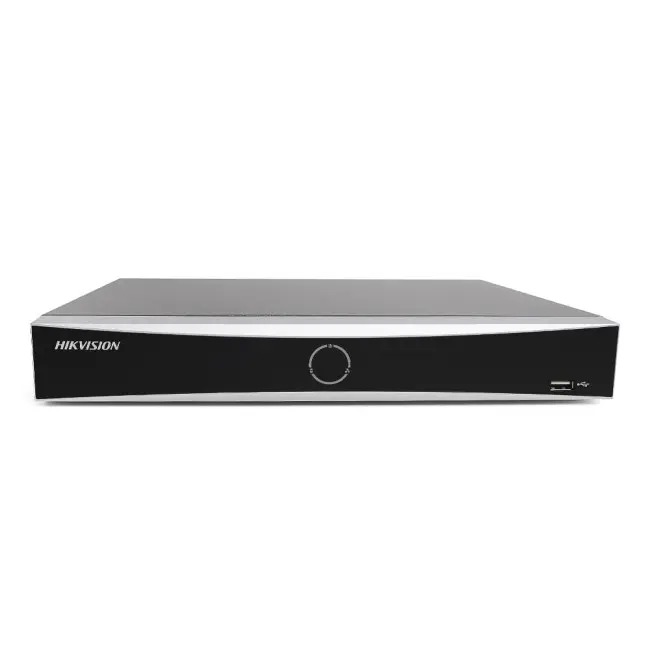
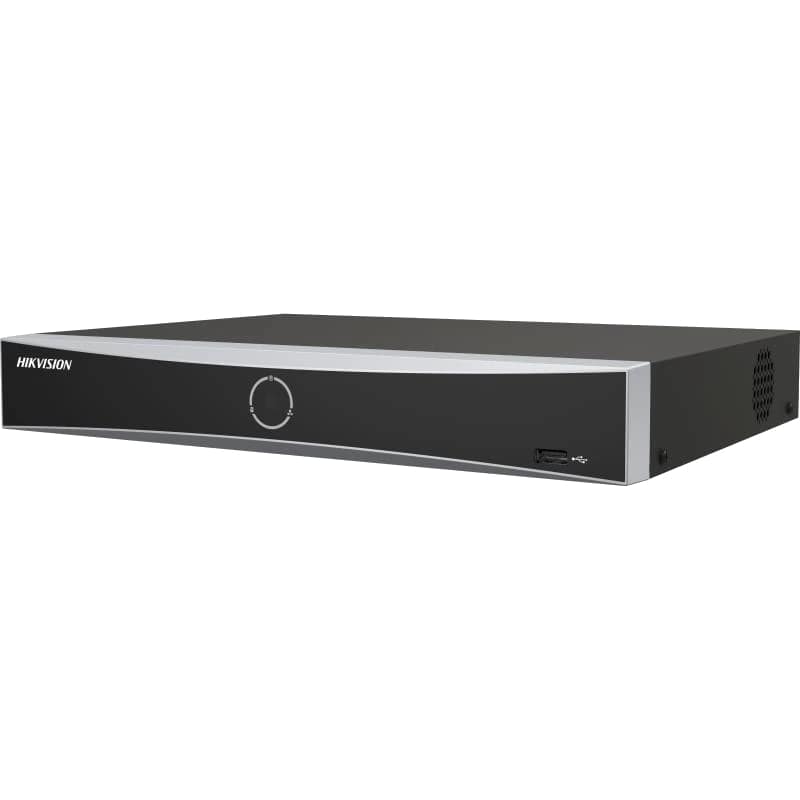


Description Hikvision DS-7604NXI-K1/4P(D)
Four PoE ports on board: one cable per camera
The /4P suffix in the model name stands for four built-in PoE ports, and that is the practical difference between this unit and the plain DS-7604NXI-K1(D). Every camera is connected with a single twisted-pair run that carries power and video at the same time, so neither a separate PoE switch nor a 12 V power supply at each mounting point is needed. The ports follow the IEEE 802.3af/at standard with a shared budget of up to 50 W for all four together, which comfortably covers four ordinary outdoor cameras drawing 5-8 W each. The picture changes if you plan a camera with a heated housing or a PTZ dome that peaks at 25-30 W, because then the 50 W budget becomes a real ceiling and such a camera is better fed from its own adapter. One more detail worth knowing: these PoE ports are 10/100 Mbps rather than gigabit, which is plenty for a single stream even at 12 MP, but noticeable when you pull a large archive export over the network. The recorder hands out addresses to cameras on its own isolated subnet, so Hikvision cameras come online with almost no configuration at all.
Four channels, 40 Mbps of incoming bandwidth and a 12 MP ceiling
The unit accepts up to four IP cameras and offers 40 Mbps of incoming bandwidth, and this is the number to check before you choose the cameras rather than after. Four 8 MP cameras encoding in H.265 produce roughly 8 Mbps each, 32 Mbps in total, which fits inside the limit with a modest reserve. Four 12 MP cameras running at full bitrate will not fit into those 40 Mbps, even though the recorder is formally able to store such streams. Outgoing bandwidth is twice as generous at 80 Mbps, meaning the device can serve archive footage to a remote client faster than it takes it in from the cameras. Decoding for the local monitor is limited separately: with analytics enabled you get one channel at 12 MP, three at 4 MP or six at 1080p simultaneously, so a live mosaic of four 8 MP cameras will already be shown at a reduced substream. In practice the most balanced build for this recorder is four 4 MP cameras, where neither the bandwidth limit nor the decoder gets in the way.
A pure network NVR, not a hybrid DVR
The NXI letters mean this is a strictly network video recorder: it works with IP cameras only and physically has no BNC inputs for analogue ones. That matters most when an existing system is being modernised, because if the site already has coaxial cable and HD-TVI cameras on the walls, this device will simply not see them and the existing wiring becomes useless. For that scenario the same catalogue offers hybrid Hikvision DVRs such as the iDS-7108HQHI-M1/S(E), the DS-71xxHGHI-M1(C) and the iDS-7208HUHI-M1/XT, which combine analogue inputs with a few IP channels. The two families must not be confused, since the boxes look nearly identical from the outside while their compatibility is mutually exclusive. For a from-scratch installation the pure NVR is the better deal: one twisted pair goes to each camera instead of coax plus a separate power line, and there is no analogue resolution ceiling to worry about. ONVIF support in profiles S and G lets you attach third-party IP cameras as well, though AcuSense analytics and automatic camera discovery are reserved for Hikvision hardware.
Archive depth: how many days actually fit on the disk
There is a single SATA bay inside, rated in this product listing for a drive of up to 16 TB, while the official documentation for early revisions of the series quoted a 10 TB limit. The arithmetic of archive depth is straightforward: one megabit per second of continuous recording consumes roughly 11 GB per day. Four 2 MP cameras in H.265 add up to about 10 Mbps, some 108 GB a day, which gives around 37 days of continuous recording on a 4 TB drive and about 74 days on an 8 TB one. Four 4 MP cameras push that to roughly 16 Mbps and 173 GB a day, so you get 23 days on 4 TB and 46 days on 8 TB. Four 8 MP cameras consume about 346 GB a day, and a 4 TB drive will hold barely eleven days of footage, which means 8 TB is the sensible minimum for such a build. H.265+ saves up to 75% of space compared with H.264, and switching cameras from round-the-clock recording to event-triggered recording multiplies the real depth several times over. The single bay carries one genuine drawback: there is no redundancy at all, a dead drive means the whole archive is gone, so important events are worth duplicating to Hik-Connect or to network storage.
AcuSense: what the recorder computes itself and what needs a smart camera
AcuSense in the K series means the recorder itself can run human and vehicle classification instead of relying entirely on the cameras. Motion Detection 2.0 covers all four channels at 4 MP, or up to 8 MP in enhanced SVC mode, and this is the everyday benefit: an alert arrives for a person or a car, not for a swaying branch, a shadow or a cat. Full perimeter protection with line-crossing and intrusion zones is computed by the recorder for one 4 MP channel only, so the remaining three cameras have to cover that job with their own on-board analytics. Face recognition is modest in scale too: one channel of live video stream, or two channels of captured snapshots, with a database of up to 16 lists and 5,000 images in total. That is enough to build a known-versus-unknown list for a small site, but not for a busy entrance with a constant flow of people. When the cameras themselves are smart models with AcuSense or ColorVu, the analytics simply run on them and the recorder limits stop being the bottleneck.
Where this recorder belongs and what it was designed for
Four channels is the classic private-house format: the gate, the yard, the front door and the back approach are covered by exactly four cameras, and that is the layout this device was designed around. The second typical scenario is a small shop floor, a service station or a workshop where you need the till, the entrance, the stockroom and the yard on screen and there is no server room to speak of. The chassis is compact at 320×240×48 mm and roughly one kilogram, so it sits on a shelf in a cabinet, under the counter or inside a lockable box without any rack mounting. IP20 protection and a working range of -10 to +55 °C mean the spot must be dry and heated, which rules out an unheated garage or an outdoor enclosure without a heater. The model is out of place wherever there are more than four cameras or more may be added later, because a 4-channel NVR cannot be expanded and you would have to buy a new one. It is equally the wrong choice when you need several months of high-resolution archive, since the single drive bay is a hard ceiling on capacity. Do budget for a UPS as well: when mains power fails the PoE ports go dark together with the recorder, and the entire system shuts down at once.
How it differs from neighbouring models in this catalogue
Its closest relative here is the DS-7604NXI-K1(D): identical internals, the same four channels and the same analytics, but without PoE ports and powered from 12 V. The difference is purely infrastructural, because the non-PoE version needs an added switch or injectors plus power at every camera, so the apparently cheaper box often ends up costlier and bulkier once the whole install is counted. The DS-7108NI-Q1/8P(D) doubles the capacity with eight channels and eight PoE ports, but it belongs to the simpler Q series with a 6 TB drive ceiling and no deep recorder-side analytics, making it the pick when camera count matters more than smart functions. The DS-76xxNXI-K2(D) is the senior model of the same NXI line with two drive bays and far more channels, yet it has no built-in PoE whatsoever. The iDS-7108HQHI-M1/S(E), by contrast, is not an NVR at all but a hybrid DVR, and it is worth buying only to keep existing analogue HD-TVI cameras alive. In short: for a from-scratch build with exactly four cameras and a wish to keep the cabinet tidy, the /4P version is what saves both cable and installation time.
Tell us how many cameras you are planning and at what resolution, and we will work out the drive capacity your desired archive depth requires and check that the build fits inside the 40 Mbps input limit.
Characteristics Hikvision DS-7604NXI-K1/4P(D)
Reviews about Hikvision DS-7604NXI-K1/4P(D) from real users
No reviews found







