
 m. Сміла, Незалежності, 67г. оф, 406/6























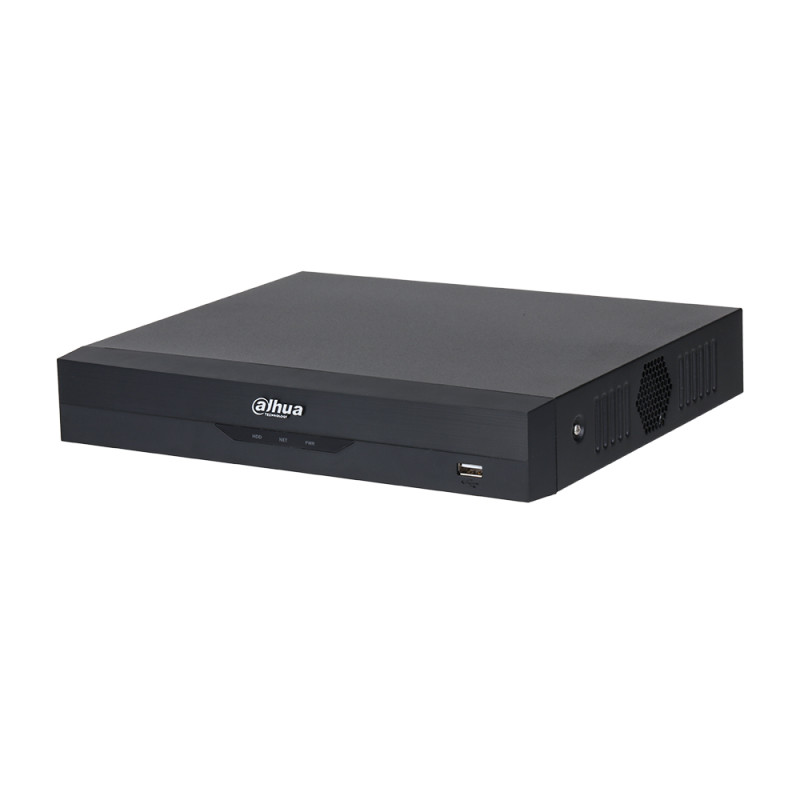
DAHUA DH-XVR41xxHS-I/T (16 ANALOG + 2 IP, RS-485) - HYBRID VIDEO RECORDER



Description Dahua DH-XVR41xxHS-I/T
Penta-brid inputs: sixteen analogue channels on cable that is already in the walls
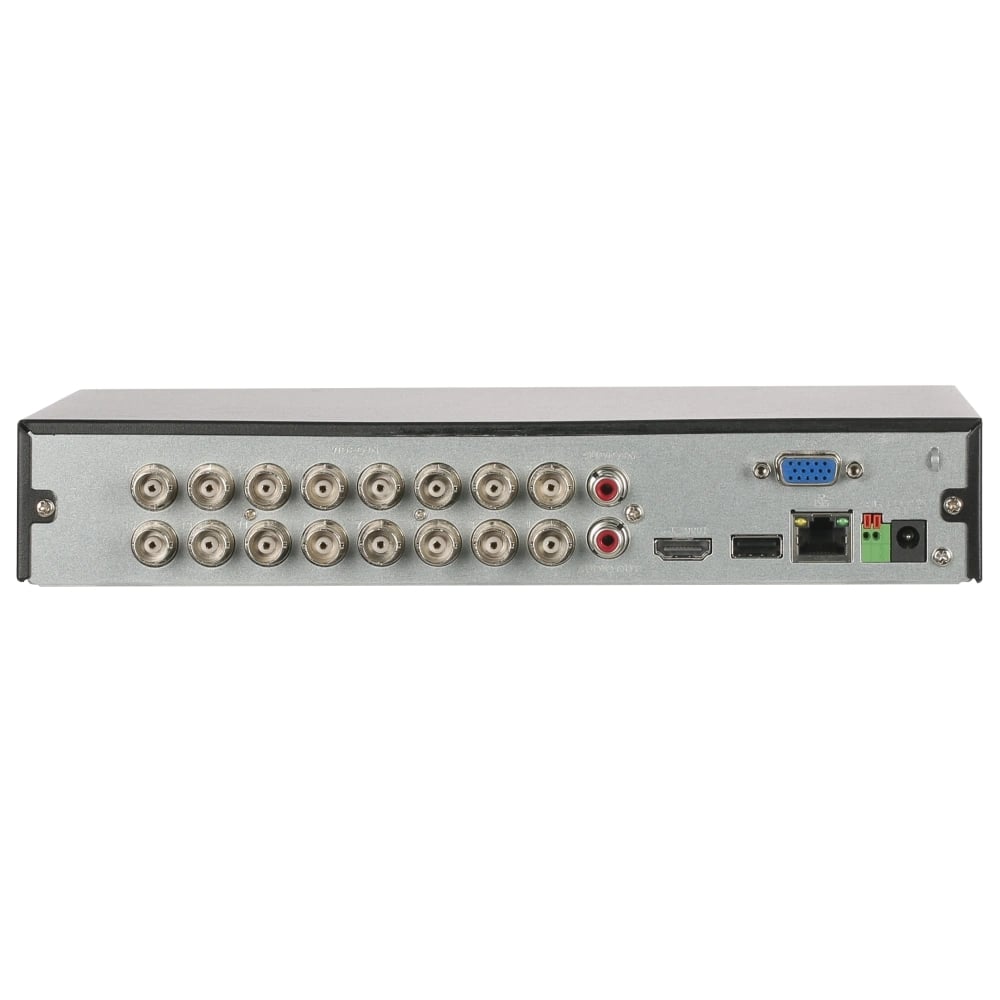
The model behind the DH-XVR41xxHS-I/T listing is the sixteen-channel DH-XVR4116HS-I/T, and every one of its sixteen BNC inputs is hybrid: each socket detects on its own whether an HDCVI, AHD, TVI or plain composite CVBS signal has been plugged into it. That removes the single most expensive part of moving to digital surveillance, because the coaxial cable already run through walls, ceilings and trenches stays exactly where it is and only the recorder — and, if you choose, the cameras — gets replaced. Converting a sixteen-camera site to pure IP would mean pulling sixteen runs of twisted pair, buying a PoE switch and cutting channels into finished walls, which on a working warehouse or shop floor means weeks of disruption. Auto-detection matters for a second reason: on older sites cameras were usually bought in batches over several years and nobody remembers which standard is on which run, so the recorder simply works it out itself. The hybrid design also runs the other way, letting you add IP channels later without throwing out equipment that still does its job.
1080N instead of true 1080p — the honest trade-off of this series
The XVR41xx family belongs to Dahua's 1080N/720p line, and this is worth understanding before the purchase rather than after it. The main stream records in 1080N, 720p, 960H, D1 or CIF, and 1080N is not full HD: it is a 960×1080 frame stretched to 1920×1080 proportions, so roughly half the horizontal pixels of real 1080p. Existing 1080p HDCVI or AHD cameras will connect and record, but in the recorder's own format — movement, clothing, direction of travel and the general scene all read clearly, while confidently reading a licence plate or small printed text from that archive only works at short range. Frame rate follows the same logic: a full 25 fps is available on channel one, the remaining fifteen channels record at 15 fps, which is fine for security footage but thin for frame-by-frame analysis of fast events. In short, this recorder exists to document that something happened across sixteen views, not to serve as a forensic identification tool.
IP channels: up to eighteen streams, a 64 Mbps ceiling and no PoE at all
Alongside the analogue inputs the unit offers two IP channels out of the box and can grow to eighteen once IP extension mode converts the analogue inputs to network ones. IP cameras of up to 6 MP are supported, and this is the route by which modern 4 MP and 6 MP cameras enter the system where detail genuinely matters: a till, an entrance gate, a front door. The real limit is not the channel count but bandwidth — 64 Mbps incoming, recording and outgoing — which covers roughly six to eight 4 MP H.265 streams rather than eighteen, so plan from bitrate instead of from the headline number. The second thing to budget for is power: there are no PoE ports here at all, only a single 10/100 Mbps RJ-45 for the network, so every IP camera needs its own PoE switch or injector. Keep in mind too that IP extension consumes analogue inputs, so you cannot run all sixteen coaxial cameras and eighteen network cameras at the same time.
SMD Plus on all sixteen channels — but this is not IVS
Analytics here means SMD Plus, which runs on the recorder itself across all sixteen channels and applies a second filtering pass to separate people and vehicles from everything else that moves in frame. The difference from plain motion detection shows up in daily use: a conventional detector fires on a branch, a cloud shadow, a cat or rain, the owner switches notifications off within a week and the system stops working as security at all, whereas SMD Plus leaves mostly events where a person or a vehicle actually appeared. Archive searching changes even more, because instead of scrubbing eight hours of recording you filter the event list for "human" over the interval you care about and watch a few minutes. It is only fair to state what is absent: there is no full IVS module with tripwire or intrusion zones, no face detection and no plate recognition — the product data marks all of these as unavailable, and that is the boundary of the 4xxx series rather than an oversight. If you specifically need zone rules and an alert the moment someone crosses a virtual fence, look at the XVR5xxx-I3 line or hand that job to a camera with analytics on board.
One bay, up to 16 TB: how many days of archive that really buys
There is a single SATA bay supporting a drive of up to 16 TB, with the manufacturer noting that the practical ceiling depends on ambient temperature. The disk is not included and there is no hot-swap, so it has to be fitted with the unit powered down — another reason to size it generously the first time. For a realistic estimate, start from bitrate: one 1080N channel with H.265+ averages around 1 Mbps, which works out at roughly 10-11 GB per day of continuous recording. Sixteen cameras running 24/7 therefore consume about 170 GB a day, so a 16 TB drive holds close to 90 days, an 8 TB drive around 45 days and a 4 TB drive about three weeks; with only eight cameras connected, that same 16 TB disk stretches to roughly six months. Two corrections to apply: any 4 MP IP camera adds about 40 GB a day on its own, costing as much as four analogue channels, while event-based recording instead of continuous can easily triple the depth at the risk of losing the first seconds of an incident.
Chassis, outputs and power: what is actually on the back panel
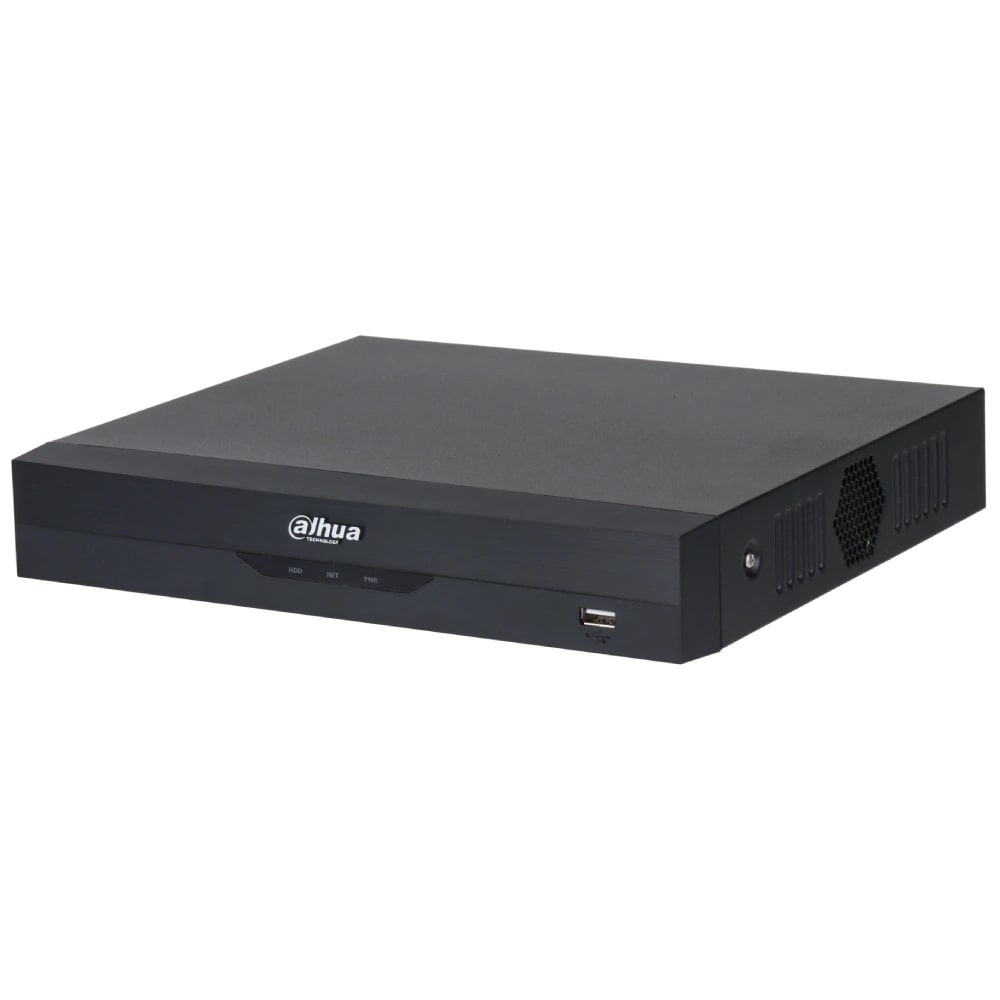
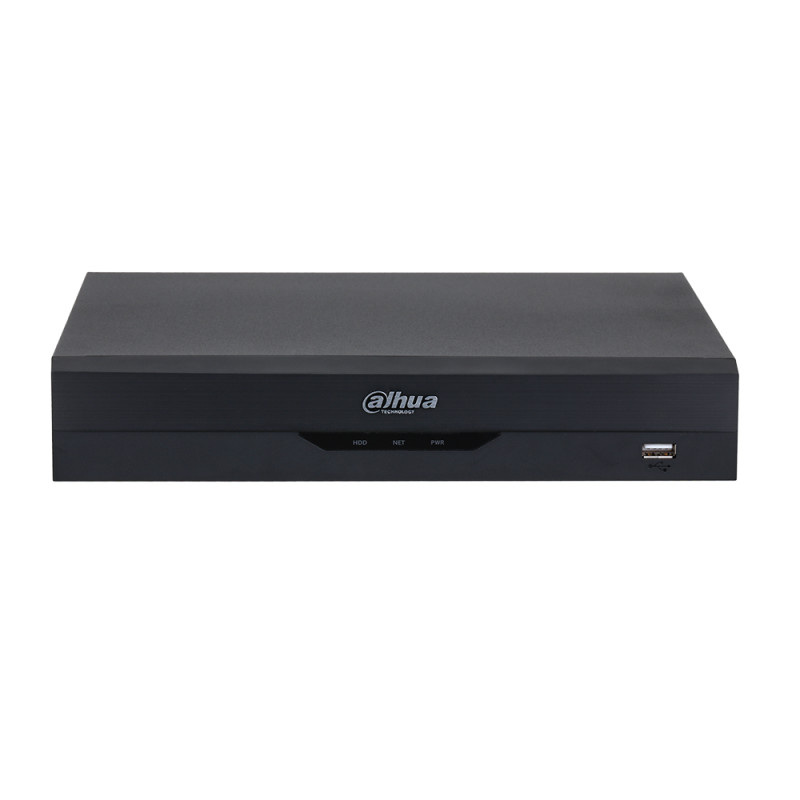
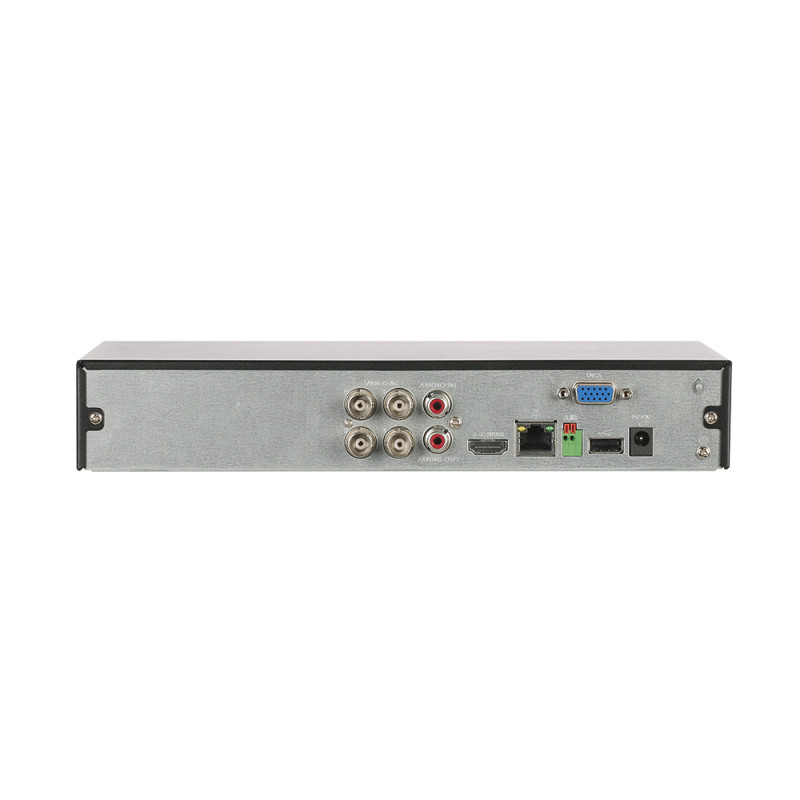
The compact 1U chassis measures 260×237.8×47.6 mm and weighs 1.13 kg, and it is designed to sit on a shelf rather than in a 19-inch rack, so a cabinet or electrical room shelf is enough. There are two video outputs, HDMI and VGA, both up to 1920×1080, and they can drive two independent monitors — a sixteen-window mosaic in the guard room and one or two selected cameras in an office, for example. Audio runs through one RCA input and one RCA output plus coaxial audio on the BNC channels, two-way talk is supported, and an RS-485 port lets you drive a PTZ camera straight from the recorder, which entry-level models often drop. Power is 12 V / 2 A with consumption under 10 W without a disk, light enough that the unit rides out a mains cut on a small UPS shared with the router. The limits are equally clear: IP20 protection and a -10…+55 °C range make this an indoor, heated-room device, there are no alarm inputs or outputs, no eSATA and no RS-232, and the 100 Mbps network port becomes noticeable when several channels are viewed remotely at once.
Where this recorder belongs and what jobs it is built for
Its natural home is a site that already has a working analogue installation of eight to sixteen cameras and an ageing DVR: a car wash, a service garage, a small warehouse, a production floor, a grocery shop, a stairwell or an apartment block with cameras around the perimeter. In that setting the value is at its highest, because sixteen channels cover every existing camera from one box, the coaxial stays untouched, SMD Plus makes the archive searchable, and two or three problem spots can later be upgraded with IP cameras through the two built-in network channels. It also suits a new budget installation across a large perimeter where the number of viewpoints matters more than the detail in each one: a long fence, a car park, a courtyard, service corridors. Where it does not belong is equally specific — a showroom with expensive goods, a filling station, or any site that needs licence plates, visitor counting or a clear face at the till, because 1080N becomes the bottleneck within the second week. It is also the wrong choice for a system planned as fully networked: if there is no coaxial and cable has to be pulled anyway, hybrid inputs buy you nothing and a pure NVR is the sensible starting point.
How it compares with the neighbouring recorders in this catalogue
The closest relative in this same catalogue is the Dahua DH-XVR51xxHS-5M-I3/T: equally compact with one bay, but sixteen analogue plus eight IP channels, recording in 5M-N instead of 1080N and with a genuine IVS module — the case where paying for the higher series is repaid in detail and zone rules. The Dahua DH-XVR5216AN-I3 goes one step further with sixteen channels at 5M-N, perimeter protection, face recognition and, most importantly, two drive bays, meaning twice the archive depth or mirroring where losing footage is unacceptable. If your site has four to eight cameras rather than sixteen, this model makes little sense: the DH-XVR51xxC-I3/T with 4+2 channels, or the DH-XVR5108HS-4KL-I3/T with eight channels and 4K-N support, deliver a better picture across fewer inputs, while the DH-XVR5104C-4KL-I3 is the minimal hybrid for a private house. Among non-hybrid neighbours, the Hikvision DS-71xxHGHI-M1(C) is a four-channel DVR capped at a 4 TB disk and a markedly simpler alternative for a flat or holiday home, while the iDS-7208HUHI-M1/XT records analogue at 8 MP but only across eight channels. Put simply, the XVR4116HS-I/T is the right pick when you need many channels, the coaxial is already there and documenting the event is enough — if any one of those conditions fails, this catalogue has a more precise option.
If you are unsure whether 1080N is enough for your cameras, or how large a disk your required archive depth needs, send us the number of cameras, their standard and how many days you want to keep, and we will size the configuration for your site.
Characteristics Dahua DH-XVR41xxHS-I/T
Reviews about Dahua DH-XVR41xxHS-I/T from real users
No reviews found







