
 m. Сміла, Незалежності, 67г. оф, 406/6























REOLINK RP-PCB12M (12 MP/4 MM) - PoE IP CAMERA



Description Reolink RP-PCB12M
12MP across 100 degrees: the maths of pixels per metre
The 1/2.49" sensor delivers 4512×2512 pixels at 25 frames per second, while the 4mm F1.6 lens covers 100.4° horizontally and 50.6° vertically. Megapixels on their own tell you very little, so the useful number is pixel density across the scene: at 10 metres this camera puts roughly 190 pixels on every metre of frame width, at 15 metres around 125, and at 20 metres about 95. The European EN 62676-4 scale asks for 250 pixels per metre to identify a stranger in court, 125 to recognise someone you already know, and only 25 to register that a person is there at all. In plain terms, footage that proves who it was comes from the first 7-8 metres, confident recognition holds to about 15 metres, and mere detection of movement stretches several dozen metres down the plot. The trade-off built into a wide lens does not disappear: 4mm gives you the whole yard in one frame, but it will not read a licence plate parked 20 metres away, and no amount of digital zoom changes that — a narrower or varifocal lens does.
Two lighting systems: invisible IR to 30 metres and a 600-lumen spotlight
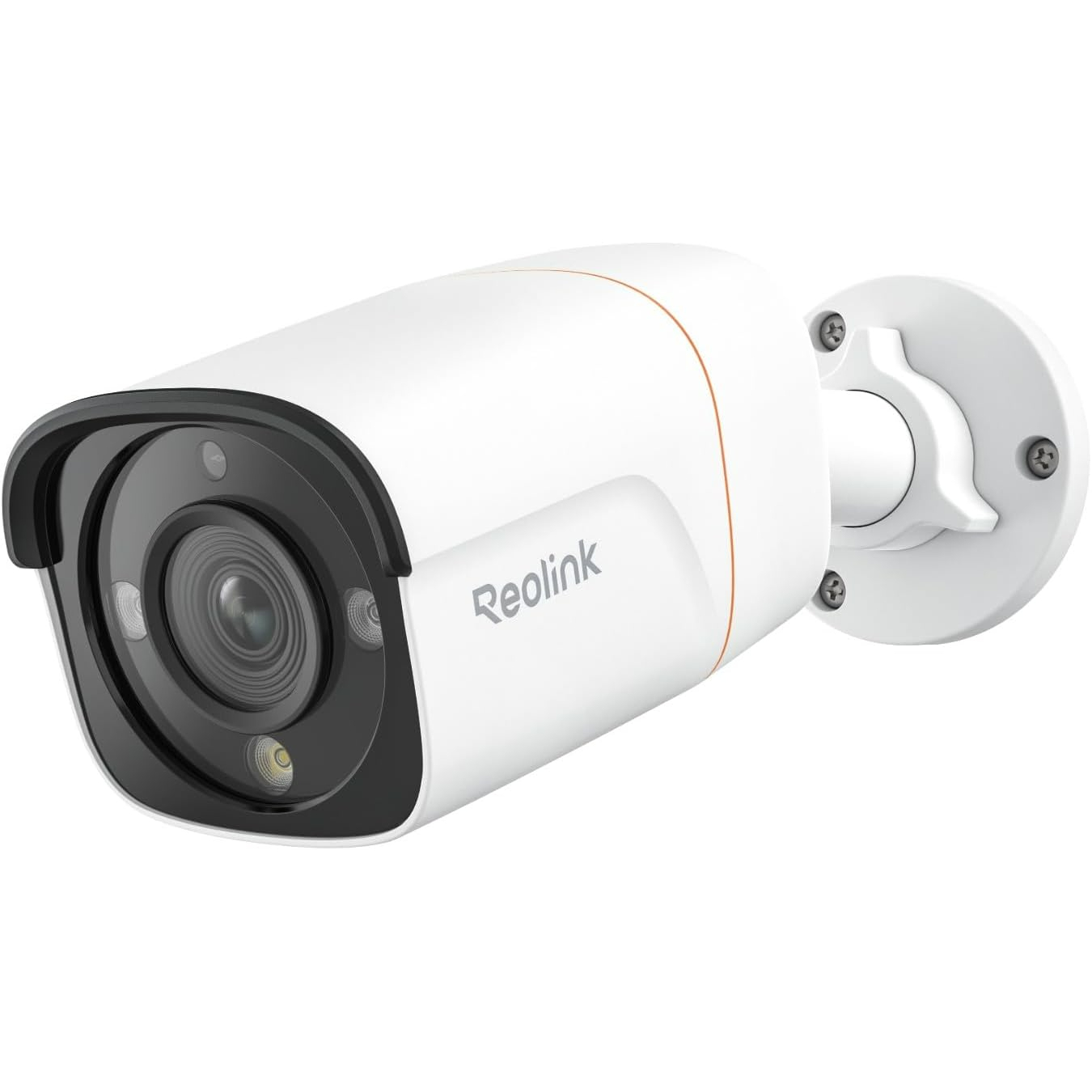
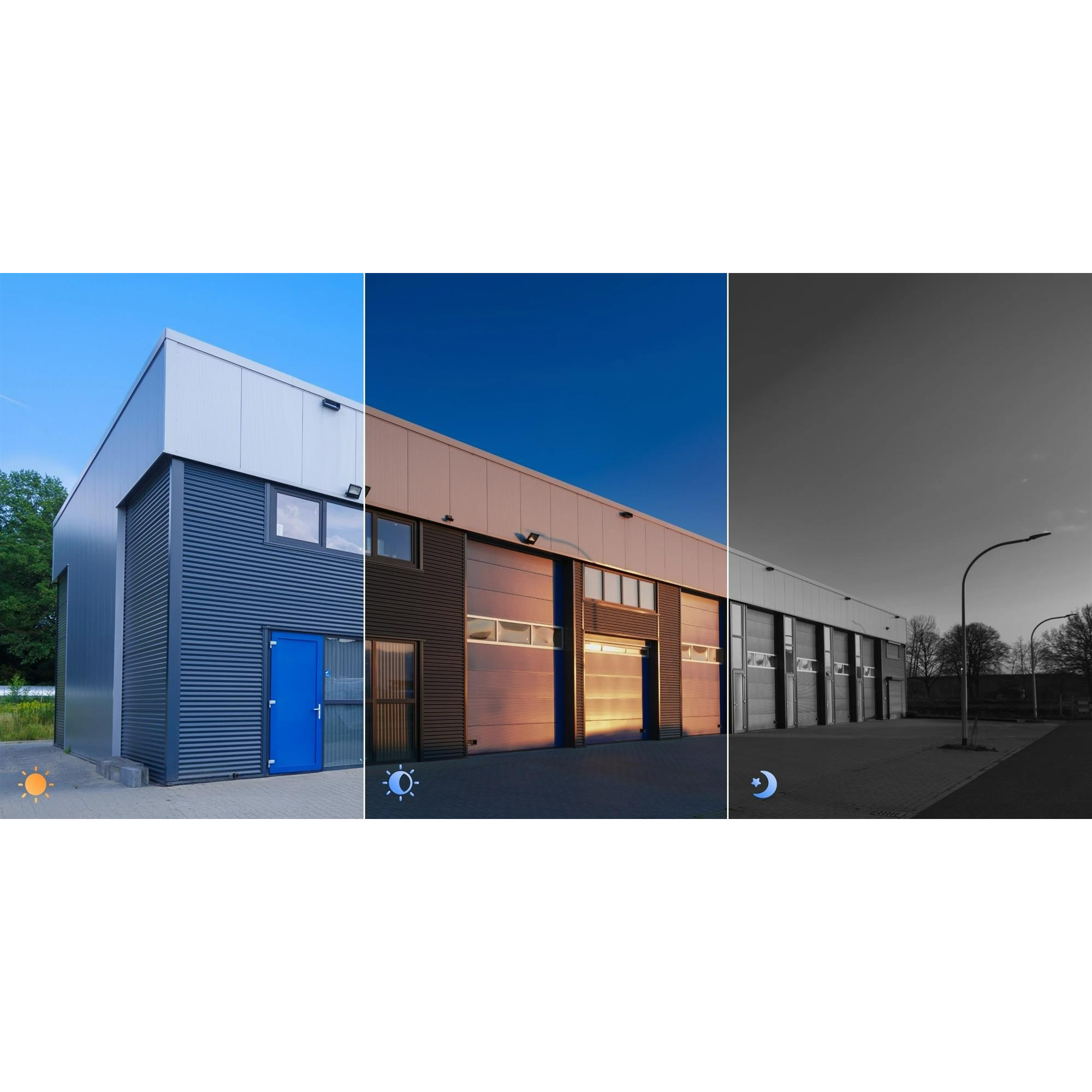
Behind the glass sit two 2.8W infrared emitters at 850nm plus a separate 4.3W white spotlight rated 6500K and 600 lumens. Infrared works silently and invisibly out to about 30 metres, but the picture it produces is monochrome: you can tell that somebody is standing at the gate, yet not whether the jacket is navy or maroon. The spotlight fires on an event and flips the frame into full colour, and colour is exactly what turns a recording into evidence — a silver saloon, a red cap, a yellow holdall are details an insurer or a police officer can actually work with. There is a deterrent bonus that owners often rate above the image itself: sudden bright light tells an intruder in the clearest possible way that he has been seen, and a fair share of attempts end right there. The honest limitation is range and weather — the spotlight really owns the nearer 8-12 metres, and in rain, snow or fog white light bounces off the droplets and veils the frame, so in that weather infrared is the smarter setting.
Perimeter rules instead of plain motion: line, zone and loitering
On top of sorting objects into person, vehicle and animal, this model runs three perimeter rules: line crossing, zone intrusion and zone loitering. The practical gap between that and a cheap motion detector is huge — motion detection fires on any pixel change at all, whereas a crossing rule only raises an alarm when a human body actually steps over the line you drew along the fence, in the direction you specified. Loitering is the rule most shops and stairwells end up using, because it does not care about people walking past; it reacts when somebody stands by the window or the door longer than the time you allow, which is precisely how a break-in is usually rehearsed. Two more scenarios, object removal and forgotten object, ship as beta features: not something to build a security policy on yet, but already useful as a secondary hint in a warehouse or an office. All of this exists for one very mundane reason — an owner who gets three or four meaningful alerts a day reads them, while an owner buried under forty alerts about branches and the neighbour's cat mutes notifications within a week, at which point the system stops protecting anything.
Bullet housing: 188mm of metal, a sun shield and the question of height
This is a bullet camera 188 millimetres long, built from metal, weighing 452 grams and carrying an integrated sun shield over the lens. That shield is functional rather than cosmetic: it keeps driving rain and low morning sun off the front glass, which is why a bullet usually ages better than a dome on a bare façade where the lens would otherwise collect streaks. The elongated silhouette is visible from a distance and works as passive deterrence, since people notice the camera before they reach the gate rather than after. The same geometry has an obvious weakness — a long body on a bracket can be reached with a hand or a stick and twisted aside, so below roughly two and a half metres in a busy spot the turret version is the safer pick. IP67 sealing and a working range of -30 to +55 °C cover a Ukrainian winter with margin, and a metal shell rather than plastic means the housing will not warp out of focus after its third season outdoors.
PoE 802.3af power and recording: from a 512GB card to an NVR
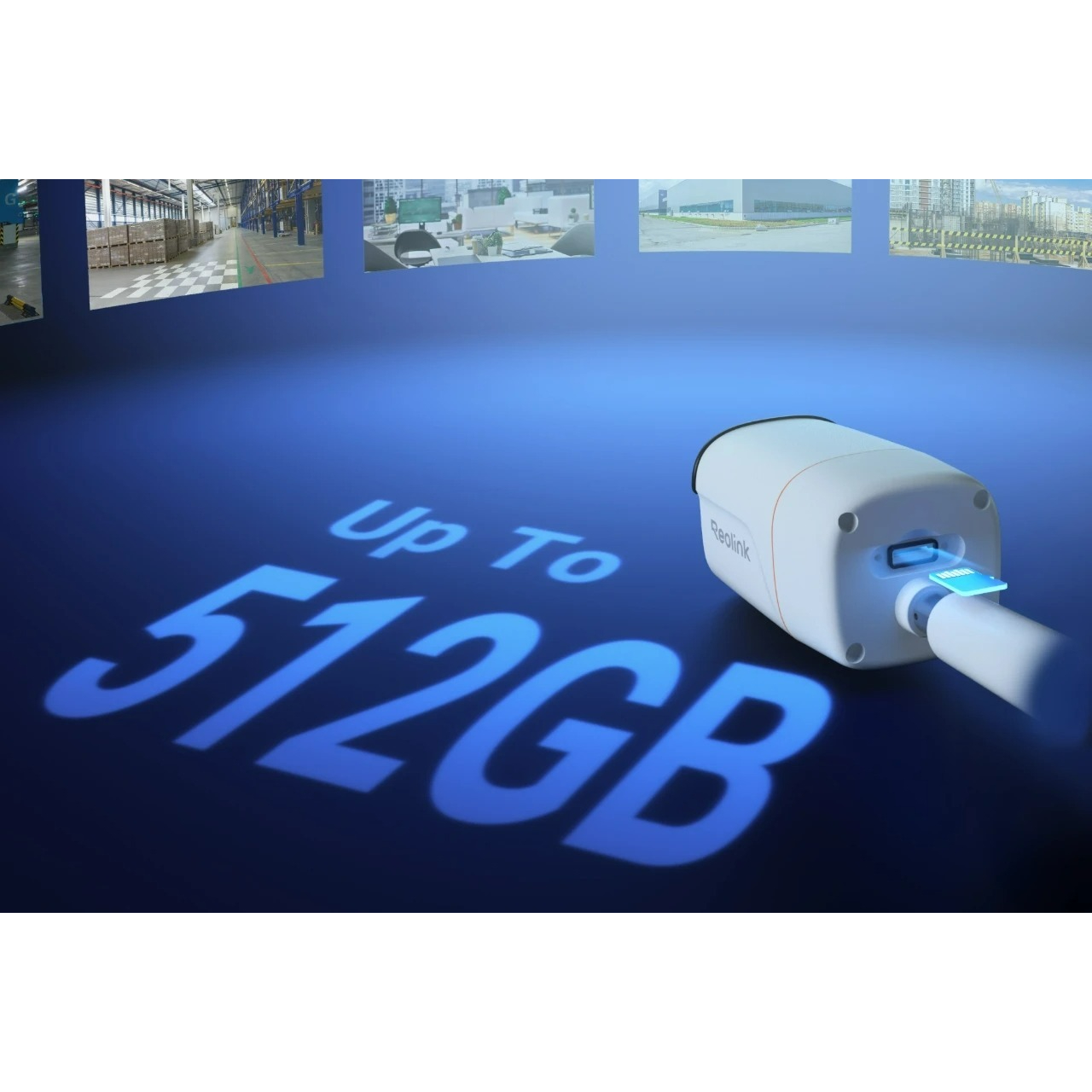
One cable carries both data and power over PoE 802.3af at 48V, with a 12V barrel connector kept as a fallback, and consumption stays under 12W. Keep that figure in view when you size a switch or a recorder: eight of these cameras peak at around 96W, while a typical eight-port PoE recorder budgets about 80W in total, and the peak arrives at night when every camera lights its IR and spotlight at the same moment. Footage can go three ways — to a microSD card of up to 512GB inside the camera, to a Reolink NVR, or to an FTP server — and because the camera is mains-fed over Ethernet it genuinely records 24/7, unlike the battery-powered Argus and Go models that can only capture events. As a rough estimate a continuous 12MP H.265 stream eats about 85GB a day, so a 512GB card holds roughly six days of looped recording: enough to check what happened yesterday, not enough for the two or three weeks of history an investigation sometimes needs, which is what the recorder with a hard drive is for. The RJ-45 port is 10/100 Mbps, ample for a single 12MP stream, but it is still worth pulling proper Cat 5e and remembering the 100-metre limit of any PoE run.
Where this camera belongs and which jobs it was built for
The sweet spot is a yard or a frontage 15 to 20 metres wide that you want to cover with one camera and still see detail: the courtyard of a private house, the gable end of a warehouse with its loading doors, a car park for five or six vehicles, a shop front with a display window. Because around 125 pixels per metre survive even at 15 metres, the recording lets you recognise someone you know and describe a car, and the 12MP headroom means you can crop into a frame after the event without the face dissolving into blocks. The bullet body with its shield points at where it should live: an exposed wall, a pole, the corner of a building or a fence line, anywhere without an eave to hide under. Where it is the wrong tool: in a narrow corridor or a stairwell a 100° angle wastes half the frame on the walls, and at a gate where the actual requirement is number plates from 20-25 metres a wide fixed lens will not save you — that job belongs to a varifocal model. On a long plot, two of these facing each other along the fence beat one in the corner, because whichever way a person walks, at least one camera has them from the front.
How it compares with the neighbouring Reolink models in this catalogue
Its closest relative is the RP-PCT12M in the same price bracket: identical sensor, identical lens, identical analytics, with the housing as the only real difference, so that choice is about the mounting point rather than about specifications. The RP-PCB8M shares the body and the feature set but runs 8MP at 2.8mm — at 15 metres it manages roughly 98 pixels per metre against 125 here, so for a scene under 10 metres deep you will never see the difference and the two thousand hryvnia are better left in your pocket. The older P340 is also a 12MP bullet, yet it comes with a wider 2.8mm lens, IP66 instead of IP67 and no perimeter rules at all: the saving is taken out of the analytics, not out of the sensor. Step up to the RP-PCB8MZ and you trade megapixels for a 2.7-13.5mm varifocal with real optical reach, which is the correct buy when plates at the gate are the actual mission rather than an overview of the yard. The cheapest neighbour, P334, is a sensible choice for a cottage or a garage where the point is simply that something was recorded; paying up for the RP-PCB12M makes sense when the recording has to prove something.
Send us the dimensions of the plot and the distance from the mounting point to the spot you need in detail, and we will tell you whether 12MP on a fixed lens covers it or whether a varifocal at the gate pays for itself.
Characteristics Reolink RP-PCB12M
Reviews about Reolink RP-PCB12M from real users
No reviews found







