
 m. Сміла, Незалежності, 67г. оф, 406/6























REOLINK P840 (2.7-13.5 MM) - PTZ IP CAMERA WITH OPTICAL ZOOM

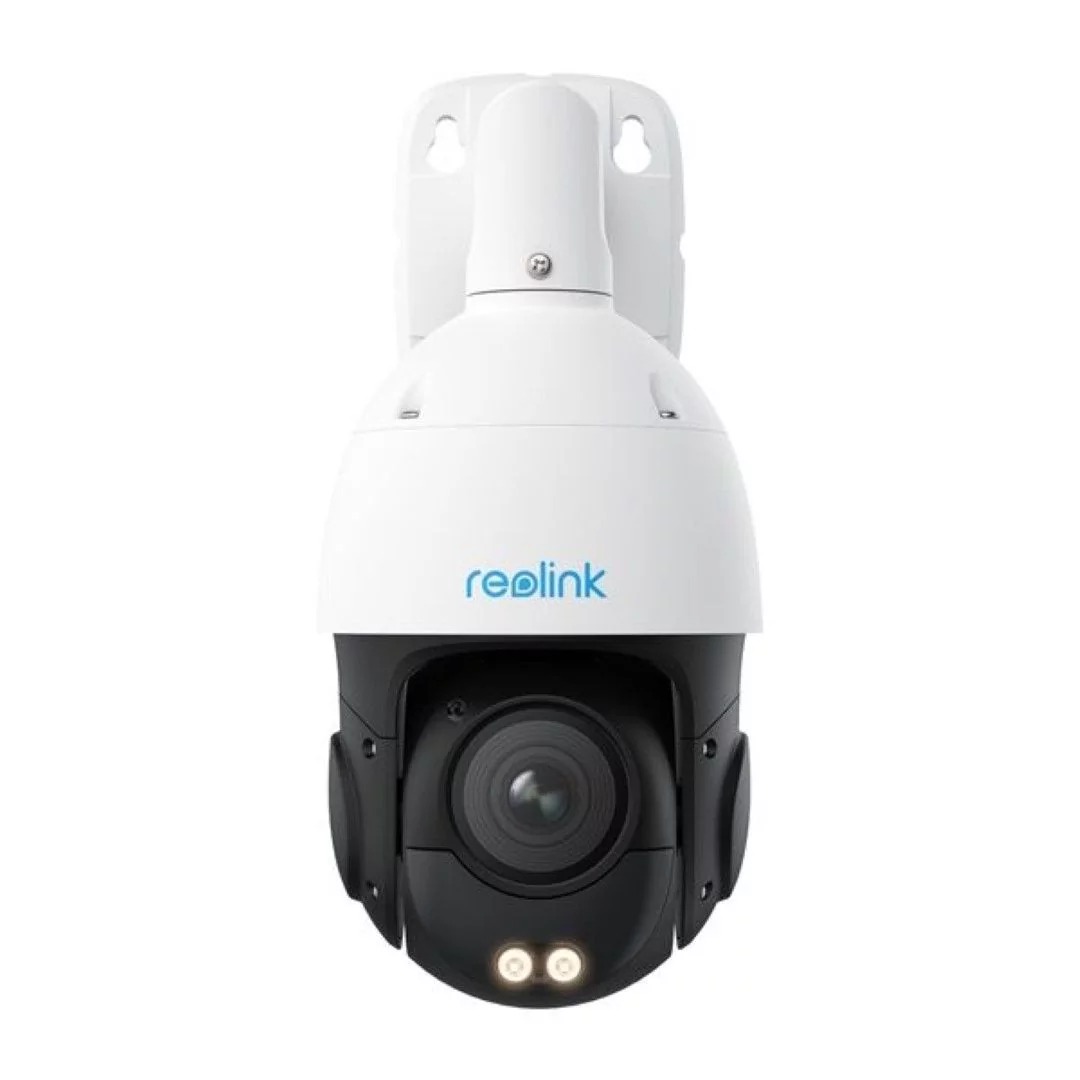
Description Reolink P840
A wired PoE camera, not a battery one — which means round-the-clock recording
The P840 belongs to Reolink's P line, the wired family that takes both power and data from a single network cable, and that is the fundamental difference between it and the battery-powered Go and Argus series. A battery camera wakes on its PIR sensor, saves a short clip and goes back to sleep, so there is simply no footage between events. The P840 is powered continuously and records continuously, which means you keep an unbroken timeline and can go back to see what happened ten minutes before an incident, not just the moment something moved. The price of that is infrastructure: you need to pull twisted pair from a PoE switch or injector to the mounting point, so the real budget is the UAH 14,399 for the camera plus cable work. On a site that already has or plans a PoE network with a recorder, this is the strongest Reolink in the catalogue; if there is neither power nor cable at the spot, the whole logic changes and the Go series with LTE is the honest answer.
5X optical zoom, 2.7-13.5 mm: when a single camera does the job of two
The motorised lens moves the field of view between 100° at the wide end and 31° fully zoomed in, and this is true optical zoom that puts real pixels on the subject rather than digitally enlarging a frame that has already been captured. At 2.7 mm the camera holds an entire yard or forecourt in one shot; zoomed to 13.5 mm from exactly the same mounting point you can read a plate or recognise a face where a fixed 2.8 mm camera would only show a blur. The 1/2.8-inch 8 MP sensor running at 25 frames per second keeps fast subjects usable frame by frame, so a car passing at 30 km/h does not smear into a streak when you step through the recording. The trade-off has to be spelled out: zoom applies to wherever the camera is currently pointed, and while it is tight on the gate the rest of the property is outside the frame entirely. That is why the P840 makes sense where presets and auto-tracking do the aiming for you, and much less sense where you need a permanently wide view with no blind spots.
360° pan, 90° tilt, auto-tracking and 64 stored positions
The head rotates a full 360° horizontally at up to 90 degrees per second and tilts through 90°, so one mounting point covers a sector that would otherwise be split between three fixed cameras. Auto-tracking locks onto a person or a vehicle that enters the scene and follows it until it leaves the zone, which is a different kind of evidence from static footage: the intruder stays in frame for the whole route across your property. The camera stores up to 64 presets and one patrol route of 16 points, so you can set a scheduled tour of the places that matter — gate, parking, back yard, gate again. Set the guard position as well: it is the home view the camera returns to by itself after a tracking event, and without it the unit tends to sit staring at whatever corner the last alert dragged it to. And the inherent limit of any PTZ still applies — at any given second it looks one way only, so it complements fixed cameras on the perimeter instead of replacing them.
Night vision: 60 metres of infrared, or full colour under the spotlights
Infrared reach is up to 60 metres, twice the 30 metres typical of the other cameras in this catalogue, and that is enough to see not only the approach to the building but the far boundary of the plot or the opposite side of a driveway. Alongside the IR array there are two 4 W white spotlights at a warm 4000 K with adjustable brightness: switch them on and the night image becomes full colour, and colour of clothing or of a car body is exactly the detail that makes footage usable when an incident has to be explained to police or an insurer. The spotlights also work as deterrence together with the built-in siren and two-way audio, so an unwanted visitor can be spoken to rather than merely watched. Here is the nuance nobody prints on the box: white light left permanently on attracts insects, and spiders follow them and build webs right in front of the lens, which produces dozens of false alerts within a week. The sensible setup is to keep IR as the default night mode and trigger the spotlights on person or vehicle detection, so the light becomes a reaction rather than permanent illumination.
PoE power, 2.34 kg of hardware and the temperature range to plan around
The product card lists 12 V, PoE 802.3af and 12 W, while Reolink's own specification for the P840 states 802.3at (PoE+) and 12 V 2 A with peaks up to 24 W — the gap is explained by the pan and tilt motors, the two 4 W spotlights and the IR array all drawing at once. In practice the rule is simple: do not hang this model off a cheap switch with a 12.95 W per-port budget, give it a PoE+ port or its own injector, and when you size a multi-camera system reserve separate headroom for this position. The body weighs 2.34 kg at 373×177×140 mm, so the bracket or wall console has to be proper metal — light mounts designed for a plastic dome will not hold it, and plasterboard is out of the question. IP66 settles dust and powerful water jets, but the -10…+50 °C operating range is the weak spot for a Ukrainian winter: in hard frost the camera is happier under an eave or on a facade that keeps some warmth. If the position is fully exposed and regularly drops below -15 °C, wired Hikvision and Dahua models rated to -40 °C are the more honest choice.
Storage: 256 GB card, an NVR, and how much space 4K really eats
The camera encodes in H.264/H.265 and supports event, scheduled and continuous recording, and it is that third mode which is the whole reason to buy a wired model. Do the arithmetic before you order: a 4K stream at a typical 8 Mbps uses roughly 80-90 GB per day, so a 256 GB card holds only about three days of continuous footage before it starts overwriting itself. Real archive depth needs a recorder — this catalogue has the Reolink NVS8 at UAH 7,899 with eight PoE ports and the RLN16-410 at UAH 12,199 with sixteen, and it is the camera-plus-NVR-with-disk combination that gets you two or three weeks of history. RTSP, ONVIF and FTP are supported, so the camera can be brought into a third-party VMS, although auto-tracking, presets and PTZ control are at their most comfortable in Reolink's own app. One small thing that routinely spoils day one: no microSD card is included, and it is worth ordering a surveillance-grade card, because ordinary ones tend to die within months under constant rewriting.
Where this camera belongs, and where it is simply overkill
The P840's natural habitat is a large open area with one dominant vantage point: a 30-50 metre yard, a car park, a warehouse or depot forecourt, a dealership lot, a farm, a filling station or the entrance group of a business. On such a site it is mounted at three to four metres — lower and it is easy to blind or knock down, higher and auto-tracking ends up looking at the tops of heads and losing faces. The model works best paired with fixed cameras: those record the perimeter with no blind spots, while the PTZ acts as the operator's eyes that can be aimed anywhere and zoomed for detail. For a small 10×15 metre yard, a single doorway or one gate it is plain overkill — a fixed 8 MP camera at four to five thousand hryvnia delivers the same result and the difference is better spent on a recorder and a disk. It is equally wrong for a shop floor or an office, where there is simply nowhere to use 60 metres of illumination and a 5X zoom.
How it compares with its neighbours in this catalogue
Its closest relatives are the Reolink RP-PCB8MZ and RP-PCV8MZ at UAH 9,099 each: the same 8 MP sensor and the same motorised 2.7-13.5 mm lens, but in a fixed housing, so zoom and focus are adjustable remotely while the direction of view is not. If your scene is one sector that just needs to be aimed accurately once and nudged occasionally, those give you about ninety per cent of the P840 and save UAH 5,300. The Reolink TrackMix G770 at UAH 11,699 also pans and tracks, but it is battery powered over LTE — the choice for a spot with no electricity, paid for with event-only recording. Among wired rivals in the same bracket, the Hikvision DS-2CD2T47G3-LIY ColorVu at UAH 12,134 gives genuinely colour images around the clock and 60 metres of reach, yet it is a fixed bullet with no zoom or pan, while the Dahua DH-IPC-HFW2849TL-S-PRO at UAH 9,360 offers 8 MP and 50 metres of IR for a third less money. The honest summary: if the property is large but the job comes down to two or three permanent directions, two fixed cameras for the same fourteen thousand will cover it more reliably than one PTZ; the P840 earns its price when one point has to deliver both the wide view and distant detail, plus the ability to look wherever nobody planned to look in advance.
If you are unsure whether your site really needs a PTZ, send us the dimensions of the property, the number of entrances and whether a PoE network is already in place, and we will work out which is better value — one P840 or a set of fixed cameras with a recorder.
Characteristics Reolink P840
Reviews about Reolink P840 from real users
No reviews found







