m. Сміла, Незалежності, 67г. оф, 406/6










Dialan F660BVF coaxial cable — 75 ohm, gel-filled

Description Dialan F660BVF
Coaxial cable with a moisture-blocking gel
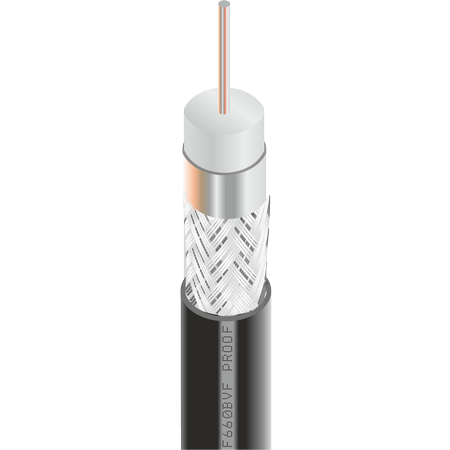
Dialan F660BVF is a 75-ohm coaxial cable whose gaps beneath the sheath are filled with a moisture-blocking gel. The letter F at the end of the designation says exactly that: a construction for places where damp is the rule rather than the exception — outdoor risers, ventilated facades, lofts, basements, communication manholes, spans between buildings. The transmission parameters remain those of the ordinary F660BV: 75 ohms, a propagation velocity of 85 %, a copper-clad steel centre conductor 1.02 mm across. What sets it apart is not the electrics but the behaviour in wet conditions.
Why moisture kills coaxial cable
Water destroys a coaxial path slowly and invisibly rather than at a stroke: it enters through a hairline crack in the sheath or an under-sealed connector and then travels along the cable between the sheath and the screen. The aluminium tape oxidises, the braid loses contact with the tape, the dielectric takes up moisture, and the impedance drifts over tens of metres at once. From the outside the cable looks intact, the signal level drops, and the cause is hunted for in the amplifier or the receiver. The gel blocks the path along the cable: even with the sheath punctured, the water stays at the point of damage instead of wandering down the whole route.
Construction and parameters
The screen is double: a hundred per cent laminated aluminium tape bonded to the dielectric and an aluminium braid covering 60 %. The dielectric is physically foamed polyethylene of 4.57 mm, the cable measures 6.80 mm overall, and the sheath is black PVC. The black is no accident: the carbon black in the compound slows the breakdown of the polymer under ultraviolet, and a gel-filled cable almost always ends up somewhere the sun reaches. Supply is in 100-metre coils and 305-metre reels.
Working with a gel-filled cable
The gel calls for a slightly different habit on site: before a connector goes on, the stripped section is wiped clean with a cloth or a lint-free rag, with spirit if needed, so that no gel reaches the contact surfaces. A trace of gel on the F thread does no harm, but on the centre contact it does, and that is where "unexplained" losses after a connector change come from. The tools are worth wiping too, otherwise the next strip is done on a slippery blade. The minimum bending radius is unchanged at ten outer diameters, about 68 mm.
Where it is justified and where it is excess
The gel-filled construction makes sense anywhere the cable leaves a heated space: facade routes, crossings between buildings, plant floors with condensation, outdoor cabinets. For dry domestic distribution there is no point paying for gel — plain F660BV or RG-6 covers it. The limit is worth remembering as well: the gel keeps water from running along the cable, but it does not make the cable fit for permanent immersion and it does not replace sealing the connectors with heat-shrink or self-amalgamating tape. A span between buildings needs a steel messenger in addition to the gel.
If any part of the route goes outdoors, the gel-filled version costs less than a single return visit to chase a drifting signal level. Describe where the cable runs and we will say whether F660BVF is enough or a messenger is needed as well.
Characteristics Dialan F660BVF
Reviews about Dialan F660BVF from real users
No reviews found