m. Сміла, Незалежності, 67г. оф, 406/6












Dialan U/UTP Cat.5 2×2×24 AWG copper LAN cable — PVC, LSZH, PE

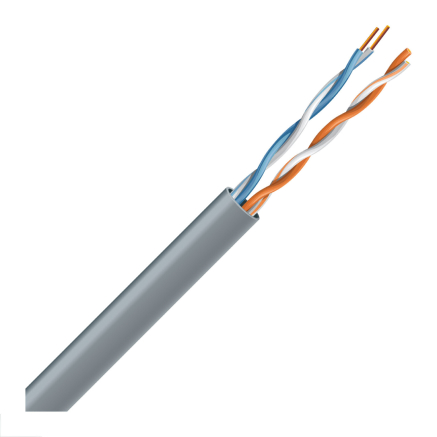
Description Dialan U/UTP Cat.5 2P CU
A two-pair cable, but a copper one
Dialan U/UTP Cat.5 PVC, LSZH, PE 2×2×24 AWG is an unscreened twisted pair with two pairs whose conductor is soft copper of 24 AWG rather than bimetal. The insulation is high-density polyethylene with colour coding, the nominal voltage up to 72 V and the permissible tensile force 85 N. It is made to ДСТУ IEC 61156–2, IEC 61156–2 and ISO/IEC 11801–1. Copper is exactly what sets this item apart from the cheaper two-pair cables of the same make, and it sets it apart substantially: a two-pair line in copper has what a two-pair line in bimetal lacks.
Why copper matters more on two pairs than on four
The standard modes of power over twisted pair use two pairs, and on a four-pair cable the unused pairs simply lie alongside. On a two-pair cable those same two pairs carry both the data and the supply current at once — there is no other reserve. The raised resistance of a bimetallic conductor therefore tells most sharply here: the voltage sags, the bundle warms, the camera reboots at night. A 24 AWG copper conductor with a voltage margin up to 72 V removes that question: a two-pair line honestly feeds a camera or an access point over a realistic distance.
Three sheaths mean three different places to install
The same construction is produced in three sheaths, and the choice decides where the cable may be used at all. PVC is for ordinary rooms: cheap, flexible, entirely sufficient. LSZH releases no halogens and produces little smoke as it burns — a requirement for buildings where people gather: schools, hospitals, stations, underground car parks. Polyethylene is for outdoors: it withstands frost, absorbs no water and resists ultraviolet. In effect these are three different products on one construction, so the sheath has to be named explicitly when ordering.
Category 5 rather than 5e: what that means
Category 5e came later than category 5 and added the requirements gigabit needs specifically: return loss and delay skew between pairs. For a two-pair cable that difference is largely academic, because gigabit does not run on two pairs whatever the category — it physically needs all four. The "Cat.5" marking is therefore not a limitation here: within the hundred megabits this cable is built for, it is complete and specified by the corresponding part of the standard.
What it is bought for
A camera powered over the cable, an access point, an IP door station, a metering terminal, an access controller, analogue telephony, an alarm line — anywhere only two pairs are needed but proper electrical characteristics are needed too. A two-pair cable is thinner than a four-pair one, so it enters a narrow channel, old conduit or an already crowded duct more easily, and sometimes that alone decides the matter. If there is even a modest chance the line will one day be asked for a gigabit, laying four pairs from the start is wiser.
Tell us which sheath you need — PVC, LSZH or polyethylene — and what will sit at the end of the line; we will pick the version and work out the footage.
Characteristics Dialan U/UTP Cat.5 2P CU
Reviews about Dialan U/UTP Cat.5 2P CU from real users
No reviews found