
 m. Сміла, Незалежності, 67г. оф, 406/6
























LG UV36R (36,000 BTU, 10 kW) - 1600 mm ceiling-suspended unit for halls without a suspended ceiling

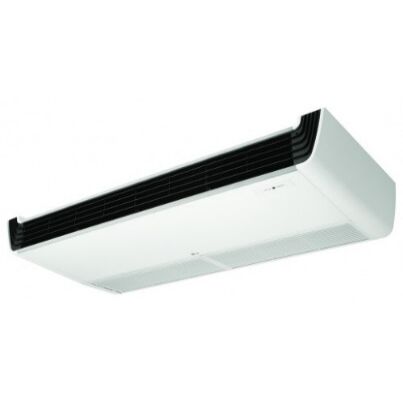
Description LG UV36R
The UV36R: a 10 kW ceiling-suspended unit
The UV36R is a ceiling-suspended indoor unit from LG's R32 semi-industrial range, rated at 10 kW cooling and 10.8 kW heating. The casing has grown compared with the smaller models in the series: 1600 mm wide, 690 mm deep and 235 mm high, with the same installation logic - straight under the slab, with no suspended ceiling and no decorative panel. Supply is 220-240 V, 50 Hz, the refrigerant is R32, the pair works with a Dual Inverter compressor, the casing is metal with plastic parts, manufacturer country and origin are Korea and the warranty is 24 months. The card carries no pipe diameters or maximum run: those depend on the outdoor unit in the pair, and we take them from the combination data sheet before installation. In floor terms this is a space of roughly 100-130 m², given elongated geometry and a ceiling no higher than four metres.
A 1600 mm casing and how far the air travels
The 1600 mm width is not size for its own sake but the length of the discharge grille: the longer it is, the wider and more stable the horizontal stream. The air leaves as a flat sheet, clings to the ceiling and runs along the room, holding its velocity far longer than the short stream from a cassette. In practice one UV36R hung at the end of a hall seven to nine metres wide works over a length of about fifteen metres - a throw no other unit type of the same capacity can match. The price is that the stream needs clear space: a column, a ventilation duct or a hanging sign in its path breaks it up and leaves the far end of the room without air. The position is therefore chosen from the room's elevation drawing rather than from where the pipes are easiest to run.
10 kW where there is no ceiling at all
The main setting for this model is a space where no suspended ceiling is planned: a warehouse with exposed trusses, a vehicle workshop, a production bay, a sports hall, a showroom in a converted factory. A cassette is physically impossible in such places, a ducted unit demands an expensive network under the roof, and a 10 kW wall unit does not exist in this line. The ceiling-suspended unit hangs on four rods into the slab or on fixings to the steelwork and starts working with no building work at all. A second advantage in such buildings is serviceability: everything is reachable from a lift, nothing has to be dismantled, and a service visit does not turn into a construction job. The third is that the unit can be taken down and rehung if the layout of the workshop changes, which on leased floorspace happens more often than anyone would like.
Mixing the air in a tall space
In a hall four or five metres high, winter brings stratification: warm air gathers under the roof while the temperature at floor level, where people work, is several degrees lower. The strong horizontal stream of a ceiling-suspended unit partly breaks that layering down - it entrains the surrounding air and mixes the volume even when the unit is running on fan only. That gives a practical benefit people rarely consider when buying: in winter, when heaters or radiant panels warm the upper zone, a few hours of fan operation bring that heat back down. The unit has a ventilation mode with neither cooling nor heating for exactly this, and in a cold workshop it is used deliberately. An air conditioner does not solve stratification completely, but it narrows the gap between roof and floor noticeably, and that feeds straight into heating costs.
Matching the outdoor unit to the supply you have
For 10 kW cooling and 10.8 kW heating the catalogue offers the single-phase UU36WR (item 1816) and the three-phase UU37WR (item 1820), the latter measuring 950 by 1170 by 330 mm. On an industrial site the three-phase version is almost always the logical one: a three-phase supply is already there for the machinery, and adding air conditioning to it is easier than loading a single-phase line. Where the supply is tight we calculate the load balance and look at what runs simultaneously: a machine tool, a compressor, the lighting and the air conditioner at peak may not fit within the allocated capacity. Space for the outdoor unit is usually easy to find in an industrial building - the roof or a plant area at the gable end - but it should not sit beside the extract from a paint booth or a welding bay. The air passing through the condenser has to be clean, or the coil fouls within a single season.
Dust, filtration and realistic service intervals
The standard filter is designed for an ordinary room, not for a joinery shop or a builders' store, so in a dusty environment the cleaning interval drops to two or three weeks. Where dust is constant, an additional coarse filter is fitted ahead of the unit or monthly coil blow-downs are planned - cheaper than losing capacity and overheating the compressor. The diagnostic sign is simple: if at the same setpoint the unit now runs longer and cools less, the first suspect is contamination rather than a fault. An annual coil wash is required even in a clean room, because greasy dust from the air settles on the fins and does not come off with compressed air. In a workshop we normally propose a service contract with two planned visits a year, timed around production shutdowns.
Installing at four metres, and control
A 1600 mm casing at four metres is installed by two people from a lift, and that belongs in the works programme - a unit of this size does not go up a ladder. Fixings into a reinforced concrete slab use anchors sized with a margin; in a steel building they attach to the truss or a beam, with a resilient mount at every point. The wired PREMTB001 controller (item 1897) is brought down to a convenient height by the entrance or into the supervisor's room, since at height the unit has no accessible interface. Where the space is large and holds several units, they are gathered under an AC EZ central controller (item 1905) so that every machine can be seen from one place. Power, control and drain runs go into a tray with the rest of the building's services, because open installation without a tray quickly becomes a cobweb under the roof.
Send an elevation of the space with its height and any obstructions under the roof, and we will place the UV36R so the stream covers the hall instead of hitting a column. We will match the outdoor unit to your supply and set out a realistic service schedule for your type of production.
Characteristics LG UV36R
Reviews about LG UV36R from real users
No reviews found







