
 m. Сміла, Незалежності, 67г. оф, 406/6























LG UU24WR (24,000 BTU, 7 kW) - outdoor unit of a semi-industrial R32 inverter system

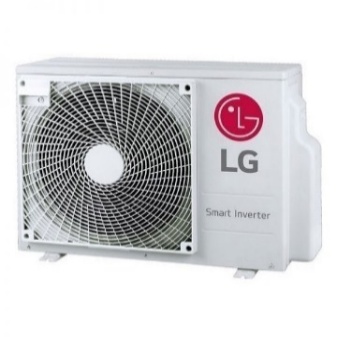
Description LG UU24WR
The UU24WR: 7 kW from a single phase
The UU24WR is the outdoor unit of an LG R32 semi-industrial system with a circuit output of 7 kW cooling and 8 kW heating. The 950 by 834 by 330 mm casing is a full-size unit that does not fit a typical recess under a window and needs its own place on the facade or on the ground. The supply is single-phase, 220-240 V, 50 Hz: seven kilowatts of cooling from one phase is the maximum this series still delivers without moving to a three-phase scheme. The compressor is a Dual Inverter, the refrigerant R32, and both the manufacturer country and the country of origin on the card are Korea. The weight is not stated on the card; the residential unit in the same casing weighs 46 kg, and that is the figure taken as a guide for the fixings, to be confirmed against the data sheet.
Indoor units at 7 kW: four different answers
At this capacity the catalogue offers four types of indoor unit, and the choice between them shapes the whole project. The CL24R (item 1827) is a ducted unit 1100 mm wide and 190 mm tall for short ducts; the CM24R (item 1829) is a ducted unit 900 mm wide and 270 mm tall with higher static pressure for a branched network. The CT24R (item 1837) is a cassette of 840 by 840 mm, 204 mm tall, with four-way distribution. The UV24R (item 1843) is a ceiling-suspended unit 1200 mm wide, mounted below an exposed ceiling where there is no suspended one. For a square hall of 60-70 m² a cassette in the centre works best; for a narrow space, a ducted scheme with grilles along its length; for a warehouse or workshop with a high exposed ceiling, a suspended unit aimed along the space.
An 840 by 840 mm cassette and a standard ceiling
Cassettes at 7 kW measure 840 by 840 mm, which does not match the popular 600 by 600 mm suspended ceiling module - something worth knowing before the ceiling is built. In practice, space for two tiles is cut in a grid ceiling with the framework reinforced, or the unit is planned while the ceiling is being installed. The unit itself is 204 mm tall, but space above it is needed for pipes, the drain and access to the pump: the real requirement is roughly 300-350 mm from tile level to the slab. The decorative panel projects 2-3 cm below the ceiling plane and forms a visible square, so its position is coordinated with the lighting layout. If there is no spare height above the ceiling, the cassette has to give way to a ducted unit in the corridor delivering air through grilles, or to a suspended option.
Air distribution in a 60-70 m² hall
Seven kilowatts in a hall of that size is roughly 100-115 W per square metre, enough for a shop, a cafe or an office with people and lighting. A cassette in the centre of the ceiling gives four diagonal streams and covers a square 8-9 metres on a side with no cold or warm zones. A ducted scheme lets air be delivered exactly where it is needed, for instance to a shop window or to workstations, but demands correctly sized grilles: too small an area whistles, too large and the velocity collapses and the air stagnates. In a hall with a high ceiling, stratification has to be considered: in heating mode warm air collects above, and without directing the stream downwards the temperature at head height will be 3-4 degrees lower. The return is planned at a distance from the supply, otherwise the system works on itself and never lowers the room temperature.
Installing a unit 834 mm tall
A full-size unit is rarely hung on a facade: in most projects it stands on a frame on the ground, on a roof or on a plant platform, all the more because the pipe runs in this series allow it to be placed tens of metres away. If it does go on a wall, the brackets are rated for at least 120 kg with through-fixings into the structure rather than into cladding. Clearances: a metre in front, 50 cm above, 30 cm behind, 50 cm on the service panel side; in an enclosed well the unit overheats and loses output exactly in a heatwave. On the ground, raising it 30-40 cm and draining the condensate are mandatory, because in heating mode the unit sheds defrost water that turns to ice in winter. Every point of the pipework discipline - evacuation, nitrogen, tightening torque - is critical at this capacity, because the refrigerant charge is larger and any leak is more expensive to put right.
Electrics: seven kilowatts of cooling on one phase
A 7 kW circuit draws roughly 2.1-2.4 kW at peak, that is 10-11 A, and that is already the point at which a single-phase service is planned together with the rest of the building's load. The circuit is 4 mm² copper with its own breaker to the design; 2.5 mm² is not adequate here even over a short distance. If the building has three phases, it is worth comparing this model with the three-phase UU37WR (item 1820): an even load across the phases often matters more in a commercial space than the simplicity of a single-phase connection. A surge protection relay and a check of supply quality under load are mandatory steps before handing the system over. Energy classes are not given on the card, as they depend on the outdoor-indoor pair, and we state them when proposing a combination.
Which jobs it fits and where it is out of place
The UU24WR is the basis of a system for a shop, a cafe, an open-plan office, a salon, a gym or a production area of 55-70 m² where the equipment has to be concealed or spread across the ceiling. It is also taken for two or three offices on a shared ducted distribution, if an identical temperature in them is acceptable. Where the model is out of place: as a separate purchase without an indoor unit; in a space with neither a suspended ceiling nor room for a suspended unit; in spaces with differing regimes, which need separate circuits or a multi-split system. If the single-phase service is already loaded, a three-phase model of the same output is the better choice. And for a hall above 90-100 m² one 7 kW circuit is insufficient - that points to the UU36WR (item 1816) and larger.
How it differs from neighbouring models in this catalogue
The UU18WR (item 1814) offers 5 kW in an 870 by 650 mm casing: an easier installation, a smaller circuit, the same single-phase supply. The UU36WR (item 1816) offers 10 kW in a tall 950 by 1380 mm casing, still single-phase but with different demands on the service. The UU37WR (item 1820) offers 10 kW in three-phase form, for sites that have three phases. The CL24R (item 1827) and CM24R (item 1829) are 7 kW ducted indoor units with different static pressures; the CT24R (item 1837) is the 840 by 840 mm cassette; the UV24R (item 1843) is the suspended unit for spaces with no suspended ceiling. The residential alternatives at this capacity are the WZ24AWN (item 1807) or the PC24SQ (item 1809): complete sets with a wall unit, cheaper to install, but without concealed mounting or wired control.
Describe the shape of the space and the type of ceiling, and we will propose a cassette, ducted or suspended unit to pair with the UU24WR and work out the air distribution.
Characteristics LG UU24WR
Reviews about LG UU24WR from real users
No reviews found







