
 m. Сміла, Незалежності, 67г. оф, 406/6























LG UU12WR (12,000 BTU, 3.5 kW) - outdoor unit of a semi-industrial R32 inverter system

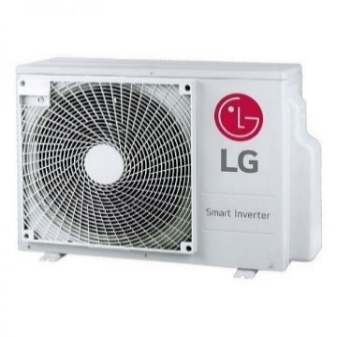
Description LG UU12WR
The UU12WR: more cooling in the same casing
The UU12WR is the outdoor unit of an LG R32 semi-industrial system with a circuit output of 3.5 kW cooling and 4 kW heating. The casing is the same as on the smaller UU09WR (item 1812): 770 by 545 by 288 mm, single-phase 220-240 V, 50 Hz, a Dual Inverter compressor. For installation that is practical news: once the location is chosen, moving from 2.5 to 3.5 kW changes neither the brackets, nor the clearances, nor the footprint on the facade. On the card both the manufacturer country and the country of origin are given as Korea - typical for the semi-industrial range, whereas the residential series in this catalogue are assembled in China. Like any outdoor unit, it works only paired with an indoor unit of matching output.
Why a semi-industrial circuit rather than a residential one at the same 3.5 kW
This catalogue does contain a residential 3.5 kW split, and it costs less, so the difference lies not in the cooling but in the duty it is designed for. Semi-industrial units are engineered for long shifts: eight to twelve hours every day through the season, under constant load, rather than a few hours in the evening. The second difference is serviceability: ducted and cassette indoor units come apart for cleaning the coil and the fan, whereas access to the internals of a residential wall unit is limited. The third is control: a wired controller is standard in this range, and it can be locked to a temperature range, which in an office or a shop removes half the arguments between staff. Finally, semi-industrial equipment is designed to work with ductwork and external static pressure, meaning it can be built into an air distribution system rather than simply hung on a wall.
The indoor unit to pair: ducted or cassette
At 3.5 kW the catalogue offers two options: the CL12R ducted unit (item 1825), 190 mm tall, and the CT12R cassette (item 1835) at 570 by 570 mm. A 190 mm ducted unit is low-static, meaning it develops little external static pressure and is designed for short ducts: in practice 2-4 metres of duct each way and two or three grilles. If the design calls for longer duct runs or flexible ducting with bends, a unit with higher static pressure is needed, such as the CM series (items 1828-1829) at larger capacities. A cassette removes that problem: it has no ductwork at all and distributes air through a ceiling panel, but it needs a square opening in the suspended ceiling and spare height above it. According to LG documentation, UU..WR outdoor units are paired with CL series ducted units; for the cassette option we confirm the pair's compatibility against the manufacturer's table before ordering.
Ducts and grilles: where the output is lost
A ducted system performs exactly as well as its ductwork is designed: every bend, every constriction and every metre of flexible hose eats static pressure, and with it the real cooling output. Flexible aluminium hoses offer the greatest resistance, so they are kept to short connection sections while the main runs are made rigid. Ducts in a cooling circuit must be insulated along their whole length: an uninsulated duct above the ceiling collects condensate, and within a month or two stains appear on the ceiling. Grilles are sized by area rather than by eye: an undersized grille whistles, and in a quiet office that whistle becomes more irritating than the noise of the unit itself. The return duct or return grille is placed at least 2-3 metres from the supply, otherwise the system starts circulating its own cooled air in a loop and never lowers the room temperature.
Installing the outdoor unit, and the indoor drain
The unit hangs on brackets with through-fixings, on vibration mounts, with a flexible section in the pipework and stiffness to spare. Clearances: 50-70 cm in front, 30-50 cm above, 15-20 cm behind; with a compact casing, recirculation of hot air is especially damaging in a heatwave. If shoulder-season heating is planned, the unit is raised 30-40 cm above ground level and given a path for defrost condensate, because ice under the unit in winter negates all the ventilation. The indoor drain in a ducted or cassette system almost always runs through a pump: in cassettes it is often built in, in ducted units an external one such as the ABDPG (item 1914) is used. The drain pipe is laid with a fall and with inspection access at least at one point, because clearing a blocked line above a closed ceiling is an expensive operation in itself.
Electrics
The supply is single-phase, 220-240 V, 50 Hz; for a 3.5 kW circuit expect a peak draw of roughly 1.1-1.3 kW, that is 5-6 A. A separate 2.5 mm² copper circuit with its own breaker is the standard solution; 4 mm² is used where the distance from the board exceeds 25-30 metres. For equipment that runs daily, a surge protection relay pays for itself at the first voltage spike on the network. The outdoor unit's card gives no energy classes, because they are determined by the pair: the same UU12WR combined with a ducted and with a cassette unit will give different seasonal figures. We provide the classes and the rated pipe data together with the proposal for a specific combination.
Which jobs it fits and where it is out of place
The UU12WR makes sense for a space of 30-35 m² where the equipment has to be invisible and controlled from a wall controller: an office, a meeting room, a salon, a pharmacy, a small shop, a clinic reception. It also suits a second circuit on a site where LG semi-industrial units already work, since it preserves a single logic of control and service. Where this product is out of place: as a standalone purchase without an indoor unit - the system will not run; paired with a residential indoor unit - combinations are set by the manufacturer's table; in a space with no suspended ceiling - there is nowhere to put a ducted or cassette unit, and a ceiling-suspended UV18R (item 1842) or a residential wall machine is the better answer. For a 50 m² hall one 3.5 kW circuit is not enough: that points to the UU18WR (item 1814). And a server room that has to be cooled in winter needs specialised equipment such as the US30F (item 1848).
How it differs from neighbouring models in this catalogue
The UU09WR (item 1812) is the smaller unit of the series at 2.5 kW in the same casing: the same installation, a smaller circuit. The UU18WR (item 1814) offers 5 kW of cooling in an 870 by 650 mm casing: different brackets, more weight, larger clearances. The CL12R (item 1825) is the 3.5 kW ducted indoor unit, 190 mm tall, the primary pairing option for this outdoor unit. The CT12R (item 1835) is the cassette indoor unit of the same output, which needs no ductwork but does need space in the ceiling. The WZ12AWN (item 1805) is the residential set at 3.45 kW: cheaper and simpler to install, with Wi-Fi and an app, but with a visible wall unit and no way to build the system into the ceiling.
Tell us the room height and whether there is a suspended ceiling, and we will select a ducted or cassette unit to pair with the UU12WR and calculate the duct lengths.
Characteristics LG UU12WR
Reviews about LG UU12WR from real users
No reviews found







