
 m. Сміла, Незалежності, 67г. оф, 406/6
























LG MU4R25 (7 kW) - multi-split outdoor unit for 4 indoor units

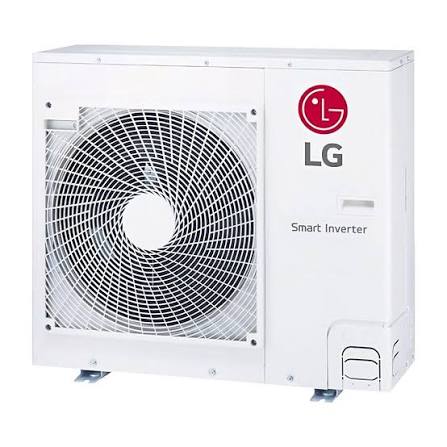
Description LG MU4R25
The MU4R25: an outdoor unit for four indoor units
The MU4R25 is the outdoor unit of an LG R32 multi-split system rated at 7 kW cooling and 8.4 kW heating for four indoor units. The casing is 870 mm wide, 650 mm high and 330 mm deep, the supply is single-phase 220-240 V, 50 Hz, the compressor is a Dual Inverter and the construction is metal with plastic parts. Manufacturer country and country of origin are Korea, with a 24-month warranty. Indoor units come from the multi range: the MA09R and MA12R wall units (items 1866-1867), the MJ05PC to MJ24PC (items 1868-1874) and the MT09R and MT11R cassettes (items 1875-1876). Four ports is the scale of a small house or office rather than a single flat, and the design approach differs accordingly.
Four rooms: the buildings this suits
The commonest scenarios for this model are a house where a living room and three bedrooms need cooling, or a small office of four rooms. A third is a large flat where, besides the bedrooms, an open-plan kitchen and a study are air conditioned. The logic is the same in each case: one outdoor unit on the facade or in a service area, four lines and four indoor units sized to the rooms. For a house this is particularly convenient, as it avoids four separate machines on the elevation and four sets of brackets, each of which will later need servicing. But the more rooms on one outdoor unit, the more important it is to judge honestly whether they will run at the same time - that is what decides whether 7 kW is enough.
A four-room office: what to allow for
An office differs from a home in three ways, and each affects the calculation. First, people: every person in a room adds a noticeable heat load, and a room with six workstations warms up quite unlike a bedroom of the same size. Second, equipment: computers, monitors, a printer and a coffee machine together give off hundreds of watts throughout the working day. Third, simultaneity: unlike a flat, where rooms are used in turn, in an office every room is occupied during the same hours, so exceeding the outdoor capacity with the sum of indoor ratings is riskier here. A fourth thing to settle in advance is who controls the temperature: if every room has its own handset, arguments about degrees are inevitable, and PREMTB001 wired controllers (item 1897) with a limited setting range resolve the matter.
When the units run together and when in turn
A multi system shares capacity between the indoor units, and when only one is running it receives more than its share under full load. That is a useful property: at night, with only the bedroom on, the unit reaches temperature quickly and then runs at low speed. With all four running, each takes its portion, and if the sum of the ratings exceeds 7 kW, in peak heat the furthest or most heavily loaded room will cool more slowly. The practical conclusion: rooms with the biggest load - the living room, the open kitchen, a study full of equipment - are given their own margin, while bedrooms can be sized tightly. We check the permitted combinations and the overlap ratio against the manufacturer's table before the order, so that nobody discovers on site that the chosen set is not supported.
Pipe runs in a two-storey house
In a house the indoor units are often on different floors, which introduces a height difference between the outdoor unit and the highest or lowest indoor one. There is a limit on that difference in the model's data sheet, and it applies both when the outdoor unit is below and when it is on the roof. The second limit is the total length of all four lines: in a two-storey house it adds up faster than expected, because vertical sections join the horizontal ones. The third is the charge: beyond the base length the system needs additional refrigerant, calculated by the formula in the manual. All the lines are laid during construction or a major refurbishment, because running four of them through floors afterwards without demolition is all but impossible.
One unit on the facade: appearance and practicality
Four separate air conditioners on a house elevation look exactly as they look, and owners often solve the problem precisely by choosing a multi. One unit is easier to place: it goes on a side or rear elevation, in the service area by the boiler room or in an enclosed yard, and it does not spoil the view of the main entrance. One condition matters - enough room for air: the unit must not be squeezed between walls or hidden in a sealed recess, because the hot air has to get away. Decorative screens are acceptable when they have enough free area and do not sit flush against it; a solid box around the unit reduces capacity and causes protection trips in hot weather. The distance to bedroom windows is planned in advance too: at night even a quiet unit is noticeable right under a window.
Honestly about the risk: one machine for four rooms
The main compromise of a multi system is that every room depends on one outdoor unit. In a home that is bearable: if the equipment stops, a few days can be managed with fans. For an office, a server room or a room with equipment that cannot tolerate heat, the risk is already unacceptable, and the right answer is to put the critical room on a separate split and leave the multi for the rest. The second thing that reduces risk is scheduled service: most failures are not sudden, and regular pressure checks and cleaning reveal a problem in advance. The third is capacity margin: a system that works at its limit through hot summers for years wears faster than one with 15-20 per cent in reserve.
What to ask the installation crew
The quality of installation on a four-line multi matters more than any feature of the equipment, so a few questions are worth asking the crew in advance. First, will the joints be brazed under nitrogen: without it, scale forms inside the pipes, travels through the system and eventually destroys the compressor. Second, how long will the system be evacuated and will there be a vacuum hold test: on four lines a short evacuation simply cannot remove the moisture. Third, how will the additional charge be calculated and will it be written into the record. Fourth, will they leave a drawing of the pipe routes with actual lengths. A crew that answers those four questions calmly will almost certainly do the job properly, and that is the best filter available to a client without technical training.
Tell us which four rooms need air conditioning, their areas and how they are used, and we will calculate the capacity for each and verify the combination against the manufacturer's table. If one of them is a server room or holds critical equipment, we will propose an arrangement in which it does not depend on the shared outdoor unit.
Characteristics LG MU4R25
Reviews about LG MU4R25 from real users
No reviews found







