
 m. Сміла, Незалежності, 67г. оф, 406/6























Deye RW-M6.1 (6.14 kWh, IP65) - low-voltage LiFePO4 battery

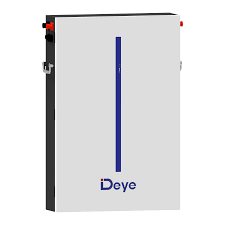
Description Deye RW-M6.1
IP65: the first battery in this catalogue you can hang outdoors
The RW-M6.1 carries an IP65 rating — full protection against dust and against water jets from any direction — while most domestic batteries are limited to IP20 or IP21 and demand a dry room. In practice that means the module can be installed on an exterior wall, under a canopy next to the inverter or in an unheated enclosure, and wind-driven rain will not harm it. But IP65 does not make the battery all-weather in the full sense: direct summer sun on the housing raises cell temperature and accelerates degradation, so a north wall or a canopy is mandatory. Equally, the housing must never end up under a snowdrift in winter, nor should water stand at its base. And the main limitation remains temperature rather than water — more on that next.
Outdoors in winter the battery delivers but does not charge
The temperature range here is standard for LiFePO4: charging from zero to plus fifty-five, discharging from minus twenty to plus fifty-five. For outdoor installation that is the key nuance: in January a battery on an exterior wall will keep delivering, but solar generation will not reach it until the cells warm above freezing. In the Ukrainian climate that means a few cold weeks a year when the system effectively works as backup only, with no daytime recharge from the panels. The ways out are simple: put the module in an unheated but enclosed box with minimal heating, or on a wall that borders a warm room and is warmed through it. And if the battery ends up indoors after all, IP65 simply becomes a margin of robustness you have already paid for.
A warranty of "10 years or 20 MWh": let us see which comes first
The maker gives a dual warranty here: ten years or twenty megawatt-hours of throughput, whichever arrives first. Do the division: 20,000 kWh divided by 5.53 kWh of usable energy per cycle gives about 3617 full cycles. Ten years is 3650 days, so the two limits coincide almost exactly on the assumption of precisely one full cycle a day. The conclusion is practical and important: this warranty is designed for the domestic "one cycle a day" pattern. If you plan two full cycles daily — charging at night on a cheap tariff and from the sun by day, with two discharge peaks — the energy limit will arrive in about five years rather than ten.
Six thousand cycles on the datasheet against 3617 under warranty
Cell life is declared as 6000 cycles at 0.5C and 25 °C with 70 % residual capacity at the end. But the warranty limit of 20 MWh corresponds to roughly 3617 cycles, and that gap is not an error but normal practice: the datasheet figure is a laboratory characteristic of the cells, while the warranty is the maker's commercial commitment. Once the warranty is used up the battery does not stop working: on paper it still has some two and a half thousand cycles of life left. What matters is something else — when comparing models, look not only at cycle counts but at how the warranty is worded, because "10 years" without an energy limit and "10 years or 20 MWh" are two different promises. In this catalogue the RW-M6.1 is one of the few models where the maker states both limits openly.
Current: 60 amps in normal use, 100 maximum, 150 for two minutes
The datasheet separates three figures: a recommended operating current of 60 A, a maximum of 100 A and a peak of 150 A for two minutes. Sixty amps at 51.2 V is about 3.1 kW of sustained power, a hundred amps around 5.1 kW, and the peak delivers up to 7.7 kW. A two-minute peak is a rare specification: most modules hold their maximum for ten seconds, enough only for a brief jolt, whereas two minutes cover a borehole pump's full run-up together with a compressor switching on. For a 5 kW hybrid inverter one module suffices even at maximum current, but in normal operation at 60 A you will get about 3 kW continuously. If you need a steady five kilowatts day after day, take two modules so that each works in its recommended zone.
A usable 5.53 kilowatt-hours and mounting a 55 kg housing
Nominal energy is 6.14 kWh at 120 Ah of capacity, and the usable figure at 90 % DoD is 5.53 kWh, stated separately in the datasheet. That is noticeably more than standard 100 Ah modules: roughly an hour and a half longer operation of a typical backup load set. The 460 × 720 × 143 mm housing weighing 55 kg is fixed to a wall or stood on the floor, and fifty-five kilograms on an exterior wall requires concrete, solid brick or a steel frame with anchors rated for dynamic load. Aerated concrete, expanded-clay blocks and an insulated facade system without embedded fixings cannot carry this weight. Cooling is passive, so free space must remain above and beside the housing, even when it hangs outdoors.
Scaling to 32 modules, and certification
Up to 32 modules can be connected in parallel, giving as much as 196 kWh — from a single battery in a private house to a mid-sized commercial store. Certification covers UN38.3, UL1973, FCC, IEC62619, CE and CEI 0-21: a complete set for sale in Europe and for projects going through technical approval. Relative humidity is permitted from 5 to 95 %, and maximum operating altitude is two thousand metres. Cooling is passive, with no fans, so the battery is completely silent — an important point if it hangs near a bedroom window. When building a set the modules must be the same model and the power connection symmetrical, otherwise the nearest modules take on more current.
How it differs from the neighbouring models here
The RW-M5.3 (item 2089) is a smaller wall unit of 5.32 kWh rated for 4000 cycles and with no declared ingress protection, so it is not intended for outdoor use. The RW-L2.5 (item 2090) is a compact 2.56 kWh battery, but in the 24-volt class, so it will not suit a 48-volt inverter. The AI-W5.1 (item 2095) also offers IP65 and a ten-year warranty, but it is a floor-standing modular stack rather than a wall module. The SE-F5 series (items 1939–1944) is cheaper, yet rated IP21 and requires a room. If what you need is specifically an outdoor wall battery with a long peak and a transparent warranty, the RW-M6.1 is the best choice in this catalogue.
Tell us where the battery will stand — outdoors or inside — and how many cycles a day you plan: we will check whether you stay inside the 20 MWh warranty and work out the module count.
Characteristics Deye RW-M6.1
Reviews about Deye RW-M6.1 from real users
No reviews found







