
 m. Сміла, Незалежності, 67г. оф, 406/6























Deye RW-M5.3 (5.32 kWh) - low-voltage LiFePO4 battery

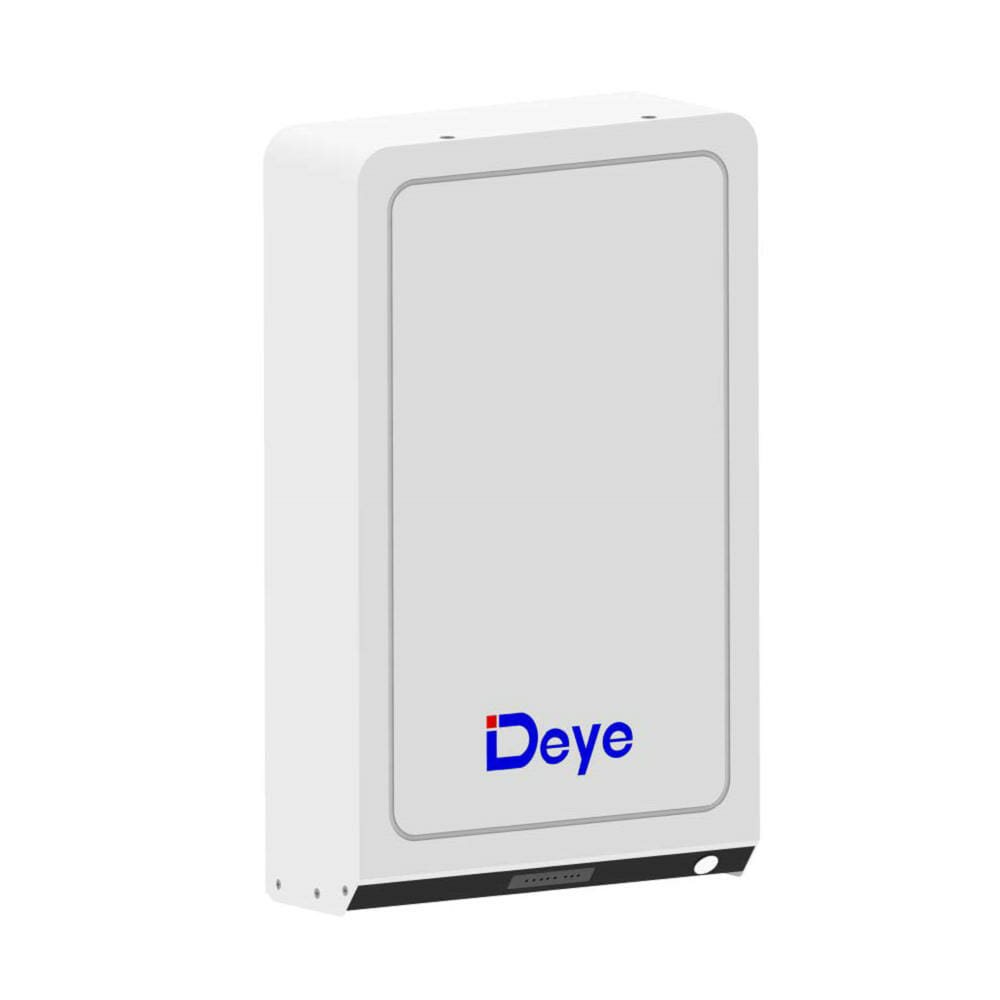
Description Deye RW-M5.3
What this battery is sized for
The RW-M5.3 is a 51.2 V wall-mounted battery with 5.32 kWh, designed to back up the essential circuits of a home rather than replace the grid entirely. Its typical job list: the fridge, lighting, a router and cameras, the circulation pump of a gas boiler, and a few sockets for everyday devices - everything that must stay alive during an outage even if the rest of the house waits for power. It works with Deye low-voltage hybrid inverters of the SG04LP1 and SG05LP3 series, where the battery bus is 48 V, and with most third-party inverters that speak Deye's CAN protocol. Where it does not fit: HP3 high-voltage three-phase inverters, which need a 160-800 V battery and a control unit (item 2099), 24 V systems, and houses where electric heating or an electric water heater is the main load - one module of this series is simply too small for that. If your goal reads "keep the fridge cold and the internet up", this is the right size class; if it reads "live exactly as if the grid were on", look at the larger models.
4.79 kWh usable: what it actually powers, and for how long
Out of the 5.32 kWh nameplate the manufacturer allows 4.79 kWh of daily use - 90 % depth of discharge - keeping the rest in reserve to preserve cell life. Translated into hours: an A-class fridge using about 0.8 kWh a day, 150 W of LED lighting, a router with cameras at 40 W and a boiler pump at 60 W add up to roughly 0.25-0.35 kW, which means a full fourteen to eighteen hours from one charge. Add an electric kettle, a microwave and a couple of workstations to that list and the reserve shrinks to six or eight hours, which is still a complete working shift. Heating water with a 2 kW element, however, consumes the entire usable reserve in two and a half hours, so that load does not belong on this battery. Do not forget the inverter's own draw either: 70-100 W at idle becomes 1.7-2.4 kWh over a day, which is exactly why the realistic planning figure is closer to 4.2-4.4 kWh.
34 A recommended, 80 A maximum: the real limit of this model
The datasheet gives a recommended charge and discharge current of 34 A for the RW-M5.3, a maximum of 80 A, and a 100 A peak that may be held for up to ten minutes at 25 °C. Converted to power, that is roughly 1.7 kW continuous, 4.1 kW at the ceiling and about 5.1 kW at peak - and those numbers, not the capacity, decide what the module can feed. The practical conclusion is very concrete: one RW-M5.3 will not sustain a 5 or 8 kW hybrid at full output no matter how many kilowatt-hours it holds, because the inverter simply limits itself to the battery's current. On the other hand, the ten-minute peak window here is unusually generous: most domestic modules offer a peak for 10 seconds or 2 minutes, while ten minutes comfortably covers not just a compressor start but a short run of a heavy appliance. If you need both energy and current, the standard answer is two modules in parallel, which immediately raises the limits to 68 A recommended and 160 A maximum.
4000 cycles at 90 % DoD: how many years, and how the bigger models differ
Cycle life for this model is specified as 4000 cycles at 90 % depth of discharge, which at one full cycle per day works out at about eleven years. For a battery with a backup role that is generous: modules like this rarely cycle fully every day - in an ordinary week without outages the battery may sit in buffer mode and spend only a fraction of a cycle. It helps to read the criterion correctly: 4000 cycles is not the moment of failure but the point where capacity has fallen to roughly 70 % of the original, so the 4.79 kWh usable gradually becomes about 3.4 kWh. Compared with the larger RW-M6.1 (item 2087), rated at 6000 cycles, the difference in service life is substantial, and it is that - rather than the extra 0.8 kWh - that makes the bigger model the better answer on a site with frequent outages. The same simple habits extend life here: do not park the battery at 100 % state of charge and do not take it to empty every day if your inverter lets you set the limits.
44 kg and 140 mm deep: the slimmest module in the family
At 380 × 620 × 140 mm this is the most compact of the wall-mounted RW units, which is a tangible advantage when the battery has to hang in a hallway, a boiler room or a technical recess. The 140 mm depth means the module does not obstruct a narrow passage, and 44 kg is the weight class two people handle comfortably without lifting gear. The product record lists wall mounting only, so there is no floor stand in the box: you need a flat load-bearing wall and anchors with margin, because tightening the cables adds dynamic load on top of the static weight. Size the DC side for the 80 A maximum: copper of 25-35 mm², a DC breaker or fuse rated accordingly, crimped lugs and a short run to the inverter. Leave at least 10-15 cm of clearance above and below the case for natural convection - this series is passively cooled, and boxing the module into an unventilated cabinet costs you both service life and available power.
Up to 32 modules in parallel: it is not only capacity that grows
The datasheet allows up to 32 modules in parallel, giving about 170 kWh - a ceiling that interests commercial sites far more than homes. For a house something else matters: every added module brings current as well as kilowatt-hours, so two RW-M5.3 units already provide about 3.4 kW of sustained power and three provide over 5 kW, and only such an assembly lets a 5-6 kW hybrid work at full output. That is why a system built on this model should be planned "for two batteries" from the start: allow the wall space, the cable run and the busbar terminals even if you buy a single module first. Modules in one assembly must be the same model and ideally the same production batch: mixing capacities and ages makes the current divide unevenly, because the weaker module ends up working harder all the time. Communication with the inverter runs over CAN, and block addressing within an assembly is set with switches on the enclosure - a procedure worth doing from the manual for your revision rather than from the installer's memory.
What the product record does not state, and how to allow for it
It is worth being direct: the RW-M5.3 record lists no enclosure protection class, no temperature limits and no certification list, while neighbouring models in the family do have them. Until your revision's datasheet confirms otherwise, plan the module as dry-room equipment: a plant room, a boiler room, a hallway, a dry cellar - no direct rain, condensation or dust. Temperature limits across the RW family are consistent in substance: charging from 0 °C, discharging from -20 °C - exactly the values listed for items 2087 and 2090 - so an unheated room in winter means the battery still supplies power but refuses to accept charge. If a cold location is unavoidable, either provide minimal heating or choose a module rated to charge from -10 °C, such as the SE-F5 Plus (item 1942). One last point: for project documentation or a grid-connection application, ask your supplier in advance for the declaration of conformity for the specific revision - the larger models in the family come with a fuller document package.
How it differs from the RW-M6.1 (item 2087) and the RW-L2.5 (item 2090)
The RW-M6.1 (item 2087) is the bigger sibling in the same family, and the gap between them runs deeper than 0.8 kWh of capacity. Item 2087 uses 120 Ah cells instead of 104 Ah, allows 100 A instead of 80 A, is rated for 6000 cycles instead of 4000, carries an IP65 enclosure where this one declares no protection class, comes with a full certification package including IEC 62619 and CE, and is warranted for 10 years or 20 MWh of throughput. The price is 55 kg against 44 kg and a larger case, which is why the RW-M5.3 remains the better pick where wall space is tight and the task is modest. The RW-L2.5 (item 2090) belongs to a different niche entirely: 2.56 kWh on a 25.6 V bus, a 24 V class module that cannot be connected to a 48 V inverter at all - it is bought for small off-grid setups, a cabin or a camper. In short: 2090 for 24 V systems, 2089 as the slim, light essential-backup module on 48 V, and 2087 as the same idea with headroom in current, cycle life and paperwork.
If the task is to keep the critical circuits of a home or office running through outages, the RW-M5.3 does it with one slim, light module on the wall. Tell us your inverter model and the list of loads that must stay alive, and we will say whether one module is enough or you should plan for two from the outset.
Characteristics Deye RW-M5.3
Reviews about Deye RW-M5.3 from real users
No reviews found







