
 m. Сміла, Незалежності, 67г. оф, 406/6























Deye RW-L2.5 (2.56 kWh) - 24 V class LiFePO4 battery

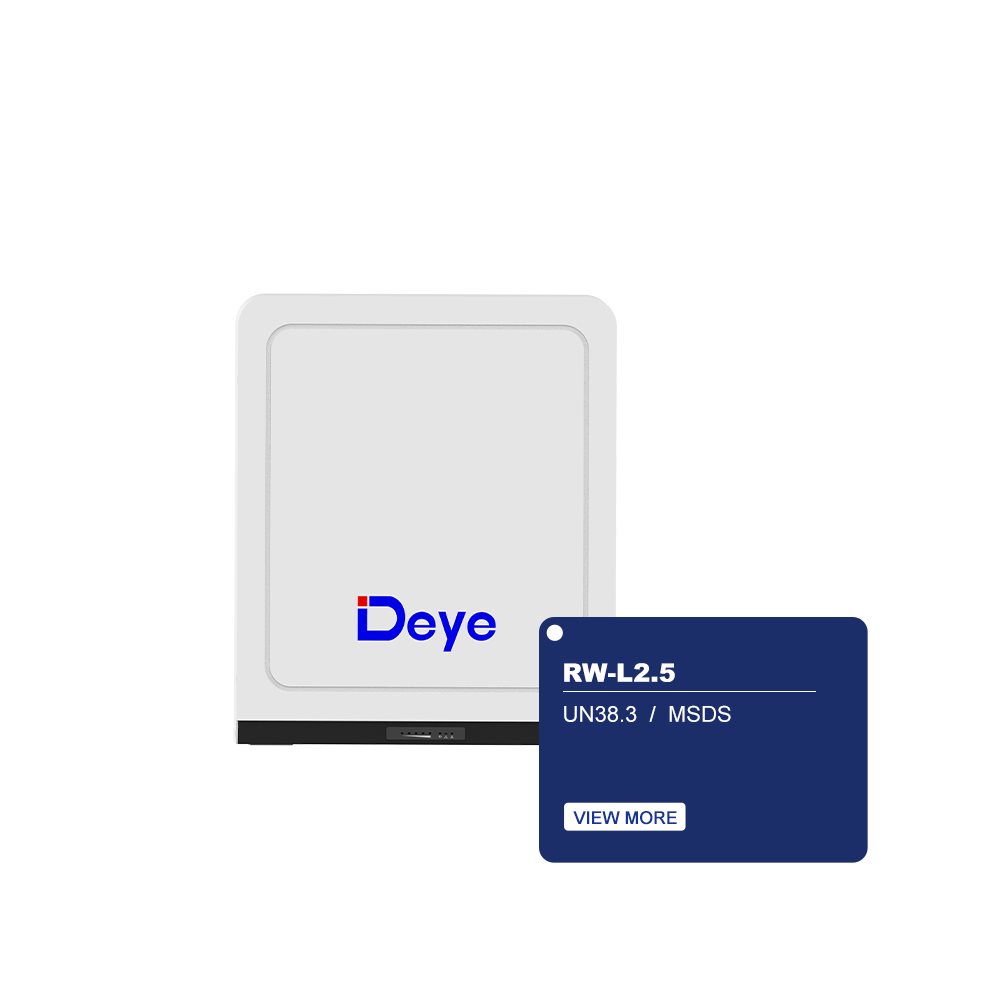
Description Deye RW-L2.5
What this battery is sized for
The RW-L2.5 is the smallest battery in the RW family and the only one built for a 25.6 V bus, which puts it in the 24 V class. Its niche is the small off-grid system where a 48 V inverter would be overkill: a holiday cottage with lighting, a fridge and a pump, a motorhome, a boat, a CCTV post or a communications node, emergency power for a boiler room. For sites like these, 24 V is a long-established standard, and plenty of affordable 1-3 kW inverters are still made for it. The crucial limitation has to be understood clearly: this module cannot be connected to a 48 V Deye hybrid (the SG04LP1, SG05LP3, LP3 or HP3 series) either on its own or as two units in series - the manufacturer forbids wiring lithium batteries with their own BMS in series, because the management then loses sight of the real cell state. If your inverter runs on 48 V you need a 51.2 V class module such as the RW-M5.3 (item 2089), not two RW-L2.5 units.
2.30 kWh usable: realistic scenarios
Out of the 2.56 kWh nameplate, 2.30 kWh is available for daily use - 90 % depth of discharge, the standard approach for LiFePO4. Translated into cottage or mobile loads it looks like this: a compressor fridge at 45 W, 60 W of LED lighting, phone charging and a laptop come to about 0.15 kW, which is roughly fifteen hours of continuous running - and with the fridge cycling and lights only on in the evening, a full day. For a CCTV post with four cameras, a recorder and a router, together 60-80 W, the same reserve gives more than a day of autonomy, which is a genuinely useful level of backup for a power failure. A 2 kW electric kettle, on the other hand, empties the module in about seventy minutes, and a water heater should not be put on this battery at all. The rule of thumb is simple: the RW-L2.5 powers anything that runs long and slow very well, and anything that heats very badly.
25.6 V with 34 / 80 / 100 A: where the modest power comes from
The recommended working current is 34 A, the maximum 80 A, and the 100 A peak may be held for up to ten minutes. At 25.6 V that is about 0.87 kW continuous, 2.05 kW at the ceiling and up to 2.56 kW at peak - figures that match a typical 24 V inverter of 2-2.4 kW almost exactly. The second consequence of a low bus voltage is often overlooked: for the same power the cable current is twice that of a 48 V system, so conductors are sized generously - from 25-35 mm² when working at the 80 A ceiling - and the run is kept as short as possible. This is precisely why 24 V systems are never built large: at 3 kW the current passes 120 A, and the copper and fuses start costing more than the saving on a cheap inverter. The ten-minute peak window, as elsewhere in the RW line, exists for the inrush of pumps and compressors, and for such loads it is the single most useful figure in the whole spec sheet.
4000 cycles at 0.2C and a warranty of five years or 4 MWh: let us do the arithmetic
Cycle life is stated as 4000 cycles at 90 % DoD with 0.2C charging and discharging, down to 70 % remaining capacity. A 0.2C rate is roughly 20 A, in other words gentle operation; if you run the module at its 80 A ceiling every day, the promised 4000 cycles will not materialise, and that is ordinary physics rather than a manufacturer's trick. A different number is far more practical, though: the warranty reads five years or 4 MWh of throughput, whichever comes first. Divide 4 MWh by the 2.3 kWh usable and you get about 1740 full cycles, which means that with one deep cycle a day the energy cap expires in under five years. The planning conclusion follows: if you need daily deep cycling, buy more capacity and cycle it less deeply; if this is a reserve that works a few times a month, the five-year term will run its full course and the module will serve considerably longer.
IP23, passive cooling and the temperature windows
An IP23 rating means protection against objects of 12.5 mm and above and against water falling at up to 60° from vertical: the module will survive rain blowing in under a canopy, but not a jet, not immersion, and not driving rain with no shelter at all. For a cottage or a camper that means mounting it in a cabinet, under a roof or inside the cabin - and in every case away from splashes. Cooling is passive, with no fan, so the case needs free space around it: discharging at 2 kW makes the module noticeably warm, and burying it in a tight unventilated recess reduces the power you can actually use. The temperature windows, as across the family, differ by mode: charging from 0 to +55 °C, discharging from -20 to +55 °C - so in a winter camper or an unheated cottage the battery will give energy out but will not take charge from the solar panel. Operating altitude is limited to 2000 m, which is worth checking in advance for mountain sites.
28 kg and 380 × 450 × 215 mm: an installation one person can do
This is the lightest module in the family: 28 kg in a compact 380 × 450 × 215 mm case, which genuinely can be mounted and wired single-handed, with no helper and no lifting gear. Wall mounting works on any load-bearing substrate with anchors rated for about four times the weight; in a camper or on a boat the module is additionally secured against movement, because dynamic loads in transit far exceed the static weight. The 215 mm depth is greater than on the 51.2 V wall modules, so check your cabinet dimensions in advance - this enclosure is closer to a cube than to a flat panel. Wire it by low-voltage rules: short power cables, crimped lugs, a DC fuse close to the battery terminals and, without exception, a switch or isolator so the module can be safely disconnected before service. The certification package in the record is lean - UN38.3 and an MSDS; that is exactly what transport requires, but for project documentation ask for the declaration covering your specific revision.
Up to 32 modules in parallel: 82 kWh, yet the inverter still sets the limit
Formally you can parallel up to 32 modules and reach 82 kWh, but in practice the limit comes from the 24 V architecture rather than from the battery. Inverters in the 24 V class are rarely built beyond 3-4 kW, so a large assembly at this voltage makes sense only as an energy store for small loads running for a long time - telemetry, communications, lighting an off-grid site. Four modules give about 10 kWh of usable energy and already over 3 kW of sustained power, and that is a sensible maximum for a domestic 24 V system; above it, moving to 48 V and 51.2 V modules is the better engineering. All blocks in an assembly must be the same model and preferably the same batch: with mixed ages the weaker module takes a smaller share of the current but degrades faster, and the assembly performs at the level of its worst block. Balancing, temperature monitoring and current limiting are handled by each module's own BMS, with state of charge reported to the inverter over CAN.
How it differs from the RW-M5.3 (item 2089) and the SE-F5-24-A (item 1939)
The key difference from the RW-M5.3 (item 2089) is not capacity but voltage: 25.6 V against 51.2 V, which makes the two fundamentally incompatible with each other's inverters in both directions. On energy, item 2089 offers 5.32 kWh against 2.56, twice as much, and nearly double the power - while the RW-L2.5 wins on mass, 28 kg against 44 kg, and on ease of installation. If you specifically need a 24 V system but with more reserve, the catalogue also holds the SE-F5-24-A (item 1939): the same 24 V class, but 200 Ah and 5.12 kWh, twice the energy in one module. Choosing between them comes down to a simple question: the RW-L2.5 is right when a day of small loads is enough and weight, size and easy mounting matter; item 1939 is right when a 24 V system needs full daily autonomy with headroom. And the overriding rule bears repeating: pick the module voltage to match the inverter, not the capacity, because a mistake there cannot be compensated for by anything.
If you run a 24 V system - a cottage, a camper, a boat or a communications node - the RW-L2.5 gives you a compact, light energy reserve you can install yourself. Send us your inverter model and your list of loads, and we will check whether one module covers your scenario.
Characteristics Deye RW-L2.5
Reviews about Deye RW-L2.5 from real users
No reviews found







