
 m. Сміла, Незалежності, 67г. оф, 406/6























Deye BOS-GM5.1 with 8 modules (40.96 kWh, 409.6 V) - high-voltage LiFePO4 rack battery

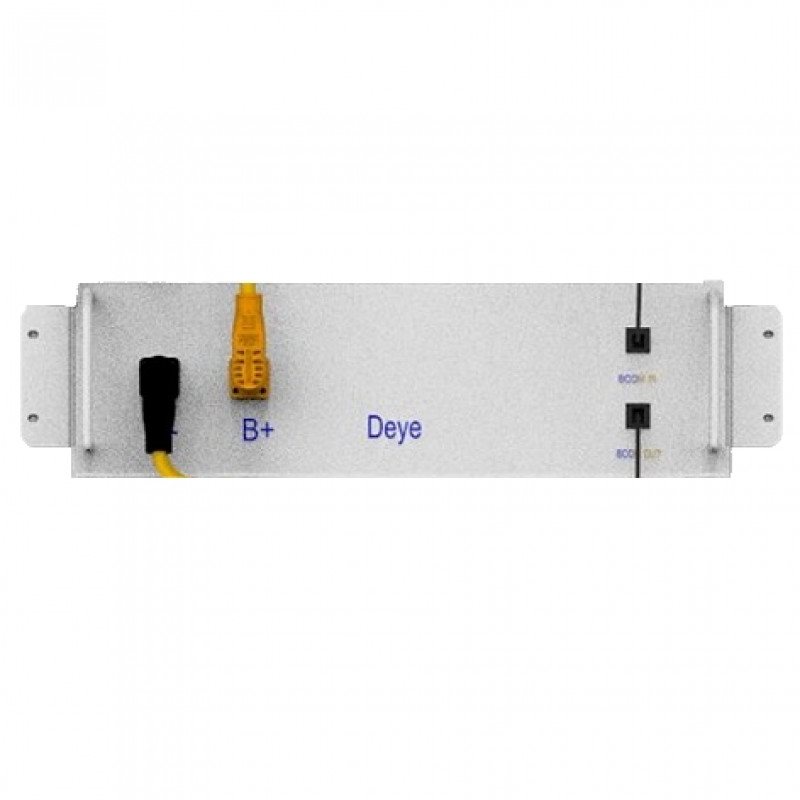
Description Deye BOS-GM5.1
What this battery is for
The BOS-GM5.1 in an eight-module set is a high-voltage LiFePO4 battery for rack mounting: a nominal energy of 40.96 kWh, a usable 36.86 kWh, a voltage of 409.6 V and a working window of 332.8-467.2 V. The battery is made up of modules of 100 Ah and 51.2 V, with a recommended charge and discharge current of 50 A, a maximum of 100 A and a discharge peak of 125 A for two minutes at 25 °C. The service life is at least 6,000 cycles at a 90 % depth of discharge down to 70 % residual capacity, the warranty 10 years, the certification CE, IEC62619, UL1973, UL9540A, UN38.3. The build: a 19-inch rack, rated IP20 and therefore indoors only, a humidity of 5-85 %, an altitude up to 2,000 m, charging from 0 to +55 °C, discharging from -20 to +55 °C and a set weight of 434 kg. Typical applications: a shop, a café or a bakery with a three-phase high-voltage inverter, a small production facility, an office building, a hotel or a guest house, a site with a 20-30 kW solar array and a need for daytime storage.
Why 409.6 V: high voltage instead of high current
Eight modules in a series string give a voltage above four hundred volts, and that is what determines the whole system's character. What the arithmetic is: eight modules of 51.2 V give 409.6 V nominal, and the full range runs from 332.8 to 467.2 V. What that gives at the same power: a current eight times lower than in a low-voltage system, so the cable sections and the demands on the contacts are far more modest. What it amounts to in kilowatts: at the recommended 50 A the battery delivers about 20 kW continuously, which is enough for a three-phase inverter of 20-25 kW. What it gives in efficiency: smaller losses on the ohmic resistance, that is more kilowatt-hours reach the consumer from the battery. What it requires: equipment with a high-voltage input and personnel with authorisation, because four hundred volts of direct current is a lethal voltage. What it means during installation: a mandatory isolator, earthing of the structure, hazard marking and an isolation procedure before any work.
A rack of eight batteries and 434 kilograms indoors
A set of this size needs a prepared place, and that is worth planning before delivery. What rack is needed: the 3U-LRACK (item 2101) takes exactly eight batteries and one control unit, that is it suits this set. What the weight is: 434 kg including the structure, which is unacceptable for an ordinary flat but normal for a plant room on the ground floor or in a basement. About the floor: the load is spread over the rack's footprint, but a concrete base or a strong slab is essential, and a timber floor calls for a structural check. How it is carried in: the modules are brought in separately at 45-50 kg each rather than as an assembled rack, so a passage and a lift or clear stairs are needed. What to provide around it: access from the front for servicing, clear space for ventilation and room for the inverter nearby so that the DC cables are short. About the room: an IP20 rating means no protection against water or dust, so only a dry, enclosed, ventilated room will do.
36.86 kWh of usable energy: scenarios for a business
A usable capacity of almost thirty-seven kilowatt-hours is already the level at which a site can work a whole shift without the grid. A shop or a café: refrigeration, lighting and the till together at 3-4 kW - the battery lasts nine to twelve hours, that is a full working day. A small production facility: at an 8 kW load that is over four hours, at 5 kW seven, which is enough to finish a process cycle. An office or a hotel: servers, the network, a lift on standby and corridor lighting are covered with a large margin. Tariff shifting: a full cycle daily gives about 1,100 kWh a month moved from the cheap zone into the expensive one. A 20-30 kW solar array: the daytime surplus is taken into the battery in full and spent in the evening and at night. What should not be planned: powering heavy equipment whose starting currents are at the limit - for such tasks it is the current limits, not the capacity, that are checked.
What a 90 % depth of discharge and a 10 % reserve mean
The difference between the nominal and the usable capacity in the card is not marketing but a protective reserve, and its purpose is worth understanding. What the difference is in figures: 40.96 kWh nominal against 36.86 kWh usable, that is about ten percent of the capacity stays inaccessible. Why that reserve is needed: a deep discharge to zero sharply shortens the cells' life, so the management system stops the discharge earlier. What a 90 % depth of discharge is: exactly the regime in which the manufacturer states a life of 6,000 cycles, that is the figure is calculated for real rather than ideal conditions. What happens with shallower cycles: if half the capacity is used each day, there will be considerably more cycles and the battery will last longer. What happens with a constant full discharge: the life falls, but the battery does not fail suddenly - the capacity declines gradually. What is practical about it: in sizing a system work from the usable 36.86 kWh rather than from the nominal figure.
Growing the system: from eight modules to twelve
A high-voltage battery scales, but the rules here are stricter than in low-voltage systems. How it grows within a rack: modules are added to the same string and the voltage rises proportionally - twelve modules already give 614.4 V. What must be checked first: the maximum battery voltage the inverter permits, because that is what limits the number of modules. What rack an expansion needs: a 3U-LRACK holds eight batteries, so twelve require a 3U-HRACK (item 2100). Why modules of different ages should not be mixed: old and new cells have different capacity and internal resistance, so the system works to the weakest module. How to expand properly: either add the modules at once, or build a second independent string with its own control unit. What to do if the need has grown a great deal: consider the industrial solutions of the MS series or containerised systems instead of extending a domestic rack.
Temperature requirements and the IP20 rating
This battery's operating conditions call for attention precisely because of the lower charging limit and the absence of enclosure protection. Why charging only from 0 °C: charging lithium iron phosphate cells below freezing is harmful to their life, so the system blocks charging in the cold. Why discharging is possible from -20 °C: delivering energy below zero is permitted, though the capacity temporarily falls. What that means for the room: it must be heated or at least frost-free, otherwise winter charging will be blocked. What IP20 means: protection against touch only, that is neither a drop of water nor construction dust is acceptable near the battery. What humidity is permitted: 5 to 85 % without condensation, so a basement with damp walls will not do. What to provide for heat removal: clear space around the rack and ventilation, because under a 20 kW load the battery gives off noticeable heat.
How it differs from the series' other batteries
The BOS-GM5.1 series is built from identical 5.12 kWh modules, and the listings differ only in their number. This listing is an eight-module set: 40.96 kWh nominal and 36.86 kWh usable, a voltage of 409.6 V, a window of 332.8-467.2 V, a weight of 434 kg and a 3U-LRACK rack. The twelve-module BOS-GM5.1 (item 2093) is 61.44 kWh and 55.29 kWh usable at 614.4 V, 628 kg and a 3U-HRACK rack. The three-module BOS-GM5.1 (item 2091) is 15.36 kWh and 13.8 kWh usable at 153.6 V, which suits only inverters with a low minimum battery voltage. What the set needs: the HVB750V/100A control unit (item 2099), the 3U-LRACK rack (item 2101) and cables, while the 3U-Bracket (item 2102) is for stacking without a rack. If a low-voltage system is needed: the RW-M6.1 (item 2087) and SE-G5.3 (item 2088) batteries for 48-51.2 V inverters.
The eight-module BOS-GM5.1 is a high-voltage 40.96 kWh battery with 36.86 kWh usable for a three-phase system. Send us your inverter's model and your daily consumption and we will check the voltage and calculate the set with its rack and control unit.
Characteristics Deye BOS-GM5.1
Reviews about Deye BOS-GM5.1 from real users
No reviews found







