
 m. Сміла, Незалежності, 67г. оф, 406/6























Deye BOS-GM5.1 with 3 modules (15.36 kWh, 153.6 V) - high-voltage LiFePO4 rack battery

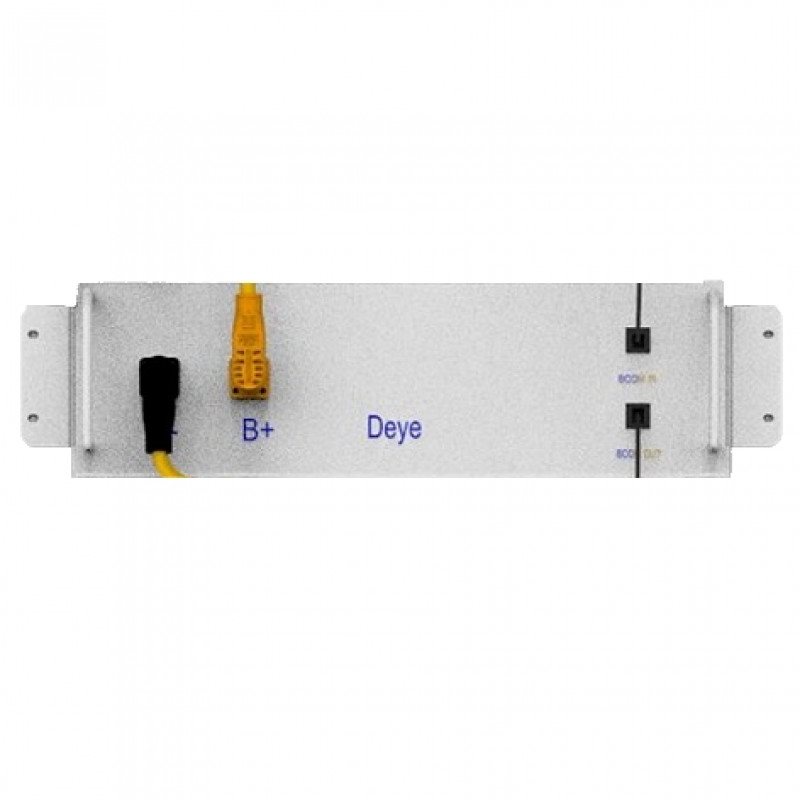
Description Deye BOS-GM5.1
What this battery is for
The BOS-GM5.1 in a three-module set is a high-voltage LiFePO4 battery for rack mounting: a nominal energy of 15.36 kWh, a usable 13.8 kWh, a voltage of 153.6 V and a working window of 124.8-175.2 V. The battery is built from modules of 100 Ah and 51.2 V, with a recommended charge and discharge current of 50 A, a maximum of 100 A and a discharge peak of 125 A for two minutes at 25 °C. The service life is at least 6,000 cycles at a 90 % depth of discharge down to 70 % residual capacity, the warranty 10 years, and the certification CE, IEC62619, UL1973, UL9540A and UN38.3. The build: mounting in a 19-inch rack, rated IP20 and therefore indoors only, a humidity of 5-85 %, an altitude up to 2,000 m, charging from 0 to +55 °C, discharging from -20 to +55 °C and a set weight of 258 kg. Typical applications: a private house with a high-voltage hybrid inverter, a small commercial site, a system with a solar array and daytime storage, an equipped plant room or boiler room.
A high-voltage battery: how it differs from a 48 V one
The division of batteries into low-voltage and high-voltage is the main thing to understand before choosing, because the two classes are not compatible with each other. What the voltage is in low-voltage systems: about 48-51.2 V, so one module works on its own with an inverter of the matching type. What the voltage is here: 153.6 V in a three-module set, because the modules are connected in series and form one high-voltage string. What the physics gives: at the same power the current is three times lower, so the losses in the cables and at the contacts are considerably smaller. What that gives in practice: thinner cables, less heating and a higher charge and discharge efficiency over the year. What the limitation is: the battery works only with inverters designed for a high-voltage input, and connecting it to an ordinary 48 V inverter is impossible. What it means for safety: a voltage above a hundred volts of direct current is dangerous, so the installation and servicing are done by qualified personnel following the isolation procedure.
What is needed besides the modules themselves
A high-voltage battery is a system of several parts, and an order has to allow for all of them rather than the modules alone. What the control unit does: the HVB750V/100A (item 2099) manages the high-voltage string, measures the voltage and current, monitors the modules' condition and communicates with the inverter. Why it cannot be done without: the modules do not manage the string themselves, and it is the control unit that connects and disconnects the battery and protects it from going outside its limits. What the rack does: the 3U-LRACK (item 2101) takes eight batteries and one control unit, while the 3U-HRACK (item 2100) takes twelve batteries and a control unit. What the bracket does: the 3U-Bracket (item 2102) is a set of four parts for stacking up to four modules without a full rack. What to check when ordering: what a particular delivery contains, because the 258 kg in the card corresponds to a set with its structure rather than to three modules alone. What we do about it: before despatch we confirm the full list with the supplier - the modules, the control unit, the rack, the cables and the documentation.
A voltage of 153.6 V and a window of 124.8-175.2 V
For a battery of three modules the voltage parameters are the main question of compatibility, and it is settled before purchase. What the nominal voltage is: 153.6 V, that is three modules of 51.2 V in a series string. What the working range's limits are: from 124.8 V deeply discharged to 175.2 V fully charged, and the inverter must work within exactly that window. Why that is critical: many high-voltage inverters have a minimum battery voltage above 150 V, and with three modules they either do not start or do not work at full power. What to do before ordering: find the inverter's minimum and maximum battery voltage in its documentation and compare them with this window. How it looks in the typical case: for many models the minimum set is four or five modules, and three modules suit only some inverters. What we advise: send us the inverter's model and we will check the ranges against the manufacturer's documentation before the order is placed.
13.8 kWh of usable energy: scenarios for a house
This set's usable capacity is 13.8 kWh, and that is enough for most domestic tasks. A house's night consumption: a refrigerator, lighting, a router, a boiler and a pump together draw about 300-500 W, so the battery covers the whole night with a large margin. Backup during a grid failure: in an economical regime of 1 kW that is almost fourteen hours, at a moderate 2 kW about seven. Shifting the day's sun: 13.8 kWh covers the evening and night maximum for a house with an 8-10 kW array. Tariff shifting: charging in the night zone and discharging in the day zone gives about 400 kWh a month given one full cycle daily. What should not be expected: powering an electric boiler, a 3 kW water heater and a hob at once through a whole evening - that regime needs more capacity. What to calculate before choosing: the night and evening consumption over a day, because it is that, not the total usage, which sets the capacity needed.
Currents of 50 and 100 A and a 125 A peak: what they mean in kW
The currents in a battery's specifications translate into power by multiplying by the voltage, and that is worth doing in advance. What the recommended current is: 50 A, which at 153.6 V gives about 7.7 kW of continuous charge or discharge power. What the maximum current is: 100 A, that is about 15.4 kW, and that regime is permitted but shortens the service life under constant use. What the 125 A peak means: about 19 kW for two minutes at 25 °C, and that margin is enough to start a pump, an air conditioner's compressor or a borehole pump. Why the recommended current is below the maximum: charging and discharging at half the current heats the cells less and noticeably extends the service life. How to combine that with the inverter: the inverter's power is chosen so that in normal operation the battery works nearer the recommended current. What it means for the choice: a three-module battery works well with inverters of 6-8 kW, while for 10-12 kW more modules are better.
6,000 cycles, a 10-year warranty and the certificates
The durability figures and the list of certificates say more about a battery than any advertising formula. What 6,000 cycles means: after six thousand full cycles at a 90 % depth of discharge the battery retains at least 70 % of its initial capacity. How many years that is: at one full cycle a day it is over sixteen years, so the cells' life exceeds the warranty period. What a 10-year warranty means: the manufacturer takes on an obligation for a decade, which is typical for LiFePO4 chemistry and is borne out in practice. What the UL9540A certificate means: testing for thermal runaway, that is checking the battery's behaviour under emergency heating - the most important test for a room's safety. What IEC62619 and UL1973 mean: conformity with the standards for industrial and stationary storage systems. What UN38.3 means: approval for transport, without which a battery cannot lawfully be carried.
How it differs from the series' other batteries
The BOS-GM5.1 series is built from identical 5.12 kWh modules, so the difference between the listings is only in their number. This listing is a three-module set: 15.36 kWh nominal and 13.8 kWh usable, a voltage of 153.6 V, a window of 124.8-175.2 V and a weight of 258 kg. The eight-module BOS-GM5.1 (item 2092) is 40.96 kWh nominal and 36.86 kWh usable at 409.6 V and 434 kg. The twelve-module BOS-GM5.1 (item 2093) is 61.44 kWh and 55.29 kWh usable at 614.4 V and 628 kg. What any of the sets needs: the HVB750V/100A control unit (item 2099), a 3U-LRACK (item 2101) or 3U-HRACK (item 2100) rack, and for stacking without a rack the 3U-Bracket (item 2102). If a low-voltage battery is needed: the RW-M6.1 (item 2087) at 6.14 kWh or the SE-G5.3 (item 2088) at 5.32 kWh for 48-51.2 V systems.
The three-module BOS-GM5.1 is a high-voltage 15.36 kWh battery with 13.8 kWh usable and over 6,000 cycles. Send us your inverter's model and we will check the voltage range and calculate the set with its control unit and rack.
Characteristics Deye BOS-GM5.1
Reviews about Deye BOS-GM5.1 from real users
No reviews found







