
 m. Сміла, Незалежності, 67г. оф, 406/6























Deye BOS-GM5.1 with 12 modules (61.44 kWh, 614.4 V) - high-voltage LiFePO4 rack battery

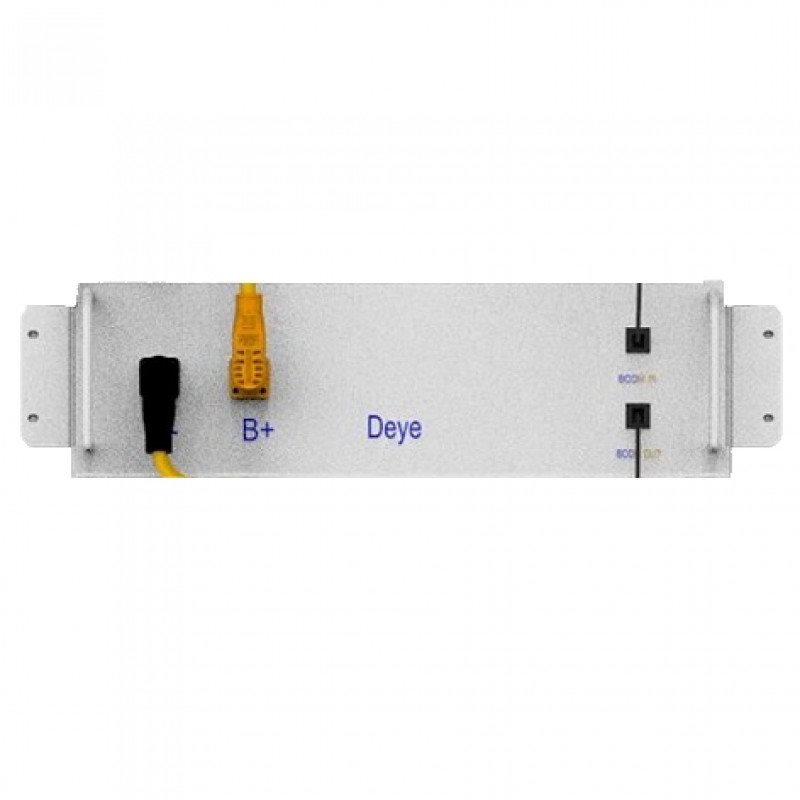
Description Deye BOS-GM5.1
What this battery is for
The BOS-GM5.1 in a twelve-module set is this series' largest high-voltage battery: a nominal energy of 61.44 kWh, a usable 55.29 kWh, a voltage of 614.4 V and a working window of 499.2-700 V. The battery is made up of modules of 100 Ah and 51.2 V, with a recommended charge and discharge current of 50 A, a maximum of 100 A and a discharge peak of 125 A for two minutes at 25 °C. The service life is at least 6,000 cycles at a 90 % depth of discharge down to 70 % residual capacity, the warranty 10 years, the certification CE, IEC62619, UL1973, UL9540A, UN38.3. The build: a 19-inch rack, rated IP20 and therefore indoors only, a humidity of 5-85 %, an altitude up to 2,000 m, charging from 0 to +55 °C, discharging from -20 to +55 °C and a set weight of 628 kg. Typical applications: production with a three-phase system of 30-50 kW, a shopping centre or supermarket, a hotel, a farm with refrigeration and pumps, a site with a 30-50 kW solar array, a critical process that must not be stopped.
A voltage of 614.4 V: the class and the safety rules
Twelve modules in a series string give a voltage at which safety stops being a formality, and that is the main thing to know about this set. What the system's voltage is: 614.4 V nominal and up to 700 V fully charged, that is high-voltage direct current. Why direct current is dangerous: it has no zero crossing, so an arc on breaking does not extinguish itself and burns as long as the voltage is there. Who is entitled to work on it: only personnel with the appropriate authorisation, in protective equipment and with a drawing marking the points of isolation. What the system must have: a DC isolator, fuses, earthing of the rack's structure and hazard marking on the room's door. What must never be done: breaking power connections under load, working without isolating the control unit, and allowing unqualified people near the equipment. Why we say this so plainly: most incidents with high-voltage batteries result from a breach of procedure rather than from an equipment failure.
The 3U-HRACK rack and 628 kilograms indoors
A twelve-module set is already a substantial structure, and the room for it is prepared in advance. What rack is needed: the 3U-HRACK (item 2100) holds twelve batteries and one control unit, that is exactly this set. What the weight is: 628 kg assembled, so the question of the floor slab is settled before ordering rather than after delivery. How it is delivered and carried in: the modules of 45-50 kg are brought in separately, and that needs a passage at least a metre wide and a strong floor along the whole route. About the rack's height: a structure for twelve modules is tall, so the room must have enough height with a margin for servicing the upper positions. What is provided alongside: room for the inverter so that the DC cables are short, and clear access from the front for diagnostics. About the conditions: a dry, enclosed, ventilated room with no construction dust, because an IP20 rating allows neither moisture nor dirt.
55.29 kWh of usable energy: scenarios for production
A usable capacity above fifty-five kilowatt-hours covers tasks for which a generator used to be installed. Production with a 10 kW load: over five hours of full autonomy, so a shift continues even during a long grid failure. A supermarket: refrigerated cabinets and cold rooms at 15 kW last almost four hours and the stock is not spoiled. A hotel: lighting, lifts, pumps and the boiler room at 8 kW - about seven hours without the grid. A farm: milking equipment, poultry-house ventilation and the milk chiller - critical processes where an interruption is unacceptable. Tariff shifting: a full cycle daily gives about 1,650 kWh a month from the cheap zone into the expensive one. A 30-50 kW solar array: the daytime surplus is taken into the battery in full and spent at the evening maximum, when the tariff is highest.
How to go beyond 61 kWh
When twelve modules are not enough, the system is extended other than within the same string, and it is important to understand that correctly. Why modules cannot simply be added: the voltage rises proportionally, and the maximum for equipment of this class is about 700-750 V, so the string is already near its limit. How it is done properly: a second independent string is built with its own HVB750V/100A control unit and its own rack. What the inverter must support: several battery inputs or the parallel operation of several control units, and that is checked in its documentation before ordering. What such an arrangement gives: a doubling of capacity to over 110 kWh usable, with a fault in one string not taking the other out of service. When it is better to move to another class of equipment: if more than 120-150 kWh is needed, the industrial cabinets of the MS and MC series are cheaper per kilowatt-hour and simpler to service. What to calculate before deciding: the daily consumption and the autonomy required, because that is what sets the limit of sensible extension.
6,000 cycles: what actually wears a battery out
The life in cycles is a rated figure for particular conditions, while the actual service life depends on how the battery is used. What the figure itself means: six thousand cycles at a 90 % depth of discharge down to 70 % residual capacity, that is over sixteen years at one cycle a day. What wears the cells most: high temperature, so a battery in a cool room lives longer than one in a hot boiler room. What also shortens the life: constant operation at the maximum 100 A instead of the recommended 50 A. What harms imperceptibly: standing at full charge for long periods without discharge, so it is better to set the system to cycle than to hold the battery at a hundred percent. What has practically no effect: the number of partial cycles, because small charges and discharges wear the cells far less than deep ones. What to do about it: keep the room cool, do not plan constant operation at the limiting current, and set a sensible upper charge level in the inverter.
Fire safety in a room with a high-voltage battery
A battery of sixty kilowatt-hours is a serious store of energy, and the room for it is equipped with that in mind. What the UL9540A certificate gives: confirmation of thermal runaway testing, that is the manufacturer has checked the battery's behaviour under emergency heating. Why LiFePO4 is safer than other lithium chemistries: this chemistry is considerably more resistant to overheating and not prone to the violent burning characteristic of other cell types. What the room still needs: a fire detector, an extinguisher of the appropriate class, no combustible materials nearby and a clear exit. About ventilation: natural or mechanical, so that heat is removed rather than accumulating in a closed volume. What to do organisationally: mark the room, put the isolation drawing in a visible place and tell the maintenance staff the procedure. What should not be done: placing the battery in a living room, in a corridor on an escape route or hard against gas equipment.
How it differs from the series' other batteries
The BOS-GM5.1 series is made up from identical 5.12 kWh modules, and the listings differ only in the number of modules. This listing is a twelve-module set: 61.44 kWh nominal and 55.29 kWh usable, a voltage of 614.4 V, a window of 499.2-700 V, a weight of 628 kg and a 3U-HRACK rack. The eight-module BOS-GM5.1 (item 2092) is 40.96 kWh and 36.86 kWh usable at 409.6 V, 434 kg and a 3U-LRACK rack. The three-module BOS-GM5.1 (item 2091) is 15.36 kWh and 13.8 kWh usable at 153.6 V for small systems. What the set needs: the HVB750V/100A control unit (item 2099), the 3U-HRACK rack (item 2100), cables, and for stacking without a rack the 3U-Bracket (item 2102). If more is needed: the industrial MS-G215 cabinets (item 2037) at 215 kWh or the containerised MC-L430-2H2 (item 2030). If the system is low-voltage: the RW-M6.1 (item 2087) and SE-G5.3 (item 2088) batteries.
The twelve-module BOS-GM5.1 is a high-voltage 61.44 kWh battery with 55.29 kWh usable. Send us your inverter's model and load profile and we will check the voltage window and calculate the set with its 3U-HRACK rack and control unit.
Characteristics Deye BOS-GM5.1
Reviews about Deye BOS-GM5.1 from real users
No reviews found







