
 m. Сміла, Незалежності, 67г. оф, 406/6























Deye SUN-50K-G03 (50 kW) - three-phase grid-tie inverter

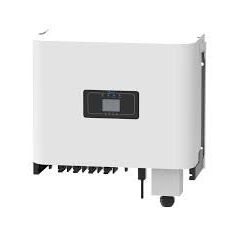
Description Deye SUN-50K-G03
Fifty kilowatts in a housing built for thirty
The SUN-50K-G03 delivers 50 kW into a three-phase grid while staying in the same 647.5 × 537 × 303.5 mm housing at 44.5 kg as the SUN-30K-G04 (item 2051). For the installation crew this means the same wall, the same four anchors and the same space in the switchroom for nearly twice the output. Inside are four independent MPPT trackers with three strings each, giving twelve rows of panels and an array of up to 65 kW. It is this power density that makes the model the most popular choice for 40–60 kW sites: alternatives of comparable output already weigh sixty kilograms and more. The inverter is grid-tie and has no battery: the moment grid voltage disappears, generation stops completely, so sites with critical loads need a separate backup solution.
Twelve strings: when they are genuinely needed
Four trackers of three strings each give twelve independent groups, and every tracker searches for its own maximum power point separately from the others. In practice that allows four different panel orientations on one site: south, east, west and, say, a carport canopy at a different angle. If you have a single flat warehouse roof, however, twelve strings simply become twelve pairs of connectors to route, label and test — extra work with no return. The sober rule is this: have as many trackers as you genuinely have different planes, and parallel the remaining strings within one group. The 40 A rating per tracker at a 60 A short-circuit current allows three strings of modern modules carrying 13–14 A each with no risk of clipping.
A 312-volt full-power threshold and the length of rows
Four trackers of 40 A give 160 A of DC together, so delivering 50 kW requires an array voltage of only about 312 V. That is a very low threshold: a row of nine or ten modules already reaches the rating on a clear day, and there is no need to stretch long strings across the whole roof. The MPP range is declared as 200 to 850 V with a start voltage of 250 V, so the inverter wakes at dawn and runs until dusk. The upper limit matters more than the lower one: the maximum input of 1000 V is reached by roughly twenty modules in a row on a frosty clear morning, and it must not be exceeded even for a second. Size the string by open-circuit voltage at minus twenty degrees rather than the datasheet figure at twenty-five — this is the one design error that destroys an inverter instantly and without warranty cover.
Seventy-six amps per phase: the site infrastructure
Rated output current is 75.8 A per phase at 380 V and 72.4 A at 400 V, with a maximum of 83.3 A, so the line is built around a three-phase 100 A breaker and 35 mm² copper cable. This is a full power feeder: it runs in a tray or conduit, is calculated for voltage drop and must be fitted with an AC surge protection device. Fifty kilowatts of generation in Ukraine can only be registered to a company or a sole trader, since households are capped at 30 kW and no contract of this size can be signed with one. Before ordering, check the permitted capacity and the operating mode in your connection agreement — many commercial consumers are limited to self-consumption with no export at all. Certification to VDE4105, IEC61727/62116, AS4777.2 and CEI 0-21 covers the requirements for generating equipment, so approval questions come down to connection capacity.
A 65 kW array and the logic of oversizing on a commercial site
A maximum module power of 65 kW against the inverter's 50 kW gives a ratio of 1.3, the standard margin for our latitude. In a factory or warehouse that margin works not only on the annual total but on the shape of the daily curve: morning and evening generation rises, and those are precisely the hours that coincide with work shifts. In summer the inverter will clip the peak to 50 kW for a few hours a day, but that loss amounts to single-digit percentages of annual yield and is fully repaid by the winter gain. For zero-export operation oversizing is effectively mandatory: without it the system will not cover its own consumption in the overcast months, and the surplus could not be exported anyway. Going beyond 65 kW is unwise — it takes the unit outside warranty conditions and overloads the input circuits on the coldest clear days, when array voltage and current are both at maximum.
Cooling, noise and the choice of room
Typical noise is below 50 dB, which for a fifty-kilowatt device is remarkably restrained: the temperature-driven fans spend most of the year at low speed. IP65 protection and tolerance of humidity up to 100 % without condensation permit installation outdoors, but under a canopy and out of direct midday sun. The operating range runs from minus twenty-five to plus sixty-five degrees, though above forty-five the unit begins reducing power smoothly to protect its own life. This is why the mounting position decides more than it appears: an inverter on a south wall under a metal roof will lose a few percent of generation every summer day. The maximum operating altitude without derating is two thousand metres, which covers any location in lowland Ukraine with an enormous margin.
Monitoring and maintaining a 50 kW plant
The 240 × 160 graphic display shows instantaneous power and daily yield, while the full picture across twelve strings is visible in the cloud over Wi-Fi, LAN, RS485 or RS232. On a site this size monitoring is not a convenience but an economic instrument: losing one string out of twelve is about eight percent of generation, which you would simply not notice without the graphs. Set alerts on deviation between strings within the same group, because that difference is the fastest way to detect soiling, shading or an oxidised connector. Maintenance comes down to an annual check of terminal torque, blowing dust out of the heatsink and visually inspecting MC4 connectors for signs of overheating. The integrated DC isolator allows the unit to be safely de-energised on the panel side without unplugging connectors, which greatly simplifies any work.
How it differs from its neighbours in this catalogue
The SUN-35K-G04 (item 2065) in the identical housing has three trackers and 35 kW — the weight difference is zero, so the choice between them rests purely on connection capacity and roof area. The SUN-60K-G (item 2066) adds 10 kW but moves to a 700 × 575 mm housing at 60 kg, which already calls for a lift and a wider wall. The SUN-80K-G (item 2069) and SUN-100K-G03 (item 2076) are industrial plant territory with a dedicated switchroom and a design by a licensed engineering firm. The smaller SUN-30K-G04 (item 2051) only makes sense when the connection is capped at thirty kilowatts, because in every other respect it loses to the fifty at the same dimensions. None of these models works without the grid: autonomy requires the three-phase LP3, SM2 or HP3 hybrids, while the G series remains a purely economic instrument.
Send us your roof plan, a daily consumption profile and your connection agreement, and we will calculate whether fifty kilowatts is the right size and how much of it you can realistically use on site.
Characteristics Deye SUN-50K-G03
Reviews about Deye SUN-50K-G03 from real users
No reviews found







