
 m. Сміла, Незалежності, 67г. оф, 406/6























Deye SUN-25K-G05 (25 kW) - three-phase grid-tie inverter

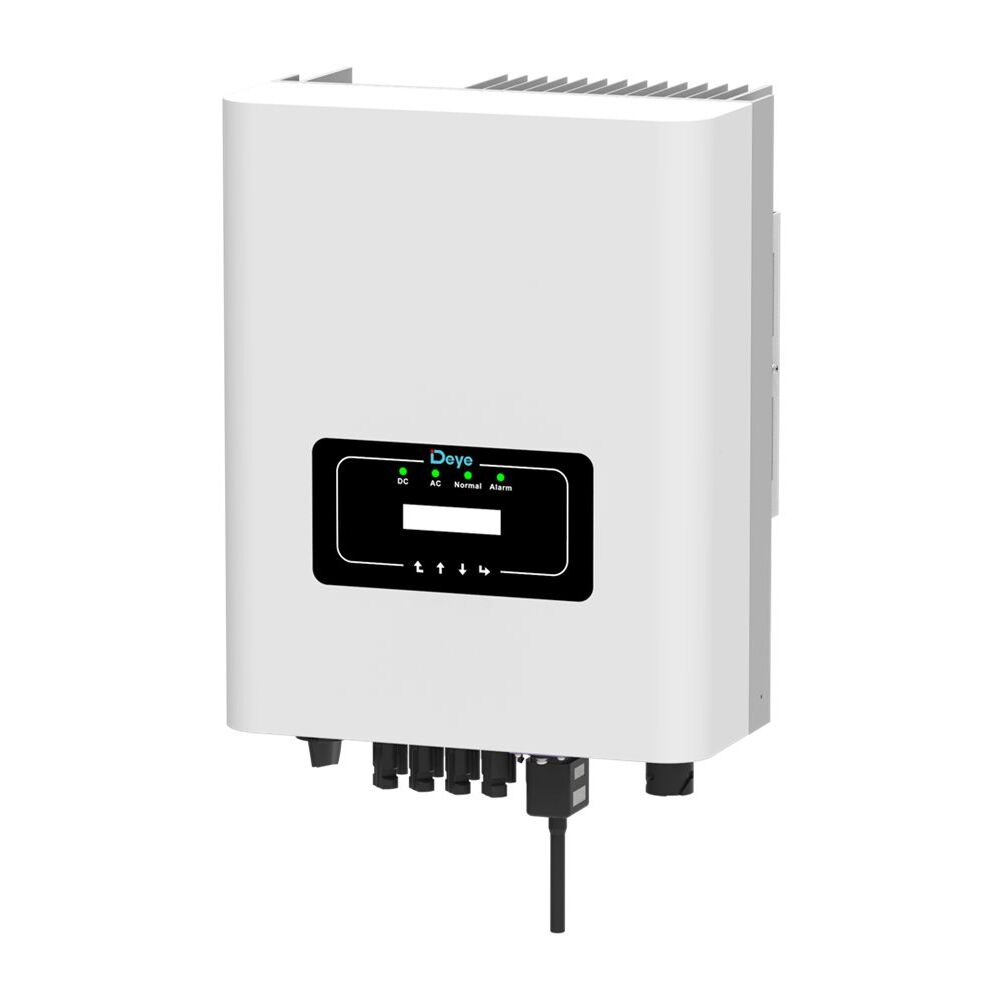
Description Deye SUN-25K-G05
Twenty-five kilowatts in a twenty-kilogram box
The SUN-25K-G05 feeds 25 kW into a three-phase grid, weighs 20 kg and occupies a 362 × 527 mm rectangle on the wall with a depth of 220 mm. For comparison, the larger SUN-30K-G04 (item 2051) adds only 5 kW of output yet weighs 44.5 kg in a housing 647.5 mm wide, which changes the whole installation job. Twenty kilograms can be lifted and bolted up by two people without a hoist, and the mounting plate takes four anchors in ordinary brick or concrete. That weight is possible precisely because the unit has no battery channel, no transformer and no backup transfer relay — only an MPPT stage and a grid inverter. The price of this lightness is unavoidable: when the grid disappears, the inverter shuts down within seconds and the building goes dark even at noon.
Four strings for 25 kW: which modules fit here
The unit has two independent MPPT trackers with two strings each, and it accepts 26 A of operating current per tracker at a short-circuit rating of 39 A. The maximum array is 32.5 kW, which averages 8.1 kW per string — roughly fourteen modern 580–600 W modules in a row. With noticeably fewer panels per string the voltage drops below the useful working range and full power never appears, so short rows of eight to ten modules are a poor fit for this model. The 26 A rating allows two strings of modern high-current modules, whose operating current reaches 13–14 A, to be paralleled without clipping. If the roof is broken into five or six separate planes, however, four strings will not be enough and the SUN-20K-G04 (item 2046) with six strings, or a larger model with three to four trackers, is the better layout.
481 volts: the level below which full power is impossible
The datasheet quotes a wide MPP range of 200 to 850 V, which creates the false impression that the inverter will deliver its rating anywhere inside that interval. The real arithmetic is simple: two trackers of 26 A give 52 A together, so reaching 25 kW requires an array voltage of at least about 480 V. Below that threshold the inverter is limited by current rather than by power — at 350 V the most it can take is roughly 18 kW instead of 25. On a July afternoon the array voltage also sags another 10–15 % below nameplate because the panels are hot, so strings must be sized with headroom rather than at the minimum. The practical conclusion is to aim for 550–650 V of working voltage in warm weather, which keeps the inverter in its most efficient zone throughout the day.
Four thousand metres with no derating
The declared maximum operating altitude is 4000 m without power reduction, the highest figure among all grid-tie Deye units in this catalogue, where the rest are limited to two thousand. Thin air at altitude removes heat from the heatsink less effectively and insulates high-voltage gaps less reliably, which is why most inverters must cut output above 2000 m. For sites in Ukraine this means that even the highest Carpathian locations — mountain pastures, telecom towers, hillside estates — sit comfortably inside the working range with a wide margin. The real benefit of that margin, though, shows up at sea level rather than in the mountains: a unit designed for thin air runs its thermal circuit underloaded at normal altitude. In practice this means cooler power switches during heatwaves and slower ageing of the electrolytic capacitors, which translates into a longer real service life.
Forty decibels: where such an inverter can hang
Typical noise is declared at no more than 40 dB, while the larger SUN-30K-G04 and SUN-60K-G (item 2066) reach 50 dB, which on the logarithmic scale sounds roughly three times louder. Forty decibels is about the level of a quiet conversation in the next room or a running refrigerator, so the unit can live in a utility room, a garage or a porch next to living space. This is achieved by smart cooling: the fans start on temperature rather than spinning constantly, so on autumn mornings the device is mostly silent. The housing is rated IP65 and tolerates humidity up to 100 % without condensation, so outdoor mounting is allowed, though direct midday sun on the case is best avoided. A shaded north wall or a canopy is the ideal spot, because an inverter that does not overheat never starts shedding power during the most valuable generation hours.
Thirty-eight amps per phase: connection and paperwork
Rated output current is 37.9 A per phase at 380 V and 36.2 A at 400 V, with a maximum of 41.7 A, so the standard line solution is a three-phase 50 A breaker and copper cable of 10 mm². The AC side uses an IP65 connector and the DC side MC4 plugs, which removes the need for a separate sealed junction box beneath the inverter. For the domestic segment in Ukraine 25 kW is usually too much: the ceiling for private households is 30 kW, but the practical limit is the connected capacity written into your grid contract. It is worth checking that contract before buying — if the metered connection is 15 kW, no feed-in tariff or net billing for 25 kW will be registered until the connected capacity is increased. The unit carries VDE4105, IEC61727/62116 and CEI 0-21 certification and meets Ukrainian requirements for generating equipment, so the utility raises no questions about the hardware itself.
98.6 % efficiency and the honest arithmetic of losses
Peak efficiency is 98.6 % and the European weighted figure is 97.8 %, and it is the second number that shows what a real year with its mornings, clouds and partial loads will actually cost you. For a 32.5 kW array producing around 33 MWh a year in central Ukraine, the gap between 97.8 % and 95 % is roughly 900 kWh — a month of consumption for a small house. MPPT efficiency exceeds 99 %, meaning the maximum power point algorithm gives away almost nothing against the theoretical optimum even under broken cloud. Night-time consumption below 1 W adds up to about 9 kWh a year in the dark, a quantity small enough to ignore entirely. Harmonic distortion under 3 % indicates a clean sine wave at the output: such generation does not disturb sensitive equipment and raises no objections during a power quality inspection.
How it differs from its neighbours in this catalogue
The SUN-20K-G04 (item 2046) offers 5 kW less but six strings instead of four and a weight of 23 kg, which makes it the choice when panels are scattered across many roof planes. The SUN-30K-G04 (item 2051) delivers 30 kW and takes an array of up to 39 kW, yet weighs 44.5 kg, reaches 50 dB and is limited to two thousand metres of altitude. The SUN-35K-G04 (item 2065), with three trackers of 40 A, is already small-business territory where installation calls for a crew and a lift. If you need light during outages rather than savings alone, the entire G series should be ruled out in favour of three-phase hybrids such as the SUN-20K-SG05LP3-EU-SM2 or the HP3 models with a high-voltage battery. Storage can only be bolted onto an installed SUN-25K-G05 through AC coupling, meaning a separate hybrid inverter added in parallel — a workable scheme, but more expensive and more complex than a hybrid system designed that way from the start.
Send us your panel layout by roof plane together with a copy of your grid connection contract, and we will check whether your strings fit the four inputs of this model and whether 25 kW is permitted for your site.
Characteristics Deye SUN-25K-G05
Reviews about Deye SUN-25K-G05 from real users
No reviews found







