
 m. Сміла, Незалежності, 67г. оф, 406/6























Deye SUN-15K-G03 (15 kW) - three-phase grid-tie inverter

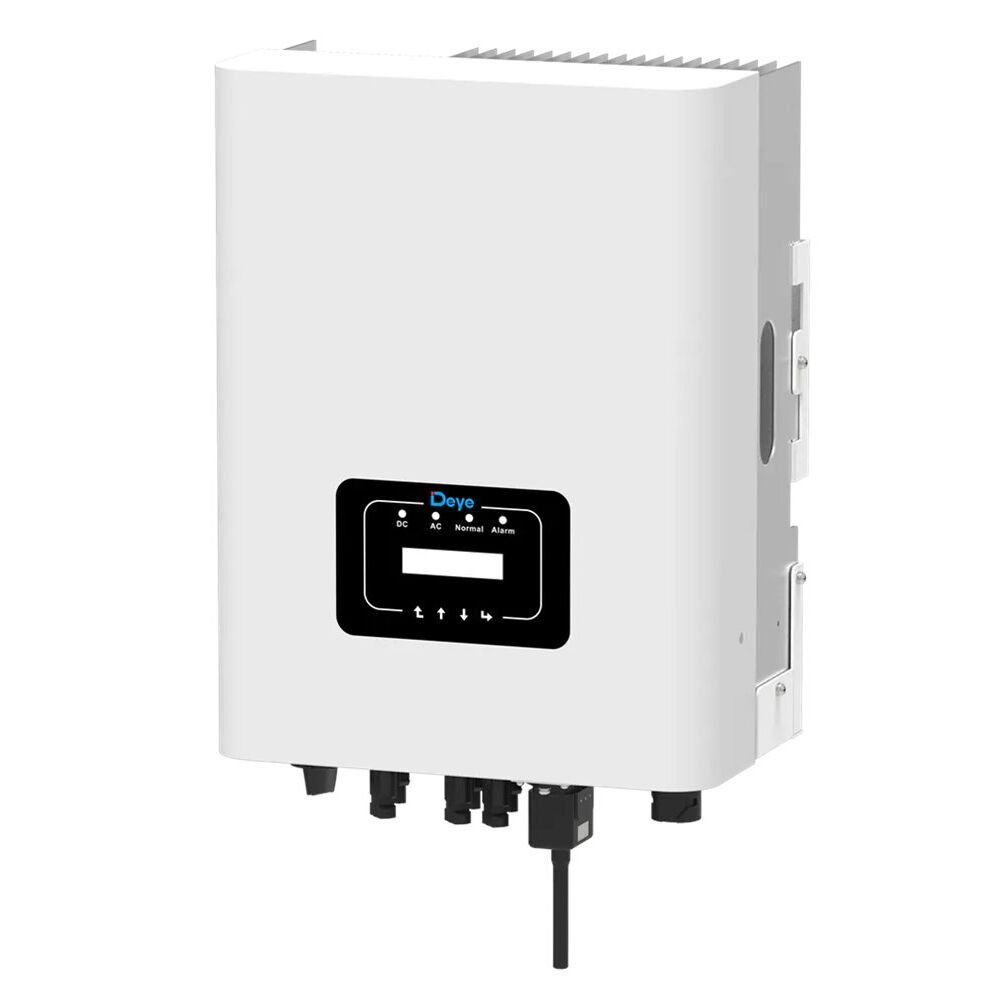
Description Deye SUN-15K-G03
Fifteen three-phase kilowatts without a battery: who it is for
The SUN-15K-G03 is the smallest three-phase grid-tie inverter in this catalogue, and it is bought with one purpose: cutting the electricity bill at a site that consumes during daylight. Typical buyers: a shop with refrigerated cabinets, a small workshop, an office building, a car wash, a bakery, a greenhouse operation, a farmyard with pumps. An array of up to 19.5 kW yields roughly 20 to 22 MWh a year at these latitudes, and if two thirds of that energy is consumed on site the saving is noticeable from the first month. The essential point to grasp before buying: this is a grid-tie inverter, it supports no battery and shuts down together with the grid during an outage — it cannot keep the site running in a blackout by design. If both are needed, look at the hybrids: the SUN-15K-SG05LP3-EU-SM2 (item 2060) with a 48 V battery or the SUN-15K-SG01HP3-EU-AM2 (item 2058) with a high-voltage one.
Fifteen kilograms for fifteen kilowatts
The 333 by 472 by 203 mm housing weighs 15 kg — an inverter two people hang on a wall in half an hour, with no lifting gear and no separate frame to prepare. For comparison, a hybrid of the same rating weighs 30 to 52 kg, because it carries a battery channel, chokes and a larger heatsink. Low weight directly affects the final installation price, particularly when the inverter goes on a technical floor, in a utility room or on an external wall under a canopy. Cooling is intelligent and typical noise stays within 40 dB, so siting it near workplaces causes no problems. Operating altitude reaches 4000 m with no derating, which in practice means no restrictions anywhere in this country, mountain sites included.
Two trackers with different capacity
The photovoltaic input is asymmetric: the first MPPT accepts one string at 13 A of operating current, the second two strings at 26 A. The array is therefore split roughly one to two, and that is worth allowing for while laying out the panels: the smaller group — a slope, a canopy, a roof section with a different orientation — goes to the first input and the main group to the second. Total array power reaches 19.5 kW against the inverter's 15 kW rating, the standard 30 % oversizing that covers winter and overcast days. The MPPT window is 200 to 850 V with a 1000 V maximum input and start-up from 250 V: this is a high-voltage input, so strings are long at fourteen to twenty modules and the cable from the roof can be thinner than in low-voltage systems. Short-circuit current is 19.5 A on the first input and 39 A on the second.
98.5 % efficiency and what it means in practice
Maximum efficiency is 98.5 % with a European figure of 97.5 %: grid-tie inverters are always more efficient than hybrids because they have no battery converter, and at fifteen kilowatts one percentage point means 150 W that never turns into heat. Maximum power point tracking exceeds 99 % efficiency, output distortion stays below 3 % and night-time self-consumption is under one watt. Rated output current is 22.7 A per phase at 220 V and 21.7 A at 230 V with a maximum of 25 A: there is no backup circuit here, the inverter connects in parallel with the service through its own 32 A per phase breaker. A three-phase output means balanced phase loading — exactly what the network operator requires when approving generation. For a site with a three-phase service it also means lower cable losses than a single-phase system of the same rating.
What an official connection requires
A grid-tie inverter is always connected through approval by the network operator, and the certification set here is complete: IEC/EN 62109-1/2, IEC 61727, IEC 62116, EN 50549, VDE4105 and the other standards a distribution operator asks for. A bidirectional meter is mandatory: without it, energy exported to the grid simply is not recorded, and for a site with 19.5 kW of panels that is real money. Anti-islanding protection is built in and works to IEC 62116: when the grid disappears the inverter disconnects within a fraction of a second, which protects repair crews on the line. The remaining protections are standard: earth-fault monitoring, grid parameter monitoring, DC reverse-polarity protection and type II surge arresters on both sides. The frequency range is 50/60 Hz and the voltage 3L/N/PE 220/380 or 230/400 V, so the inverter works in older 380 V networks and newer 400 V ones alike.
Monitoring and maintenance
Communication comes through RS485, RS232, Wi-Fi and LAN simultaneously, all built into the housing, so connecting to an app or a company metering system needs no extra modules. For a commercial site that matters: per-tracker yield, daily and monthly curves, an event log and fault notifications are all available remotely, with no trip to the roof. The practical value of two tracker curves: if one string starts producing less because of soiling, shading or a failed module, it shows up immediately rather than at the end of the season. Maintenance amounts to checking terminal torque, inspecting the MC4 connectors and keeping the panels clean; the inverter itself contains no serviceable parts. The manufacturer warranty is five years, and an operating range of -25 to +65 °C with derating above +45 °C covers any conditions found in this climate.
How it differs from its neighbours in this catalogue
The larger SUN-20K-G04 (item 2046) has two 32 A trackers with three strings each — six strings — and an array of up to 26 kW at 23 kg, which suits sites where panels are scattered across many surfaces. The SUN-25K-G05 (item 2049) delivers 25 kW with a 32.5 kW array at just 20 kg, while the SUN-30K-G04 (item 2051) offers 30 kW and a 39 kW array but weighs 44.5 kg with noise up to 50 dB. Within the grid-tie line the choice is driven solely by array size and the generation capacity your agreement with the operator allows. If you need power during outages, no model of the G series will do — that is a fundamentally different architecture and calls for a hybrid. There is no fifteen-kilowatt single-phase grid-tie unit in this catalogue: the top of the single-phase grid-tie series is the SUN-10K-G (item 2068).
Tell us how many panels your roof holds and what generation capacity the network operator has approved, and we will advise whether fifteen kilowatts is enough.
Characteristics Deye SUN-15K-G03
Reviews about Deye SUN-15K-G03 from real users
No reviews found







