
 m. Сміла, Незалежності, 67г. оф, 406/6























Deye SUN-100K-G03 (100 kW) - three-phase grid-tie inverter

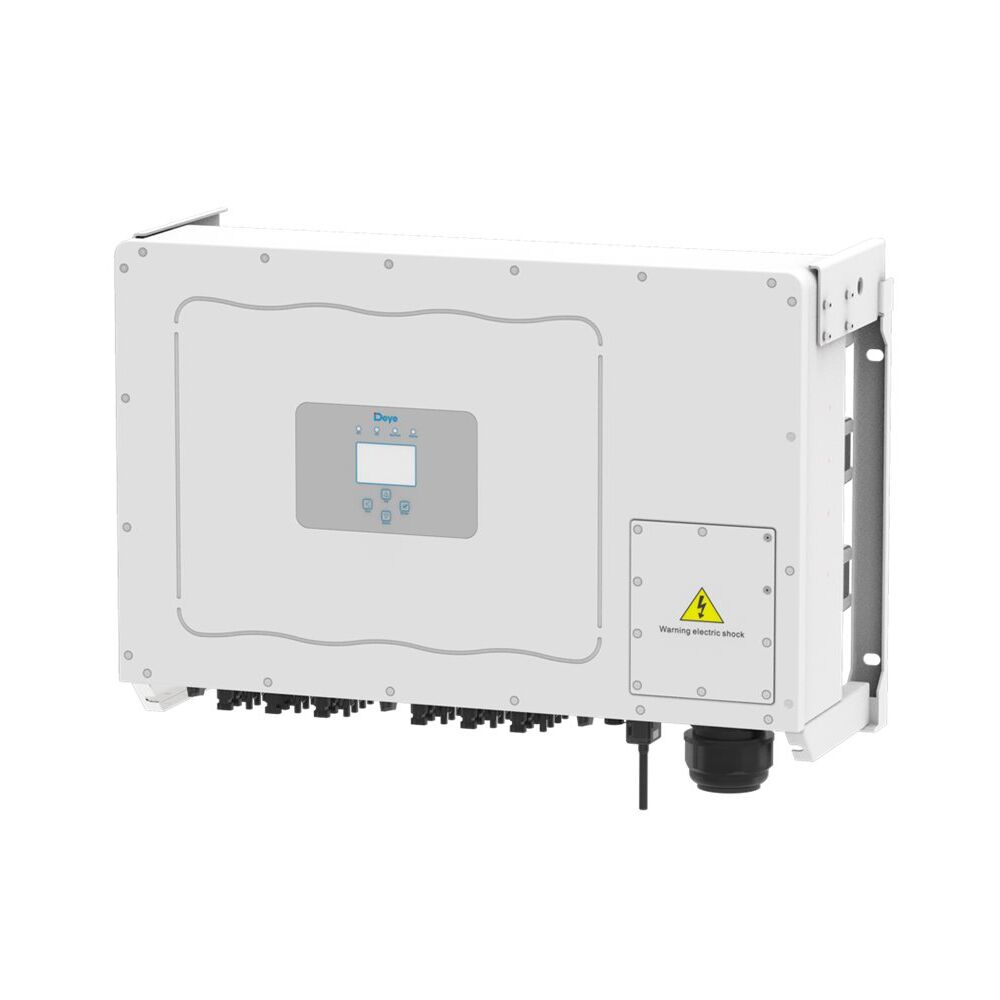
Description Deye SUN-100K-G03
A hundred kilowatts and six trackers: an industrial machine
The SUN-100K-G03 feeds 100 kW into a three-phase grid and accepts an array of up to 150 kW across six independent MPPT trackers with four strings each — twenty-four rows of panels. A housing of 838 × 568 × 326 mm at 81 kg moves the unit into a class where installation needs a crew with a hoist or a lift, and where the mounting position belongs in the design from the start. Six trackers give 240 A of DC together, half again as much as the SUN-80K-G (item 2069), and that is what determines how comfortably the array can be laid out. Typical sites of this class are logistics complexes, cold stores, greenhouse operations and factories with a hundred kilowatts of daytime load. The inverter is grid-tie with no battery channel and stops completely when the grid goes down, so backup for critical processes is built separately.
A 150 kW array on a 100 kW inverter: oversizing of 1.5
Maximum module power here is 150 kW against a 100 kW rating — one and a half to one, the most generous ratio in this series, where the other models are capped at 1.3. Such headroom changes the character of the plant: it reaches full output not only during June middays but considerably earlier in the morning and later in the evening, and on a cloudy day it yields substantially more than the design norm. The flip side is peak clipping: in summer the inverter holds at 100 kW for several hours a day, and part of the potential generation is lost. In practice that loss runs from three to seven percent of the annual total and is almost always outweighed by the gain during the rest of the year, especially in self-consumption mode without export. It is precisely this 1.5 ratio that makes the model a rational choice where connected capacity is capped at a hundred kilowatts but the roof allows more panels.
A 417-volt threshold and freedom in string layout
Six trackers of 40 A give 240 A, so delivering 100 kW requires an array voltage of about 417 V — noticeably less than the 500 V of the SUN-80K-G (item 2069), despite the higher rating. That means rows of roughly thirteen or fourteen modern modules instead of sixteen, which on an industrial roof with ventilation shafts and level changes is often the decisive difference. Twenty-four strings theoretically allow six different orientations of four rows each, but remember the 40 A per tracker limit: four parallel strings of modern modules carrying 13–14 A will exceed it. The optimal configuration for a uniform array is three strings per tracker — eighteen rows — leaving spare inputs for future expansion. A maximum operating altitude of 4000 m without derating and a wide 200–850 V MPP range complete the picture: the unit has no design bottlenecks apart from the 1000 V input ceiling.
A hundred and sixty-seven amps per phase: a separate electrical design
Rated output current is 151.5 A per phase at 380 V and 144.9 A at 400 V, with a maximum of 166.7 A, so the line is built around a 200 A breaker and 95 mm² copper or 150 mm² aluminium cable. At these currents the electrical design is produced by a licensed firm: short-circuit current calculations, protection selectivity and the thermal regime of the cable route are all required. Voltage drop becomes critical from thirty metres onward, and every poorly torqued bolt on a terminal block turns into a hot spot with a fire risk. A three-phase breaker, a maintenance isolator, a type II surge protection device and a dedicated earthing system with verified resistance are all mandatory. Generating 100 kW in Ukraine is registered to a legal entity with matching permitted capacity in the connection agreement, and without that document the installation makes no sense.
Eighty-one kilograms: lifting and the room
A housing 838 mm wide weighing 81 kg is not lifted by hand — a chain hoist on a fixed beam or a lift with a platform is required. The mounting frame is rated for at least double the load and fixed to concrete or welded steelwork, never to brickwork without inserts. Leave at least thirty centimetres of free space at the sides and half a metre above: active cooling at a hundred kilowatts of conversion releases over a kilowatt of heat into the room. Noise of up to 55 dB together with that heat output means the room must be a technical one, ventilated and access-controlled. The IP65 housing permits outdoor installation, and for sites without spare rooms that is often the only option — under a canopy, on a north wall, fenced against unauthorised access.
98.8 % efficiency and losses at a hundred-kilowatt scale
Peak efficiency of 98.8 % is the highest figure in this group of models, while the European weighted value of 98.3 % describes behaviour across the real distribution of load over a year. A 150 kW array in central Ukraine produces roughly 155 MWh annually, so conversion losses at 98.3 % amount to about 2.6 MWh. MPPT efficiency above 99 % shows its worth particularly across six trackers: each group of panels holds its own optimum for its own orientation, and the total mismatch loss across the array stays minimal. Harmonic distortion below 3 % at a hundred kilowatts of output matters on a site with its own transformer substation: a clean sine wave neither overheats the transformer nor upsets reactive power compensation. Night-time consumption below 1 W is irrelevant at this scale and plays no part in the payback calculation.
Twenty-four strings: monitoring as a mandatory part of the design
Each of the twenty-four strings reports its own current and voltage curve to the cloud over Wi-Fi, LAN, RS485 or RS232, with summary data mirrored on the 240 × 160 display. On an array of two hundred and fifty panels manual supervision is impossible: without automatic alerts a failed string will only surface months later as a gap against the generation plan. Configure string-to-string comparison inside each tracker and a threshold alert on deviations above five percent — this catches soiling, shading and oxidised connectors early. Ground fault monitoring matters especially across several kilometres of DC cable, since deteriorating insulation becomes visible long before an emergency shutdown. On zero-export sites monitoring also serves a protective function, recording actual export to the grid in case the operator raises a claim.
How it differs from its neighbours in this catalogue
The SUN-110K-G03 (item 2071) is the same machine in the same 81 kg housing with six trackers, but rated at 110 kW, and its maximum array is also 150 kW, so the oversizing ratio drops to 1.36. The choice between them follows the permitted capacity in your agreement: if the operator allowed a hundred kilowatts, taking a hundred and ten is pointless, and if it allowed a hundred and ten, taking it is the better value. The SUN-80K-G (item 2069) and SUN-60K-G (item 2066) in the lighter 60 kg housing are simpler to install but carry only four trackers and demand a higher array voltage. The SUN-50K-G03 (item 2072) remains the option for connections up to fifty kilowatts in a light 44.5 kg housing. No G-series model works without the grid: if production depends critically on continuity, backup is built on three-phase LP3, SM2 or HP3 hybrids, or on a generator with automatic transfer.
Send us your roof plan, the capacity permitted by your agreement and a daily consumption profile, and we will calculate whether the full 150 kW of oversizing is worth using and how much of the generation you will consume on site.
Characteristics Deye SUN-100K-G03
Reviews about Deye SUN-100K-G03 from real users
No reviews found







