m. Сміла, Незалежності, 67г. оф, 406/6











Інвертор трифазний автономний Anenji ANJ-12K-H3-WIFI 12 кВт 48В WiFi

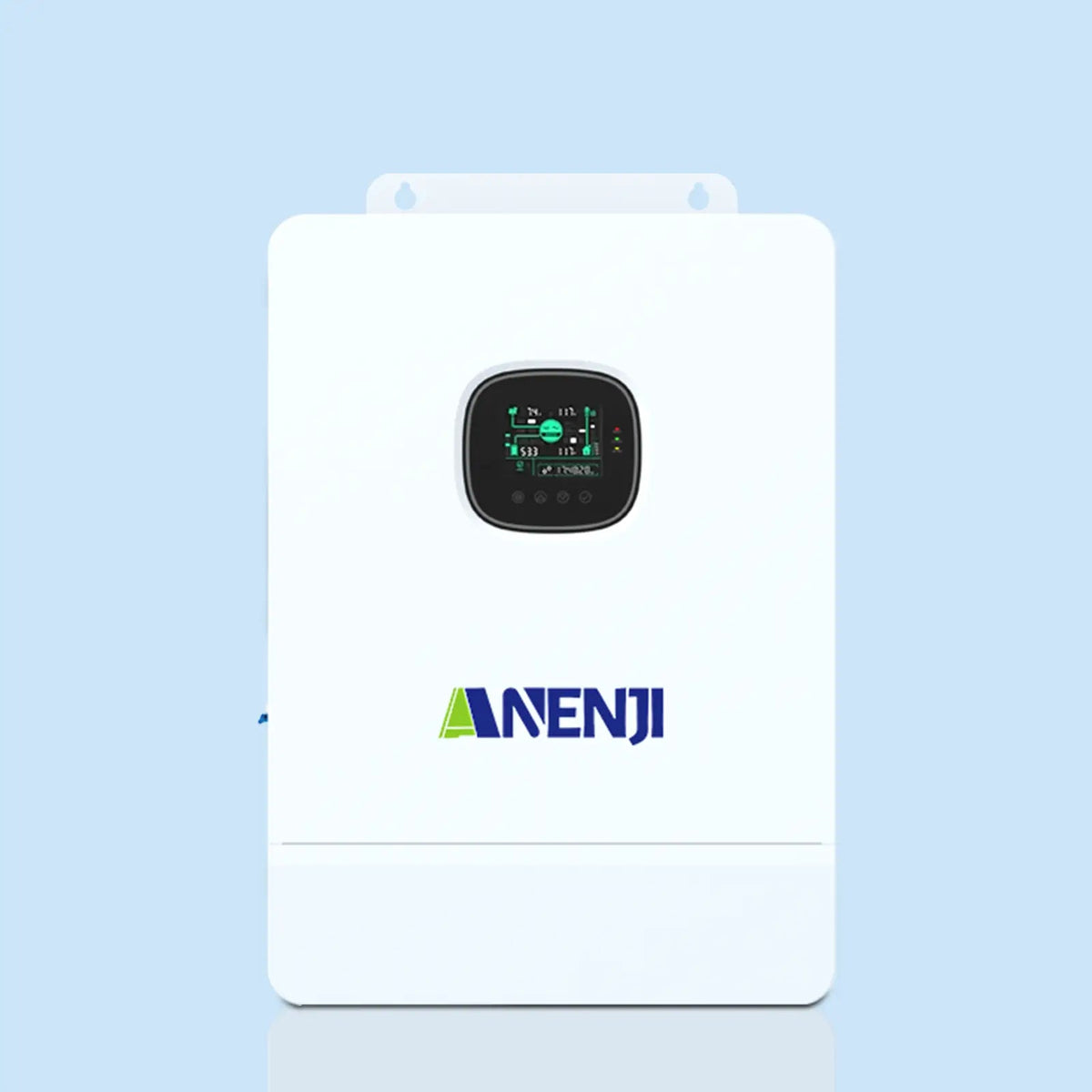


Description Інвертор трифазний автономний Anenji ANJ-12K-H3-WIFI 12 кВт 48В WiFi
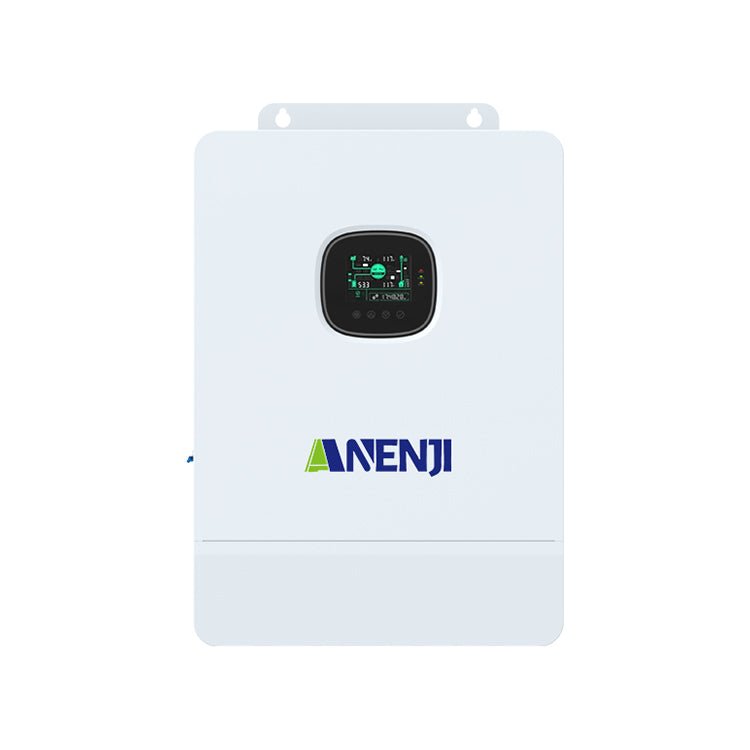
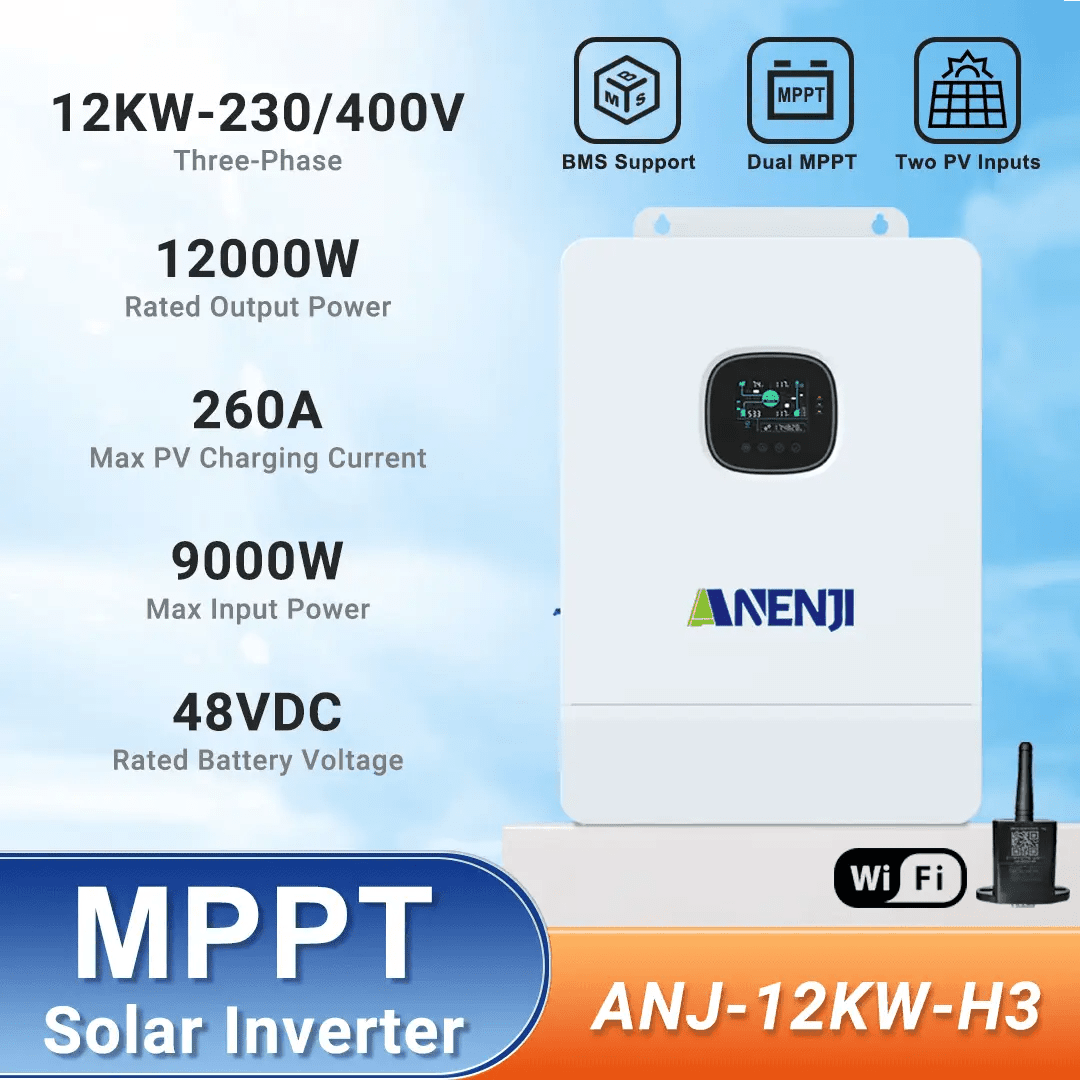
The Anenji ANJ-12K-H3-WIFI is a three-phase off-grid inverter rated 12 kW with a 230/400 V output and a 24,000 W peak. Two trackers of 22 A each accept an array of up to 18,000 W in a 200–650 V window capped at 800 V, battery charging reaches 260 A and the bypass is rated 63 A. European efficiency is 97.5 %, tracker accuracy 99.9 %, transfer time 10 ms. Weight 27 kg, warranty 24 months.
Three phases and 400 volts: what they are really for
A three-phase 230/400 V output is not a way of getting more power but a way of running equipment that will not work otherwise. A three-phase induction motor creates a rotating magnetic field from the shape of the supply itself, so it starts its load smoothly and needs neither capacitors nor starting windings.
The list of such equipment on a working property is longer than people expect: borehole pumps of three to five kilowatts, woodworking and metalworking machines, ventilation and extraction, compressors, grain elevators, refrigeration plant, lifts and hoists. All of it is designed for 400 volts between phases, and a single-phase inverter, however powerful, cannot help here.
The second reason is balance. Twelve kilowatts spread over three phases give about four kilowatts and seventeen amps per phase instead of fifty-two in a single-phase scheme. Cable cross-section, breaker ratings and contact heating all fall threefold, which shows up both in the budget and in the reliability of the distribution board.
The one thing to get right is how single-phase loads are spread between the phases. The inverter holds each phase separately, so if the whole house hangs on one of them, two idle while the first runs into limiting. During installation this is solved by distributing circuit groups across phases, and we recommend doing it at the board design stage rather than afterwards.
Off-grid with a 63 A bypass
The specification lists the unit as off-grid: it builds its own three-phase supply from panels and battery, and uses the utility as a charging source and a reserve rather than as a partner for export. For a production site that is often exactly right: your own clean supply regardless of what is happening on the line.
The 63 A bypass is an important part of that logic. When the inverter is switched off for service, or the load exceeds what it can carry, mains passes straight through to the loads along the bypass channel. Sixty-three amps per phase is roughly 14 kilowatts per phase, more than forty across all three, so the bypass is not the bottleneck.
The practical value of a bypass shows during maintenance. The unit can be taken out of service without stopping the site: the line runs on mains, production continues, and the inverter waits for the technician. For cold stores and continuous processes that capability is sometimes decisive.
Generator support is listed separately as well. Together with the bypass that gives three levels of supply — sun with battery, grid, generator — and any one of them covers the site with no manual switching.
Eight hundred volts at the input: a different array logic
The solar side of this inverter is built differently from the single-phase models in the series. The absolute input ceiling is 800 V, the tracker window is 200–650 V, and current is limited to 22 A on each of the two channels. The total array may reach 18,000 W, nine kilowatts per channel.
The 200 V lower bound means short strings do not work here: an array of four modules will never enter the operating window. In exchange, the permitted high voltage opens up long strings — twelve to sixteen modern modules in series give 500–650 V of working voltage, which is the ideal point for this tracker.
Work out the margin to 800 V. Sixteen modules with a 49 V open-circuit rating give 784 V on a warm day and would cross the limit in frost with a ten per cent uplift. A safe string is fourteen modules: about 686 V in the heat and around 750 V in January, leaving margin without wasting the window.
High voltage brings a concrete benefit in the cabling. Nine kilowatts at 650 volts is under fourteen amps, so 4 mm² conductor suffices from roof to inverter even over a long run. On single-phase models limited to 500 V, the same array would demand thicker copper.
Two hundred and sixty amps of charge against a 48 V bus
Charge current here is the highest in the whole family: 260 A from the solar path and 120 A from the grid. On a 48 V bus that is roughly 12.5 kW and 5.8 kW, so a 25 kWh battery fills from the sun in two hours.
That same 48 V bus at 12 kilowatts of output means about 250 amps of discharge. Taken together, charge and discharge put industrial demands on the storage: at least two or three parallel 100 Ah packs under a common BMS, or a rack pack of 300 Ah and above. The copper between battery and inverter becomes a busbar or two 70 mm² cables per pole.
The manufacturer also states the battery window: 40–60 V. A lithium pack of sixteen LiFePO₄ cells fits entirely inside it, and so does a lead bank of four batteries. Besides lithium and lead, the battery type list includes a user-defined mode where charge and cut-off thresholds are set by hand, which is what unusual packs require.
For battery communication there is not only RS485 but CAN, the bus most modern lithium racks speak. That noticeably widens your choice of storage: you are not forced to find a pack with one particular manufacturer RS485 protocol.
Ninety-seven and a half: what European efficiency means
The datasheet quotes 97.5 % European efficiency, which is not the same thing as peak efficiency. European efficiency is a weighted average across several load levels — five per cent of rating, ten, twenty, thirty, fifty and one hundred — with each level weighted by how often it occurs in real operation.
That is precisely why the figure is more honest than a maximum. An inverter rarely runs at full power: most of the time it carries 20–40 % load, and a unit with a fine peak but poor behaviour at light load will deliver less energy over a year. When a manufacturer quotes European efficiency, it is effectively reporting an annual result rather than a bench record.
Tracker accuracy is stated separately as 99.9 %. That is the share of the theoretically available array power the unit actually finds and takes. On an 18-kilowatt array every tenth of a per cent is eighteen watts, and across a season such details add up to real kilowatt-hours.
From the battery, efficiency is no less than 92 %. The gap against the solar path is the boost from 48 V to three-phase 400, the hardest duty for any converter. At twelve kilowatts from the battery the unit dissipates around a kilowatt of heat, which has to be allowed for in the room ventilation.
Certification: the fullest list in the series
For this model the manufacturer names more documents than for any other: IEC 62109–1 and IEC 62109–2 for the safety of converters in photovoltaic systems, UL1741, the EN 61000–6-1 and 6–3 series for electromagnetic compatibility, FCC part 15 B and RoHS.
The presence of UL1741 is interesting: it is the American standard for grid-interactive equipment, and not every Chinese manufacturer passes it. Together with FCC 15 B it indicates the unit was certified for the United States market, which usually implies tighter component control than for the domestic one.
EN 61000–6-1 and 6–3 cover immunity to interference and the unit own emissions in residential and light industrial environments. In practice that means the inverter does not spoil radio reception and is not itself upset when a welder starts in the next bay.
RoHS limits heavy metals and hazardous substances. For a commercial site this whole group of documents has a purely practical value too: without them equipment is hard to carry through official connection, insurance and inspection.
Twenty-seven kilograms, IP20 and air cooling
The case measures 445 × 620 × 130 mm and weighs 27 kg, the largest and heaviest unit in the series. Mounting is on the wall, and here you genuinely need anchors into concrete and a second pair of hands: twenty-seven kilograms at shoulder height is not a one-person job.
Cooling is by air with a noise level below 60 dB. The IP20 rating means a dry room only: the case is protected against contact with live parts but not against dust or splashing. In a dusty workshop that matters — such a unit belongs in a technical room or a cabinet with filtered ventilation, not in the middle of a joinery shop.
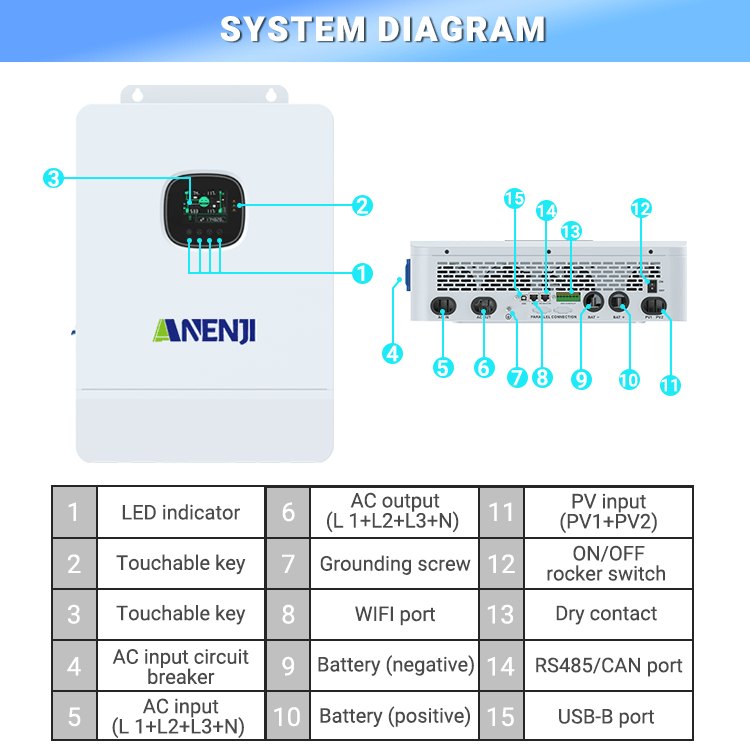
The operating range is −10 to +55 °C and control is by LCD with touch keys. There are five interfaces: RS485 and CAN for the battery, USB for service, a dry contact for automation and Wi-Fi or GPRS for telemetry. The GPRS option matters where there is no internet yet the system state still has to be known.
The warranty is 24 months, the longest among the Anenji inverters in our catalogue, and for equipment of this class that is a sensible signal from the manufacturer. When specifications look alike, the warranty term is often the best indicator of how confident a maker is in its own design.
A three-phase off-grid system is always a project rather than a shelf purchase, from spreading circuit groups across phases to a battery rated for two hundred and fifty amps. Tell us what has to run and we will size the strings for the 200–650 V window, the storage for the charge and discharge currents, and check what remains on the bypass.
Characteristics Інвертор трифазний автономний Anenji ANJ-12K-H3-WIFI 12 кВт 48В WiFi
Reviews about Інвертор трифазний автономний Anenji ANJ-12K-H3-WIFI 12 кВт 48В WiFi from real users
No reviews found