m. Сміла, Незалежності, 67г. оф, 406/6














Інвертор однофазний гібридний Anenji ANJ-6200-48PL-WIFI 6.2 кВт 48В WiFi паралельний






Description Інвертор однофазний гібридний Anenji ANJ-6200-48PL-WIFI 6.2 кВт 48В WiFi паралельний
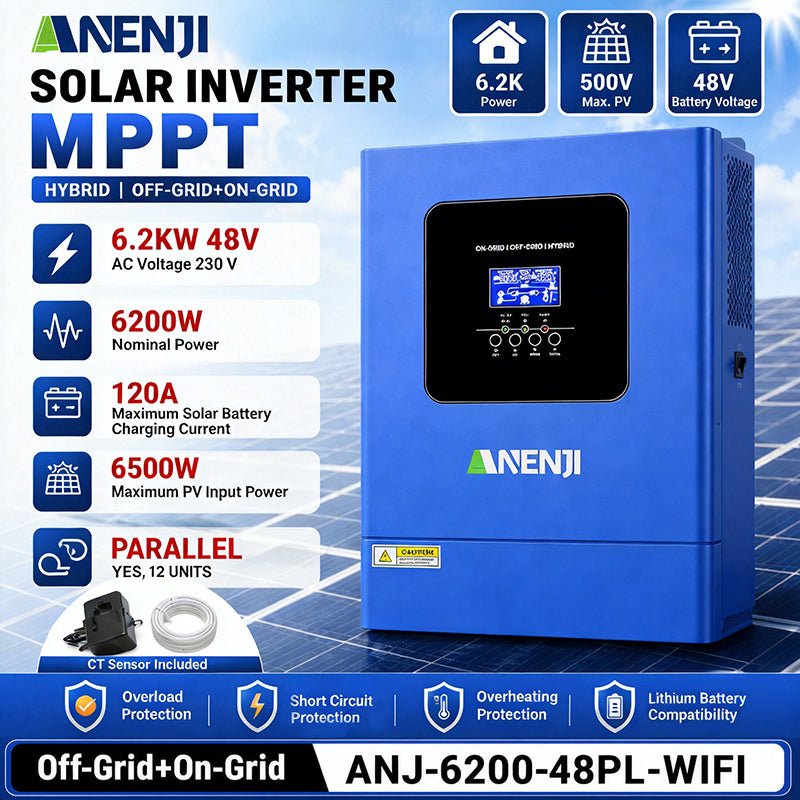
The Anenji ANJ-6200–48PL-WIFI is a single-phase hybrid inverter rated 6.2 kW for a 48 V bus with a selectable output of 220, 230 or 240 V. Rated current is 27 A, the grid input accepts up to 40 A, charging reaches 120 A from the panels and 80 A from the grid, and the array may reach 6500 W in a 60–500 V window with a 150 V start-up threshold. It has a port for an external current transformer, is rated 94 % efficient, weighs 12 kg and carries a 12-month warranty.
A current-transformer port: what sets this model apart
The interface list of this inverter contains something none of the other single-phase models in the series offer: a port for an external current transformer, a CT. It is a small ring coil clamped over the incoming conductor in the distribution board, and it tells the inverter what it cannot know by itself — how much energy is actually flowing through the service point, and in which direction.
The main practical benefit of that measurement is zero export. The inverter sees when solar generation exceeds household consumption and holds production back so the surplus never crosses the boundary of the property. Where export is forbidden by the connection terms or simply unpaid, this turns a potential violation into a normal operating mode.
The second use is intelligent prioritisation. Knowing real consumption, the unit can cover loads from the sun first, charge the battery second and leave the grid as the last resort. Without a CT all those decisions are made blind, on voltage and time of day, and the system inevitably behaves more crudely.
A 150 V start-up threshold and what it means for your array
The specification lists a start-up voltage of 150 V, a rare parameter most datasheets omit entirely. It means the tracker only begins to work once the array reaches at least one hundred and fifty volts, even if there is already current available.
For the array layout that is a concrete requirement. Three modern modules in series give around 120 V of working voltage: such an array will run at midday, but through the morning and evening hours, when voltage sags, the system simply will not start. Four modules or more settle the question with margin.
The rest of the tracker window is wide — 60 to 500 V, with a 500 V input limit and up to 27 A. The rated 6500 W array at that current implies a working voltage near 240 V, that is a string of eight to ten modern modules. Within that range both the start-up threshold and the cold-weather margin are satisfied automatically.
Twenty-seven amps out, forty amps in
The manufacturer quotes currents as well as power, and they are worth checking by arithmetic: 6200 VA at 230 volts is exactly 27 amps, precisely the figure printed in the datasheet. The data is therefore self-consistent rather than copied from different documents.
For the installer those amps matter more than the watts. A 27 A output line needs 4–6 mm² cable and a matching breaker, while a grid input rated 40 A calls for 10 mm² and a 40 A device. If the service to the building is weaker, cap the charge current in the menu, otherwise the unit will trip protection regularly — not through any fault, but through its own appetite.
Forty amps on the input is about fast charging as much as about grid loading. When power is on for two hours, the unit can draw some nine kilowatts from the grid: part to the house, the rest into the battery. Under rolling outages, that is what decides whether the system refills its reserve before the next window.
Charging at 120 A from the sun, 80 A from the grid
Charge current is limited to 120 A on the solar path and 80 A from the grid. On a 48 V bus that is about 5.8 kW and 3.8 kW, so a 15 kWh battery fills in under three hours from the sun and in four from the grid.
That ratio suits a house where the grid exists but cannot be relied on. The solar path uses the full potential of the array, while the AC path stays strong enough that you are not waiting half a day. At the same time 3.8 kW of charging is well within the reach of a mid-sized domestic generator if its turn comes.
The battery is LiFePO₄ with BMS communication. At 120 A that channel is essential: the pack itself reports the permitted charge rate, cell condition and temperature, and the inverter does not have to infer them from voltage. Note that 120 A is what the inverter can do — the battery has to be chosen deliberately to match it, not the other way round.
Three output voltages: 220, 230 and 240 V
The output voltage can be set to 220, 230 or 240 V. In an ordinary home that sounds like a detail, but in two scenarios it decides the job: when equipment is built for 240 V to the British or Australian standard, and when a long line runs from the inverter to a distant load.
The second case occurs more often than people expect. On a plot with a workshop a hundred metres from the house, voltage drop in the cable easily consumes ten volts, and appliances at the far end run on noticeably less. Switching the output to 240 V compensates that loss without replacing the cable.
The grid input window is adjustable too — 170–280 V or 90–280 V. The narrow range protects sensitive equipment from sags; the wide one reduces the number of transfers to battery where mains voltage wanders. The choice is always a compromise between saving battery cycles and the quality of voltage at the load.
What this datasheet does not say
Let us be straightforward: the supplier specification for this model does not state a peak power figure, although the other inverters in the series do. For a buying decision that is a real gap, because the peak is what determines whether a borehole pump or a compressor will start.
Nor is the transfer time stated, which in sibling models is 10 ms for computer equipment and 20 ms for household loads. There is no structural reason to expect substantially different values here, but we will not quote a figure that does not appear in the documents.
A third inconsistency sits in the source data: the attribute for the adjustable power-factor range holds a value in volts, which is physically impossible — evidently the value landed in the wrong field during an exchange with the accounting system. We have reported it to the supplier and are clarifying the correct data. If those three parameters are critical for your project, write to us and we will ask the manufacturer through the official channel.
Twelve kilograms, 94 % and installation conditions
The case measures 300 × 450 × 130 mm and weighs 12 kg, the heaviest of the single-phase models in the series, and that shows during installation: plasterboard is out of the question, a solid wall and proper anchors are required. The extra mass is not a flaw but the consequence of a larger power transformer and heatsink.
An efficiency of 94 % at full power means about 370 W of heat, comparable to a small space heater. In a cramped technical cabinet without ventilation such a unit will heat itself into protection, so the installation space must breathe and clear room is needed above and below the case.
Permitted conditions run from −10 to +50 °C and up to 95 % humidity with no condensation. The manufacturer warranty is 12 months; this is one of four inverters in the series whose term is stated in the specification outright, and when prices are level such details often decide the purchase.
If export is prohibited on your connection, or you want the system governed by real consumption rather than assumptions, the CT port is what makes this model worth a look. Write to us: we will choose the current transformer, size the array for the 150 V start-up threshold and check whether your service can carry forty amps.
Characteristics Інвертор однофазний гібридний Anenji ANJ-6200-48PL-WIFI 6.2 кВт 48В WiFi паралельний
Reviews about Інвертор однофазний гібридний Anenji ANJ-6200-48PL-WIFI 6.2 кВт 48В WiFi паралельний from real users
No reviews found