m. Сміла, Незалежності, 67г. оф, 406/6











Інвертор однофазний гібридний Anenji ANJ-5KW-48V-WIFI 5 кВт 48В WiFi



Description Інвертор однофазний гібридний Anenji ANJ-5KW-48V-WIFI 5 кВт 48В WiFi
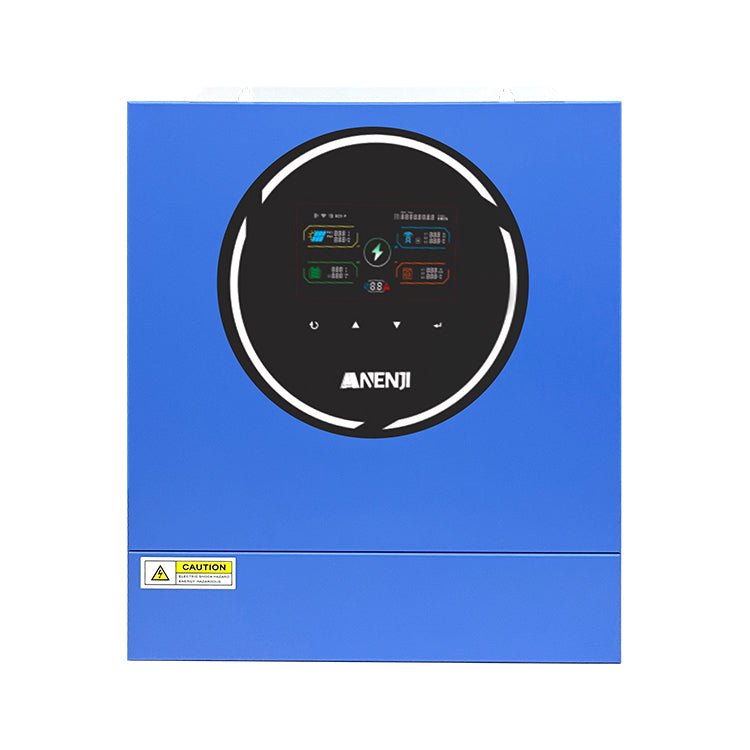
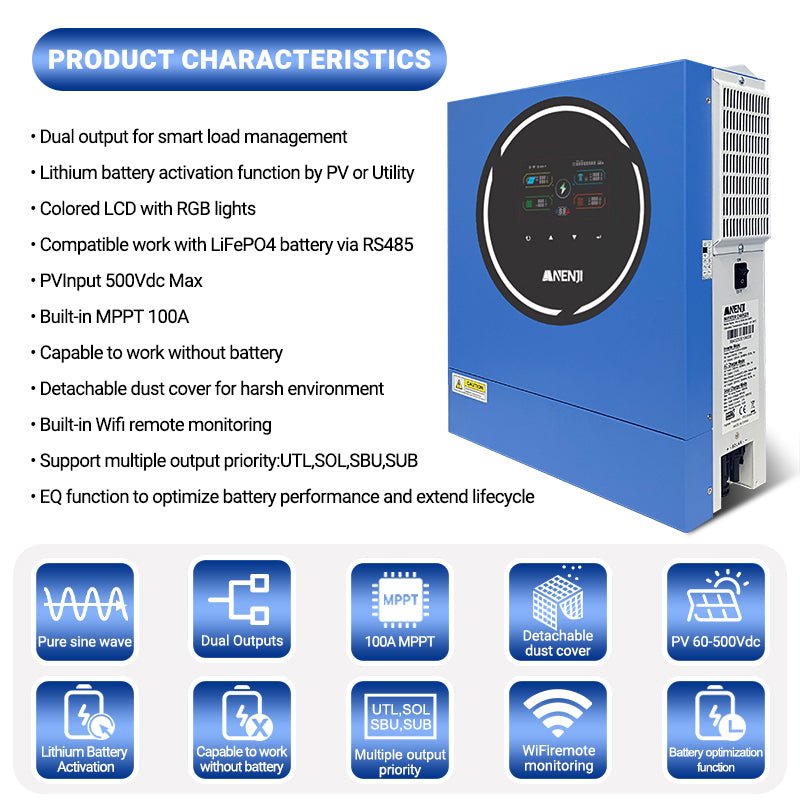
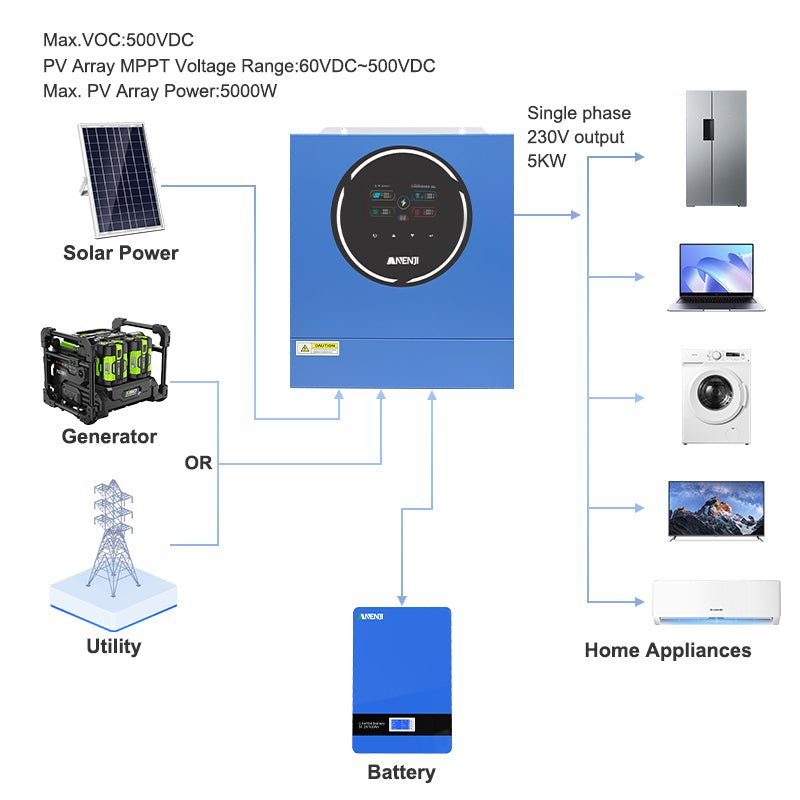
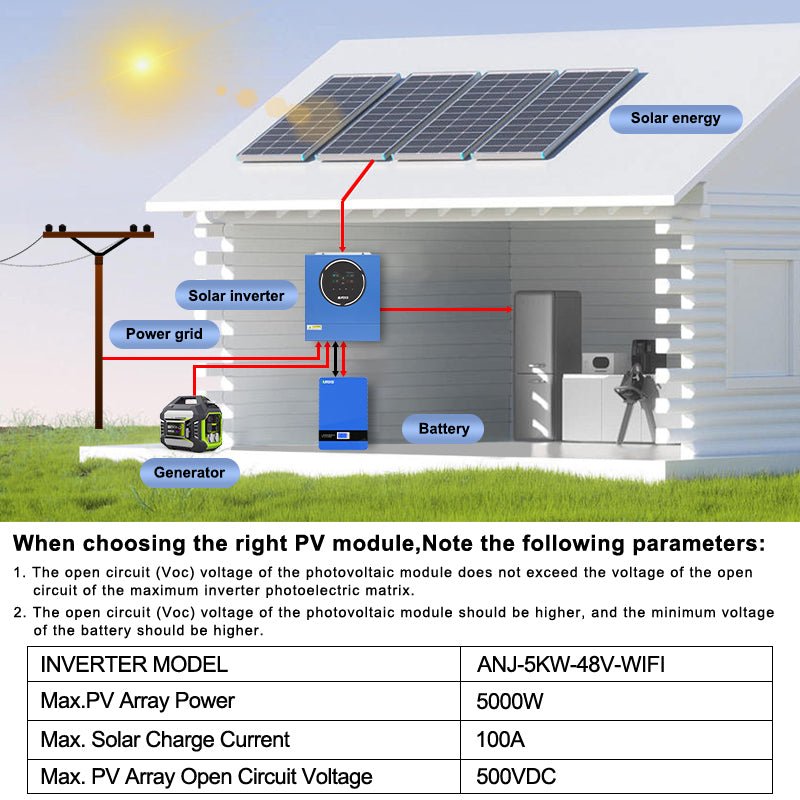
The Anenji ANJ-5KW-48V-WIFI is a single-phase hybrid inverter rated 5 kW for a 48 V bus with a 220/230 V output. It peaks at 10,000 VA, accepts an array of up to 5000 W in a 60–500 V window with up to 27 A of current, charges at 100 A from the panels and 60 A from the grid, and is rated 96 % efficient. A colour display with RGB backlight, BMS communication over RS485, 8.5 kg.
Forty-eight volts: why this bus became the standard
Five kilowatts at a battery voltage of 48 V means about 104 amps of direct current, and that is the boundary beyond which cabling still stays sensible. The same power on a 24 V bus would demand over 200 amps and twice the copper; on 12 V the system would simply never be built.
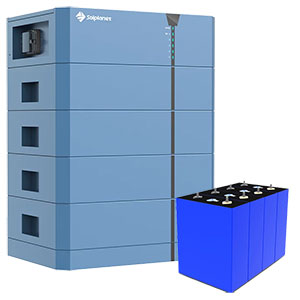
That is why forty-eight volts became the de facto standard for home storage. Dozens of manufacturers build ready-made lithium packs for this bus, so you can compare them on price and add modules later instead of ordering from whichever brand made your inverter. High-voltage systems offer no such freedom.
The second reason is safety. Forty-eight volts DC belongs to safe extra-low voltage, so work on the battery side needs no special qualification and a wiring error does not carry the consequences it would on a bus of several hundred volts. For a private house this is a calm and predictable architecture.
Ten thousand volt-amperes: exactly double the headroom
The 10,000 VA peak is precisely twice the rating. That headroom covers the inrush of practically everything found in a private house: a borehole pump, a fridge compressor, a welding inverter in the workshop, a heating pump.
Understand that a double peak exists for the seconds of starting, not for continuous work. An induction motor draws several times its rated power at the moment it starts, and an inverter without that headroom will trip even though it has ample capacity to run the very same motor afterwards.
The design conclusion is practical: size the rating by the sum of your steady loads and the peak by the heaviest single start. For a five-kilowatt system with double headroom that means one large motor starts without reservation, while two at once are better separated in time.
Five kilowatts of panels, one tracker and 27 amps
The solar input accepts an array of up to 5000 W, exactly matching the inverter rating. There is a single tracker with one string at the input, an absolute ceiling of 500 V and a maximum PV current of 27 A.
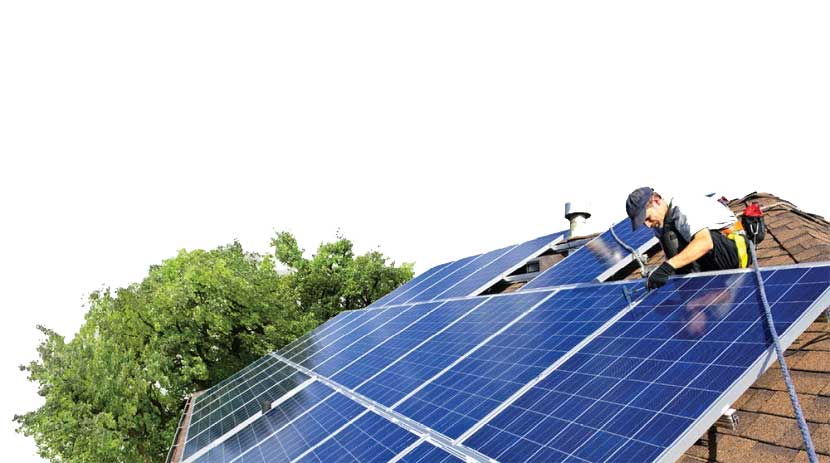
Those figures leave room to lay out the array in two ways. One is a single high-voltage string of ten 500 W modules: around 400 V of working voltage, current inside 13 amps, minimal cable loss. The other is two parallel strings of five modules: half the voltage, a current near 26 amps that nearly exhausts the rated limit, but shade on one roof slope no longer drags the other down with it.
A single tracker does mean both strings must be identical: the same module count, the same orientation, the same tilt. If the roof is complex and the slopes differ, look for a model with two independent trackers — the same series offers them in the 11 kW class. Otherwise the weaker string pulls the operating point of the stronger one.
Charging at 100 A from the sun, 60 A from the grid
Charge current is capped at one hundred amps on the solar path and sixty when running from the grid. On a 48 V bus that is roughly 4.8 kW and 2.9 kW: a 10 kWh battery fills in two hours of clear generation from the sun, or three and a half from the grid.
The asymmetry here is deliberate and useful. A 2.9 kW grid charge corresponds to about thirteen amps of alternating current, which overloads neither a typical 25 A main breaker nor a mid-sized domestic generator. The full hundred amps are drawn only when the energy comes from the sun rather than from your electricity bill.
Battery type is LiFePO₄ with a communication channel to the BMS. The inverter therefore works from the pack own data — real state of charge, cell temperature, permitted currents — instead of guessed voltage thresholds. For a battery accepting a hundred amps that control is not a luxury but a condition of long life.
A colour display with RGB backlight
Among the single-phase models of this series, this one carries a colour LCD with an RGB backlight instead of the usual monochrome panel. That is not cosmetic: the backlight changes colour with the operating mode, so the state of the system is visible from the doorway without reading any numbers.
In practice it saves those few seconds that feel long in the dark during an outage. You walk in and see immediately whether the system runs from sun, from battery or from the grid, without hunting through menu screens or shining a phone at the panel.
The settings themselves stay classic: buttons under the display rather than a touch panel. For a technical room that is the better choice — a button can be pressed with a glove on, while a touch surface in a damp boiler room eventually starts a life of its own.
Three ports and standard connectors
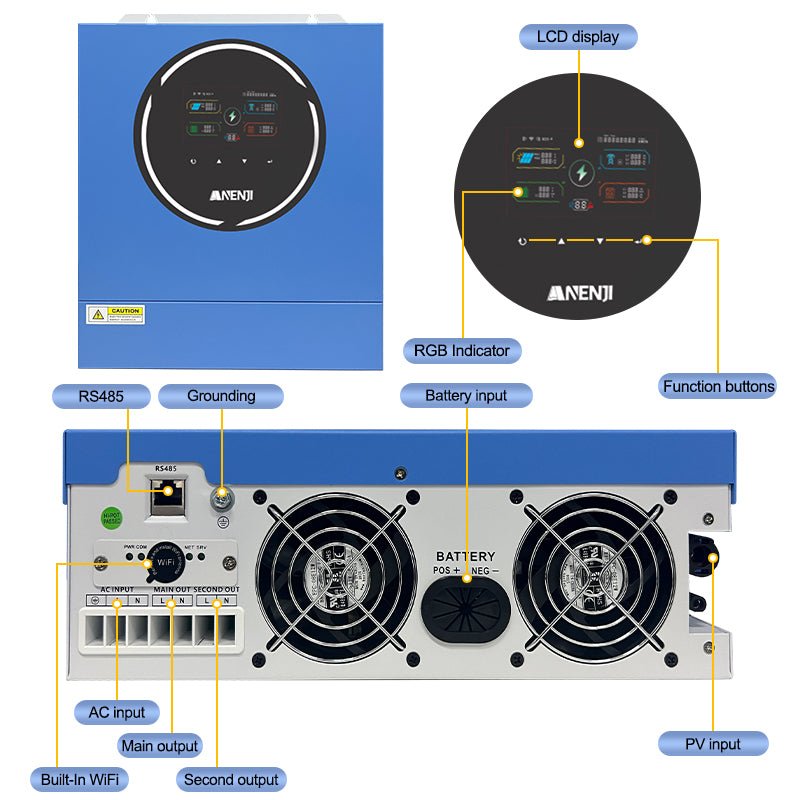
The interfaces are listed with their connector types, which is rare honesty in a specification: Wi-Fi for the app, RS485 on RJ45 for the battery and RS232 on DB9 for a computer or controller.
RJ45 for the BMS means the link to the battery is made with an ordinary patch cord, sold in any shop and cut to length in five minutes. That removes the most banal installation problem of all, where the battery sits three metres from the inverter and the supplied cable is one and a half.
The DB9 port looks archaic today, yet it remains the language of industrial supervisory systems and older controllers. When the inverter goes not into a house but onto a small production site with existing automation, this connector is often the only way in without adapters.
Dimensions, heat and installation conditions
The case measures 312 × 350 × 115 mm at 8.5 kg and mounts on a solid wall. An efficiency of 96 % at full load means about 200 W of heat, so leave clear space above and below the unit and provide ventilation openings inside a closed cabinet.
The operating range is −10 to +50 °C with humidity up to 95 % non-condensing. For a utility room, a boiler room or a hallway that is comfortable; for an unheated garage in winter it sits at the edge, and the first component to give up will be the lithium battery rather than the electronics, since it refuses a charge at sub-zero cell temperature.
The grid input window is 170–280 V for sensitive equipment and 90–280 V in household mode, with transfer in 10 and 20 ms respectively. On a weak rural grid the wide mode reduces the number of transfers and the battery cycles they spend, but it also passes voltage sags through to your loads, so a server rack is better served by the narrow one.
Five kilowatts on a 48 V bus is the most common configuration for a private house, which is exactly why mistakes in it cost the most. Write to us: we will size the array for a single tracker, check whether your roof divides into identical strings, and recommend a battery that takes a hundred amps of charge calmly.
Characteristics Інвертор однофазний гібридний Anenji ANJ-5KW-48V-WIFI 5 кВт 48В WiFi
Reviews about Інвертор однофазний гібридний Anenji ANJ-5KW-48V-WIFI 5 кВт 48В WiFi from real users
No reviews found