m. Сміла, Незалежності, 67г. оф, 406/6











Інвертор однофазний гібридний Anenji ANJ-4000W-24V-WIFI 4.2 кВт 24В WiFi



Description Інвертор однофазний гібридний Anenji ANJ-4000W-24V-WIFI 4.2 кВт 24В WiFi
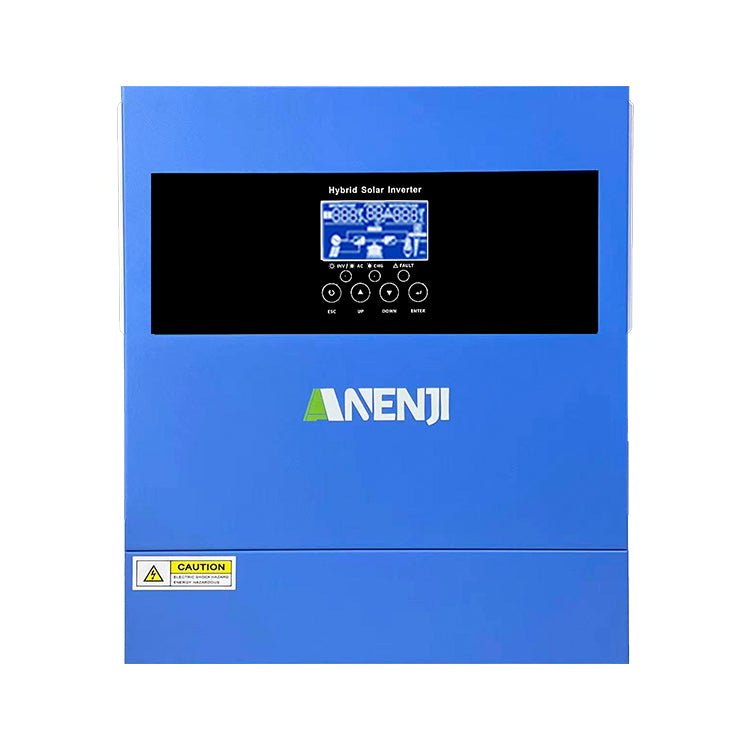
The Anenji ANJ-4000W-24V-WIFI is a single-phase hybrid inverter for a 24 V bus, rated 4200 VA of apparent power with a 220/230 V output. It accepts up to 4500 W of PV in a 60–500 V window with a 15 A current limit, charges at up to 100 A from the panels and 80 A from the grid, and reaches 96 % on the solar path. It works with lithium batteries over RS485, is 100 mm deep and weighs 7 kg.
Four kilowatts in the name, 4200 VA on the datasheet
The model name says 4000 W while the specification says 4200 VA. That is not a discrepancy or a catalogue error but two ways of measuring the same capability. Volt-amperes describe apparent power, watts describe active power, and the ratio between them is the power factor of the load.
Four thousand watts out of 4200 volt-amperes implies a power factor of about 0.95, a typical value for a domestic mix of motors, pumps and switching supplies. In other words the inverter can pass 4200 VA, of which your appliances will actually turn some 4 kW into useful work.
In practice, plan in watts, because watts are what heat, turn and illuminate. When you list your loads, work to four kilowatts of total consumption and leave the volt-amperes for comparing models with one another.
Lithium only: a limitation worth knowing before you buy
The specification is unambiguous about battery type: lithium, communicating over RS485. Lead-acid batteries are not on the list, and that is the main difference from the PRO version of the same power, which handles AGM and GEL as well.
For a new system this is more of an advantage than a drawback. A 24 V lithium pack delivers twice the useful cycles per unit of cost, weighs a third of a lead bank of the same capacity and gives back nearly all of its energy without shortening its life. The manufacturer simply chose not to carry firmware profiles that buyers of this model would never use.
If you already own a lead bank from an old UPS, however, this inverter will not adopt it, and the gradual-upgrade path is closed. In that case look at the PRO version: the same power, more chemistries supported. We will tell you plainly if that is your situation.
Four and a half kilowatts of panels at a 15 A limit
The solar input takes an array of up to 4500 W, a slight surplus over the rating. But one figure dictates the wiring: maximum PV current is only 15 A, so that power has to be reached through voltage rather than current.
The arithmetic is simple: 4500 W at 15 amps implies an operating voltage near 300 V. That is a string of seven or eight modern modules in series, with no parallel branch at all, because a second branch would immediately exceed the permitted current. The tracker spans 60–500 V, so three hundred volts sits right in the middle of its comfortable range.
Check the margin to the 500 V ceiling in cold weather. Eight modules with a 49 V open-circuit rating give 392 V on a warm day and roughly 430 V on a January morning: safe, but with no room for a ninth module. If the roof is to carry more, choose a model with two trackers rather than splitting the array artificially.
A 7000 VA peak: an honest one hundred and sixty-seven per cent
Peak power here is 7000 VA, roughly 1.67 times the rating rather than the double headroom some of its relatives offer. The difference shows up precisely in motor inrush, and it is better understood before installation than after.
Most domestic starts still fit: a fridge, a washing machine, a heating circulation pump, a 1–2 kW power tool. The awkward cases are a large borehole pump with direct-on-line starting or an old compressor without a soft starter, where inrush runs five or six times the rating and can push the inverter into protection.
There are two cures. The first is to separate heavy starts in time so the pump never starts alongside the boiler. The second is a soft starter on the offending motor, which costs incomparably less than an inverter of the next class up. If your house has such a motor, send us its nameplate data and we will tell you whether there will be a conflict.
A hundred amps of sun, eighty amps of mains
Charge current is capped at one hundred amps from the solar path and eighty from the grid. On a 24 V bus that is about 2.4 and 1.9 kW respectively: a 5 kWh battery fills in two hours from the sun and in two and a half from the grid.
That ratio suits sites under rolling outages. When the power is on for three or four hours, the system has time both to cover current consumption and to fill the battery almost completely, without straining the main breaker: eighty amps at 24 volts is about nine amps of alternating current on a 230 V service.
BMS communication over RS485 is not an optional extra here but part of the intended design: this is the port through which the inverter learns the permitted currents and the state of the cells. Wire it during installation, otherwise the unit manages the battery by voltage alone, and for a lithium pack that is not enough.
Ninety-six and ninety-three per cent
The datasheet splits efficiency by path: 96 % when running from the panels and 93 % when running from the battery. The three-point gap is the boost stage from twenty-four volts, through which every watt of stored energy must pass.
In watts, at the full 4.2 kW load from the battery the unit dissipates around 290 W of heat. That is substantial: inside a closed cabinet without ventilation such a load raises the temperature by tens of degrees within an hour, so the installation space has to breathe.
It is worth comparing with the PRO version, which quotes a single 94 % for all modes. This model is more efficient by day and slightly more modest by night, so for a system whose generation is mostly solar the difference favours this variant.
One hundred millimetres deep: the slimmest in its class
At 295 × 358 × 100 mm this is the slimmest single-phase model in the series — exactly ten centimetres from the wall. For a narrow hallway, a technical niche or a cabinet with doors that figure decides the job, and it is rarely advertised yet always remembered during installation.
Seven kilograms means ordinary anchors in concrete or brick and a one-person lift. The operating range is −10 to +50 °C with humidity up to 95 % non-condensing, so a utility room, a hallway or a boiler room will do, while an uninsulated balcony or a yard will not.
There are two interfaces: Wi-Fi for the phone app and RS485 for the battery. This is a minimal set with no USB and no dry contact, so automatic generator starting cannot be wired here — one more argument for the PRO version if you already own a genset.
This model comes into its own where there is a lithium battery, a shallow space to mount it and a solar array built as a single high-voltage string. Write to us: we will count the modules that fit a 15 A limit, check the cold-weather margin to 500 V and recommend a pack that takes one hundred amps of charge without complaint.
Characteristics Інвертор однофазний гібридний Anenji ANJ-4000W-24V-WIFI 4.2 кВт 24В WiFi
Reviews about Інвертор однофазний гібридний Anenji ANJ-4000W-24V-WIFI 4.2 кВт 24В WiFi from real users
No reviews found