m. Сміла, Незалежності, 67г. оф, 406/6












Інвертор однофазний гібридний Anenji ANJ-4.2KW-24V-W-PRO 4.2 кВт 24В WiFi




Description Інвертор однофазний гібридний Anenji ANJ-4.2KW-24V-W-PRO 4.2 кВт 24В WiFi
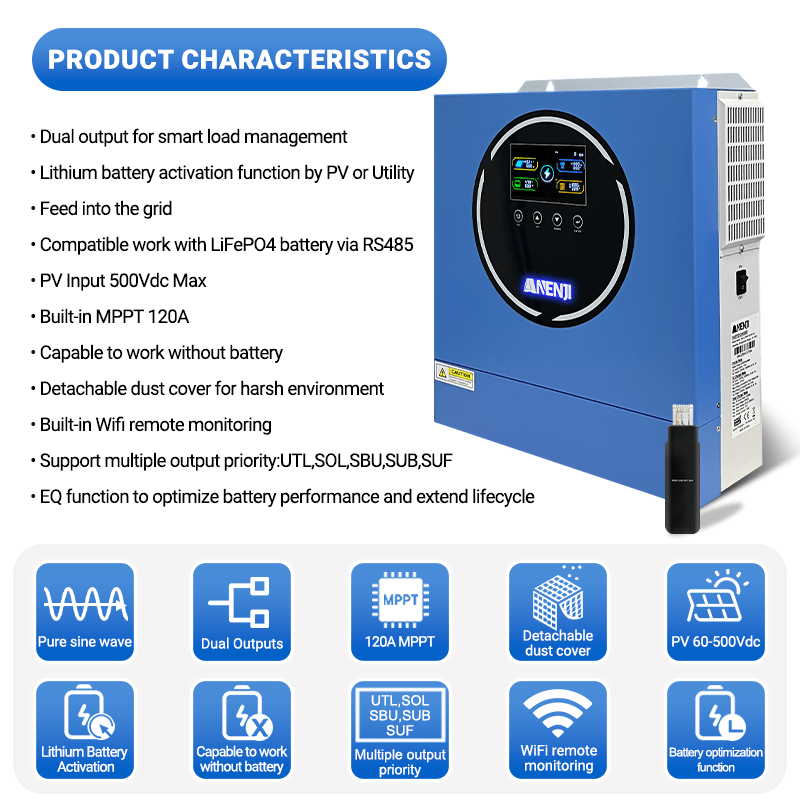
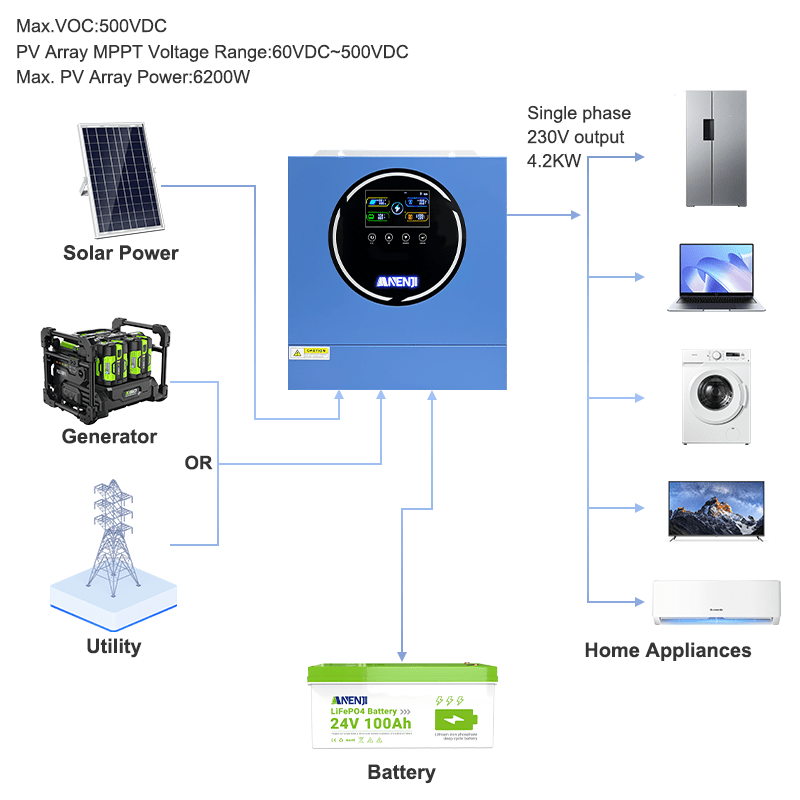
The Anenji ANJ-4.2KW-24V-W-PRO is a single-phase hybrid inverter rated 4.2 kW for a 24 V bus with a 230 V ±5 % output. Its 8400 VA peak is held for five seconds, charging reaches 120 A from both the panels and the grid, and the tracker spans 60–500 V with up to 27 A of PV current. It supports generator operation, LiFePO₄ as well as AGM and GEL lead batteries, and BMS communication. Weight 7 kg.
Eight thousand four hundred volt-amperes, for five seconds
The datasheet of this model states not merely an 8400 VA peak but the time it is held: five seconds. That is rare and genuinely useful precision. Most manufacturers print a peak figure without a word about duration, yet duration is what decides whether your pump starts or the inverter trips.
Five seconds at double power covers practically every domestic inrush. A kilowatt borehole pump asks for three or four at start, a fridge compressor draws five to seven times its rating for a fraction of a second, and a circular saw in a workshop reaches speed in two or three seconds. All of those events fit inside the window the inverter offers.
Understand the limit of that generosity too. The double headroom applies to a short start, not to sustained work: if the total load sits at five or six kilowatts continuously, a 4.2 kW unit will overheat whatever the peak figure says. Peak power is about starting; the rated figure is about everyday life.
One hundred and twenty amps of charging from both sides
This model draws 120 A from the solar path and 120 A from the grid alike — a symmetry most of its relatives lack, where the AC stage is weaker than the solar one. On a 24 V bus, 120 amps means about 2.9 kW of charging power in either direction.
In practice that is what saves you through winter weeks when sun is scarce and the grid appears for only a few hours a day. A 5 kWh battery fills in roughly two hours of grid supply, so the system captures its reserve inside the narrow window while the power is on. Under rolling outages that matters more than any efficiency figure.
Those same 120 amps place a demand on the battery, however. For a 100 Ah pack this is 1.2 C, while typical 24 V LiFePO₄ packs allow 0.5 C. Charge current is set in the menu and must follow your pack datasheet: the inverter permits more than the battery is willing to take, and the judgement is yours.
A generator as a proper source, not an emergency crutch
Generator support is listed separately in this specification, and it changes the use case. The inverter expects not only a utility supply on its input but a genset with its less stable frequency and voltage, and does not trip at every swing in engine speed.
For a site with a generator that means a different rhythm of life altogether. The set starts not to carry the house directly but to refill the battery quickly, then stops — fuel consumption falls several times compared with running the engine all night on a light load. That is exactly why 120 A charging and generator support work so well together.
One caveat deserves planning: the generator has to survive the charge. The three kilowatts the inverter is willing to take, plus the current household load, easily reach five or six kilowatts, and a 3 kW domestic set will simply stall. AC charge current is capped in the menu, and for a small genset that setting is mandatory, not optional.
A 60–500 V tracker and up to 27 amps
The tracker window is wide, from 60 to 500 V, with the same 500 V limit at the input. Maximum PV current is 27 A, twice the familiar 15 A of the smaller models, and that opens two quite different ways to build an array.
The first is a high-voltage string of six or seven modules in series: around 250 V of working voltage at a modest current, minimal cable loss, thinner wire. The second is two parallel strings of three or four modules: lower voltage, higher current, but far less sensitivity to one shaded edge of the roof. The 27 A headroom is what makes the second option real rather than theoretical.
What the datasheet does not give is a maximum array power in watts. The manufacturer stopped at voltage and current, so the practical ceiling follows from those: a 500 V input limit and 27 A leave room for roughly five to six kilowatts of panels. Confirm that figure with us before you buy the array, rather than meeting the limit once it is on the roof.
Two battery chemistries: lithium and classic lead
The inverter works with LiFePO₄ as well as with AGM and GEL lead-acid batteries. The second category matters more than it seems: many sites already own a lead bank from an old UPS, and being able to keep it lets the investment be spread over time.
The charge profiles of the two chemistries differ, and not cosmetically. Lead needs a three-stage charge with equalisation; lithium needs a simple voltage and current limit with a stop on the BMS command. The battery type must be selected in the menu: a lithium pack on a lead profile is regularly overcharged, while a lead bank on a lithium profile never reaches full capacity and sulphates instead.
For a lithium pack there is BMS communication here and it is worth wiring. The inverter sees real state of charge, cell temperature and permitted currents rather than guessing them from terminal voltage. That channel is what saves a pack from the slow capacity loss a voltmeter can never reveal.
Ninety-four per cent, seven kilograms and three interfaces
Rated efficiency is 94 %, a single figure for every mode with no split between solar and battery paths. It means that at the full 4.2 kW load the unit releases about 250 W of heat into the room, and the installation spot should be chosen for that rather than for the dimensions.
At 328 × 368 × 120 mm and only 7 kg this is remarkably light for a four-kilowatt class machine. Mounting is on the wall, and the low weight is not merely about installation: for replacement or service one person can lift it down without dismantling half the cabinet.
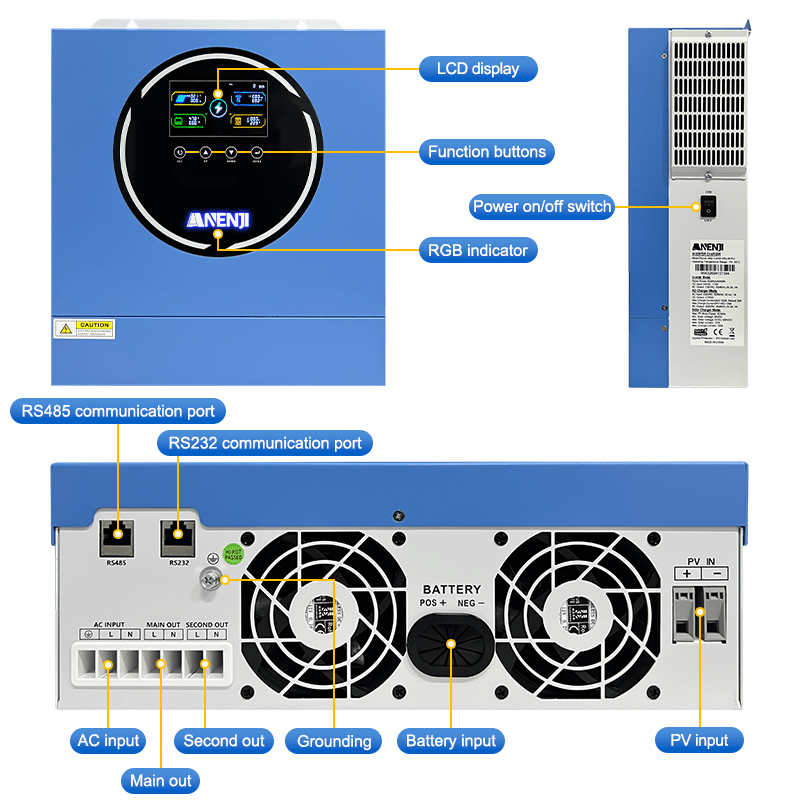
There are three interfaces: Wi-Fi for the app, RS485 for BMS communication and RS232 for a computer or an older controller. That third port looks archaic today, yet it is exactly what allows the unit to join industrial supervisory systems which still live on a serial line.
Operating conditions and where this inverter belongs
The operating range is −10 to +55 °C with humidity up to 95 % non-condensing. The 55-degree upper limit is five degrees above several smaller models in the series, which counts inside a tight technical cabinet or on a south wall during a summer heatwave.
The site profile writes itself: a house or workshop with an unstable or scheduled grid, a generator already in place, and a battery you want filled fast. Four kilowatts cover a pump, a fridge, lighting, power tools and a boiler; the five-second peak covers the inrush of that same set.
If your grid is stable and there is no generator, part of what you pay for here goes unused, and the ordinary 4.2 kW version with a lower charge current, or the 5 kW model on a 48 V bus with cheaper cabling, deserves a look instead. Write to us and we will compare both for your site.
If you own a generator and want the battery filled quickly, this model was designed for exactly that scenario. Write to us: we will check whether your set can carry a 120 A charge, work out the array that fits 27 A of tracker current, and recommend a pack that lets both charging paths run at full tilt.
Characteristics Інвертор однофазний гібридний Anenji ANJ-4.2KW-24V-W-PRO 4.2 кВт 24В WiFi
Reviews about Інвертор однофазний гібридний Anenji ANJ-4.2KW-24V-W-PRO 4.2 кВт 24В WiFi from real users
No reviews found