m. Сміла, Незалежності, 67г. оф, 406/6












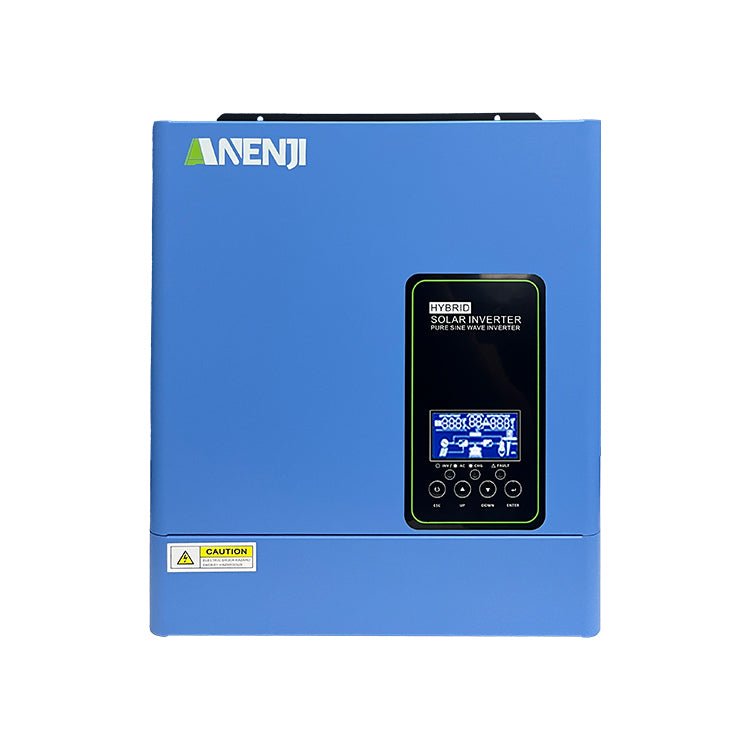
Інвертор однофазний гібридний Anenji ANJ-3KW-24V-LV-WIFI 3 кВт 24В 120В AC WiFi



Description Інвертор однофазний гібридний Anenji ANJ-3KW-24V-LV-WIFI 3 кВт 24В 120В AC WiFi
The Anenji ANJ-3KW-24V-LV-WIFI is a single-phase hybrid inverter rated 3 kW for a 24 V bus with a 110/120 V AC output. It peaks at 6000 VA, charges at up to 100 A from the panels and 80 A from the grid, accepts up to 4000 W of PV within a 60–450 V window and reaches 97 % on the solar path. It weighs 8.5 kg, carries an IP21 enclosure, Wi-Fi, RS485 and a dry contact.
A 120 V output: who this model is for
The defining feature of this inverter should be clear before you buy: it delivers 110/120 V, not the 230 V used across Europe. The LV in the model name stands for low voltage, the American and Japanese grid standard. Nominal grid voltage on the input is 120 V as well, with a permitted window of 95–140 V in the mode for sensitive equipment and 65–140 V for household loads.
The unit therefore belongs on sites where the grid standard really is 120 V, or where the load itself is built for that voltage: American power tools, medical and laboratory instruments, telecom racks with 110 V supplies, equipment on export projects. In those systems the inverter fits naturally and no converter is needed anywhere in the chain.
If your sockets and appliances are the usual 230 V, this unit will only work behind a step-up transformer, which brings its own losses, weight and cost. For that job it is more sensible to choose a 230 V model, and the same Anenji range has several, from 2.5 to 11 kW. Our honest advice: take the LV version only when your load is genuinely 120 V.
Twenty-four volts at three kilowatts: the middle ground
A 24 V battery bus sits between the simplicity of twelve volts and the efficiency of forty-eight. Three kilowatts at 24 V means about 125 amps of direct current, where 12 V would demand 250 A and 48 V only 62 A. The difference shows up in the budget: 125 amps is served by 25–35 mm² cable, half the copper of a twelve-volt system of the same power.
Twenty-four volts also stays within safe extra-low voltage, so work on the battery side needs no special qualification and a wiring mistake does not carry the consequences it would on a high-voltage bus. For a small house, a workshop or an office this is the calmest architecture available.
A 24 V bank can be built from two 12 V batteries in series or from a single 24 V pack. The second is better: one BMS balances every cell, whereas two series batteries with their own boards always drift apart in state of charge and in time become a chain whose weakest link sets the capacity of the whole system.
A 60–450 V tracker and up to four kilowatts of panels
The solar input accepts an array of up to 4000 W, a third above the inverter rating. That headroom earns its place when the system has to charge a battery as well as carry a load: in the morning the panels cover the house first and only the surplus reaches the battery. With an array sized level with the inverter, a cloudy day leaves almost nothing for charging.
The tracker window is 60–450 V, the absolute input limit is 500 V and maximum PV current is 18 A. Four kilowatts at that current implies an operating voltage near 220 V, that is a string of five or six modern modules. The gap between the 450 V working window and the 500 V hard limit is exactly the margin that cold-weather open-circuit voltage will consume.
Size that margin for January, not August. Six modules with a 49 V open-circuit rating give 294 V on a warm day and about 320 V in frost, which is safe. Nine of them would approach 490 V in January, right at the edge, and the first sunny morning at −15 °C would be the tracker last.
One hundred amps from the sun, eighty from the grid
Charge current is capped at one hundred amps from the solar path and eighty when running from the grid. On a 24 V bus that is roughly 2.4 kW and 1.9 kW respectively, so a 200 Ah bank goes from half to full in a little over two hours.
The asymmetry between the two paths is not accidental. The AC path runs through an input rectifier and transformer and is limited by its weakest stage, while the solar path works straight off the tracker. On a 120 V grid, eighty amps of charging corresponds to roughly 16 A of alternating current, which is worth remembering when you pick the breaker and the supply cable.
Battery chemistry is not stated in the supplier specification, so agree it separately: charge profiles for LiFePO₄ and for lead differ, and the choice decides whether the bank reaches its rated life. If you plan lithium, ask us about BMS communication for your particular pack — the interface list includes RS485, which is how that exchange is normally wired.
Ninety-seven per cent: the highest efficiency in the range
The 97 % figure on the solar path is the best among the single-phase models of this series, and it has a simple physical explanation. An output of 120 V is half of 230 V, so the transistors in the inverter bridge switch a lower voltage and lose less at every transition.
The battery path delivers 93 %. Those four points are the boost stage from 24 V, without which no alternating voltage can be produced at all. Under a two-kilowatt load from the battery the unit dissipates around 150 W of heat, and that heat has to go somewhere: leave clear space above and below the case.
As with any inverter, the nameplate percentages are peak values at roughly two thirds of rated load. Through a quiet night with only a fridge and a router running, the unit own consumption becomes a visible share of the bill. That is a property of all converters rather than a flaw in this model, and for systems with a small constant load a more modest inverter is the better buy.
A 65–140 V input window and ten-millisecond transfer
Transfer to battery takes 10 ms for computer equipment and 20 ms for household loads. On a 120 V grid those numbers mean what they mean on 230 V: a typical power supply holds its rail for about twenty milliseconds, so the shorter transfer passes unnoticed by a computer.
The two modes differ in their permitted input window. The narrow 95–140 V protects sensitive equipment from sags; the wide 65–140 V reduces the number of transfers where the grid is weak and the voltage regularly drops. The wider the window, the fewer battery cycles are spent, but the lower the voltage your loads will see.
The dry contact in the interface list is a small feature that is often underrated. Through it the inverter can start a generator when the battery runs low or raise a signal in a building management system. Together with Wi-Fi and RS485 it gives three independent channels: local display, telemetry and simple automation without a controller of any kind.
Enclosure, dimensions and installation conditions
At 312 × 350 × 115 mm and 8.5 kg the unit is wall-mounted on anchors into a solid wall. IP21 means indoors only: the case is protected against contact and vertical drips but not against dust or splashing, so a utility room or boiler room is fine while an open canopy is not.
The temperature range is −10 to +50 °C with humidity up to 95 % non-condensing. If the unit lives in an unheated room, watch the battery rather than the inverter: lithium packs refuse a charge at sub-zero cell temperature, and the system simply will not fill up although the inverter is in perfect order.
Control is by LCD and buttons, with no phone or laptop required: modes, voltage limits and charge current are all set from the panel. Set them on day one, because the factory values assume an average lead-acid battery rather than the pack you actually installed.
If your equipment really runs on 110/120 V, write to us: we will work out a string for the 60–450 V window and match a battery to the 100 A and 80 A limits. And if your sockets are the ordinary kind, we will say so straight away — a 230 V model from the same series beats paying for a transformer.
Characteristics Інвертор однофазний гібридний Anenji ANJ-3KW-24V-LV-WIFI 3 кВт 24В 120В AC WiFi
Reviews about Інвертор однофазний гібридний Anenji ANJ-3KW-24V-LV-WIFI 3 кВт 24В 120В AC WiFi from real users
No reviews found