m. Сміла, Незалежності, 67г. оф, 406/6













Інвертор однофазний гібридний Anenji ANJ-2500W-12V-WIFI 2.5 кВт 12В WiFi




Description Інвертор однофазний гібридний Anenji ANJ-2500W-12V-WIFI 2.5 кВт 12В WiFi
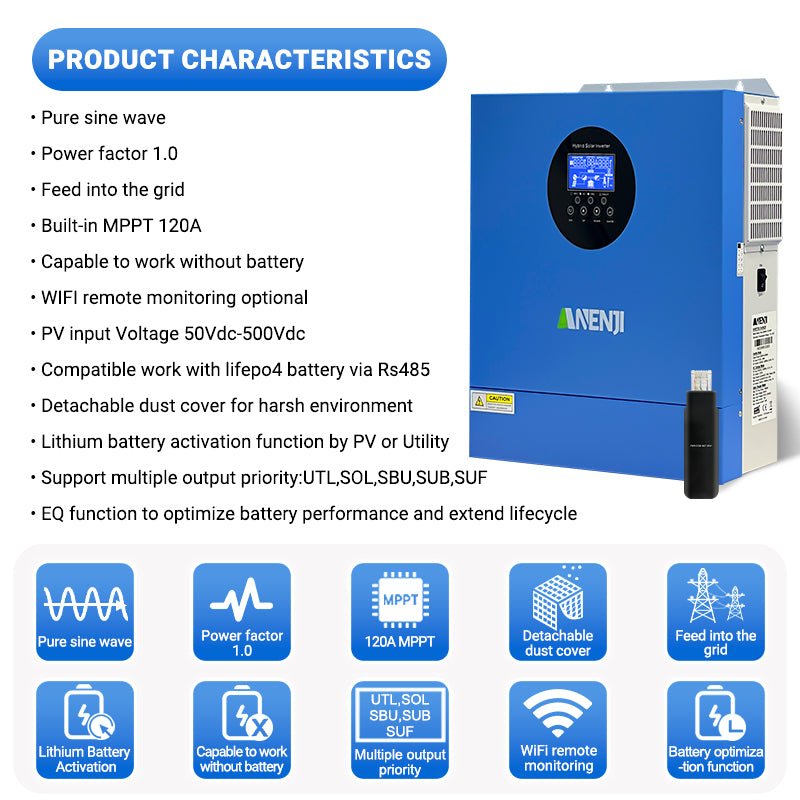
The Anenji ANJ-2500W-12V-WIFI is a single-phase hybrid inverter rated 2.5 kW for a 12 V battery bus. It peaks at 5000 VA, charges at up to 120 A, accepts a PV array of up to 3000 W within a 50–500 V window and reaches 96 % efficiency on the solar path. The IP21 enclosure weighs 6 kg, is driven from an LCD and buttons, and talks to a lithium battery BMS.
Twelve volts at 2.5 kW: the trade-off that defines this model
The most important number here is not on the label but in the arithmetic: 2500 VA at a battery voltage of 12 V means more than 200 amps of direct current on the battery side. The same power on a 48 V bus would draw roughly 52 amps, four times less. That is why 12 V inverters are rarely built above three kilowatts — beyond that the cable and the lugs cost more than the inverter itself.
The practical consequence is straightforward: keep the run from battery to inverter short and thick. At 200 amps a sensible conductor is 50–70 mm² over a length of up to two metres, with crimped rather than twisted terminals. Ten milliohms of stray contact resistance at that current produce about two volts of drop and over 400 watts of heat in the joint alone — that is no longer a loss, it is a fire risk.
So 12 V makes sense where the battery is already a 12 V bank and will stay that way: a camper, a boat, a kiosk, a guard post, a single room with a fridge and lighting. If you are building a whole-house system from scratch, look at 24 or 48 V instead — the same Anenji range offers them, and the cabling works out markedly cheaper.
Three kilowatts of panels on a 2.5 kW inverter
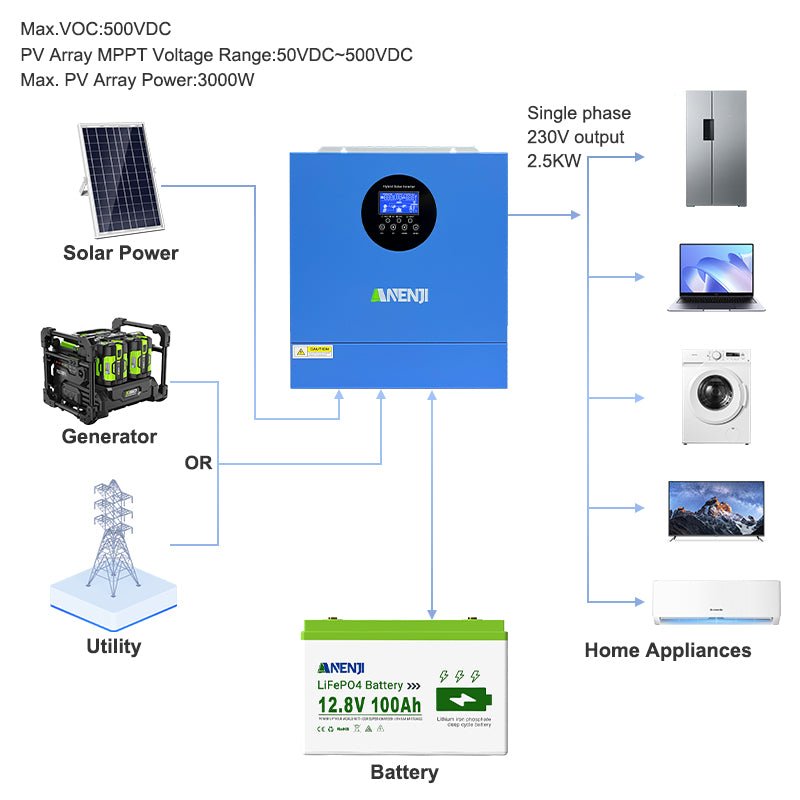
The solar input takes an array of up to 3000 W, twenty per cent above the inverter rating. That is not a manufacturer error but ordinary practice: panels deliver their nameplate figure only at clear noon and 25 °C, and spend the rest of the day between forty and seventy per cent of it. An oversized array lengthens the system day, so morning and evening yield useful watts instead of nothing.
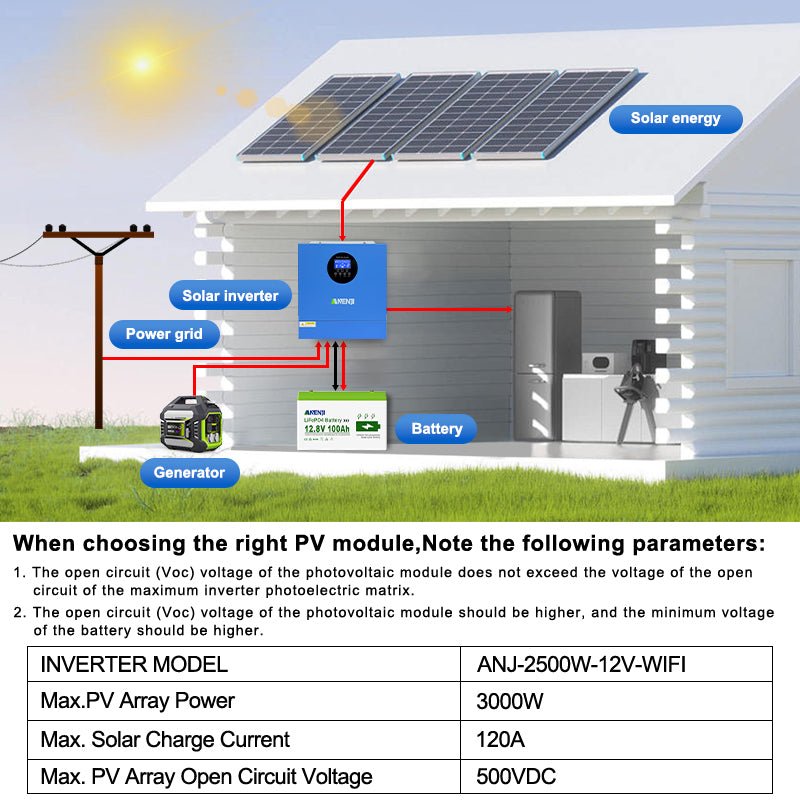
The tracker works between 50 and 500 V, the absolute input ceiling is 500 V, and the maximum PV current is 15 A. That sets a concrete wiring requirement: three kilowatts at fifteen amps implies an operating voltage near 200 V, so the modules must be wired in series rather than in parallel. Five or six modern 550 W modules make exactly such a string.
Treat the 500 V ceiling with respect. Open-circuit voltage rises by about ten per cent in the cold, so a string reading 450 V in August will comfortably show 490 V on a January morning. Six modules with a Voc near 49 V give 294 V and a calm margin; ten of them would cross the limit and ruin the tracker on the first cold morning.
Charging at up to 120 A, and a conversation with the BMS
Maximum charge and discharge current is 120 A, and the inverter can draw the same from the grid. At twelve volts that is about 1.4 kW of exchange with the battery: from the grid or from the panels, a 200 Ah bank goes from half to full in roughly an hour.
There is a caveat worth knowing before you buy. One hundred and twenty amps is what the inverter can do, not a licence for any battery. For a 100 Ah lithium pack that current is 1.2 C, while most 12 V LiFePO₄ packs are limited to half their capacity per hour, that is 50 A. Charge current is set in the menu and must follow your battery datasheet, not the inverter maximum.
The BMS link removes most of that worry. The inverter sees real state of charge, temperature and permitted currents instead of guessing the pack state from terminal voltage. The battery itself asks for less current in the cold or for the charge to stop, which saves a pack from the slow degradation that voltage alone never reveals.
Ten-millisecond transfer and a wide grid window
Transfer to battery takes 10 ms in the mode for computer equipment and 20 ms in the appliance mode. The figure has physical meaning: the capacitors in an ordinary PC power supply hold the rail for about 16–20 milliseconds, so at ten milliseconds the machine never notices the outage. Fridges, pumps and boilers tolerate longer gaps, which is why the wider mode is allowed for them.
The modes differ in more than speed: the permitted input window is 170–280 V for sensitive equipment and 90–280 V for household loads. On a weak rural grid the wide window means fewer transfers and fewer battery cycles spent, but also that a sagging voltage reaches your loads. For a server rack or medical equipment the narrow mode is the right choice.
Both 50 and 60 Hz are accepted, so the unit runs happily from a generator. Just cap the charge current from the AC input: a two-litre petrol genset asked to carry the house and push 120 A into the battery at the same time will simply stall. One and a half to two kilowatts of charging is a realistic ceiling for a typical domestic set.
96 % from the sun, 93 % from the battery
Two different figures describe two different paths through the machine. With power coming from the panels the current passes the tracker and the inverter bridge, hence 96 %. With the battery working, 12 V has to be stepped up almost twenty times, and that extra boost stage costs another three per cent.
In watts it looks like this: under a two-kilowatt load from the battery the unit dissipates around 150 W of heat. That is noticeable for a wall-mounted case, so leave clear space above and below it, and provide at least passive ventilation inside a tight cabinet.
Remember too that nameplate percentages are peak values at optimal load, around two thirds of rating. If a 2.5 kW inverter spends the night carrying only a 150 W fridge, real efficiency will be lower and the unit own consumption becomes a visible share of the bill. For standby duty with small loads, size the inverter closer to the real load.
Enclosure, mounting and what is actually in the box
At 327 × 368 × 121 mm and 6 kg the unit hangs on an ordinary wall without reinforcement — sound anchors into concrete or brick are enough. IP21 means indoors only: the case stops neither dust nor splashes, so a yard canopy or an unheated gazebo is out of the question.
The operating range runs from −10 to +55 °C with humidity up to 95 % non-condensing. An unheated garage in winter already sits at the edge of the datasheet, and a warm cabinet is worth having there: in frost it is not so much the electronics that give up as the lithium battery willingness to take a charge.
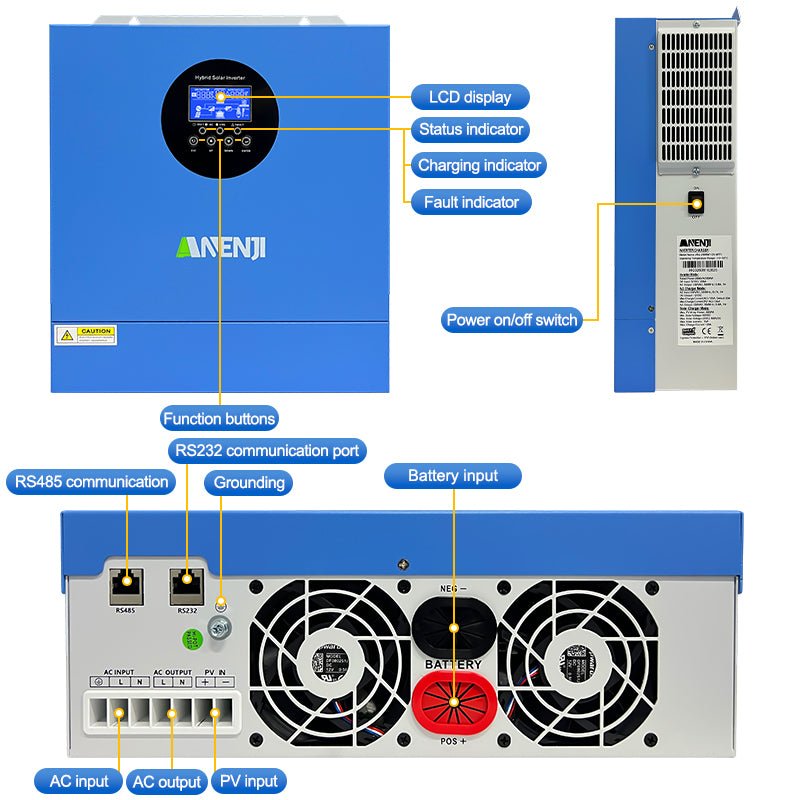
Control is by LCD and buttons, with RS232 and RS485 for telemetry. Wi-Fi appears in the specification as an optional module even though the model name carries the letters WIFI, so confirm whether the dongle is included in your particular shipment. If remote monitoring is part of the plan, settle that question before ordering rather than hunting for the module later.
If you are unsure whether your battery can take 120 A of charge, or how to build a string that fits the 50–500 V window, write to us. We will size the cable, work out a configuration for your site and say plainly if a 24 V or 48 V model would serve you better.
Characteristics Інвертор однофазний гібридний Anenji ANJ-2500W-12V-WIFI 2.5 кВт 12В WiFi
Reviews about Інвертор однофазний гібридний Anenji ANJ-2500W-12V-WIFI 2.5 кВт 12В WiFi from real users
No reviews found