m. Сміла, Незалежності, 67г. оф, 406/6













Інвертор однофазний гібридний Anenji ANJ-11KW-48V-WIFI-P 11 кВт 48В WiFi паралельний

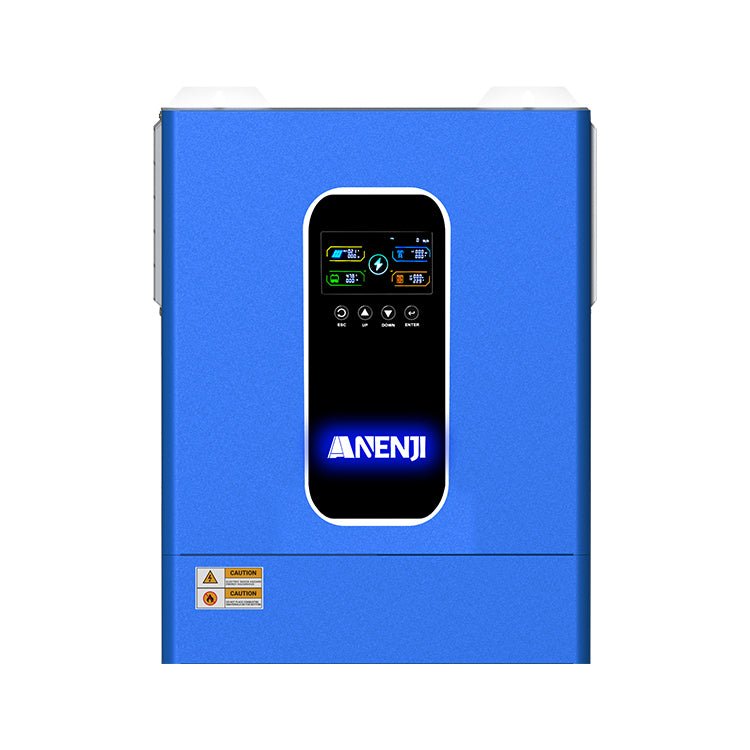


Description Інвертор однофазний гібридний Anenji ANJ-11KW-48V-WIFI-P 11 кВт 48В WiFi паралельний
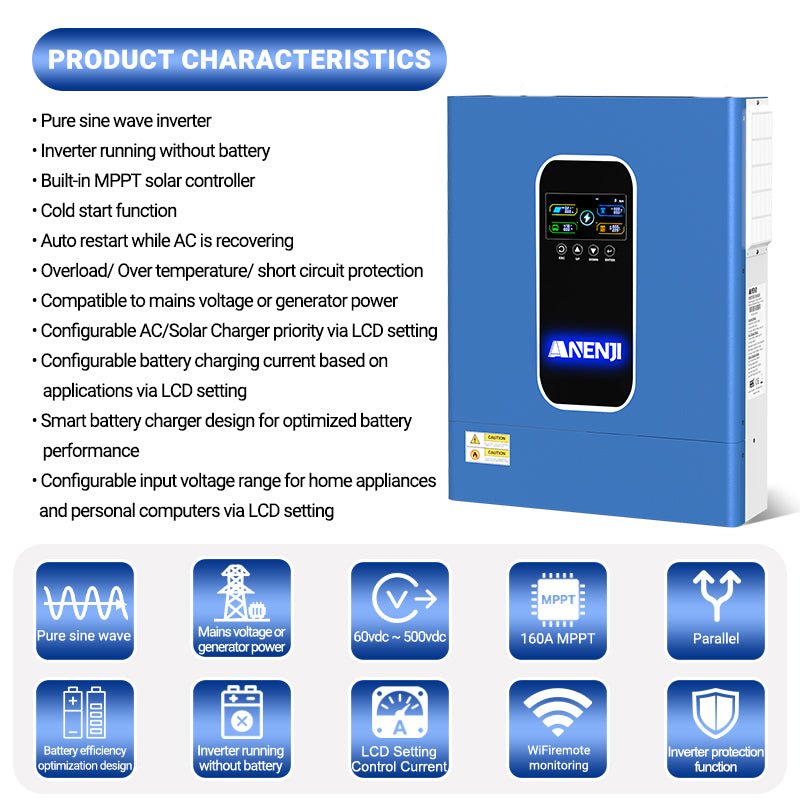
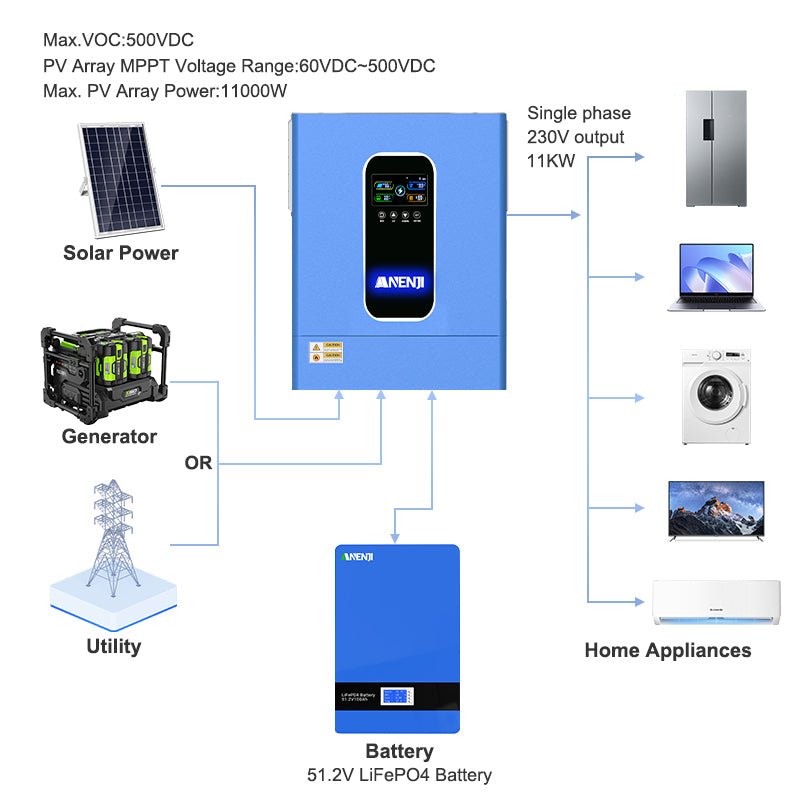
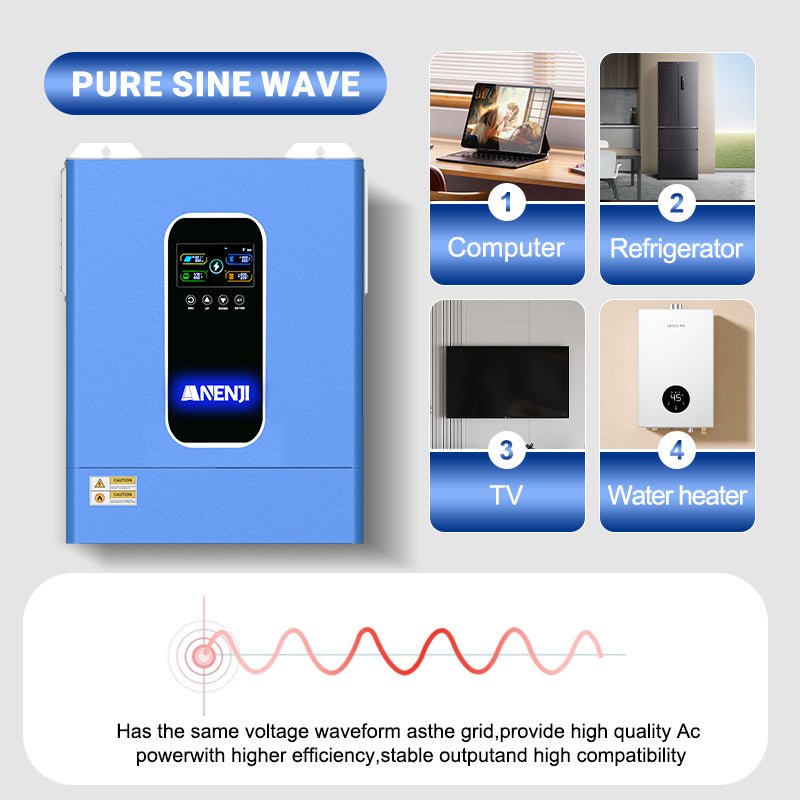
The Anenji ANJ-11KW-48V-WIFI-P is a single-phase hybrid inverter rated 11 kW for a 48 V bus with a 230 V ±5 % output that can be paralleled up to six units. It peaks at 22,000 VA, has two trackers of 18 A each, accepts an array of up to 11,000 W (5500 W per channel) and charges at up to 160 A from the panels and 120 A from the grid. It supports a generator, LiFePO₄ and AGM or GEL lead batteries, and carries CE certification. Weight 14.8 kg, warranty 12 months.
Six units in parallel: 66 kilowatts from single-phase blocks
The P in the model name stands for parallel operation, and the interface list states a parallel port for up to six units outright. Six blocks of eleven kilowatts give sixty-six, enough for a small production site, a hotel, a farm with refrigeration, or a service station.
Parallel capability is valuable not only for the power but for the way that power is acquired. A system can start with one inverter sized for today and gain a second or a third a year or two later as load or budget grows. All blocks work onto one battery bus and one output line, sharing the load between them.
There is a less obvious benefit as well: redundancy. If one unit fails, the others pick up its share of the load and the site does not stop altogether, it merely loses some capacity. For cold stores, a server room or an incubator, that behaviour is worth more than any efficiency figure.
Before planning a multi-block system, three conditions matter: every inverter must be the same model on the same firmware version, the battery bus must carry the combined current of all blocks, and the proper cable set is needed for communication between them. We confirm the supported number of units for your particular shipment with a document from the manufacturer — ask us and we will send it before payment.
Two trackers of 18 A: the string has to be high-voltage
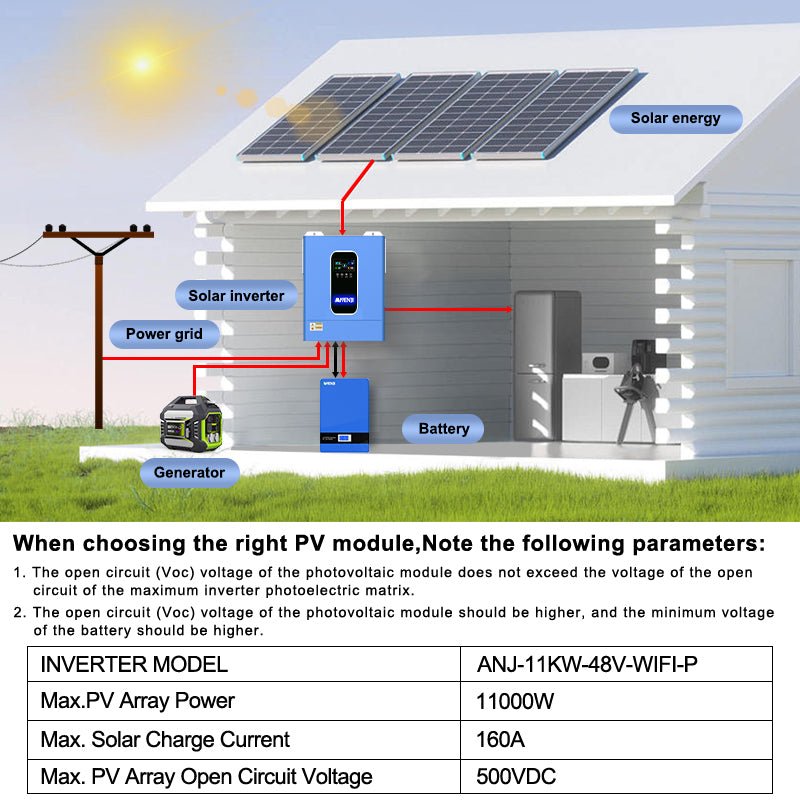
The inverter has two independent MPPT inputs with one string each, a maximum of 18 A per input and an array of up to 11,000 W, 5500 W per channel. The current here is lower than in the related HHS model, which allows 27 A per input, and that directly dictates the array layout.
The arithmetic is unambiguous: 5500 W at 18 amps implies a working voltage near 305 V. Each channel is therefore a series string of eight to ten modern modules, and paralleling two branches within one tracker is not an option here. The 60–500 V tracker window handles that voltage comfortably.
Check the margin to the 500 V ceiling in frost. Ten modules with a 49 V open-circuit rating give 490 V on a warm day, which is already too much, because January adds another ten per cent. The safe configuration is eight or nine modules per string, which is exactly what the rated 5500 W per channel implies.
Two separate trackers, as in the larger model, free you from making the roof slopes identical: the east and west planes live their own lives, each at its own operating point.
A generator, two battery chemistries and CE certification
Generator support appears as a separate line in the specification. For an eleven-kilowatt system that is logical: such sites rarely live on sun and grid alone, and a genset is usually already there. The inverter accepts the less stable voltage and frequency of an engine-driven set and does not trip at every swing in speed.
Two battery types are supported: LiFePO₄ and lead-acid AGM or GEL. That is rare flexibility in the eleven-kilowatt class, and it lets an existing lead bank serve at the start and be replaced with lithium later without changing the inverter. The battery type must be selected in the menu, because the charge profiles differ and a mistake here costs cycle life.
Among the documents the specification names CE certification. For a commercial site that is not a formality: without CE marking the equipment is hard to put through official channels, from connection to insurance and inspections.
Together these three points describe the intended customer more precisely than any marketing phrase: a site with a generator, an existing battery and a need for paperwork — a small business rather than a holiday cottage.
Charging at 160 A and what it means for the battery bus
Charge current is 160 A from the panels and 120 A from the grid, about 7.7 and 5.8 kilowatts on a 48 V bus. For a single unit that means a 15 kWh battery fills in two hours of sun or two and a half from the grid.
In a parallel system those currents add up, and this is where most mistakes happen. Three inverters will push up to 480 amps into a shared battery, and no 100 Ah pack accepts that. For a multi-block system the battery is sized by permitted current rather than by capacity: parallel modules under a common BMS, or an industrial pack rated for the corresponding amps.
The same logic applies to discharge. Eleven kilowatts at 48 volts is about 230 amps, and three units at full load will ask for some seven hundred. The copper, the protection devices and the batteries themselves have to be rated for that figure, otherwise the system will be limited not by the inverters but by the storage behind them.
The BMS channel is provided and in a parallel configuration it is mandatory: this is how the pack reports its permitted currents, and it is what stops three units from simultaneously demanding more than the battery can deliver.
A 230 V ±5 % output and a 90–280 V grid window
Output voltage accuracy is quoted as ±5 %, that is 218.5 to 241.5 volts. For household appliances that is a comfortable corridor, and for equipment with power-quality requirements it is a parameter worth comparing between inverters, because cheap units often say nothing about it at all.
The grid input window has two modes: 170–280 V for sensitive equipment and 90–280 V for household loads. The wide mode saves the day where rural voltage regularly sags to a hundred and seventy or below: the inverter does not transfer to battery every half hour and therefore does not spend cycles on fluctuations that appliances would survive anyway.
Both 50 and 60 Hz are accepted. Combined with generator support that means the system runs happily from an imported 60 Hz set as well as from an old diesel with wandering speed, a situation typical of industrial yards.
What this specification does not state is the transfer time to battery. In sibling units of the series it is 10 ms for computer equipment and 20 ms for household loads, but we will not quote a figure absent from the supplier documents. If that parameter is critical for your equipment, we will request official confirmation.
Enclosure, heat and installation
At 403 × 540 × 122 mm and 14.8 kg this is a large wall-mounted unit needing a solid wall and proper anchors rather than plugs in plasterboard. In a parallel system allow for spacing between blocks too: three inverters side by side need not only room but free air between their heatsinks.
An efficiency of 94 % at full load means about 660 W of heat per unit. For a three-block system that is nearly two kilowatts, so the room needs considered ventilation and possibly forced air in hot weather. This is not an Anenji peculiarity but the arithmetic of any system of that size.
Rated conditions are −10 to +55 °C and up to 95 % humidity without condensation. The 55-degree upper limit is particularly welcome here precisely because of dense multi-block mounting: in a cramped technical room the air easily reaches forty in summer.
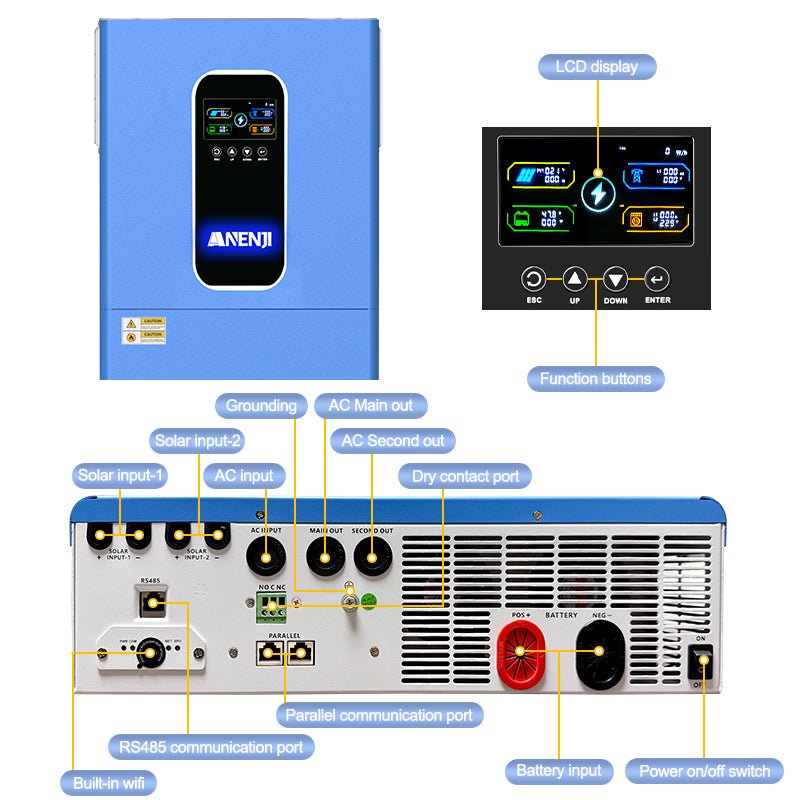
Interfaces are Wi-Fi, RS485, a dry contact and the parallel port. The dry contact is best devoted to automatic generator starting and RS485 to the battery; the Wi-Fi app shows the state of the whole system, including how load is shared between blocks.
When to choose this model and when its sibling
If you need eleven kilowatts now and never more, the simpler HHS model of the same power delivers the same for less money, and with 27 A per tracker instead of 18, which makes array design more flexible.
If, however, there is any chance the capacity will have to grow, or if the site has no right to stop, the parallel version earns the difference back. A second block joins without rebuilding the battery side and without replacing the first inverter, and redundancy arrives as a by-product.
A third scenario is replacing a three-phase service with single-phase blocks. Where a three-phase connection costs as much as half the system, three parallel single-phase inverters sometimes work out cheaper than a three-phase unit plus the service upgrade. That calculation is always individual, and we do it with you before recommending anything.
A parallel system is always a plan for several years ahead, and it is cheaper to get right from the first block. Write to us: we will work out how many units your battery must match, lay out strings for 18 amps per tracker, and confirm in writing how many units may be paralleled.
Characteristics Інвертор однофазний гібридний Anenji ANJ-11KW-48V-WIFI-P 11 кВт 48В WiFi паралельний
Reviews about Інвертор однофазний гібридний Anenji ANJ-11KW-48V-WIFI-P 11 кВт 48В WiFi паралельний from real users
No reviews found