m. Сміла, Незалежності, 67г. оф, 406/6












Інвертор однофазний автономний Anenji ANJ-3600W-LVP-WIFI 3.6 кВт 48В 120В AC WiFi

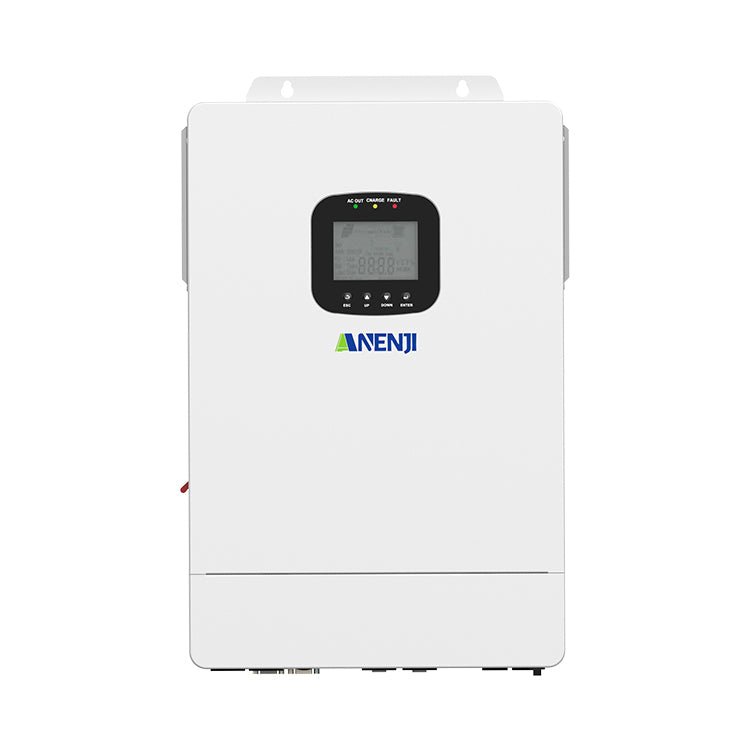


Description Інвертор однофазний автономний Anenji ANJ-3600W-LVP-WIFI 3.6 кВт 48В 120В AC WiFi
The Anenji ANJ-3600W-LVP-WIFI is a single-phase off-grid inverter rated 3.6 kW for a 48 V bus with a 120 V AC output. It peaks at 7200 VA, accepts up to 4000 W of PV within a 90–260 V window capped at 300 V, charges at up to 80 A from the panels and 40 A from the grid, and transfers in 10 ms. Forced cooling with variable fan speed, noise up to 60 dB, 7.8 kg.
Off-grid rather than hybrid: what that means in practice
The specification lists this model as off-grid, and the label is not a formality. An off-grid inverter builds its own supply from battery and panels and uses the utility only as a charging source and a bypass. It never exports a surplus and never runs in parallel with the grid: the grid is a backup, not a partner.
On site that produces simple, predictable behaviour. Sun and battery always come first; the grid steps in only when the battery runs down or the load exceeds what the inverter can carry. Where there is no grid at all — a remote plot, a telecom mast, a farm, an apiary — this architecture is the only one available and the most dependable.
If your goal is a smaller electricity bill on a stable grid, however, the off-grid topology serves you worse than a hybrid: it cannot export under a feed-in tariff and cannot blend sources as flexibly. The same Anenji range includes 230 V hybrids that suit an ordinary town house better. We say so plainly so that you do not pay for features you will never use.
A low-voltage array: a 90–260 V window and a 300 V ceiling
The most unusual part of this inverter is its solar input. The tracker works in a narrow 90–260 V window and the absolute input ceiling is only 300 V, where most modern units accept 500 V and more. In practice that means a string of four or five modules, no more.
Count it on real panels. Five modern modules with an open-circuit rating near 49 V give 245 V on a warm day and about 270 V in frost, still inside the limit. Six modules would cross 300 V in January and destroy the input, so five is the safe boundary. To reach the rated 4000 W the strings are wired in parallel, which is exactly why the maximum PV current here is a high 22 A.
The architecture has a genuine strength as well. A low array voltage makes the system safer to service and less sensitive to partial shade: each parallel string sags on its own instead of dragging the whole array down. The price is thicker DC cable — at 22 amps over a long run, size the conductor generously.
Forty-eight volts with a 40–60 V window
For the battery side the manufacturer states not only the 48 V nominal figure but the real operating range of 40–60 V. That is useful precision: your pack has to stay inside those limits in every mode, from deep discharge to the end of charge.
A lithium pack of sixteen LiFePO₄ cells is nominally 51.2 V and works from roughly 44.8 to 57.6 V, comfortably inside the window. A lead bank of four 12 V batteries lives between 42 and 58 V and also fits. The inverter officially supports both chemistries, lead-acid and lithium-ion.
The 40 V lower limit matters for another reason: it means the inverter will not shut down before the battery is genuinely deeply discharged. On a lithium pack you therefore have to set the cut-off by hand, because 40 V across sixteen cells is 2.5 V per cell, far below where LiFePO₄ should be taken if you care about cycle life.
Eighty amps from the sun, forty from the grid
Charge current is limited to eighty amps on the solar path and forty from the grid. On a 48 V bus that is about 3.8 kW and 1.9 kW respectively: from the panels a 10 kWh battery fills in under three hours of clear sun, from the grid in roughly five.
Halving the AC charge current is a reasonable choice for an off-grid design: here the grid is a reserve rather than the main source, so the input stage is built smaller and cheaper. On a 120 V supply forty amps of charging corresponds to about 16 A of alternating current, a modest demand even for a weak service or a small generator.
That ratio is what makes this model a good match for sites with a generator. When the set starts it can carry the load and push a moderate 1.9 kW into the battery without stalling. The dry contact in the interface list lets the inverter start the generator automatically on a deep discharge — on an unattended site that detail decides everything.
Above 91 %: the honest cost of an off-grid topology
Rated efficiency in inverter mode is above 91 %, the most modest figure in the Anenji family. The reason is design rather than quality: an off-grid circuit with a 120 V output and a wide battery window loses more than a narrowly specialised grid-tied converter.
Work the consequence out in watts before you install it. At the full 3.6 kW load, losses of about nine per cent produce more than 300 W of heat, comparable to a small oil radiator running continuously. That is precisely why this unit has forced cooling instead of a passive heatsink.
The gap against the hybrids in the same series is noticeable: their solar path reaches 96–97 %. If your grid is stable and efficiency is what you are buying, that argues for a hybrid. If there is no grid at all, 91 % is a fair price for a system that works without one.
Variable-speed cooling and sixty decibels
Cooling is forced, with fan speed regulation, so the unit does not roar from the first minute but raises its speed as it warms up. At light load it is nearly silent, and that matters more than it sounds: most of the time a system runs far below its rating.
Rated noise is up to 60 dB. For scale, that is roughly a person speaking in a calm conversation a metre away. In a utility room, a boiler room or a garage it is a non-issue, but next to a bed or in a small flat you will hear it, which is worth weighing when you choose the spot.
The operating temperature range here is the widest in the family: −15 to +55 °C. For an unheated room that is a real advantage, although the battery remains the weak link — lithium refuses a charge at sub-zero cell temperature no matter how cold-tolerant the inverter itself may be.
Certification, communication and what the display shows
Declared documents include CE to IEC 62109–1 and IEC 62109–2 and conformity with the EN 61000 series for electromagnetic compatibility. For a site that means the unit will not fill the neighbourhood with radio interference and will pass a formal check at connection.
Interfaces are USB, RS485, a choice of Wi-Fi or GPRS, plus a dry contact. The GPRS option is particularly valuable on remote sites: where there is no internet to attach Wi-Fi to, telemetry travels over the mobile network and you can see the system state without driving out to it.
Control is by LCD with touch keys rather than mechanical buttons. At 280 × 415 × 100 mm and 7.8 kg the unit is among the most compact in its power class, so it will fit even a shallow technical cabinet — provided you leave room for the fan.
An off-grid system deserves an honest calculation: how many hours without the grid it must cover, and what exactly it has to run. Write to us and we will size an array for the narrow 90–260 V window, a battery for the 40–60 V range, and tell you if a 230 V hybrid would serve you better.
Characteristics Інвертор однофазний автономний Anenji ANJ-3600W-LVP-WIFI 3.6 кВт 48В 120В AC WiFi
Reviews about Інвертор однофазний автономний Anenji ANJ-3600W-LVP-WIFI 3.6 кВт 48В 120В AC WiFi from real users
No reviews found