m. Сміла, Незалежності, 67г. оф, 406/6











Інвертор однофазний Anenji ANJ-HHS-11KW-48V-WIFI 11 кВт 48В WiFi



Description Інвертор однофазний Anenji ANJ-HHS-11KW-48V-WIFI 11 кВт 48В WiFi
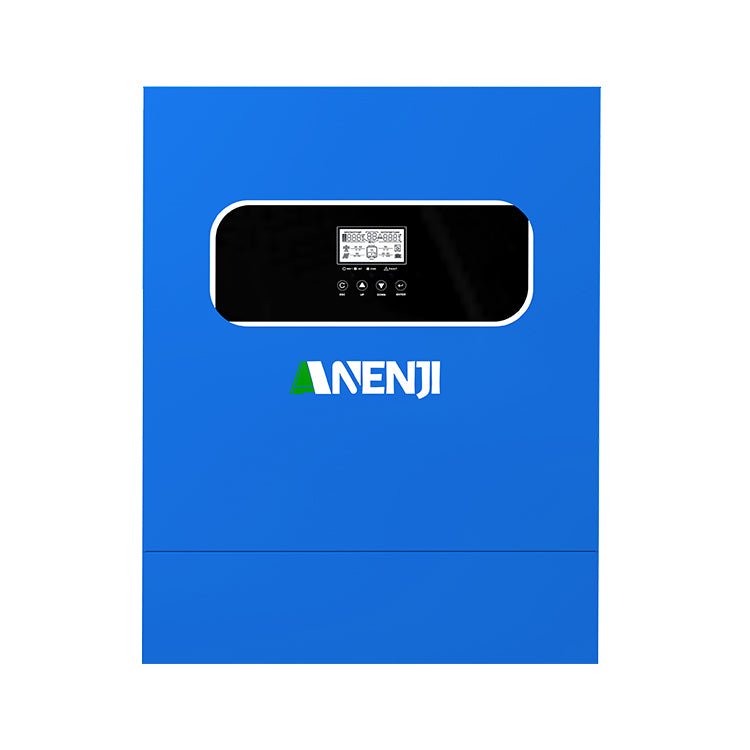
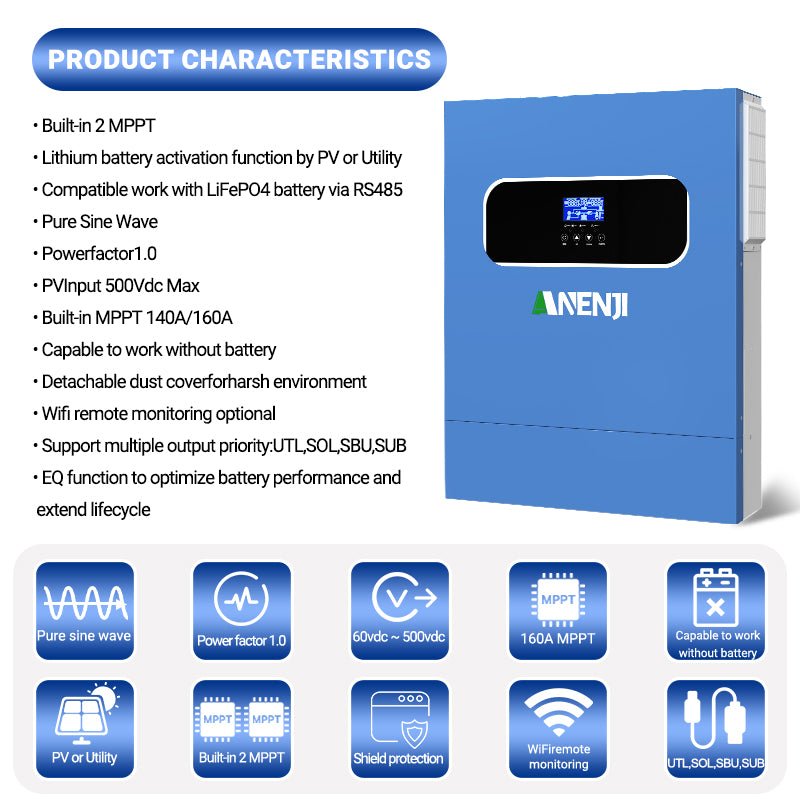
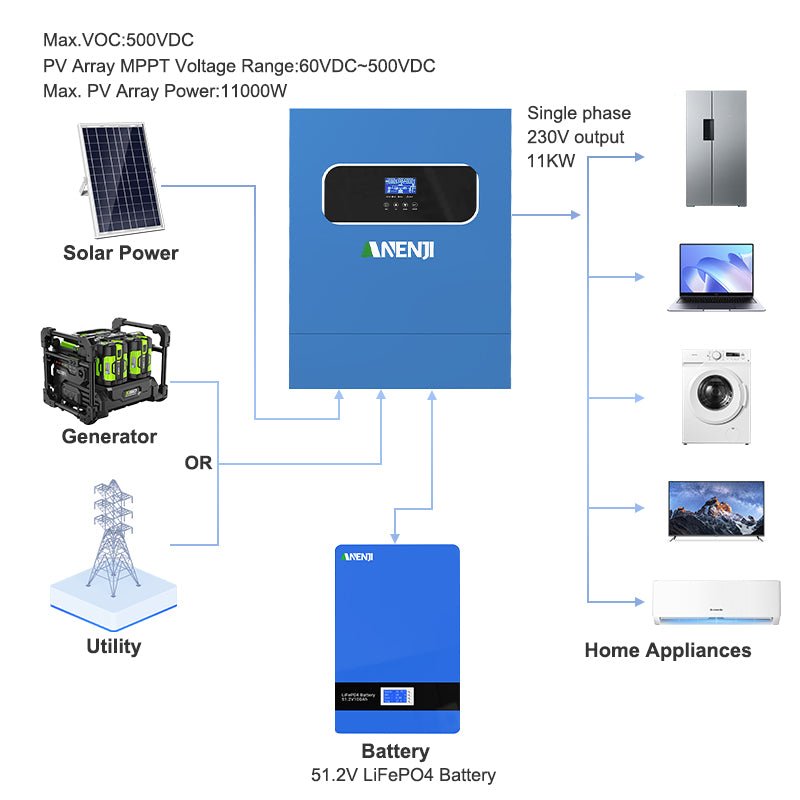
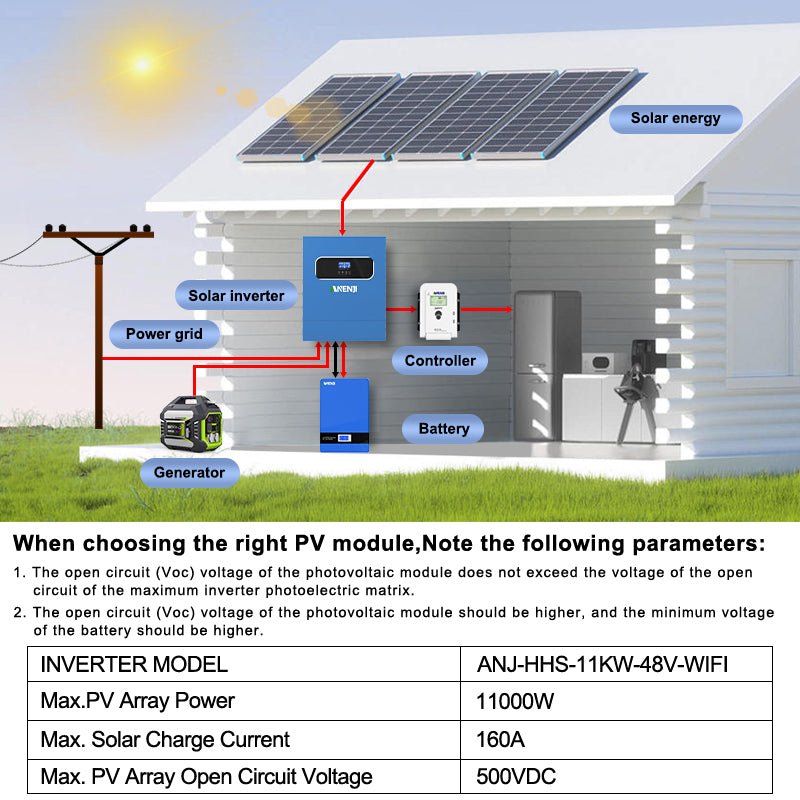
The Anenji ANJ-HHS-11KW-48V-WIFI is a single-phase inverter rated 11 kW for a 48 V bus with a 220, 230 or 240 V output. It peaks at 22,000 VA, carries two independent trackers of 27 A each, accepts an array of up to 11,000 W (5500 W per channel) in a 60–500 V window and charges at up to 160 A from the panels and 120 A from the grid. Rated 94 % efficient, 10 ms transfer, 15 kg.
Eleven kilowatts on one phase: the ceiling of the genre
Eleven kilowatts is roughly the ceiling for single-phase inverters, and the reason is purely electrical. At 230 V that power means 48 amps of output current, which calls for a 10 mm² line and a 50 A breaker. Beyond this point a single-phase design stops making economic sense and manufacturers move to three phases.
Before settling on this model, check your own connection. A typical single-phase service to a private house is contracted for 5–10 kW, and eleven kilowatts of load will simply exceed it — protection will trip on the utility side rather than on the inverter. If the power is wanted for solar generation and battery rather than for drawing from the grid, the issue disappears, but it is worth discussing before installation.
Where eleven kilowatts really are needed, this model covers a whole house with no division into important and unimportant circuits. Air conditioners, a water heater, an electric hob, a pump, power tools in the workshop all run at once, and nobody has to teach the family to switch off the iron while the washing machine runs.
Two hundred and thirty amps on the battery bus
The most important number to work out before buying does not appear on the datasheet. Eleven kilowatts at a battery voltage of 48 V means about 230 amps of direct current in the discharge path. That is a serious current: it calls for 2 × 70 mm² cable or a copper busbar, crimped lugs and short runs, because every few milliohms of contact resistance turn into tens of watts of heat at the terminal.
The second demand falls on the battery itself. Most ready-made 48 V 100 Ah lithium packs allow a continuous discharge of around 100 amps. To pull a full eleven kilowatts from such a system you need three modules in parallel rather than one: otherwise the BMS will curtail power exactly when it matters most and the house will sag on every motor start.
This arithmetic is not a flaw in the inverter but a consequence of choosing a 48 V bus for high power. The manufacturer deliberately stayed within safe extra-low voltage, where installation is simpler and batteries cheaper. The price is copper and the number of battery modules, and that part of the budget has to be planned from the start.
Two trackers of 27 A: a roof without compromises
The inverter has two independent MPPT inputs with one string each, a maximum of 27 A per input and a total array of up to 11,000 W, 5500 W per channel. Two trackers mean the roof slopes no longer have to match.
In practice this solves the commonest problem on real sites. An east and a west slope, different tilts, different module counts, even different panel models: each channel follows its own operating point and does not drag the other down. The system picks up generation in the morning on the east side and catches up in the evening on the west, producing a flatter curve rather than one midday peak.
Each channel accepts 5500 W, which is exactly ten modern 550 W modules. Ten modules in series give around 410 V of working voltage at 13–14 amps, so both the 60–500 V window and the 27 A limit are met with a generous margin. A frosty morning adds about ten per cent to open-circuit voltage, and even then there is room left before the 500 V ceiling.
Charging at 160 A: the fastest in the family
Charge current is 160 A on the solar path and 120 A from the grid. On a 48 V bus that is about 7.7 kW and 5.8 kW, the highest figures among the single-phase Anenji models. A 15 kWh battery fills in two hours from the sun or two and a half from the grid.
For life under rolling outages this is the decisive specification. When power is on for two hours, the unit can put more than ten kilowatt-hours into the battery, leaving the window with a full reserve rather than half of one. No efficiency figure delivers the practical effect that an adequate charge current does inside a narrow window of grid availability.
But 160 A imposes the same demand as discharge: the battery must be able to take it. For a 100 Ah pack that is 1.6 C, forbidden almost everywhere; a realistic system behind this inverter means three or four parallel modules under a common BMS, or an industrial 300 Ah pack. The BMS communication channel is provided here and wiring it is not optional.
Twenty-two thousand volt-amperes for starting
The 22,000 VA peak is exactly double the rating. In this class that means the inverter starts equipment ordinary domestic systems will not even attempt: a three or four kilowatt borehole pump with direct-on-line starting, an industrial compressor, a woodworking machine.
The double headroom works for the seconds of starting, and that should be read literally. The unit will not hold a continuous load above eleven kilowatts; thermal protection will intervene. But a brief surge to eighteen or twenty kilowatts, typical of a large motor starting, passes without a trip.
The unit switches to battery in 10 ms on the computer setting and 20 ms on the household one. For an eleven-kilowatt system that means even at full load the loss of mains upsets neither computers, nor a server rack, nor the control electronics of a boiler.
What the specification does not contain
Let us be open about the gaps. The supplier data for this model does not state the permitted grid input voltage range, whereas sibling inverters do quote one: 170–280 V for sensitive equipment and 90–280 V in household mode. On a site with a weak grid that is an important parameter and we are clarifying it with the manufacturer.
The specification also omits the device type and the warranty term. By its feature set — solar input, battery, grid, BMS communication — this is a classic hybrid and behaves as one; but we do not write into a description what the supplier documents do not contain.
The letters HHS in the model name denote the manufacturer series rather than a separate function. If your project needs documentary confirmation of a particular parameter, write to us and we will request an official letter from Anenji instead of offering assumptions.
Enclosure, heat and where to put it
At 415 × 540 × 122 mm and 15 kg the unit is noticeably larger than the smaller models and needs a solid wall. Two trackers, a substantial power stage and a large heatsink do not fit into a compact case, and that is the normal price of eleven kilowatts.
An efficiency of 94 % at full load means about 660 W of heat. That is the output of a small electric heater running continuously, so the technical room for such a system has to be ventilated rather than sealed. In a cramped boiler room in summer the unit will heat itself into power limiting.
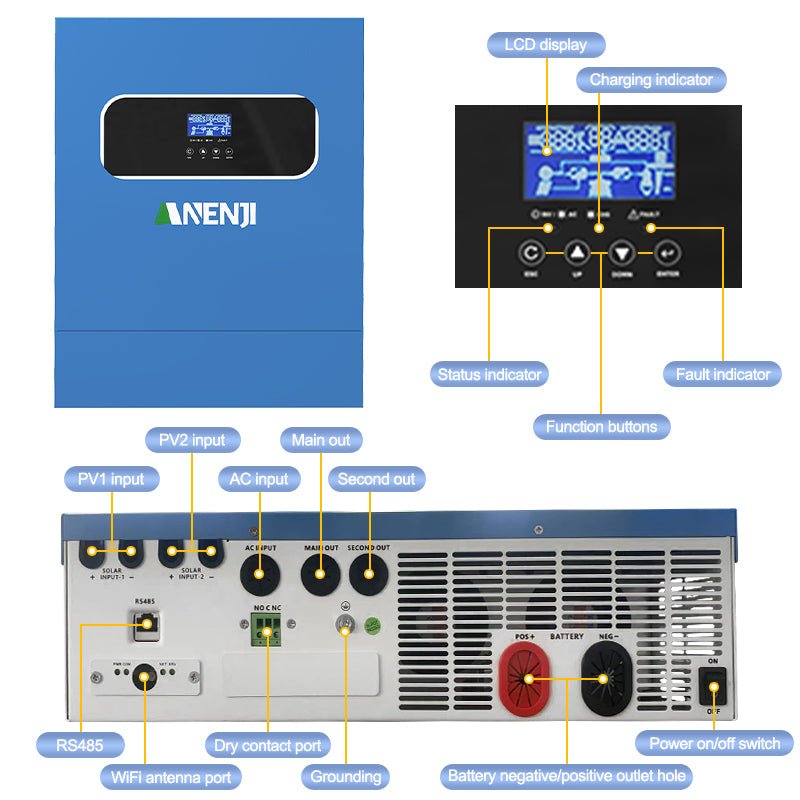
The datasheet allows operation from −10 to +50 °C at humidity up to 95 % without condensation. Interfaces are Wi-Fi, RS485 for the battery and a dry contact for automation: enough both for the phone app and for starting a generator on a deep discharge.
Eleven kilowatts on a 48 V bus demand the right battery and the right copper, and that is exactly where projects usually break. Write to us: we will size the battery side for 230 amps of discharge, split the array across two 5500 W trackers and tell you whether your service can carry such a system.
Characteristics Інвертор однофазний Anenji ANJ-HHS-11KW-48V-WIFI 11 кВт 48В WiFi
Reviews about Інвертор однофазний Anenji ANJ-HHS-11KW-48V-WIFI 11 кВт 48В WiFi from real users
No reviews found