
 m. Сміла, Незалежності, 67г. оф, 406/6























REOLINK NVS12W 2TB (12 CHANNELS, WI-FI 6) - WIRELESS VIDEO RECORDER





Description Reolink NVS12W 2TB
A Wi-Fi recorder is a different class of device: there is no PoE at all
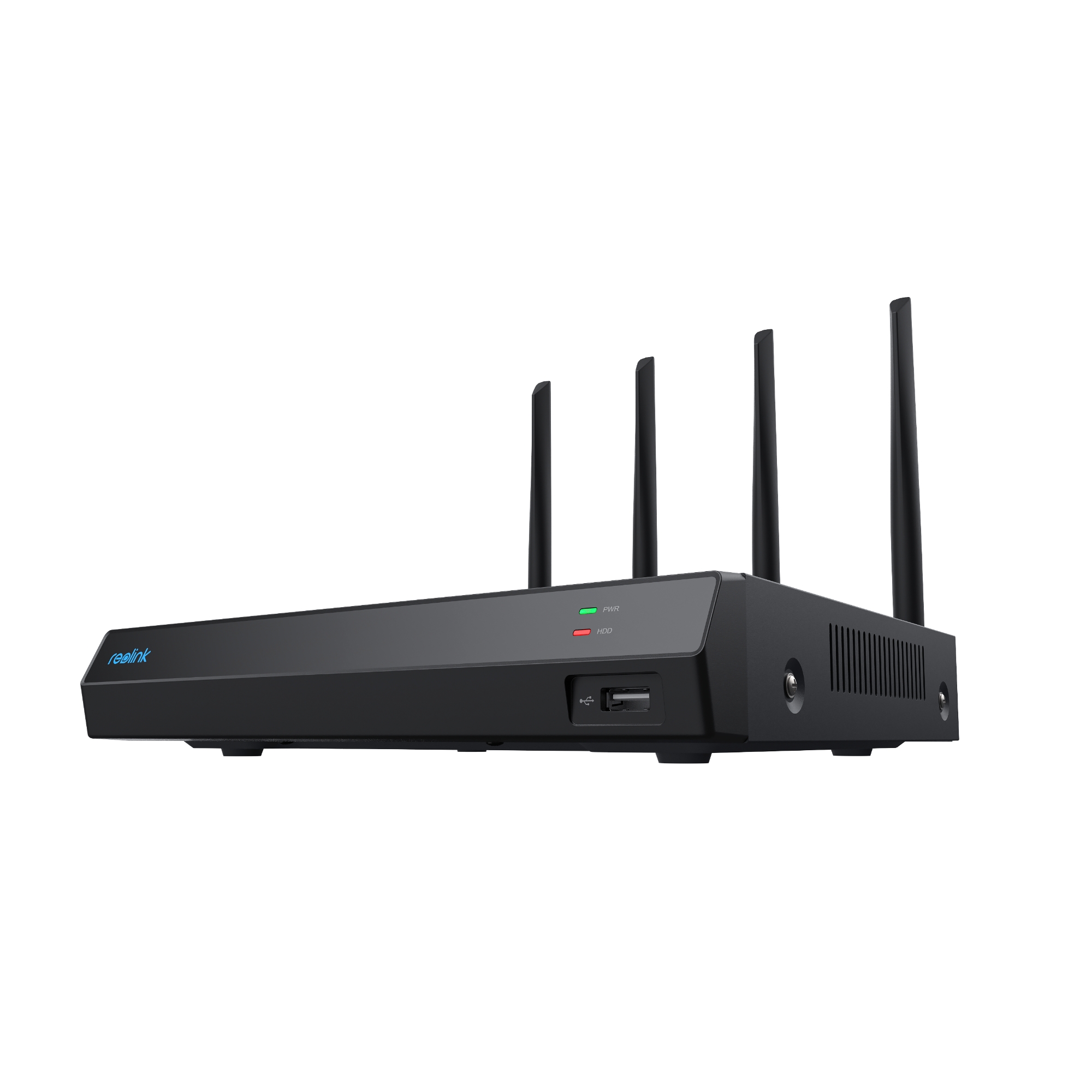
The first thing to know about the NVS12W is that it has no PoE ports whatsoever, and that is the point of the model rather than an oversight. The four RJ-45 sockets on the rear are meant for cameras but carry no power, so every wired camera plugged in here needs its own 12 V supply at the mounting point. The remaining channels arrive over the air: the recorder is itself a Wi-Fi access point and pairs with cameras directly, without the household router and without pulling cable. That is exactly why people buy it — it covers situations where chasing walls or trenching a cable across the yard is impossible or absurdly expensive. If the building is new and cable can realistically be run, the honest advice is to choose a PoE recorder instead, because copper is steadier than radio and spares you a socket beside every camera.
Four antennas, 2.4 and 5 GHz, WPA3: what the coverage really reaches
The unit speaks 802.11a/b/g/n/ac/ax, meaning full Wi-Fi 6 on both bands — 2.4 GHz for reach and 5 GHz for throughput. Four external high-gain antennas are rated by the manufacturer for roughly 1,000 square metres, a figure measured in open space with nothing in the way. Inside a real house you halve it at least: a brick wall takes a slice of the signal, a reinforced concrete floor or foil-backed insulation takes most of it, and metal gates or sandwich panels smother 5 GHz almost completely. Encryption is WPA3, today's newest standard, so the camera streams are not readable by a neighbour with a laptop the way they were on open or WEP networks. The practical conclusion is simple: keep 5 GHz cameras within line of sight or one wall away, and move distant points down to 2.4 GHz while accepting a lower bitrate.
A 2 TB drive included: one bay and the real ceiling for upgrades
The recorder ships with a 2 TB disk already fitted, so it starts writing as soon as the Wi-Fi is configured and needs no extra purchases on day one. There is only one bay inside, and that is the key storage limitation: growing capacity means replacing the disk, never adding a second one. The product card quotes a ceiling of 16 TB, yet Reolink's own documentation for the RLN12W confirms correct operation with a single drive of up to 8 TB — plan the upgrade around that number so you do not buy a disk the system cannot fully address. There is no eSATA socket here either, unlike the wired models in the range, so an external drive cannot be bolted on later. Choose a surveillance-grade replacement such as WD Purple or Seagate SkyHawk, because continuous recording is a constant load under which an ordinary desktop disk wears out considerably faster.
Archive depth: how many days fit on 2 TB and what camera type changes
The arithmetic is straightforward: one megabit per second of stream is about 10.8 GB per day, and Reolink cameras in H.265 produce roughly 3 Mbps at 4 MP, 4 Mbps at 5 MP and 8 Mbps at 8 MP. Twelve 4 MP cameras recording around the clock consume close to 390 GB per day, so the factory 2 TB covers about five days, while eight such cameras stretch the same disk to roughly eight days. Four 5 MP cameras come to about 170 GB per day and nearly twelve days of history, and swapping in an 8 TB disk takes that same setup to around a month and a half. One correction matters a great deal: battery cameras physically cannot record continuously and instead wake on an event, so in a mixed system their contribution to volume is a fraction of the figures above and the archive lasts far longer than the raw calculation suggests. That is why a mixed layout — a few mains-powered cameras recording continuously at the critical points plus battery units on the periphery working by event — gives the best balance of depth and coverage.
Which cameras connect to it, and how that actually looks
The model is designed around three kinds of Reolink device: battery Wi-Fi cameras, mains-powered 12 V network cameras, and PoE cameras reached through the ordinary network if you supply your own injector or switch. From this catalogue the Argus B330, B340 and B430 fit it particularly well — all battery powered, all with person and vehicle detection, which is precisely the scenario a Wi-Fi recorder exists for. The recorder runs completely offline: internet is needed only for remote viewing through the app, while recording, playback and local monitoring depend on neither your provider nor a cloud subscription. Third-party cameras can be added over ONVIF and RTSP, but they have to arrive through the wired ports or the LAN rather than the proprietary Wi-Fi, and along with the brand you lose AI alerts inside the Reolink app. Keep the channel ceiling in mind: the product card states twelve while the official specification allows up to sixteen cameras, of which at most four can sit on the recorder's wired ports.
Where to install it and when radio beats cable
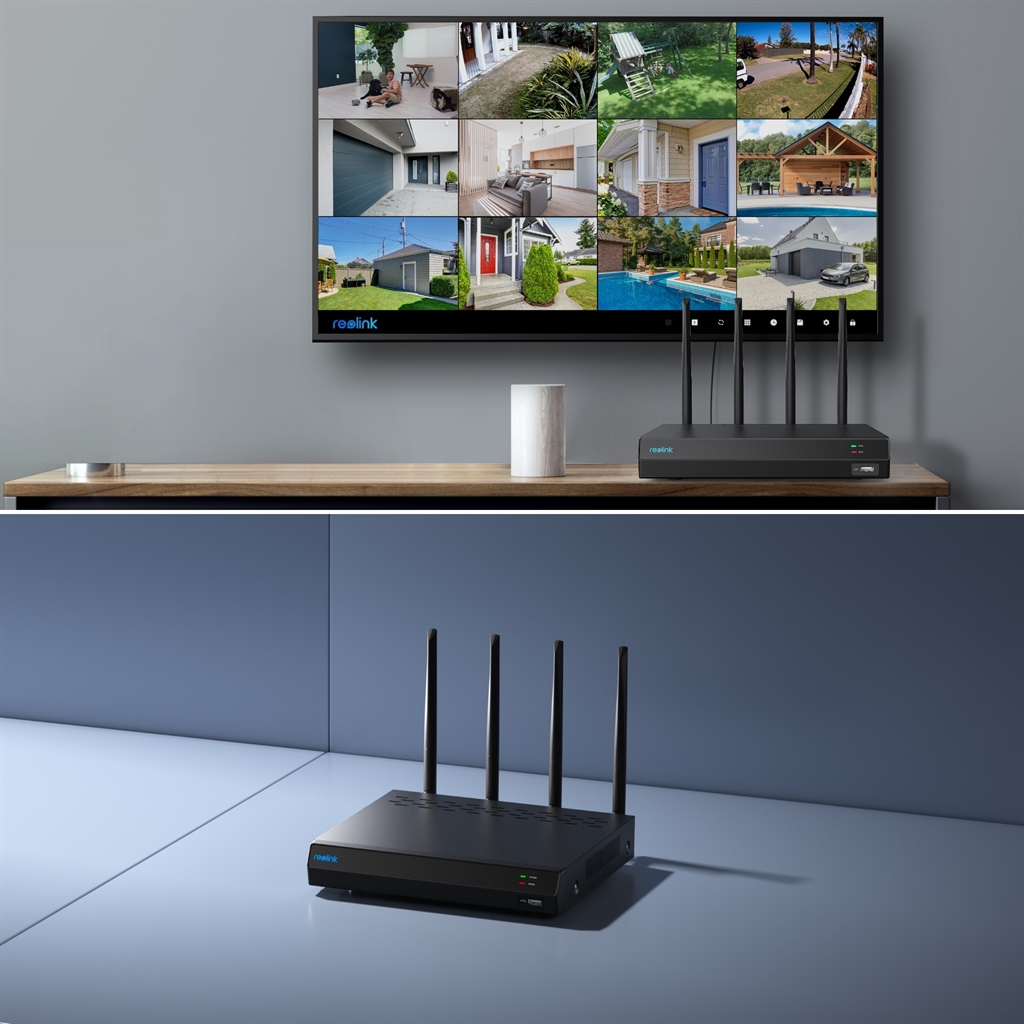
The most typical case is a country house or holiday plot where cameras belong on the garage, the gazebo and the gate, and nobody intends to dig a trench across the garden for cable. The second is rented premises or a flat the system will eventually have to leave: Wi-Fi cameras come down in an hour and leave no chased channels or drilled holes behind. The third is a small shop or coffee bar with a finished interior, where surface trunking would ruin the look and four to six cameras are quite enough anyway. The chassis is compact at 255×222.7×49.5 mm and 1.4 kg, powered by a 12 V adapter drawing under 10 W, so the recorder itself rides out a blackout on a modest UPS — provided the cameras are kept alive too. An operating range of -10 to +45 °C and IP20 rating mean a heated room rather than a porch or an unheated garage, and the antennas should be brought outside any metal cabinet, which otherwise acts as a shield.
How it compares with neighbouring recorders in this catalogue
Its direct budget rival is the Reolink NVS8: cheaper, with eight genuine PoE ports, but shipped without a disk and without Wi-Fi. Do the honest sum — an NVS8 plus a 2 TB drive lands close to the price of this model, and where cable can be run the wired option wins on stability, which means the NVS12W earns its keep precisely where cable will never exist. The Reolink NVS36 takes up to thirty-six channels and also lacks PoE, but it has neither built-in Wi-Fi nor a disk, so it is a machine for a large existing network rather than for a country plot. The bigger Reolink NVS16 is another weight class entirely: sixteen PoE ports, two bays and a 4 TB disk included, the right answer once you pass a dozen wired cameras. From other brands, the Hikvision DS-7604NXI-K1(D) and the Imou NVR-N118-8A0E are markedly cheaper, yet both lack Wi-Fi, PoE and storage, so they address a completely different problem.
Tell us where the cameras will sit and how many walls the signal has to cross, and we will advise which of them deserve a cable and which can safely stay on Wi-Fi.
Characteristics Reolink NVS12W 2TB
Reviews about Reolink NVS12W 2TB from real users
No reviews found







