
 m. Сміла, Незалежності, 67г. оф, 406/6























IMOU NVR-N118-8A0E (18 CHANNELS, 8 MP) - IP VIDEO RECORDER

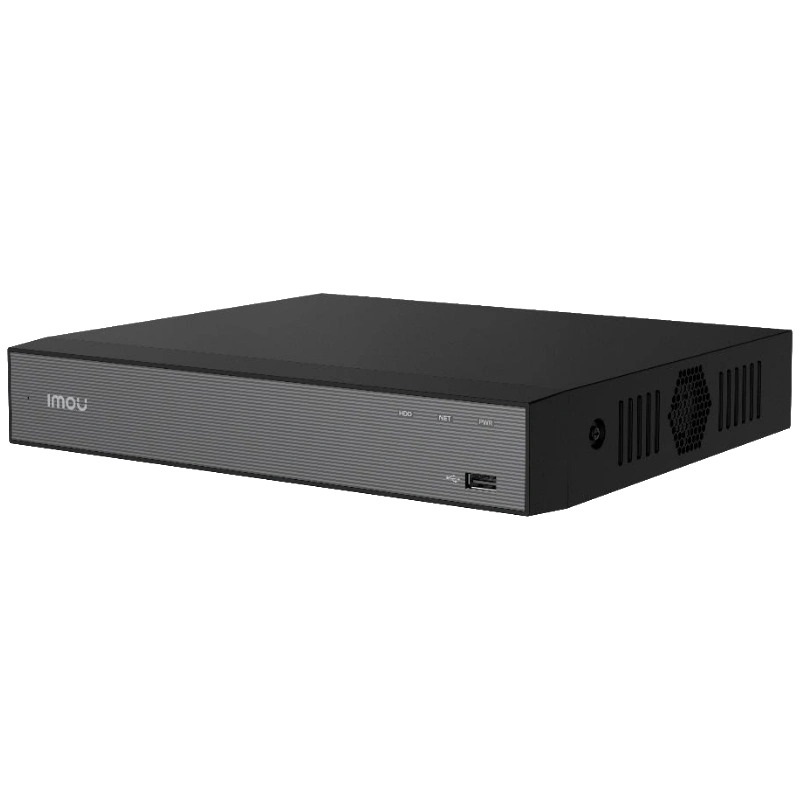
Description Imou NVR-N118-8A0E
18 channels but no built-in PoE: what you still have to buy
The recorder accepts up to 18 IP cameras, yet it has no PoE ports at all — the spec sheet states this plainly, and it is the number one surprise during a first installation. Cameras do not plug into the recorder; they go into an ordinary network switch and draw power either from that switch's PoE ports or from individual injectors or 12 V supplies at each location. Here is the practical arithmetic: an outdoor 4-8 MP camera with illumination draws 10-12 W, so a full build of 16-18 cameras needs a switch with roughly a 200 W PoE budget, not merely one with enough sockets — cheap 16-port units often cap out at 120-150 W and start dropping ports the moment every camera switches its IR array on after dark. The recorder itself runs from an external 12 V / 2 A adapter and consumes about 20 W without a drive, which means your UPS has to carry both it and the switch: if the switch loses power, recording stops on every channel at once. There is an upside to this topology as well — cameras are not tied to a single box, you can spread them across several switches in different buildings and put the recorder wherever there is space and a network drop, whereas a model with built-in PoE forces every camera cable to terminate at the recorder itself.
90 Mbps of incoming bandwidth is the real ceiling, not the number 18
Channel counts in this class always look more generous than the throughput behind them, and the gap matters here: those 18 channels share a total incoming stream of 90 Mbps, served by a single network port. Translate that into real cameras — an 8 MP H.265 stream averages 5-6 Mbps, so eighteen of them would come to about 100 Mbps and simply would not fit the device's budget. Eighteen 2-4 MP cameras in H.265, on the other hand, add up to roughly 40-70 Mbps and run with headroom, and a mixed build works comfortably too: four 8 MP units on the gate plus twelve 4 MP cameras around the perimeter stay well inside the limit. This is not a flaw peculiar to this model but normal practice in the budget tier — the manufacturer honestly publishes both the 18 channels and the 90 Mbps, buyers simply tend to read only the first figure. The planning rule is straightforward: budget for 12-14 cameras if the whole system will be 8 MP, and use all 18 channels when the bulk of the cameras are 2-4 MP.
No drive in the box: one bay up to 10 TB, and what follows from that
The unit ships without storage — the specification lists no pre-installed drive — so the HDD is a separate purchase that belongs in the project budget from the start. There is only one bay, rated to 10 TB, with neither RAID nor hot swap: you change the disk with the recorder powered down, and a disk failure takes the entire archive with it, which is why sites where footage carries legal weight should also keep a parallel copy on SD cards inside the cameras or on an FTP target. The drive must be a surveillance-grade model (WD Purple, Seagate SkyHawk or equivalent), because a desktop HDD is engineered for a few hours of use per day rather than for the continuous sequential writing of eighteen streams, and in that duty cycle it fails far sooner than its warranty suggests. The 45 mm tall chassis, 227.5 x 260 mm and 850 g, is built around a single 3.5-inch disk, so adding a second drive later is not an option — that limit is fixed on day one. An operating range of -10 to +45 degrees Celsius and an IP20 rating mean the recorder needs a dry, ventilated spot: an unventilated cabinet in summer heat is the most common cause of disk overheating and gaps in the recording.
How many days of archive a drive actually holds
It helps to carry the arithmetic in your head before buying: one megabit per second of continuous recording produces roughly 10.5 GB per day, and everything scales from there by camera count. Eight 4 MP cameras in H.265 at about 4 Mbps each come to 32 Mbps and some 340 GB per day, so a 10 TB disk covers nearly four weeks of uninterrupted archive. Drop to 2 MP cameras and the same disk stretches to about two months, while a full sixteen-camera 4 MP build shrinks the depth to a fortnight — the point at which owners start noticing that a week-old incident is already gone. Four 8 MP cameras on 10 TB give roughly five weeks, which is the sweet spot for a private house where detail matters more than the number of viewpoints. Event-based recording instead of 24/7 multiplies the retention by two or three, but it leaves holes wherever detection failed to trigger, so keep continuous recording on the gate and the till and switch the secondary cameras to event mode.
Motion detection lives in the recorder, person recognition in the camera
The recorder's specification lists motion detection and no person or vehicle recognition, and that distinction shapes how the system behaves day to day. On its own the recorder reacts to pixel change, which means a branch in the wind, a cloud shadow, a cat or rain drifting through the IR beam — dozens of events a night, after which the owner mutes notifications and the installation quietly stops working as security. The fix is simple and correct: take the analytics from the camera. Modern IP cameras from Imou, Dahua, Hikvision or Reolink classify the object on board and hand over a ready-made person or vehicle event, leaving the recorder to store the stream and the markers, which is what turns alerts back into something worth opening. That is why savings belong on the recorder rather than on the cameras: without AI in the cameras, any NVR remains a network tape deck nobody watches.
Imou cameras pair themselves, third-party ones go through ONVIF
Cameras from the same ecosystem are found automatically: put one on the network and it appears in the channel list without manually typing an IP address, port and password, which is the single biggest time saver for a non-installer. Third-party cameras connect over ONVIF, and that works, but from foreign devices you normally get the stream and basic detection only, while the vendor's own features (analytics zones, spotlight control, siren) stay inside that camera's app. Monitor output is provided over HDMI with 3840 x 2160 support and over VGA, one display is supported, and control is by mouse locally or over the network from Windows, macOS, iOS and Android. The two USB ports serve the mouse and the export of a clip to a flash drive — this is exactly how footage is handed to the police or an insurer, and the procedure is worth rehearsing once in advance rather than during the incident. Decoding has its limit too: simultaneous playback is capped at roughly four 8 MP channels, so a wall of eighteen live tiles on the local monitor will be drawn from substreams rather than at full resolution.
Where this recorder belongs and where to pick a different one
Its natural habitat is a site with many inexpensive cameras spread across several buildings: a homestead with outbuildings, a small warehouse, a car workshop, a cafe, a shop with a floor area, a stockroom and a yard. The absence of built-in PoE is even convenient there, since the network is being built on switches anyway, and 18 channels let one recorder and one app cover every point instead of two separate systems. It is the wrong choice in three cases: when coaxial cable for analogue cameras is already in the walls (that calls for a hybrid XVR rather than a pure network NVR), when the whole system is planned as 8 MP across 16 or more points (90 Mbps will not stretch), and when the archive is critical and you need RAID or two drive bays. Be honest about retention requirements as well: if the rules demand 30 days across sixteen cameras, a single 10 TB disk will not deliver that at any compression setting. For a flat, or one or two cameras at a weekend house, an 18-channel recorder makes no sense at all — cameras with SD cards and an app solve the same task without a box in a cabinet.
How it differs from the neighbouring recorders in this catalogue
The closest equivalents by purpose are the Hikvision DS-7616NXI-K1(B) and the Dahua DHI-NVR2116HS-I2: both are also PoE-less single-drive units, both offer 16 channels against 18 here, but both bring recorder-side analytics (AcuSense and WizSense respectively) and deeper configuration, so if the cameras are Hikvision or Dahua it is more sensible to stay with the matching brand. The Reolink NVS8 and NVS16 take the opposite approach with 8 and 16 PoE ports on board — no switch needed and cameras powered by the recorder itself, at the cost of a hard limit on camera count and of working fully only with Reolink cameras. The Reolink NVS12W arrives with a 2 TB disk already fitted and also without PoE, an all-in-one option for 12 cameras when you would rather not choose storage separately, though 2 TB across twelve channels buys only a few days of history. If there is legacy coax on site, none of these NVRs fit — look at the hybrid Dahua DH-XVR5216AN-I3 or Hikvision iDS-7208HUHI-M1/XT, which handle analogue and IP cameras together. In short, this Imou is the pick for a budget-minded build with many affordable cameras in one ecosystem, where the priorities are point count and an easy app rather than deep analytics on the recorder side.
If you are unsure how many channels and what size of drive your site actually needs, send us the camera count, their resolution and the retention you require — we will calculate the bitrate, the disk capacity and the switch's PoE budget for your configuration.
Characteristics Imou NVR-N118-8A0E
Reviews about Imou NVR-N118-8A0E from real users
No reviews found







