
 m. Сміла, Незалежності, 67г. оф, 406/6























HIKVISION DS-7616NI-Q1(E) (16 CHANNELS, 8 MP) - IP VIDEO RECORDER

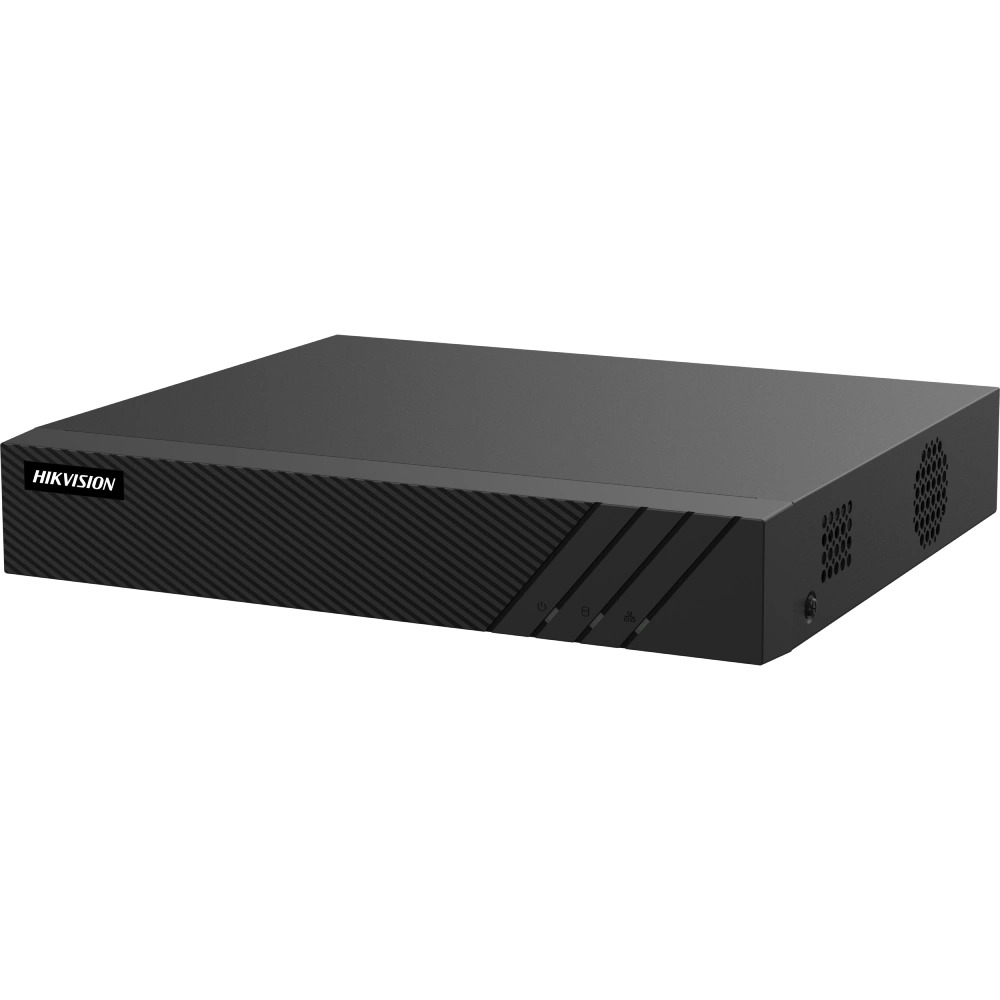


Description Hikvision DS-7616NI-Q1(E)
The Q series: what this recorder deliberately leaves out
The NI-Q index marks Hikvision's base line, and the most useful place to start is with what is missing, because the whole purchasing logic rests on it. There is no AcuSense here, which means no human-versus-vehicle classification performed by the device itself; there are no perimeter rules and no handling of face recognition events; and there are no physical alarm inputs or outputs, so a siren or a door contact cannot be wired to it. What you get instead is exactly what a sixteen-channel system has to have: dependable recording of sixteen IP cameras in H.265+ at up to 8 MP per channel, local mouse control, remote access through Hik-Connect and a quick way to export the clip you need onto a USB stick. That configuration answers the one task surveillance really exists for — having footage when something happens — without paying for features the owner will never open. One consequence belongs in the same breath: detection here is the simple pixel-change kind, so phone alerts will fire for branches and for rain crossing the IR beam, and on this platform smart filtering comes from cameras with their own analytics rather than from the recorder.
A pure network NVR: IP only, no coax anywhere
The DS-7616NI-Q1(E) is a pure network video recorder, and that is a compatibility statement rather than marketing: it works exclusively with IP cameras over the LAN and has no coaxial inputs for analogue HD-TVI devices. If the site already runs an analogue system on coax, this recorder will not adopt it — that case calls for the hybrid XVR and DVR units marked in this catalogue as universally compatible. In exchange the network approach delivers three things analogue cannot: one cable per camera instead of two, since video and power share it; effectively unlimited reach through switches and cascades; and the freedom to place the recorder where it is convenient to service rather than where every cable happens to converge. Cameras join either over ONVIF or over Hikvision's own protocol, and this is where attention pays off: Hikvision cameras arrive with all their settings intact, while third-party brands connect through ONVIF with some capability left behind — usually the stream and basic detection survive, the finer analytics configuration does not. The network stack covers TCP/IP, DHCP, DNS, DDNS, NTP, SADP, SMTP and UPnP, which is everything needed for initial discovery, clock synchronisation and emailing alarms.
No PoE ports: the switch is a separate purchase
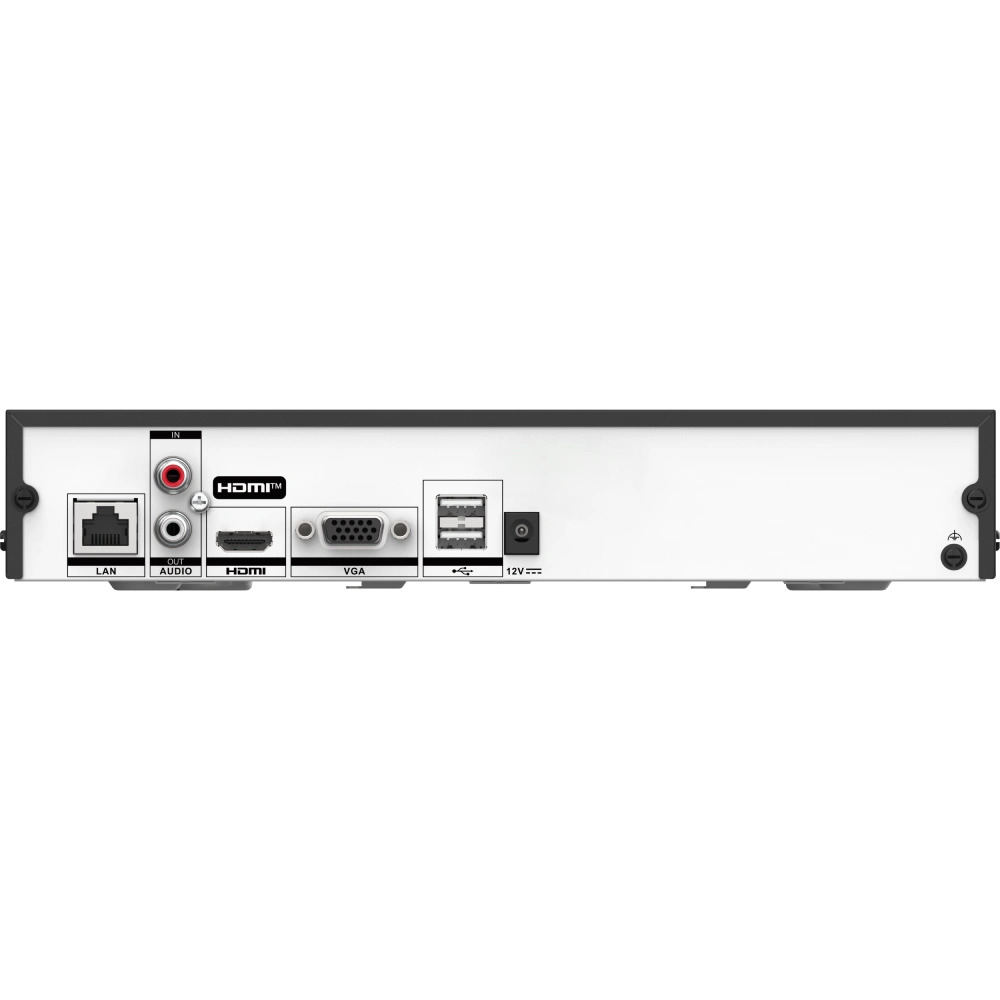
This is the practical point to settle before installation day: the model has no PoE ports at all, only one RJ-45 interface that connects the recorder to the local network. Camera power comes from a separate PoE switch, and both its cost and its rack space have to be planned from the start — otherwise you end up on site with a recorder, sixteen cameras and nothing to energise them. Use these figures for sizing: a typical 4 MP dome draws 7-9 W and budget 2 MP models 5-7 W, so sixteen cameras need roughly 110-140 W of PoE budget; a 120 W switch is working at its limit, and the sensible choice is 180 W or more, or two eight-port units sharing the load. The flip side of having no PoE in the recorder is freedom on site: switches can live close to each cluster of cameras, which sidesteps the 100-metre limit per twisted-pair run and lets a system span two buildings or several floors without dragging sixteen cables to one point. The cost is manual configuration — the installer assigns camera addresses rather than the recorder doing it, so a do-it-yourself install means learning IP addressing first, or ordering the commissioning along with the hardware.
Recording up to 8 MP against a shared 160 Mbps budget
The recorder accepts sixteen channels and writes up to 8 MP per channel in H.265+, H.265, H.264+ and H.264, which covers the overwhelming majority of current cameras, since 4 and 8 MP are today's standard and 12 MP sensors are rare in systems of this class. Far more important than megapixels is another number: the 160 Mbps incoming bandwidth is a single budget shared by every camera, and it is what really decides what fits. The sums are quick — sixteen 4 MP cameras in H.265 come to about 60-70 Mbps and leave generous headroom, sixteen 8 MP cameras approach 130 Mbps, close to the edge but still inside it, while setting every channel to its maximum bitrate just in case is not an option. H.265+ support is not a line item here but the key to the whole economics of the system: against H.264 it roughly halves archive volume at the same picture quality, and it is the reason a single drive makes sense in this box. If your cameras are older and speak only H.264, recalculate both the bandwidth and the archive depth with a factor of two — that mismatch is the usual reason a real archive turns out shorter than the one promised.
One drive up to 8 TB: how many days of archive you actually get
Inside there is a single SATA bay supporting a drive of up to 8 TB; the disk is not included, there is no RAID and no hot swap, so storage is bought separately and the recorder has to be powered down whenever it is changed. Here is the real depth for continuous 24/7 recording in H.265: one 4 MP camera writes about 40-45 GB a day, so sixteen of them total roughly 650-700 GB daily, and an 8 TB drive — about 7.3 TB usable — delivers approximately 11 days of archive. With 2 MP cameras consumption falls to around 340 GB a day and the archive stretches to some three weeks; with eight cameras instead of sixteen you get the same three weeks at 4 MP; sixteen 8 MP cameras will fill that drive in under a week. When the required depth does not add up, three techniques work: scheduled or motion-triggered recording instead of continuous, which buys a factor of two to three at the price of events outside the detection zone never reaching the archive; dropping secondary channels to 12-15 fps; and lowering resolution where fine detail is not the point. And the honest warning: one bay is one point of failure, a dead drive takes the entire archive with it, so where footage must serve as evidence, consider a two-bay model or run parallel recording to memory cards inside the cameras.
Video outputs, two monitors and day-to-day control
The rear panel carries HDMI and VGA working simultaneously, and the specification for this particular item lists video outputs up to 1920×1080 — in other words, plan around an ordinary Full HD monitor or television rather than a 4K panel, and it is worth confirming this line for the specific batch you buy, because revisions within the Q series differ precisely in output capability. In practice Full HD is enough for a sixteen-channel mosaic: in a 4×4 grid each camera gets roughly 480×270 pixels whether the monitor is 2K or 4K, so screen resolution affects how comfortable the interface feels rather than how much detail a single channel shows. Support for two monitors gives a working pattern for a shop or a warehouse: one screen goes somewhere visible for its deterrent effect, the other sits where the archive is genuinely reviewed. Control is by mouse locally and over the network from Windows, macOS, iOS and Android; two USB ports serve the mouse and clip export, two RCA connectors handle audio. The 263×223×48 mm chassis weighs 1.5 kg, carries an IP20 rating and works from -10 to +55 °C, which makes it an indoor device: a rack, a shelf in the back office or an enclosed cabinet inside the building, but not an outdoor enclosure and not an unheated garage.
Which sites suit this model and when to choose another
This recorder fits a site with many cameras and a straightforward brief: a shop with a sales floor, stockroom and loading bay, a service station, a production hall, a car park, an office building, a large private house with outbuildings. In places like those sixteen channels are not spare capacity for later but a reflection of how many control points exist — till, entrance, service door, corridors, perimeter — each one needing its own camera. The model suits especially well anyone who has already bought, or plans to buy, cameras with on-board analytics: classification of people and vehicles then happens in the cameras, the recorder simply receives and stores their events, and paying twice for the same function makes no sense. Where it is out of place: a flat or holiday house needing two to four cameras, where sixteen channels will never be used; a site already cabled with coax for analogue cameras; and a requirement for a month or more of archive across sixteen channels, which a single 8 TB drive cannot physically satisfy. One more exclusion deserves its own sentence: if you need the recorder to trigger a siren, drive an electric lock or accept an alarm sensor, this model cannot do it, because it has no alarm inputs or outputs.
How it differs from the neighbouring recorders in this catalogue
Its closest relative in the catalogue is the DS-7616NXI-K1(B): the same sixteen channels and the same 160 Mbps of incoming bandwidth, but K series with AcuSense, recording up to 12 MP, four alarm inputs, 4K output and a drive limit of 10 TB — what you pay extra for is recorder-side analytics and alarm peripherals, so if your cameras already distinguish people from vehicles, the gap will feel smaller than the spec table suggests. When the camera count is modest and a separate switch is unwelcome, the catalogue holds models with PoE built in — the eight-channel DS-7108NI-Q1/8P(D) or the four-channel DS-7604NXI-K1/4P(D) — where cameras plug directly into the recorder and receive addresses automatically, which is far simpler for a self-install. If the archive has to be deeper, look toward the two-bay units such as the DS-76xxNXI-K2(D) or the DS-7608NXI-I2/S(E) supporting up to 16 TB: fewer channels, twice the storage. The direct cross-brand alternative is the Dahua DHI-NVR2116HS-I2 — sixteen channels as well, no PoE as well, a 10 TB drive limit — and the decision between them almost always comes down to which brand of camera is already installed or ordered. For a site with analogue infrastructure this recorder is fundamentally the wrong tool: the hybrid iDS-7108HQHI-M1/S(E) or the sixteen-channel Dahua DH-XVR5216AN-I3, which take coax and IP at the same time, are what that job needs.
Tell us how many cameras you plan, at what resolution, and how far back you want to be able to pull footage — we will size the drive for that depth, match a PoE switch to the real load, and say honestly whether the Q series is enough or the K series analytics are worth the difference.
Characteristics Hikvision DS-7616NI-Q1(E)
Reviews about Hikvision DS-7616NI-Q1(E) from real users
No reviews found







