
 m. Сміла, Незалежності, 67г. оф, 406/6























HIKVISION DS-7608NI-I2/S(E) (8 CHANNELS, ANPR) - IP VIDEO RECORDER

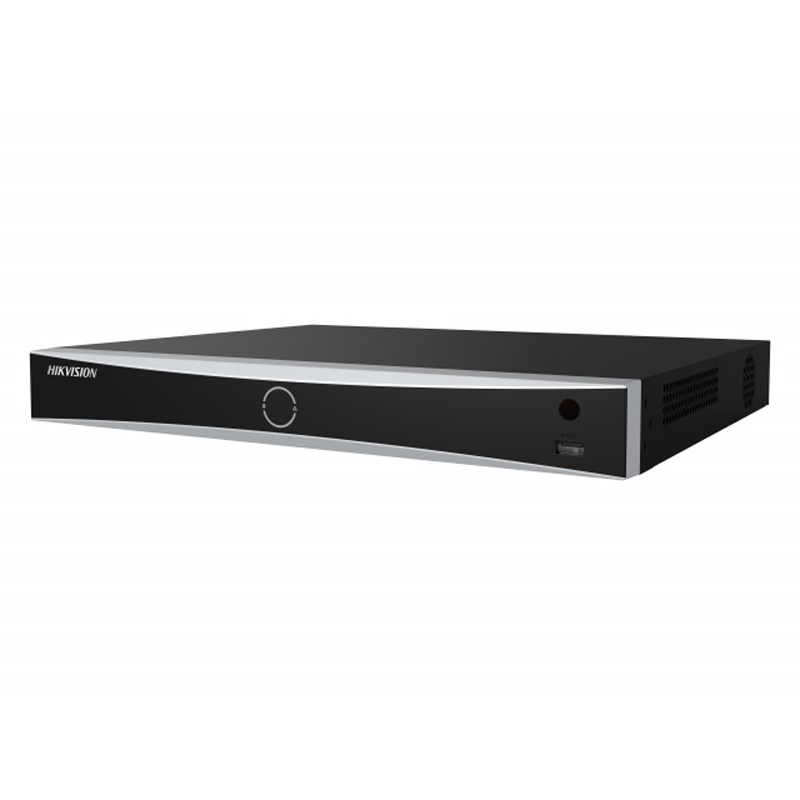
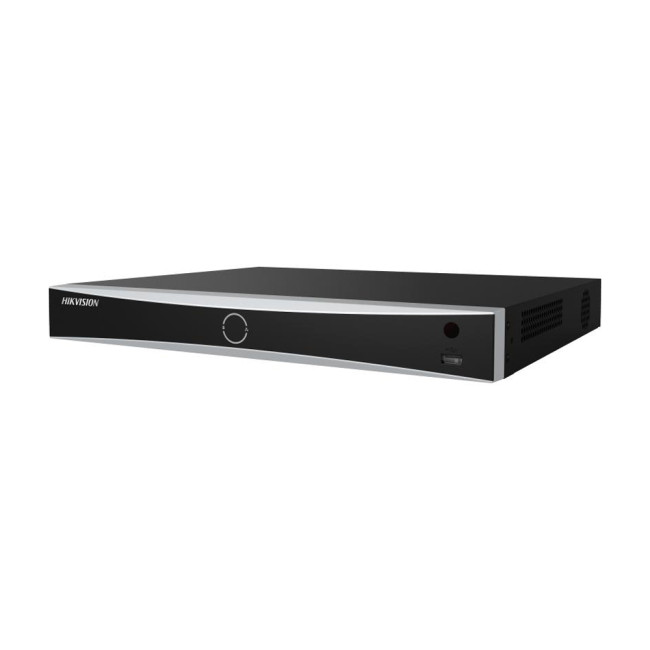


Description Hikvision DS-7608NI-I2/S(E)
A pure network NVR: IP cameras only, no coaxial input
The DS-7608NXI-I2/S(E) belongs to the NXI family, which makes it a true Network Video Recorder: it accepts video only from IP cameras over the LAN, and the spec sheet states the camera type plainly as "IP". Sitting next to it in this catalogue are the almost identical-looking Hikvision iDS-7108HQHI-M1/S(E) and iDS-7208HUHI-M1/XT, but those are hybrid DVRs that work with analogue HD-TVI cameras over coax; the enclosures look alike and the model names differ by a few letters, so the mix-up happens constantly. The consequence is very concrete: if the site already has analogue cameras on coaxial cable, this recorder will never see them, neither through an adapter nor after a firmware update, because it simply has no BNC inputs. In a new twisted-pair installation, however, it gives you what a hybrid structurally cannot: full resolution with no "Lite" modes, 25-30 frames per second on every channel, and a two-way digital link to the camera that carries control and audio as well. So the choice between these two classes is driven by the cable already in your walls, not by the model that looks newer.
Eight channels with no built-in PoE: budget for a switch
This is the single most important practical detail about this particular variant: the name carries no "/8P" block, the PoE input row in the specification is a dash, and there is exactly one network port for cameras. The recorder has one gigabit RJ-45 that plugs into your switch and supplies no power to the cameras at all. In other words, a project for eight cameras must also include an eight-port PoE switch or eight separate injectors, plus a decision about where they physically live and what feeds them. There is an upside that makes many installers choose the non-PoE version deliberately: cameras connect to any switch anywhere on the network rather than in a star running back to the recorder, so each cable run can start at the nearest cabinet instead of dragging all eight lines into one room. On a site that already has a network - an office, a workshop, a hotel - that saves enough cable and labour to cover the switch; for a house wired from scratch a model with PoE on board, such as the DS-7604NXI-K1/4P(D) for four cameras or the DS-7108NI-Q1/8P(D) for eight, is the saner starting point.
Two drive bays and a realistic archive-depth calculation
The "I2" index means two SATA bays for 3.5-inch drives; the specification quotes up to 16 TB in total, disks are not supplied, and there is no hot swap, so replacing a drive means powering the unit down. A rough H.265 calculation looks like this: eight 2 MP cameras recording continuously produce roughly 16 Mbit/s in total, about 170 GB a day, which fills 16 TB in a little over three months. Eight 4 MP cameras push that to roughly 340 GB a day and about six weeks of history, while eight 8 MP cameras consume up to 700 GB a day and leave you around three weeks. If you specifically need thirty days, as retail and warehouse sites usually do, the cheapest route is not a bigger disk but switching cameras to event-based recording or halving the frame rate - either trick buys a factor of two or three with no extra hardware. One warning that costs people drives: do not fit desktop-class HDDs here, because two disks in one chassis run hot and vibrate, and that is exactly the duty cycle ordinary drives fail under first.
12 MP and an 80 Mbit/s input cap: where the real limit sits
The maximum recording resolution is listed as 12 MP, and that is not a typo - the NXI family genuinely ingests streams from 12-megapixel panoramic cameras, which the K and Q series elsewhere in this catalogue cannot do. Right beside it, though, sits the number that actually shapes your configuration: incoming bandwidth is capped at 80 Mbit/s across all eight channels together. That works out to roughly 10 Mbit/s per camera, comfortable for 8 MP in H.265 and generous for 4 MP at a high bitrate, but genuinely tight if you try to feed eight 12-megapixel cameras at top quality at once. The practical reading is that 12 MP support is an invitation to put one or two panoramic cameras over a large open yard and fill the remaining channels with 4 MP units, not a promise of eight 12 MP streams. The display side imposes no such compromise: HDMI outputs 4K at 3840x2160, there is a separate VGA port, and up to three monitors are supported, so the live view can be split between a guard desk and a manager's screen.
AcuSense and face recognition run inside the recorder itself
The letter "I" in the model index is not a hardware revision but the presence of a deep-learning engine, and that is precisely what separates the NXI family from the cheaper K and Q lines. The specification lists face recognition, perimeter intrusion protection, people counting, licence-plate recognition and structural analysis as active - all computed on the recorder, which means they work even with plain cameras that have no analytics of their own. For the site this buys two concrete things: alerts fire on people and vehicles instead of every branch and shadow, so the owner stops switching notifications off after a week; and recorded footage becomes searchable by event and by face instead of scrubbing through eight hours by hand. The limit is worth knowing up front: each function runs on fewer than eight channels at once, so face recognition is normally assigned to the two or three most important entry points while the rest of the cameras stay on ordinary detection. That makes channel planning deliberate work - a camera at a doorway at face height will deliver, while the same function on a roof-mounted camera looking steeply down will deliver nothing.
Chassis, mains power and where this box can physically live
This is a full-width 1U chassis, 384 mm across and 317 mm deep, weighing 2.5 kg - designed for a 19-inch rack or its own shelf, not to sit on a desk beside the router. Unlike the compact hybrids with an external 12 V brick, it has an internal power supply running straight off 220 V and draws up to 30 W, so there is one cable to the socket and no adapter in a trunking run waiting to be knocked loose. That is also a constraint: you cannot run this unit directly from a 12 V battery, so autonomy means a UPS, and at 30 W plus two spinning disks you should be sizing something in the 350-500 VA class to ride out a typical outage. The IP20 rating and the -10 to +55 degree Celsius operating range mean indoor mounting only: an unheated garage is still acceptable in winter, an outdoor cabinet without a heater is not. Keep the front accessible as well - there are almost no buttons, control is a USB mouse or a remote session, but you will need to open the case to change a disk.
Where this recorder belongs and the jobs it was built for
The target site is a six-to-eight IP camera installation that already has structured cabling and a switch of its own: a small office, a production floor, a vehicle workshop, a mid-sized shop, a hotel or a school. That is where two drives and AcuSense pay off in full - months of history, face recognition aimed at the entrance, plates captured at the gate, and search by event instead of manual review. For a private house with four cameras the model is overkill on every axis: a 1U chassis, mains wiring and two disks have nowhere to go there, and a four-channel unit with PoE on board is the smarter buy. It is equally wrong for a site where some cameras are analogue - a mixed installation needs a hybrid, not an NVR. One more case justifies it even with few cameras: if archive continuity is critical, two bays let you keep recording on one disk while periodically pulling the second to store a copy off site.
How it compares with the neighbouring recorders in this catalogue
Its closest relatives here are the eight-channel DS-76xxNXI-K2(D) and the four-channel DS-7604NXI-K1(D): same NXI naming, but the K series is simpler in both analytics and input bandwidth, so a site that only needs human and vehicle detection without face or plate recognition is served more cheaply by one of those. The DS-7616NXI-K1(B) and DS-7616NI-Q1(E) double the channel count but each take a single disk - sixteen cameras onto one drive gives a shorter archive than eight cameras onto two, so more channels does not automatically mean a better system. If powering cameras from the recorder is the priority, this catalogue has the DS-7604NXI-K1/4P(D) with four PoE ports and the DS-7108NI-Q1/8P(D) with eight: no switch to buy, but you give up free camera placement across the network and accept simpler analytics. And a fundamentally different branch is the iDS-7208HUHI-M1/XT or iDS-7108HQHI-M1/S(E), chosen when the site already has coax and analogue cameras nobody wants to rip out. In short, the DS-7608NXI-I2/S(E) suits an existing network where serious analytics and a long archive matter and a switch in the bill of materials is not a problem.
If you are unsure whether eight channels are enough, or what drive size your required retention actually needs, send us the camera count, their resolution and how many days must be kept, and we will size the configuration together with the switch.
Characteristics Hikvision DS-7608NI-I2/S(E)
Reviews about Hikvision DS-7608NI-I2/S(E) from real users
No reviews found







