
 m. Сміла, Незалежності, 67г. оф, 406/6























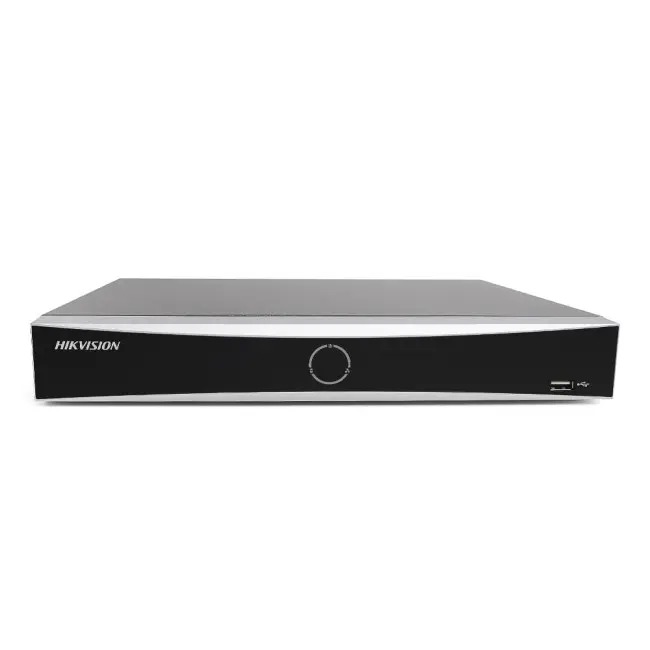
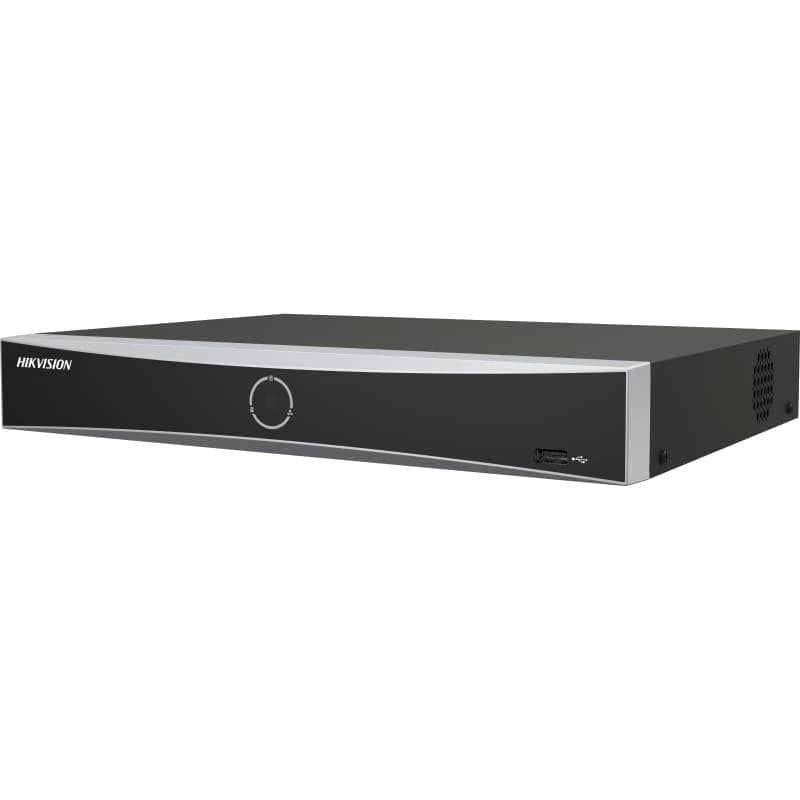
HIKVISION DS-7604NXI-K1(D) (4 CHANNELS, 12 MP, 4K) - IP VIDEO RECORDER



Description Hikvision DS-7604NXI-K1(D)
A pure network NVR, not a hybrid recorder
The NXI letters in DS-7604NXI-K1(D) stand for a network video recorder with built-in AcuSense analytics, and it handles IP cameras only: there is not a single BNC socket on the rear panel, so an analogue HD-TVI camera physically cannot be wired into it. This is the single most common ordering mistake — the buyer sees a familiar Hikvision name, assumes the new box will pick up the existing coax cameras, and discovers on site that a completely different class of device is required. Where coaxial cable is already pulled and analogue cameras are in place, the right answer is a hybrid DVR from this same catalogue: Hikvision iDS-7108HQHI-M1/S(E) or DS-71xxHGHI-M1(C), both of which accept analogue and IP feeds at the same time. For network cameras, though, this recorder offers something the hybrids do not — ONVIF profiles S and G plus ISAPI and SDK support, so third-party IP cameras with a proper ONVIF implementation connect alongside Hikvision units. The rule of thumb is short: coax on site means a hybrid DVR, twisted pair or a brand-new installation means exactly this kind of NVR.
Four channels, 12 MP on paper and a real 40 Mbps ceiling
The datasheet lists recording resolutions up to 12 MP, but that line only makes sense when read together with the 40 Mbps total incoming bandwidth, which is the recorder's genuine limit. Spread across four channels that works out at roughly 10 Mbps per camera: four 4 MP cameras in H.265 consume around 16 Mbps and leave more than double the headroom, four 8 MP cameras at a decent bitrate approach 32 Mbps and still fit, but four simultaneous 12 MP streams are beyond this unit. Decoding for live view has its own ceiling — two channels at 12 MP, four at 8 MP or eight at 4 MP — so a four-way mosaic of 8 MP streams displays fine while a four-way 12 MP mosaic does not, even though recording continues in the background. The HDMI output at 4K/30 Hz and the VGA output at Full HD run independently, which lets you put one monitor at the guard desk and a second one in the manager's office with its own window layout. Twenty-five frames per second on every channel is enough for frame-by-frame review when you need to pin down the moment of a car park collision or a hand reaching for goods on a shelf.
AcuSense analytics run inside the recorder, not only in the cameras
What separates the NXI line from entry-level network recorders is that the device itself does part of the thinking: one channel of perimeter protection at up to 4 MP is analysed inside the recorder with human and vehicle classification. In practice that means even a plain camera with no on-board AI, once assigned to that channel, gains proper line-crossing and intrusion rules that ignore branches, shadows, rain and cats. Motion Detection 2.0 covers every channel when Hikvision cameras are used, and facial recognition is supported for one live video stream or two channels of face-picture comparison, which is enough to maintain a short list of staff members or unwanted visitors. The honest limitation is the count: there is only one on-device perimeter channel, so if you want intelligent alerts on all four directions, the cameras themselves must be AcuSense models with the recorder acting as the event collector. The difference in daily life is dramatic — a filtered system sends a handful of meaningful notifications per day instead of hundreds of motion triggers, after which owners simply switch push alerts off and lose the security function entirely.
No PoE on board: camera power has to be budgeted separately
The K1(D) designation without the /4P suffix means there are no built-in PoE ports here — the rear panel carries a single network socket for the switch or router. In budgeting terms a four to eight port PoE switch or a set of injectors goes into the quote right away: four typical outdoor cameras draw about 7-12 W each, so the switch power budget should be at least 50-60 W with reserve for heater elements in winter. The recorder itself runs from an external 12 V 1.5 A adapter and draws up to 10 W without a hard disk, which means at least two mains sockets inside the cabinet, one for the recorder and one for the switch. The absence of PoE brings genuine advantages too: the switch can sit closer to the cameras and shorten the cable runs, camera power is decoupled from the recorder, and rebooting the recording unit does not cut power to the cameras. The drawback is equally real — cameras are not picked up automatically, each one needs its address assigned manually or through SADP, so first-time commissioning takes longer than on a model with integrated PoE.
One disk bay and what it means for archive depth
There is one SATA bay for a drive of up to 16 TB, no hot-swap tray, and no disk in the box — the drive is purchased separately. Take a typical case: a 4 MP camera in H.265 with continuous recording produces roughly 4 Mbps, which is about 43 GB per day, so four such cameras running 24/7 write around 170 GB daily. A 4 TB drive therefore holds roughly three weeks, an 8 TB drive about six weeks, and the maximum 16 TB close to three months of uninterrupted footage. Drop to 2 MP cameras and daily consumption falls to about 110 GB, stretching an 8 TB drive past two months; move up to four 8 MP cameras and it climbs to about 340 GB a day, leaving the same 8 TB with barely three weeks. Event-based recording multiplies those figures by three to five, at the price of gaps exactly where nothing moved, so for premises with stock or cash liability a larger drive with continuous recording is the safer choice. One last practical point: fit a surveillance-grade drive such as WD Purple or Seagate SkyHawk, because a desktop disk is not designed for round-the-clock writing and usually fails within a year or two.
The sites this recorder actually suits
Four channels with no expansion path is the format of a private house, a small shop, an office or a workshop, where cameras follow the classic pattern: the gate, the yard, the facade with the entrance door and a rear yard or storeroom. The model is comfortable wherever a network already exists — a router with free ports or a managed switch — and where there is no requirement to mirror recordings onto a second disk. If the site is growing and six or eight cameras are likely within a year or two, a four-channel recorder is a poor investment: channels cannot be added, the whole unit has to be replaced, so any expansion plans argue for an eight-channel model from the start. The 48 mm high chassis measuring 320 by 240 mm is meant for a shelf or a small comms cabinet, the IP20 rating means no protection against dust or moisture at all, and the -10 to +55 °C range rules out an unheated garage in winter. The standard answer is an enclosed cabinet in a low-dust room, always behind a UPS, because a sudden power cut during recording most often damages the file system on the disk itself.
How it differs from the neighbouring recorders in this catalogue
Its closest relative is the DS-7604NXI-K1/4P(D) from this same catalogue: identical internals, the same single disk and the same analytics, but with four built-in PoE ports, meaning one cable per camera and no separate switch. Choosing between them is straightforward — if all four cameras run back to the recorder and no new network hardware is planned, the PoE version removes a device from the cabinet; if a managed switch is already installed or the cameras are powered locally, paying extra for built-in PoE brings nothing. The DS-7108NI-Q1/8P(D) looks more generous with eight channels and eight PoE ports, but it belongs to the junior Value line: 60 Mbps incoming, a disk capped at 6 TB, decoding limited to four 1080p channels and, crucially, no analytics inside the recorder at all, everything relying on the cameras. The DS-76xxNXI-K2(D) is the step up in storage terms with two drive bays and alarm inputs, chosen when three or four months of depth or integration with a barrier and siren are needed. And if more than four cameras are planned while recorder-side analytics still matter, look at the sixteen-channel DS-7616NXI-K1(B) with a single disk, which saves you from replacing the unit a year later.
Tell us how many cameras you are installing, at what resolution, and how many days of archive you expect, and we will size the hard drive and, if needed, the PoE switch for that exact configuration.
Characteristics Hikvision DS-7604NXI-K1(D)
Reviews about Hikvision DS-7604NXI-K1(D) from real users
No reviews found







