
 m. Сміла, Незалежності, 67г. оф, 406/6























DAHUA DHI-NVR2104-P-I2 (4 CHANNELS, 4 PoE) - IP VIDEO RECORDER

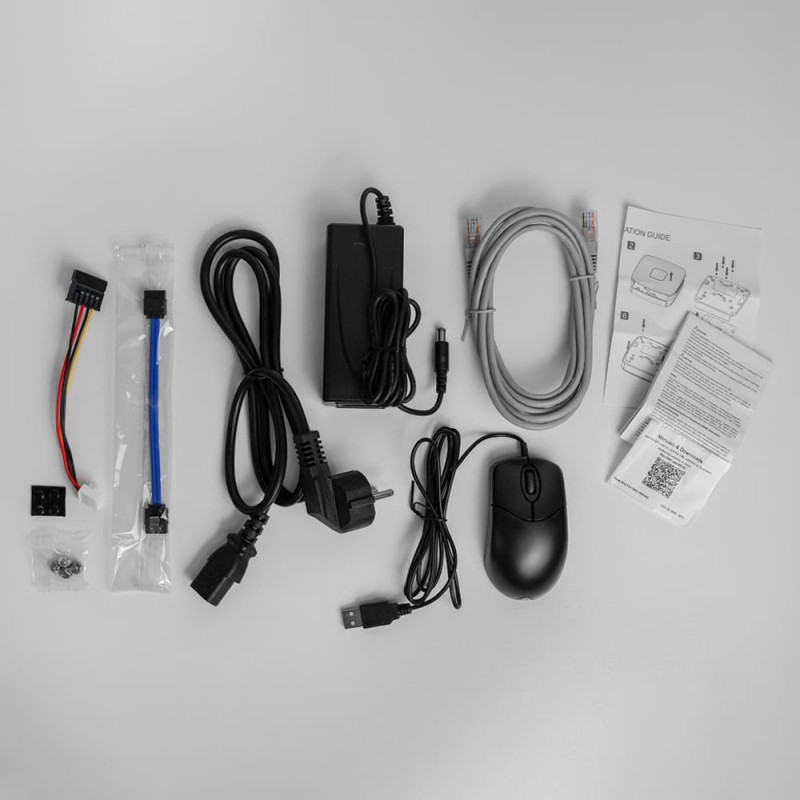


Description Dahua DHI-NVR2104-P-I2
Four channels with built-in PoE: the whole system on one cable
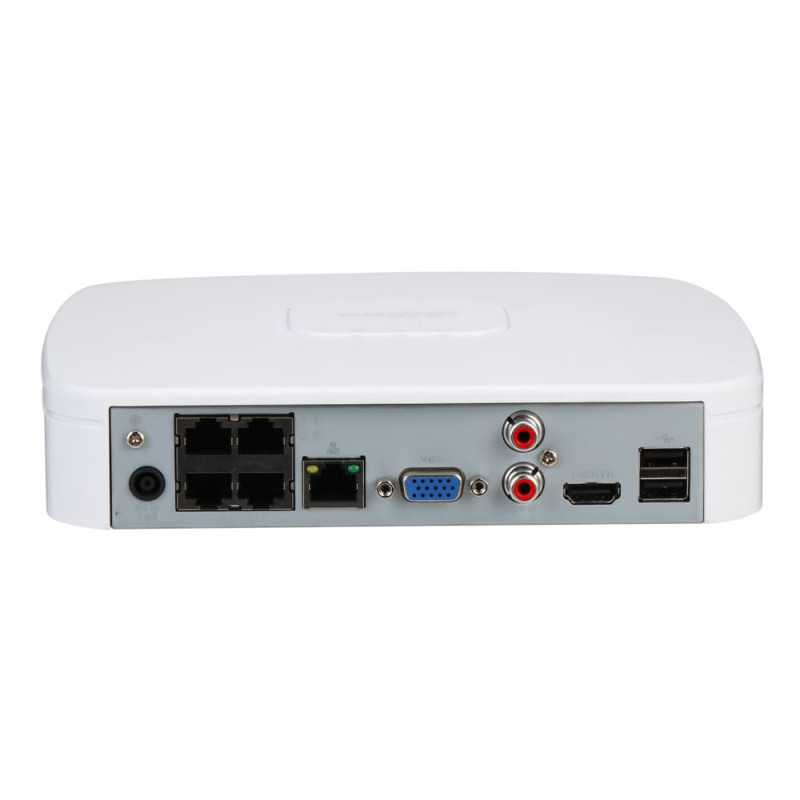
The P in NVR2104-P-I2 stands for four built-in PoE ports, and that is the main practical difference from an ordinary recorder: each camera arrives on a single patch cable carrying both data and power, with no separate 12 V adapter at every mounting point. A fifth RJ-45 port is reserved for the LAN, so the cameras live in their own isolated segment and only the recorder itself reaches the home network — a side benefit that matters, because the cameras cannot then be addressed from the internet directly. The 53 V / 1.13 A power supply gives roughly 60 W of total budget and the recorder can deliver up to 25.5 W to a single port, which is enough even for a camera with a heated housing or a compact pan-tilt module. In practice four typical Dahua 4 MP cameras draw 5-6 W each, about 24 W together, so half the budget stays free — and that headroom is what keeps the system up in winter, when camera consumption rises. The limitation is worth knowing as well: standard PoE reaches 100 metres over twisted pair, and a camera further out needs either a relay switch midway or a move to fibre, which is far cheaper to plan before the cable goes in than after.
One disk up to 10 TB: how much archive you actually get
There is a single 3.5-inch bay for a disk of up to 10 TB, with no hot swap and no RAID, which makes this a device for sites where losing the archive would be unpleasant rather than catastrophic. Let us do the depth calculation on real figures: one 4 MP H.265 stream runs at about 4-5 Mbps, which is roughly 45 GB per day, so four such cameras recording around the clock produce about 180 GB daily. That means a 4 TB disk holds about three weeks of continuous recording, 6 TB about a month, and the maximum 10 TB roughly 55-60 days, comfortably covering the common requirement of a thirty-day archive. With 2 MP cameras the same 10 TB stretches to about 100-110 days, while 8 MP cameras pull it down to roughly 28-30 days — which is where you see that camera resolution costs you archive as well as money. The cheapest way to double or triple the depth is to record on analytics events with a few seconds of pre-buffer instead of continuously; and one more piece of advice that gets ignored far too often: buy a surveillance-grade drive, because a desktop HDD is not designed for non-stop writing and typically dies within a year or so.
80 Mbps of incoming bandwidth and 12 MP recording: the real limits
The recorder accepts up to 80 Mbps across all channels and supports cameras recording at up to 12 MP, so with four channels the ceiling is practically out of reach: even four 8 MP cameras at 8-10 Mbps occupy less than half the available bandwidth. The headroom serves a different purpose — it frees you from compromising in the settings, letting you keep a higher main-stream bitrate for detail instead of squeezing the picture until compression artefacts appear. Smart H.265+ and Smart H.264+ analyse the static parts of a scene and drop the bitrate where nothing is happening, which on a night-time yard saves real disk space without sacrificing quality at the moment something does happen. One nuance for expectations: the HDMI and VGA outputs run at up to 1920×1080, so even an 8 MP camera appears in Full HD on the local monitor — the full detail is there when you zoom into a recorded fragment, not in the live multi-view. Both outputs work at the same time and can show different layouts, so two monitors can be attached — one in the back office for staff, another in the manager's room, for instance.
Analytics inside the recorder: SMD Plus, perimeter rules and faces
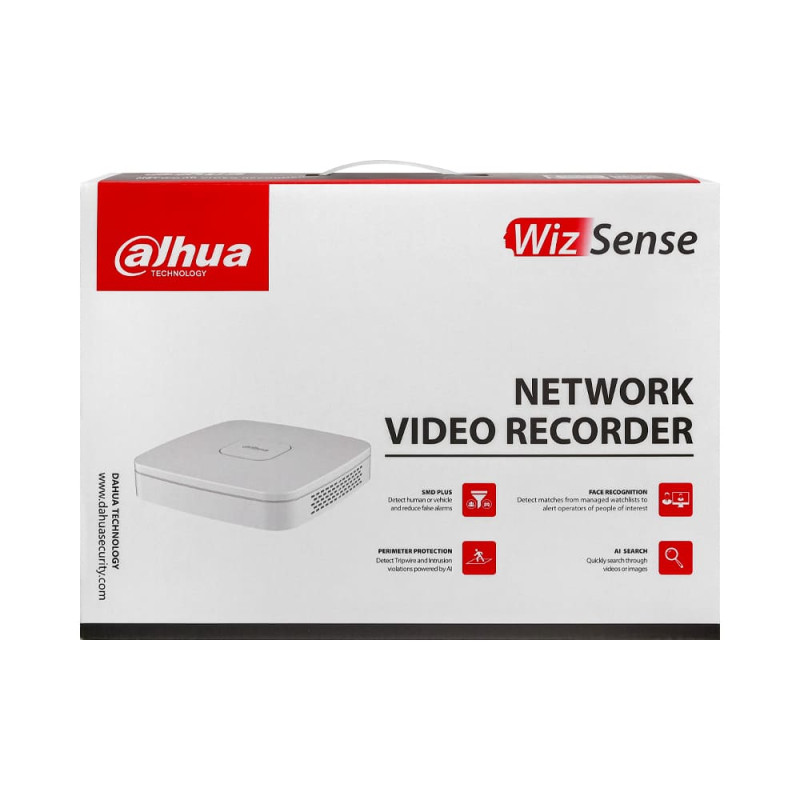
The I2 index marks the WizSense series: the analytics run on the recorder itself rather than relying on the cameras, so the smart functions work even with plain cameras that have no AI of their own. The base layer is SMD Plus, separating people and vehicles from branches, shadows and rain caught in an illuminator beam — exactly what turns a flood of false alerts into a handful of meaningful events per night. Above it sits perimeter protection with tripwire and intrusion rules and object classification, plus face detection and face-database work, which earns its keep at a shop or office entrance where staff have to be told apart from visitors. The real value of analytics shows up less in notifications than in searching: instead of scrubbing through six hours of night footage you filter the archive by object type and get a dozen clips in which a human actually appeared. What is not here: licence plate recognition, people counting, heat maps and structural analysis; and face recognition in this device class runs on a limited number of channels, so a retailer with serious identification requirements should be looking at higher series.
Connections, the app and working with other brands' cameras
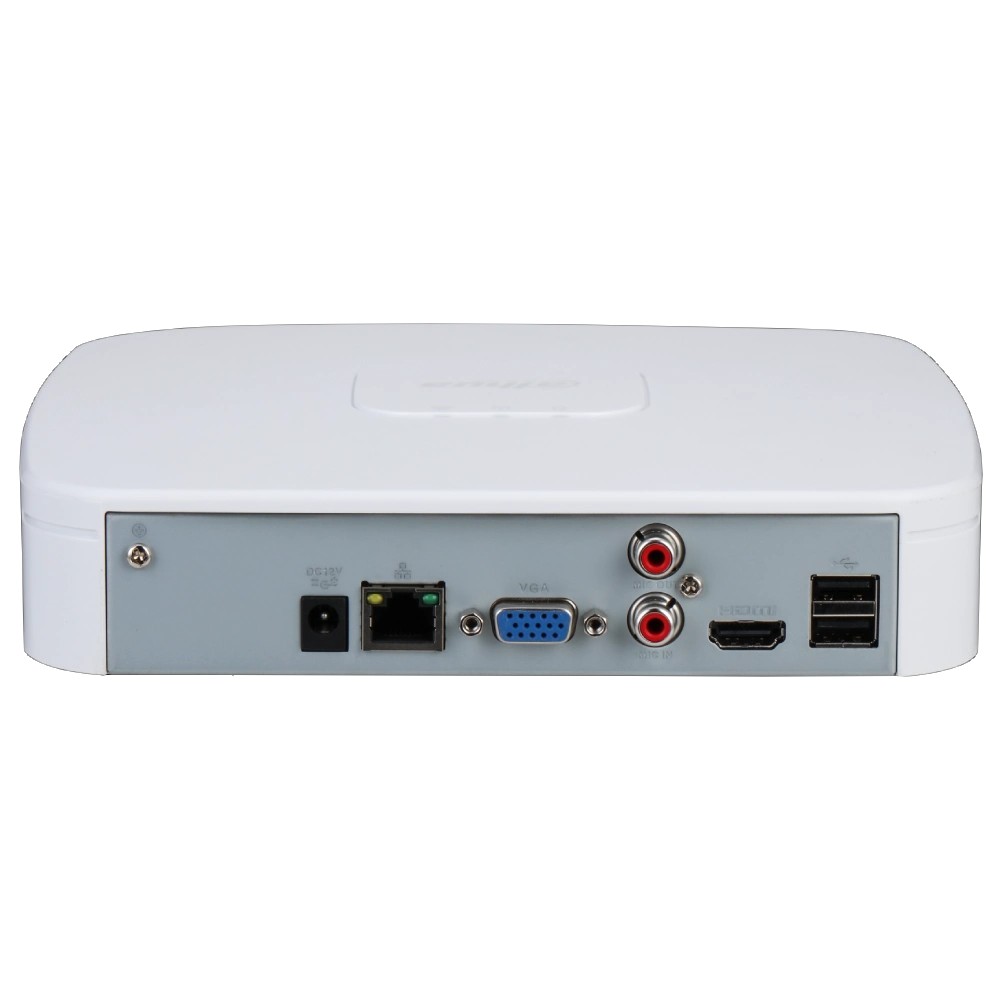
It is operated with a mouse on the local monitor or entirely over the network from a browser, the DMSS apps for iOS and Android and desktop software for Windows and macOS — no extra cloud subscription is needed for basic remote viewing, P2P is enough. Two USB ports serve the mouse and the export of archive clips onto a flash drive, while a pair of RCA jacks provides audio in and out, meaning you can record sound from a camera or an external microphone and send audio to a speaker. The recorder is not restricted to Dahua cameras: third-party IP cameras connect over ONVIF, which rescues the situation when another brand is already installed on site, although some vendor-specific analytics will not be available in that mode. One thing to settle in advance: this model has no alarm inputs or outputs and no RS-232 or RS-485 ports, so a wired siren, a door contact or a controlled barrier cannot be connected to the recorder directly. There is a workaround through camera relays or app automations, but if the project calls for a wired siren driven by the recorder, choose a model with alarm terminals from the start.
Where to install this recorder and the sites it was built for
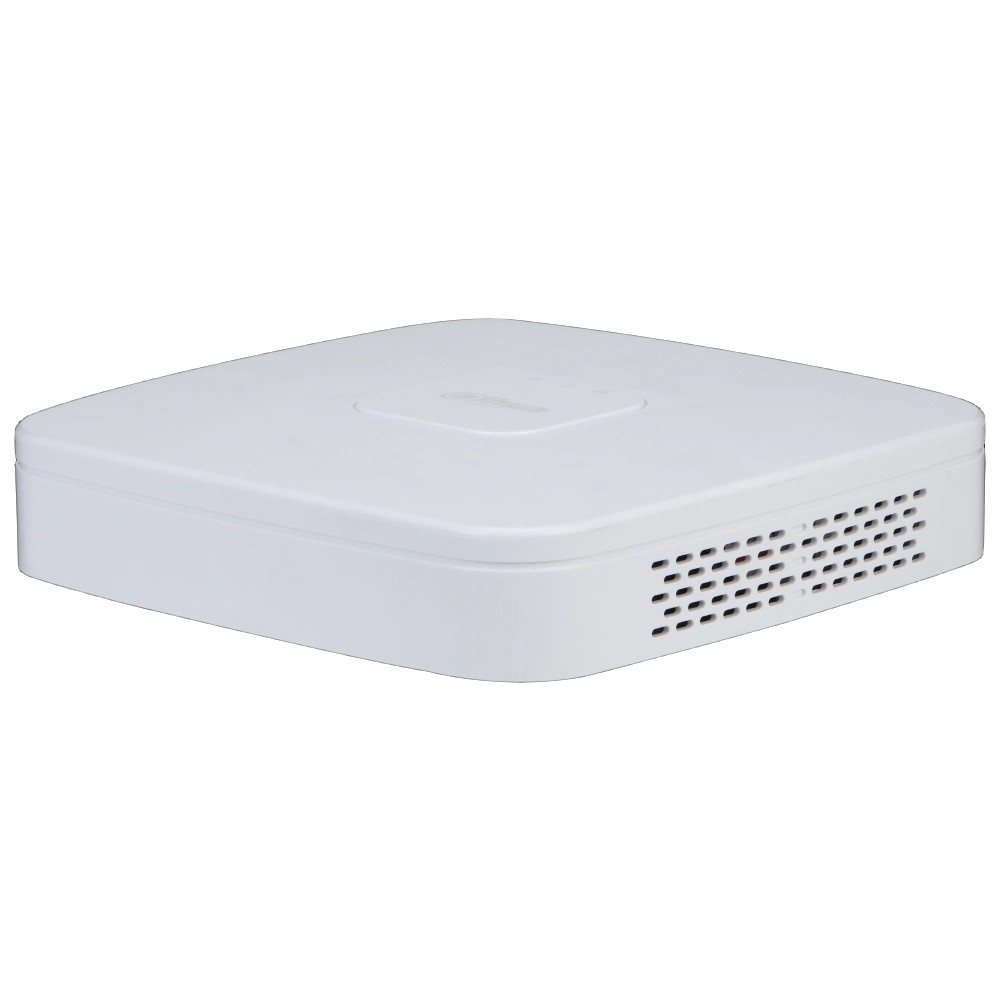
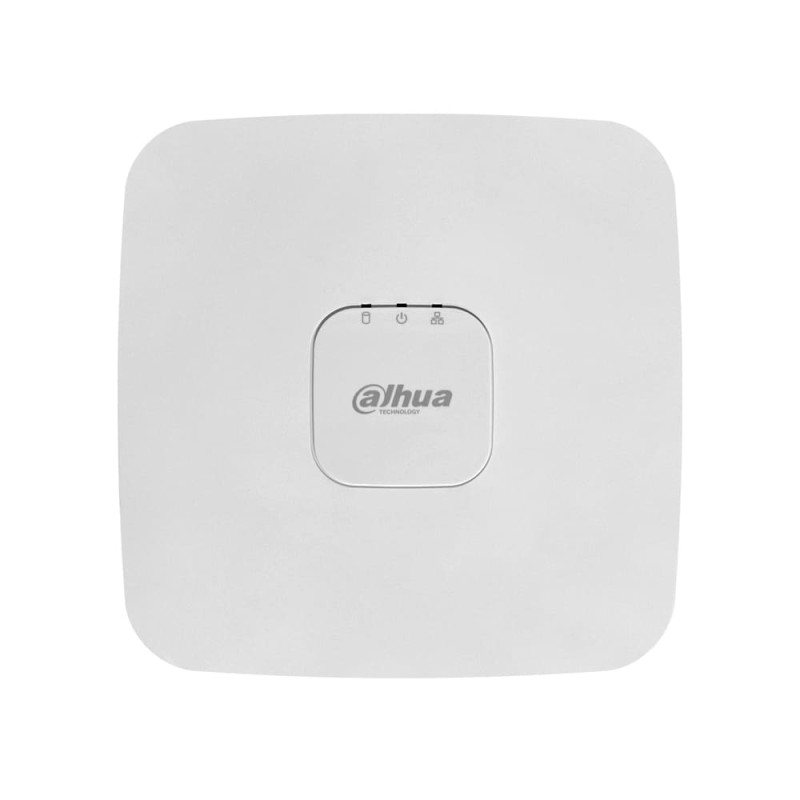
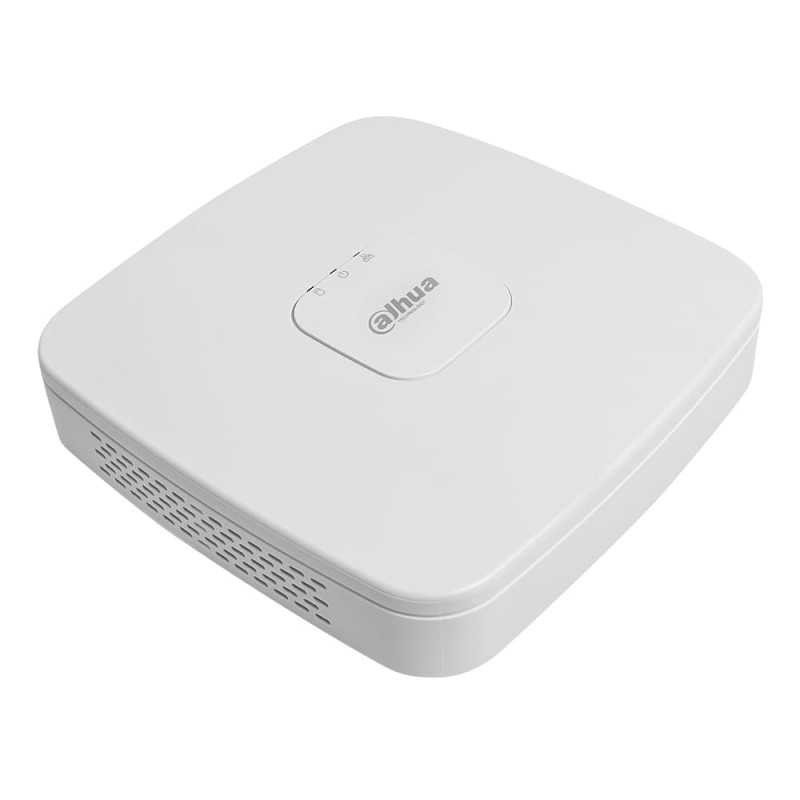
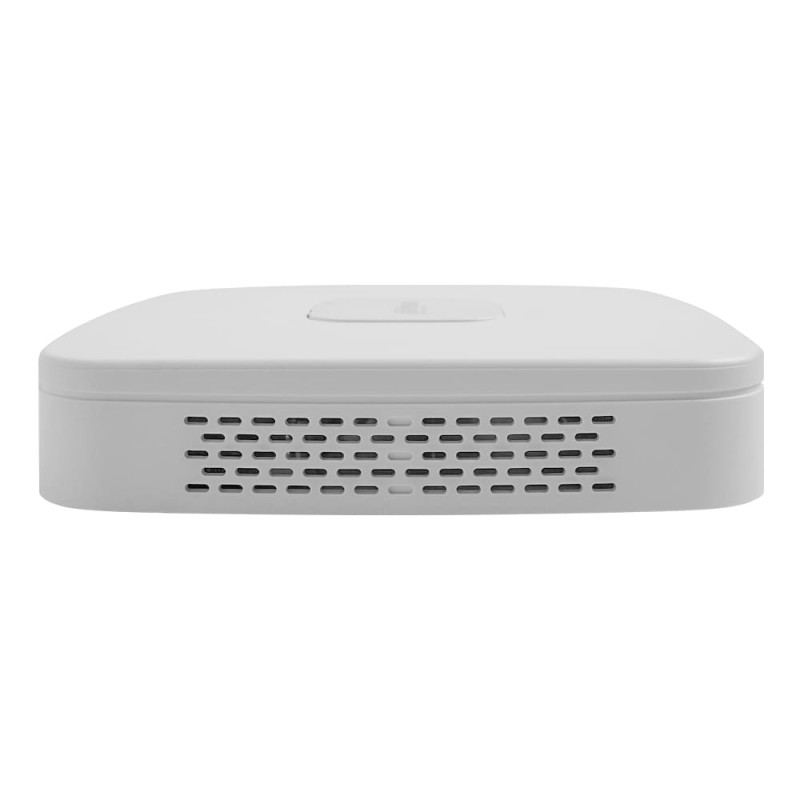
This is a four-camera solution: a private house with a yard and a gate, a flat covering the landing and the balcony, a small shop, an office, a single-gate warehouse, a repair garage. The compact plastic chassis of 205×206×46 mm weighing about 0.5 kg sits on a shelf or a desk, needs no server rack, and the −10 to +55 °C range lets it live in an unheated utility room — but not outdoors, since IP20 means the case stops neither moisture nor dust. The disk and the fan inside make a quiet but constant noise, so a bedroom is the wrong place for it: the natural spot is a store room, a low-voltage cabinet or a technical niche, preferably within reach of a socket without an extension lead. Where the model does not belong: a site that needs a guaranteed uninterrupted archive, because there is one disk and no RAID, so a drive failure means losing the recordings, and on a serious site the archive should be mirrored to a server or to the cloud. Equally, do not buy a four-channel unit for a site where six cameras are already foreseeable — an eight-channel recorder now is cheaper than a second box and two apps a year later.
How it differs from the neighbouring recorders in this catalogue
Its closest counterpart is the Dahua DHI-NVR21xx-I2: the same series with the same WizSense analytics and the same 10 TB ceiling, but without built-in PoE, so it needs a separate PoE switch and power supplies — which together eat the whole saving on the box and add another point of failure. The Dahua DHI-NVR1104HS-P-S3/H is the junior 1-series with the same four PoE ports but an 8 TB ceiling and without the I2-level features such as face-database work; a sensible choice when you simply need four cameras recorded with motion filtering and no face analytics. If there will be more than four cameras, look at the Dahua DHI-NVR2108-8P-I2: eight channels, eight PoE ports and identical analytics, and paying for spare channels is almost always cheaper than buying a second recorder. The Reolink NVS4 also offers four channels with PoE, but it lives properly mostly with Reolink cameras, so take it when the whole system is one brand rather than a mixture. And a fundamentally different case: if coaxial cable from analogue cameras is already in the walls, a network recorder is the wrong tool entirely and you should be looking at hybrid XVRs such as the Dahua DH-XVR41xxHS-I/T or the DH-XVR5104C-4KL-I3 from this same catalogue.
If you are unsure which disk to buy or how many days of archive your configuration will give, send us the number of cameras, their resolution and the recording depth you need — we will calculate the capacity and put the set together along with the cameras.
Characteristics Dahua DHI-NVR2104-P-I2
Reviews about Dahua DHI-NVR2104-P-I2 from real users
No reviews found







