
 m. Сміла, Незалежності, 67г. оф, 406/6























DAHUA DHI-NVR1104HS-P-S3/H (4 CHANNELS, 4 PoE) - IP VIDEO RECORDER

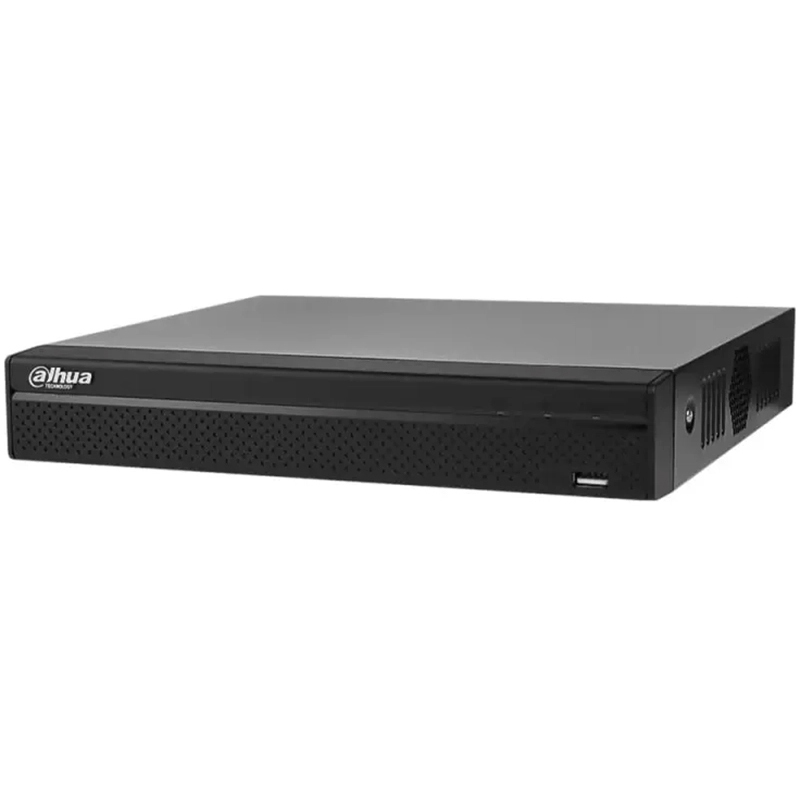
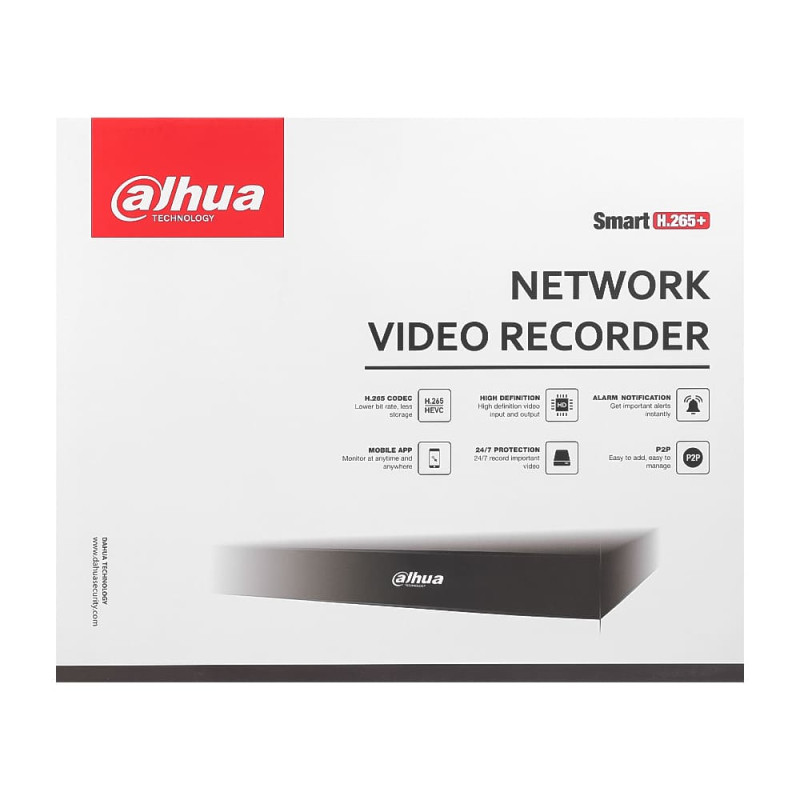
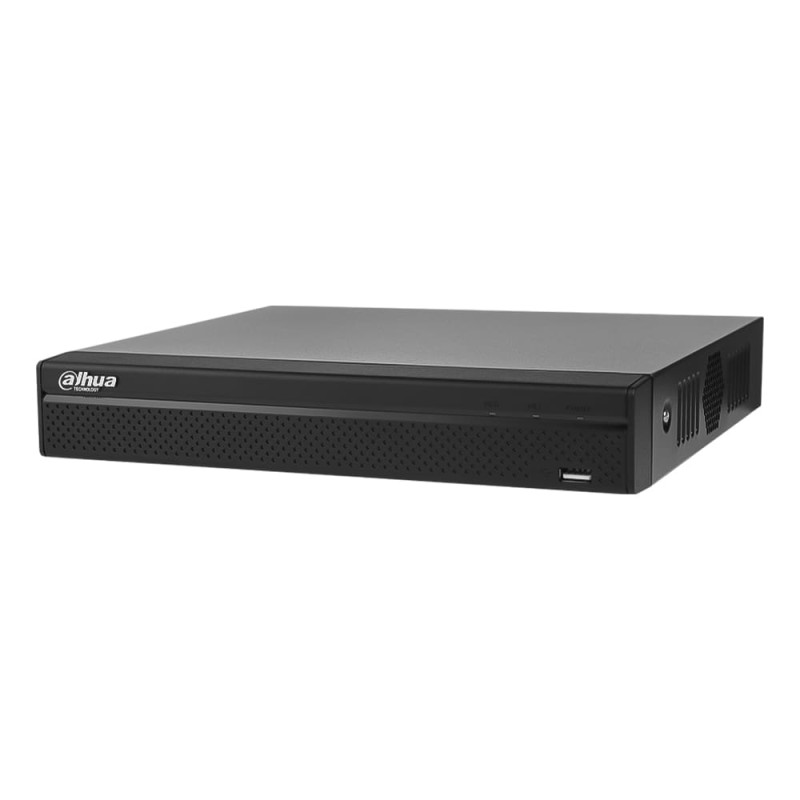
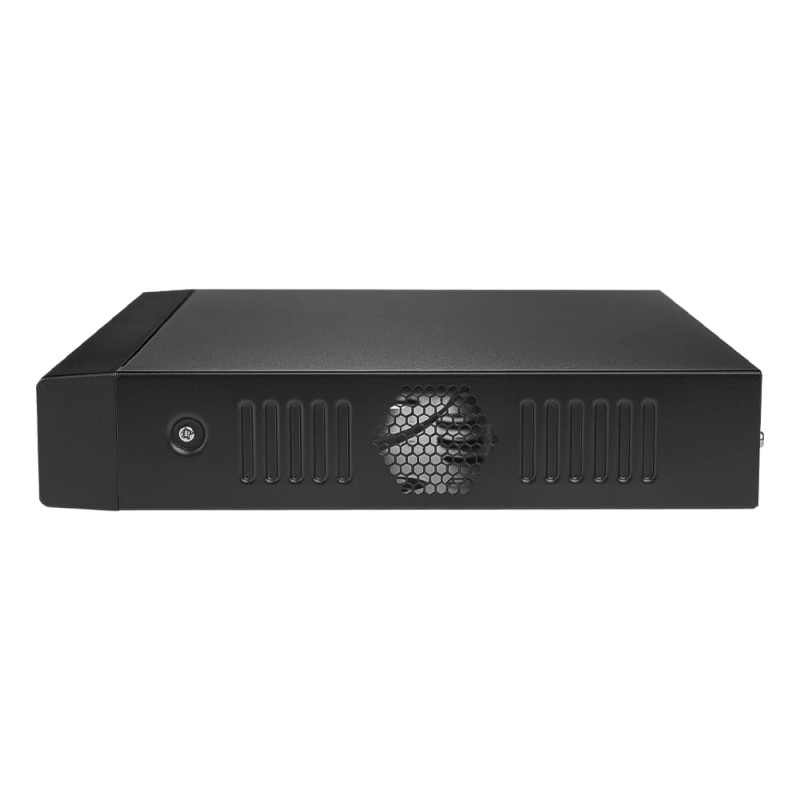



Description Dahua DHI-NVR1104HS-P-S3/H
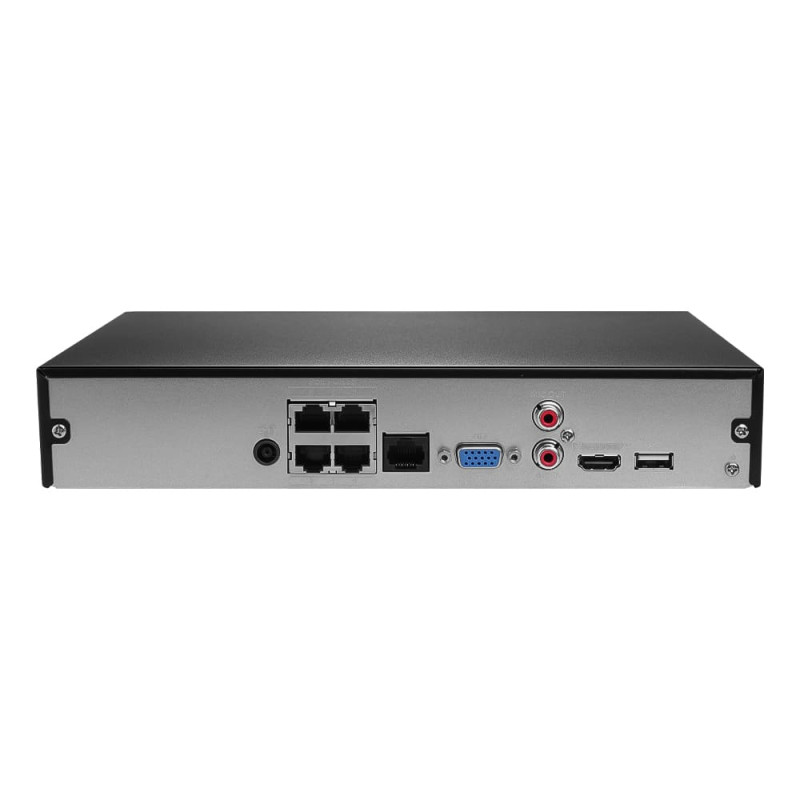
Four PoE ports built in: one box instead of three
The letter P in the model name means exactly one thing: the four rear ports do not merely receive the camera streams, they power the cameras over the very same cable. In practice that removes a separate PoE switch and four power supplies with their sockets from the installation — one twisted pair runs from each camera to the recorder and nothing else. The gain is not only in the bill of materials: fewer devices in the cabinet means fewer points of failure, and above all the whole set hangs on a single UPS, so during a power cut cameras and recorder go down and come back together rather than one after the other. On the non-PoE version (the DHI-NVR1104HS-S3/H in this same catalogue) the classic installer mistake is precisely this — recorder on the UPS, switch in an ordinary socket — and after an outage the archive exists but there is no picture in it. The flip side is worth knowing up front: self-powered cameras, Wi-Fi models and anything sitting beyond 100 metres will not work on these ports, and for those you will still need an external switch.
A 36 W budget and 25.5 W per port: the arithmetic to do before you buy
The total PoE budget is 36 W across all four ports, while a single port can deliver up to 25.5 W, which is the 802.3at standard for heavier loads. The maths follows straight from that: a typical outdoor 2–4 MP camera with IR illumination draws 5 to 8 W, four of them together take 20 to 32 W and do fit the budget, but without much slack. Add a PTZ camera, a model with a heated housing or a camera with a powerful white floodlight, and that single position can swallow 15 to 25 W and leave almost nothing for the other three ports. Overload does not announce itself with a dead port; it shows up in the most confusing way possible — cameras start rebooting in a loop at night, exactly when the illuminators switch on and consumption spikes, and the owner spends days hunting for a network or firmware fault. So the rule is simple: add up the rated consumption of all four cameras, add 20% for inrush current and long cable runs, and if the total climbs past 30 W, feed the hungriest camera from its own 12 V adapter instead.
An isolated camera subnet: more convenient and more secure at once
Cameras attached to the PoE ports are normally placed by the recorder into its own service subnet and picked up automatically — plug and play in the literal sense: connect the cable and the camera appears in the channel list with no manual IP addressing at all. For an owner with no network administration experience that saves half a day, because there is no need to open the router settings or worry about address conflicts with household devices. There is an important security side effect too: the cameras cannot see the home network and have no direct route to the internet, so even a camera running outdated firmware does not become an open door into your LAN from outside. The same coin has a reverse: reaching a specific camera's own web interface from a laptop requires extra routing or going through the recorder, which matters if you are used to tuning every camera directly. Third-party cameras work here through ONVIF and RTSP, but automatic discovery and per-port power control are at their most complete with Dahua cameras.
Four channels up to 8 MP on an 80 Mbps pipe: the real ceiling
The unit records up to four channels at up to 8 MP each with 80 Mbps of incoming bandwidth, and it is the bandwidth rather than the megapixels that sets the true limit of the configuration. Four 8 MP cameras encoded in H.265 with movement in frame come to roughly 8 Mbps apiece, about 32 Mbps together, so you keep more than a twofold reserve and can deliberately raise the bitrate on the channels where detail actually matters. Smart H.265+ and Smart H.264+ are supported: on static scenes they trim the stream by a further third to a half because the codec stops spending bits on a motionless background, and it is these modes that make a deep archive affordable without an expensive drive. One specification detail that rarely makes it into product listings — the HDMI and VGA outputs top out at 1920×1080, so an 8 MP image is scaled down to Full HD on the local monitor. The recording itself stays at full resolution, so the detail is not lost; you simply zoom into the frame during playback or review the archive on a computer or in the app.
A single drive up to 8 TB: archive depth in real days
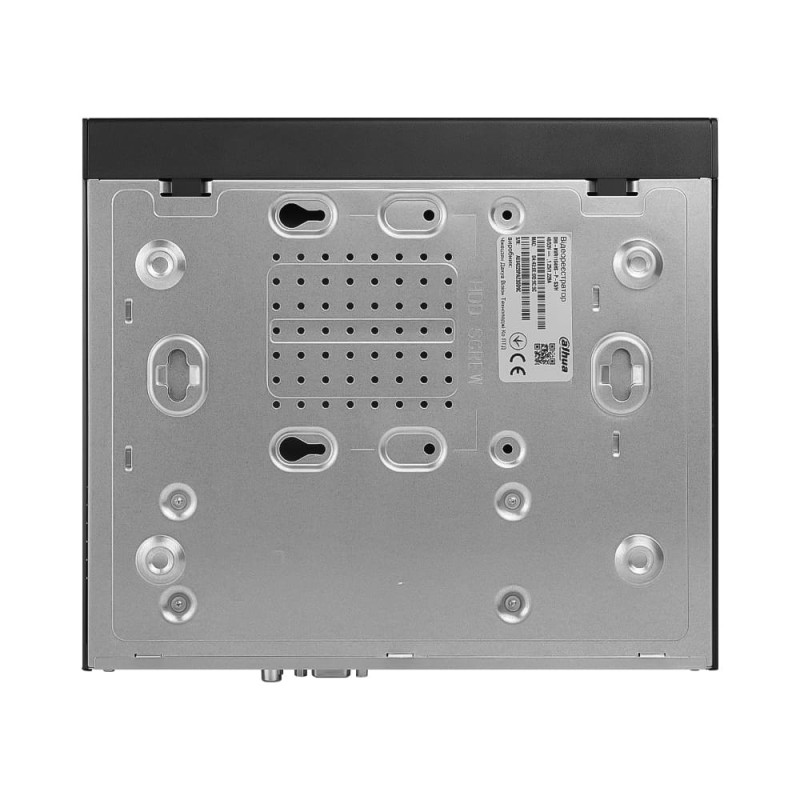
There is one SATA bay inside for a drive of up to 8 TB; the disk is not supplied, and hot swap, RAID and eSATA are all absent because there is physically nowhere to put a second drive. The numbers for continuous 24/7 recording in H.265 look like this: a 2 MP camera consumes around 21 GB per day, a 4 MP camera about 42 GB, an 8 MP camera about 85 GB. On an 8 TB drive — roughly 7.3 TB once formatted — four 2 MP cameras therefore give you about 85 to 90 days, four 4 MP cameras around six weeks, and four 8 MP cameras only about three weeks. Two settings stretch those figures noticeably: Smart H.265+ on static scenes, and moving part of the channels to motion-triggered recording, after which an empty yard overnight costs almost no storage at all. As a practical benchmark: a guaranteed month of footage from four 4 MP cameras fits on a 4 TB drive, while 8 TB makes sense when you need three months of depth, run 8 MP cameras, or record around the clock in a busy place.
Where this model belongs and what it was built for
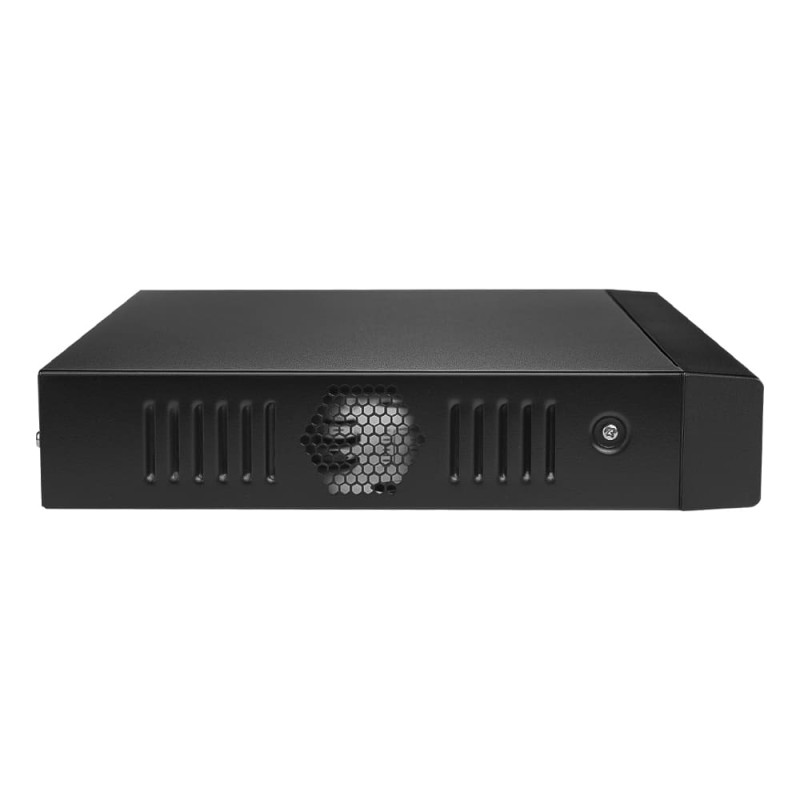
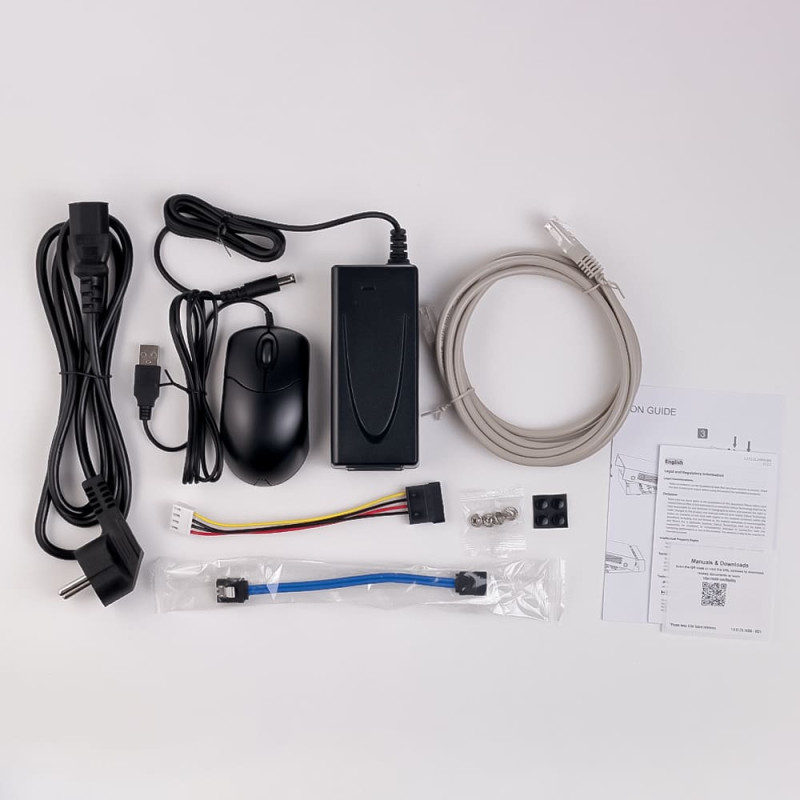
Four PoE channels make a ready-made kit for a private house: the driveway gate, the front door, the back yard and the garage, with all four cameras fed from a single box. The model sits just as comfortably in a small shop, a car service or a few-room office where the cameras are wired, stay within a hundred metres and need no electrical work of their own. The 260×225×48 mm, 0.84 kg chassis goes onto a shelf in a low-voltage cabinet or into a niche, but note that power here is not 12 V: an external 48–53 V supply feeds the unit and it is that supply which produces the PoE, so a UPS has to be sized around this adapter rather than around a 12 V battery. IP20 protection and a -10 to +45 °C range mean indoor mounting only — an unheated garage or an outdoor enclosure is out in winter, and dust settles directly on the board because cooling is passive. Do not choose this model if a sixth or eighth camera is anywhere in your plans: there are exactly four channels and they cannot be expanded.
How it differs from the neighbouring recorders in this catalogue
Its direct relative is the DHI-NVR1104HS-S3/H: same platform, same four channels, but without PoE. With all-wired cameras the PoE version is almost always worth the extra outlay, and the non-PoE model makes sense only when you already own a switch or some cameras are powered separately. The DHI-NVR1108HS-8P-S3/H is the eight-channel sibling with eight PoE ports and a 72 W budget — that is the one to buy if you have more than four cameras or expect to grow, because going from four channels to eight means replacing the recorder outright. The DHI-NVR2104-P-I2 from the senior series offers the same «4 channels plus 4 PoE» format but takes drives up to 10 TB and carries stronger on-board analytics, so it is the choice for a deeper archive and for human and vehicle classification done by the recorder itself. Reolink's NVS4 in this catalogue also gives four PoE ports and a simpler app, but it only shows its full strength with Reolink cameras, whereas the Dahua is more open to a mixed fleet through ONVIF. And separately: if coaxial cable for analogue cameras is already in the walls, none of these NVRs will do the job — that calls for a hybrid such as the DH-XVR5104C-4KL-I3.
Tell us how many cameras you plan, what they draw and how far they sit from the recorder — we will check that you stay inside the PoE budget and match a drive to the archive depth you want.
Characteristics Dahua DHI-NVR1104HS-P-S3/H
Reviews about Dahua DHI-NVR1104HS-P-S3/H from real users
No reviews found







