
 m. Сміла, Незалежності, 67г. оф, 406/6























DAHUA DH-XVR51xxC-I3/T (4 ANALOG + 2 IP) - HYBRID VIDEO RECORDER




Description Dahua DH-XVR51xxC-I3/T
A four-camera hybrid: why keeping the coax makes sense on a small site
The X in XVR stands for five signal types at once — analogue HDCVI, AHD and TVI, legacy CVBS, and ordinary network IP cameras. On a small system that translates into saved labour rather than abstract versatility: if a yard or a shop already carries four old analogue cameras on existing coax, you simply swap the recorder and the cameras for modern HDCVI units and the image becomes two or three times more detailed without a single new cable. For a private house the saving is especially tangible, because the cable to the gate camera usually runs under paving or inside plastered wall, and pulling Cat5 there means either lifting the surface or running visible trunking across the façade. HDCVI has another merit that gets mentioned less often: audio travels down the same coax, so a camera with a microphone needs no separate line, and a reach of several hundred metres lets you place a camera at the far corner of the plot without intermediate equipment. The honest limitation of a hybrid: the analogue channel records at 5M-N at best, and neither 4K nor two-way talk through the camera will come over coax — those remain the privilege of network cameras on the IP channels.
Four analogue and two network channels, and how to combine them
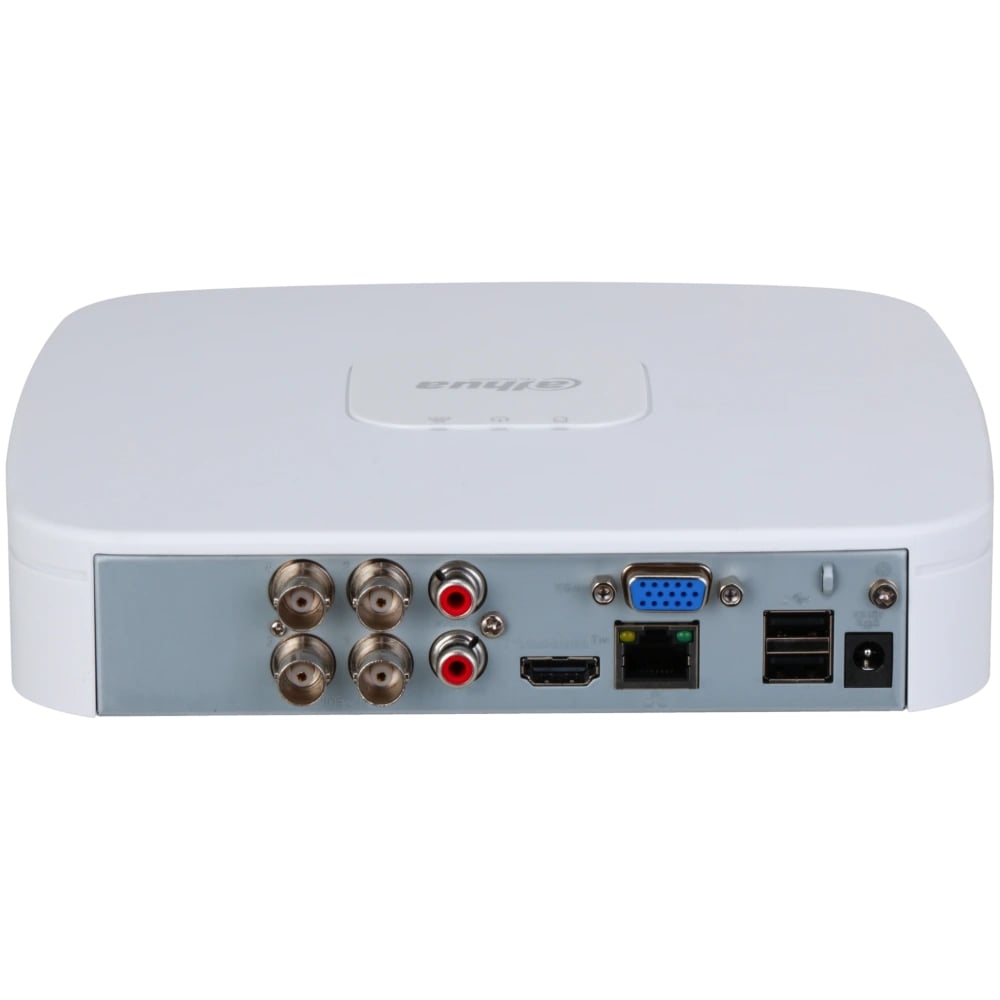
The standard configuration is four BNC inputs plus two IP channels, so six cameras record simultaneously — exactly the number that covers a typical house: the gate, the yard, the rear wall, the front door, plus two spots where a network camera makes more sense. The allocation logic is straightforward: give the analogue inputs to the positions that already have cable, and the IP channels to new positions where Cat5 is easy to run, or to any point that needs real resolution, since an IP channel accepts up to 6 MP while the analogue side is capped at 5M-N. If the BNC inputs go unused entirely, the recorder still works as a small network unit with up to six streams in total, so it is not wasted in an all-IP installation — it merely stops exercising its main advantage. One real benefit of this four-channel version over high-count hybrids: 25 fps is available on every analogue channel at the same time and in 5M-N mode, with no drop in frame rate, because the processor is not splitting its budget across sixteen inputs. In practice that means smooth motion at the gate — a car driving in does not jump between frames, and a plate stays readable on a single frame provided the camera was chosen for that distance.
One drive bay up to 16 TB: what that really means in days
There is a single drive bay, but it takes a disk of up to 16 TB, so the constraint is your drive budget rather than the recorder itself. The estimate is easy to make: four analogue cameras at 5M-N with H.265 run around 2.5-3 Mbps each, two 4 MP IP cameras add roughly 3 Mbps apiece, and the total lands near 17-18 Mbps — about 180-190 GB per day of round-the-clock recording. That yields clear numbers: a 2 TB disk gives ten or eleven days, 4 TB gives three weeks, 8 TB about six weeks, and 16 TB covers almost three months of continuous archive. Drop the analogue channels to 1080p instead of 5M-N and the daily figure falls to roughly 150 GB, stretching the same drives by a quarter; switching from continuous to motion-triggered recording multiplies the depth two to four times, and on a private yard where nothing happens at night the result will be nearer the upper figure. One caveat to plan for: there is a single disk with no RAID and no hot swap, so if it fails the archive is gone in full — important clips are worth exporting over USB or keeping a copy of in the app straight away.
WizSense: SMD Plus on every channel, perimeter and faces on some
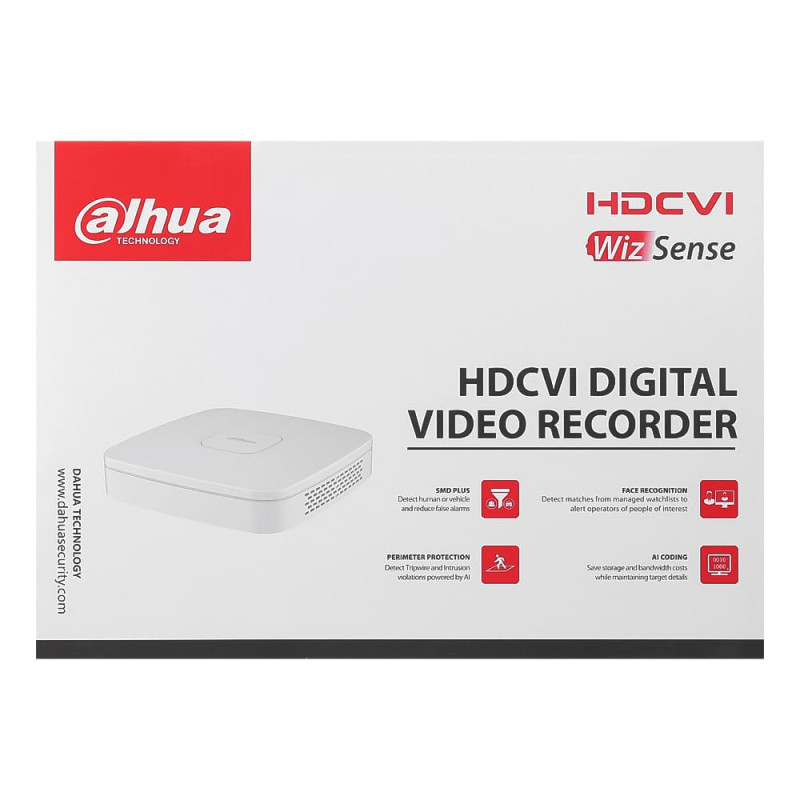
The analytics run in the recorder rather than in the camera, which is why even inexpensive analogue cameras stop burying their owner in false alerts once paired with this unit. SMD Plus works on all four analogue channels: the recorder separates people and vehicles from branches, shadows, droplets on the lens and the cat crossing the yard. The practical difference shows up by day two or three — plain motion detection produces hundreds of events over one windy night, the owner mutes notifications, and the system stops acting as security, leaving only an archive that gets opened after the fact. Heavier analytics are spread across channels unevenly and this is worth planning before installation: perimeter protection with tripwire and intrusion rules is available on four channels, while face detection and recognition work on two, so those two belong on the gate and the front door rather than on a view of the lawn. Analytics also help with retrieval: archive events can be filtered by object type, so finding the moment somebody entered the yard takes a minute instead of scanning a whole night in fast-forward.
A compact chassis, 5 W draw and survival through power cuts
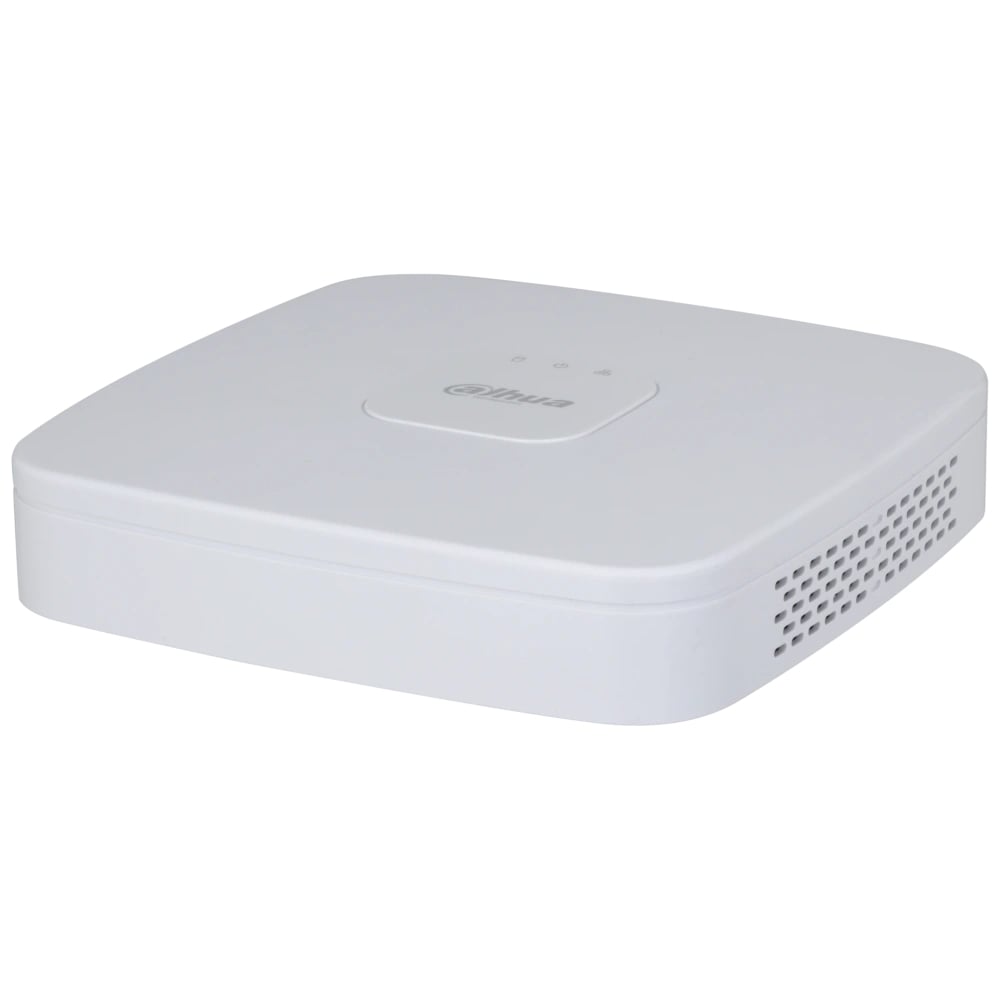
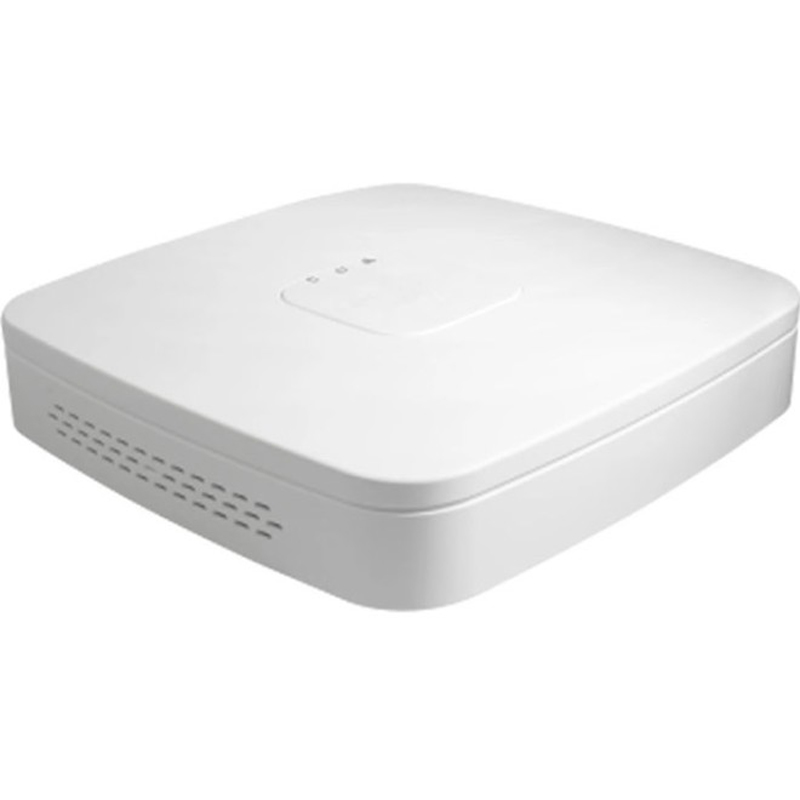
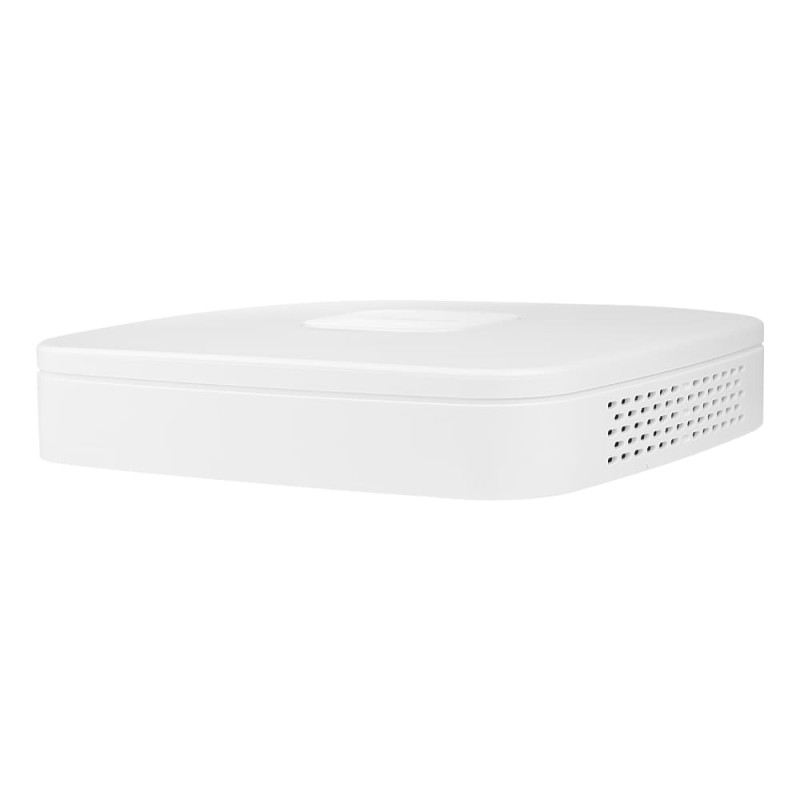
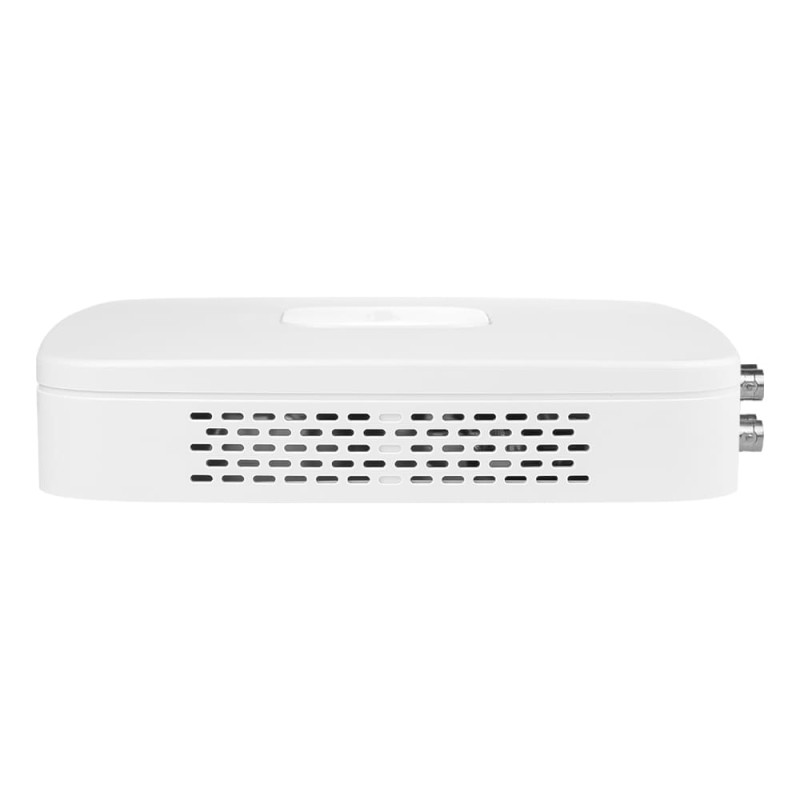
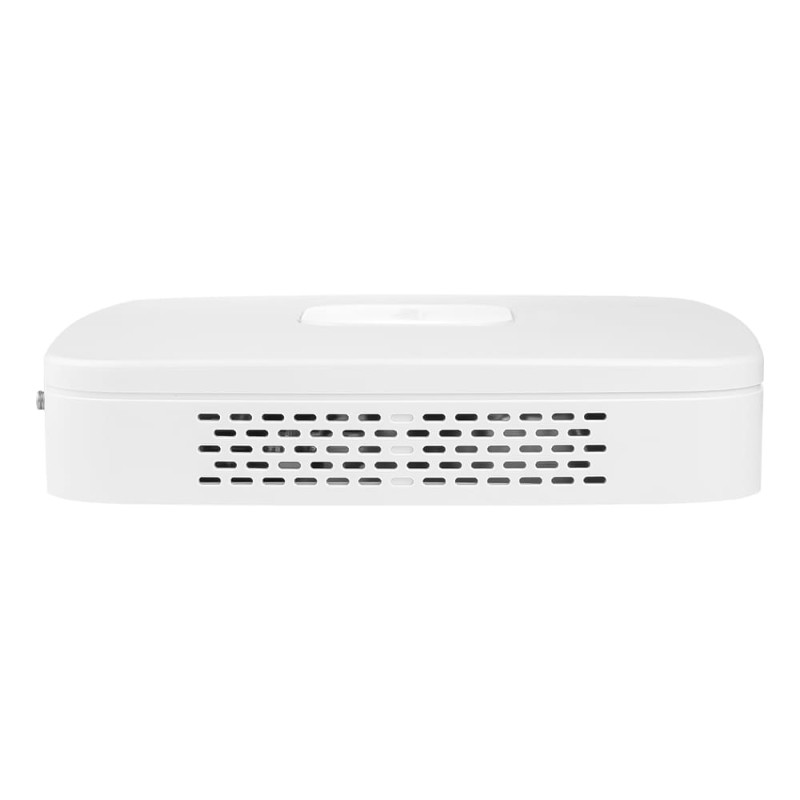
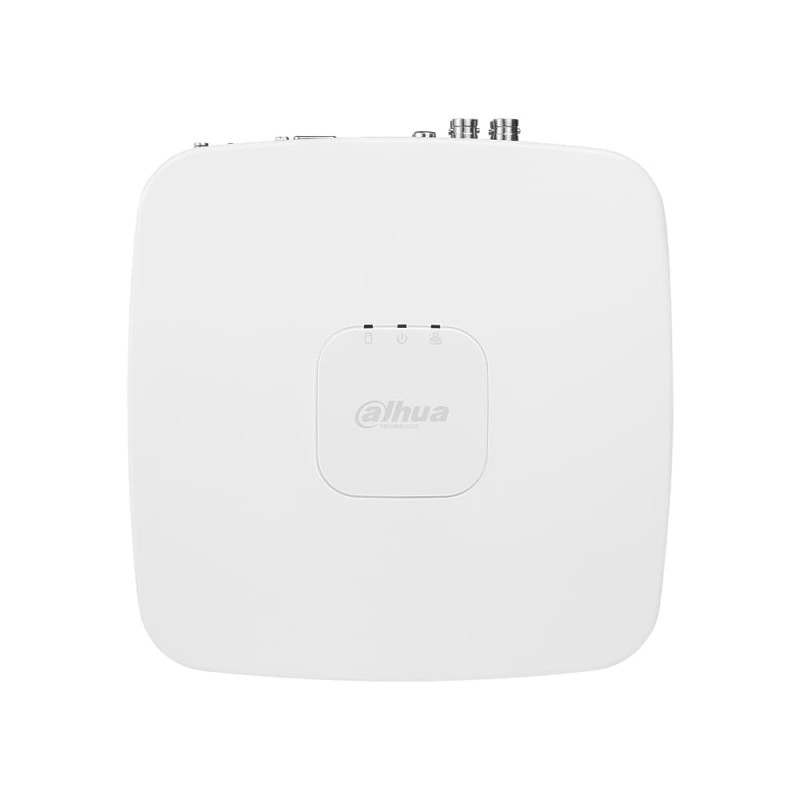
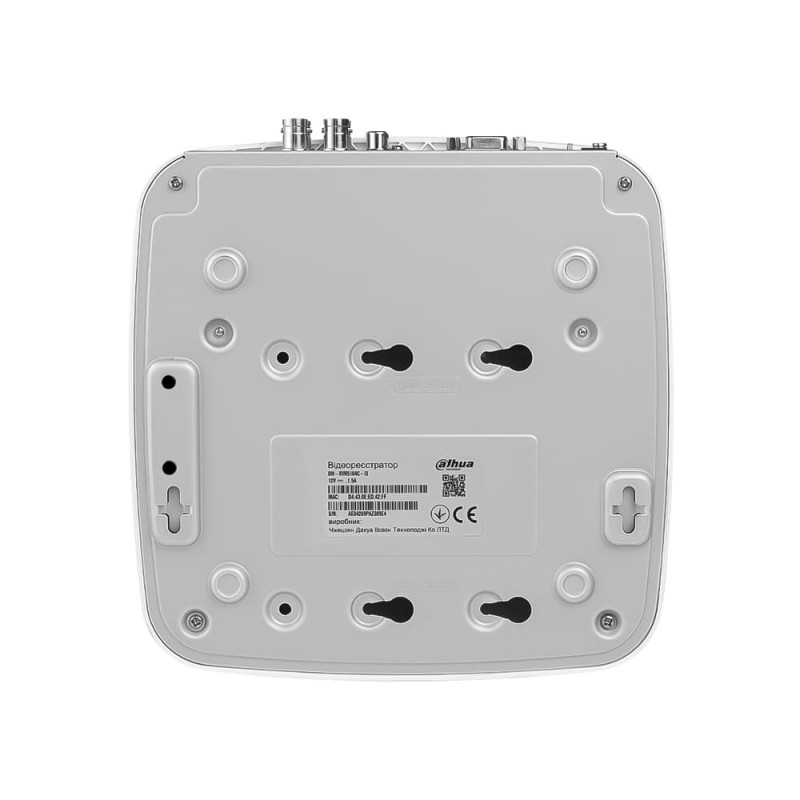
At 205×211×46 mm and under half a kilogram the unit is the size of a thick book, and that is what sets it apart from full-size recorders: it needs no rack shelf and no dedicated niche, and it lives happily in a hallway cupboard, behind a TV or in a wiring box next to the router. The white plastic case is an asset rather than a drawback in a living space, since the device does not look like server hardware and draws no attention. Its biggest practical advantage is a draw of about 5 W without a disk and a mere 12 V / 1.5 A adapter: with a drive fitted the node still stays within a few dozen watts, so even a modest UPS or a 12 V battery keeps the recorder and several cameras alive for hours rather than minutes — during scheduled outages that is the difference between a working system and a dark screen. The HDMI and VGA outputs operate independently, so a modern monitor and an old VGA screen you had lying around can both be connected at once. What is absent: RS-485 terminals, so a legacy analogue pan-tilt camera with its own control line cannot be driven here — modern HDCVI PTZ cameras are controlled over coax and are unaffected, but genuinely old hardware calls for a model with RS-485.
Where this model belongs and the jobs it is built for
Six channels in a compact box describe a system for a private house, a flat with grounds, a small shop, a café, an office of a few rooms, a service bay or a holiday home with outbuildings. It fits the staged-modernisation scenario most precisely: a site has analogue cameras whose quality no longer satisfies anybody, the owner replaces the recorder, immediately gains H.265, analytics and a proper app, and then swaps cameras one by one as the budget allows. The second typical case is a mixed system — some cameras have already been installed as IP, while there is no reason to abandon working coax at the gate or in the garage; this recorder merges both halves into one archive and one app instead of two separate systems with two logins. The low power draw makes it apt wherever supply is unreliable — a holiday house, a building site, a small property without a generator — because the simplest UPS is enough for autonomy. Where it does not belong: if you need more than six cameras, or months of archive at high resolution, one disk and six channels will not do; and for a system built from scratch entirely on IP cameras the analogue inputs would sit idle, making a network recorder with PoE the smarter purchase.
How it differs from the neighbouring models in this catalogue
Its closest relative here is the Dahua DH-XVR5104C-4KL-I3: the same compact body and the same analogue input count, but with 4K-Lite support — higher recording resolution and 4K output to a monitor — at the cost of a lower maximum disk capacity. The choice comes down to one question: if you are already buying 8 MP cameras and want their full picture on a large screen, the 4KL version is worth the premium; if your cameras are 5 MP and archive depth matters most, this model wins precisely because of the 16 TB ceiling. The Dahua DH-XVR41xxHS-I/T is a noticeably cheaper option from the same hybrid family, but it records analogue channels only in 1080N and has neither perimeter protection nor face detection, so it is the pick for the simplest brief of just seeing what happens. The Dahua DH-XVR5108HS-4KL-I3/T doubles the channel count and makes sense once you are at eight cameras or more. And if the site has no coax at all, the comparison should be with the Dahua DHI-NVR1104HS-P-S3/H or DHI-NVR2104-P-I2: also four channels, but with built-in PoE ports, so cameras take power and data over one cable from the recorder and no separate switch is needed — for an all-network system that is a materially simpler install.
If you are unsure how many cameras need an analogue input and how many a network channel, or which disk suits the archive depth you want, tell us what is already installed on site and we will put together a configuration without unnecessary spending.
Characteristics Dahua DH-XVR51xxC-I3/T
Reviews about Dahua DH-XVR51xxC-I3/T from real users
No reviews found







