
 m. Сміла, Незалежності, 67г. оф, 406/6























IMOU TURRET SE-C (2 MP/2.8 MM) - WI-FI IP CAMERA




Description Imou Turret SE-C
Two megapixels: when that is genuinely enough
A 2 MP sensor (1920×1080) looks modest beside its 3 and 4 megapixel neighbours, so the real question is not the number itself but the distance at which you intend to recognise somebody. Within four or five metres — by a flat door, above a till, in a warehouse corridor — those pixels are enough to show facial features and the colour of a jacket rather than an abstract figure. Beyond eight to ten metres, 2 MP reduces a person to a silhouette: the camera will record that somebody was there, but it will not answer the question of who. That is exactly why the Turret SE-C belongs on a short, controlled zone instead of a wide yard where every extra metre eats away detail. Modest resolution has a genuine upside too: the stream is light, the archive on a card or recorder stretches much further, and a Wi-Fi network already carrying several cameras does not choke.
Infrared up to 30 metres — nights will be black and white
This model carries only classic infrared illumination with no white LEDs, so the night image is always monochrome, and that is a fact worth absorbing before the purchase rather than after. Infrared light is invisible to the eye, which is its strength: the camera does not reveal itself, does not shine into windows and does not attract insects, while still working the scene out to 30 metres. What you will never get from a night recording, however, is the colour of a coat or a car, and if that footage ever has to go to the police the omission can matter. H.265 compresses the stream about twice as tightly as H.264 at equal quality, so the quiet night hours barely inflate the archive at all. If colour at night is essential for your location, this catalogue has models with dual illumination — the Turret SE-C deliberately saves money on precisely that feature.
Human and vehicle recognition in a two-thousand-hryvnia camera
Despite its budget position, the analytics here separate a person and a vehicle from ordinary movement, and that is what divides this model from the cheapest pixel-change detectors. The practical effect is simple: an alert arrives when someone walks up to the door or a car enters the yard, not when wind shakes a branch or headlights throw a shadow across the wall. An owner who is not woken ten times a night keeps push notifications switched on, which means the camera keeps doing security work instead of sitting in the app as a dead icon. The detection zone can be limited to a rectangle, cutting out the pavement, the roadway or a neighbour's door so that other people's traffic does not drag alarms with it. Notifications travel through two channels, app push and e-mail, so an event is still visible when the phone is on silent.
An eye-ball body of 110×81 mm: aiming and glare control
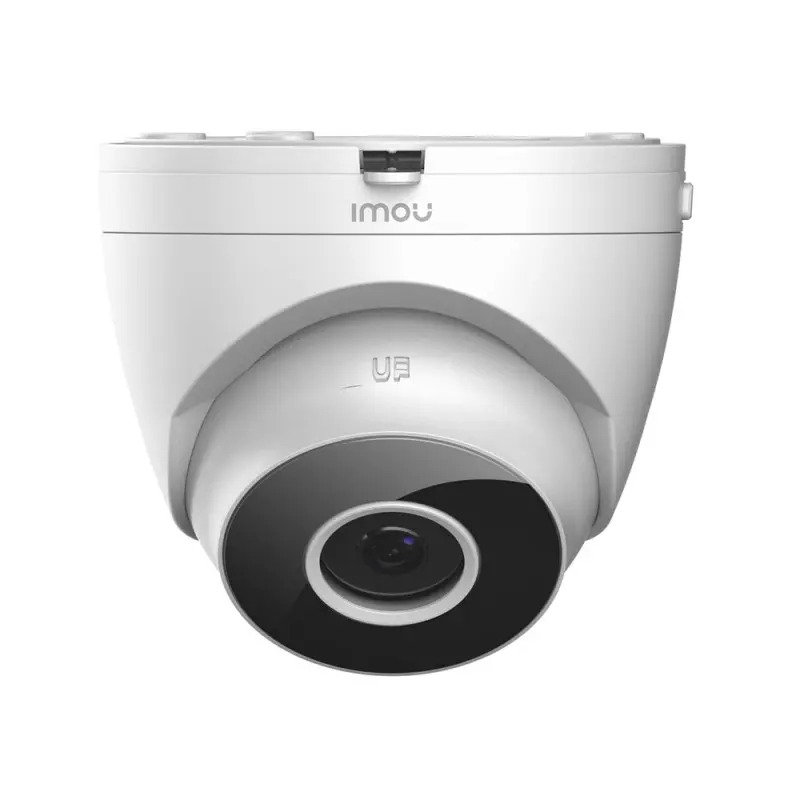
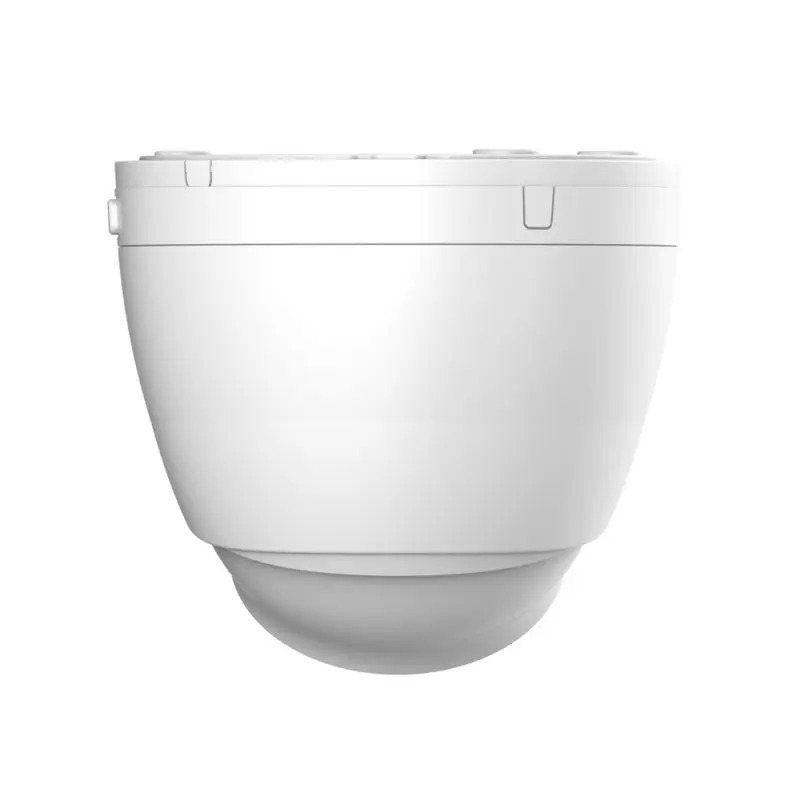
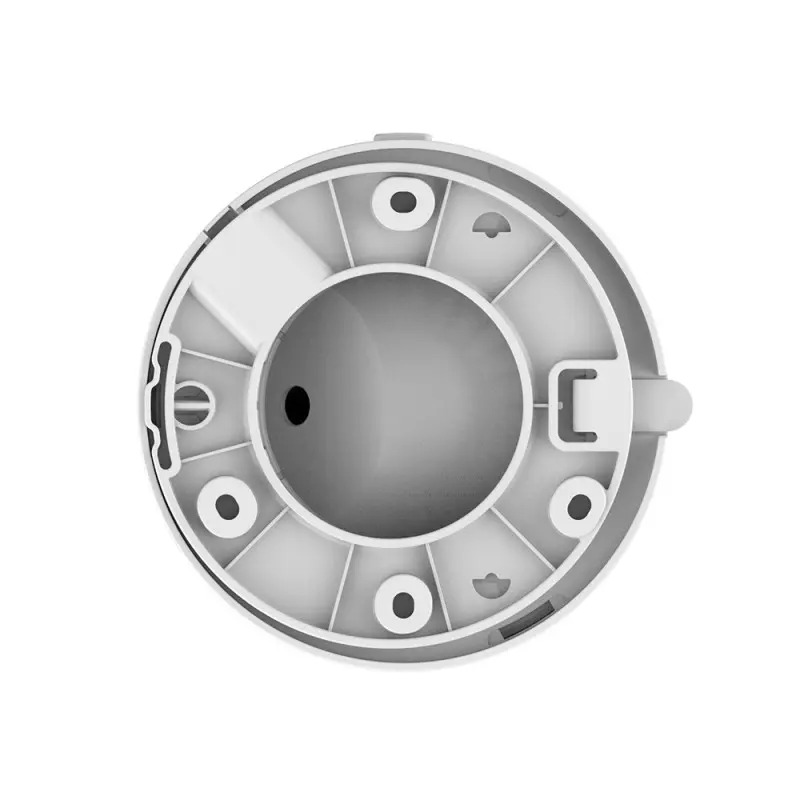
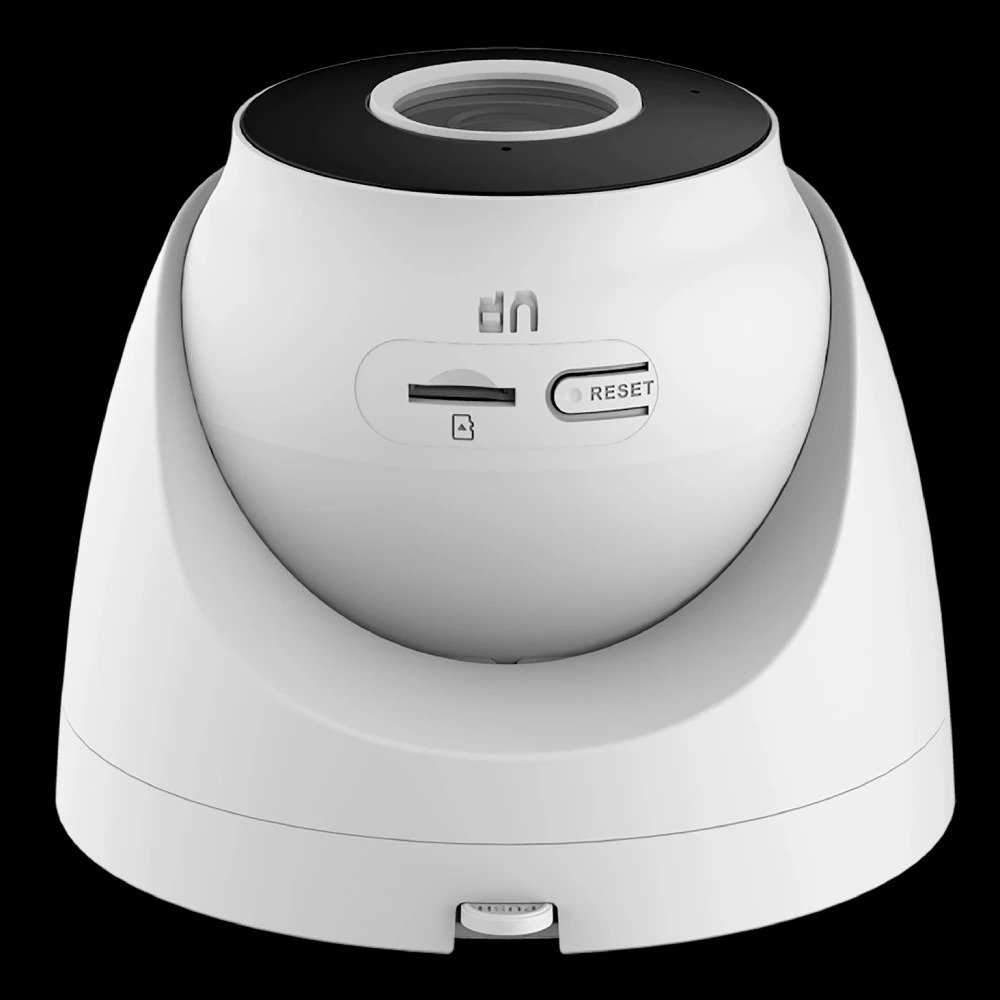
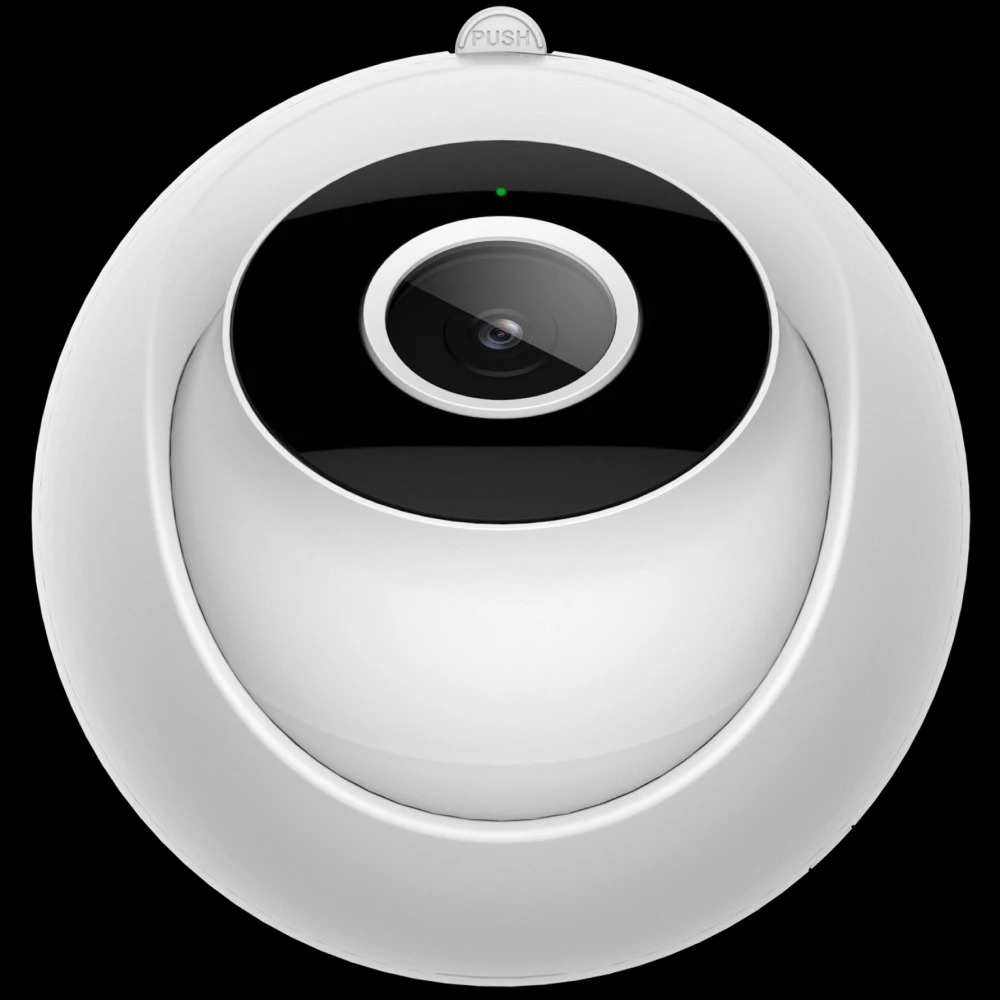
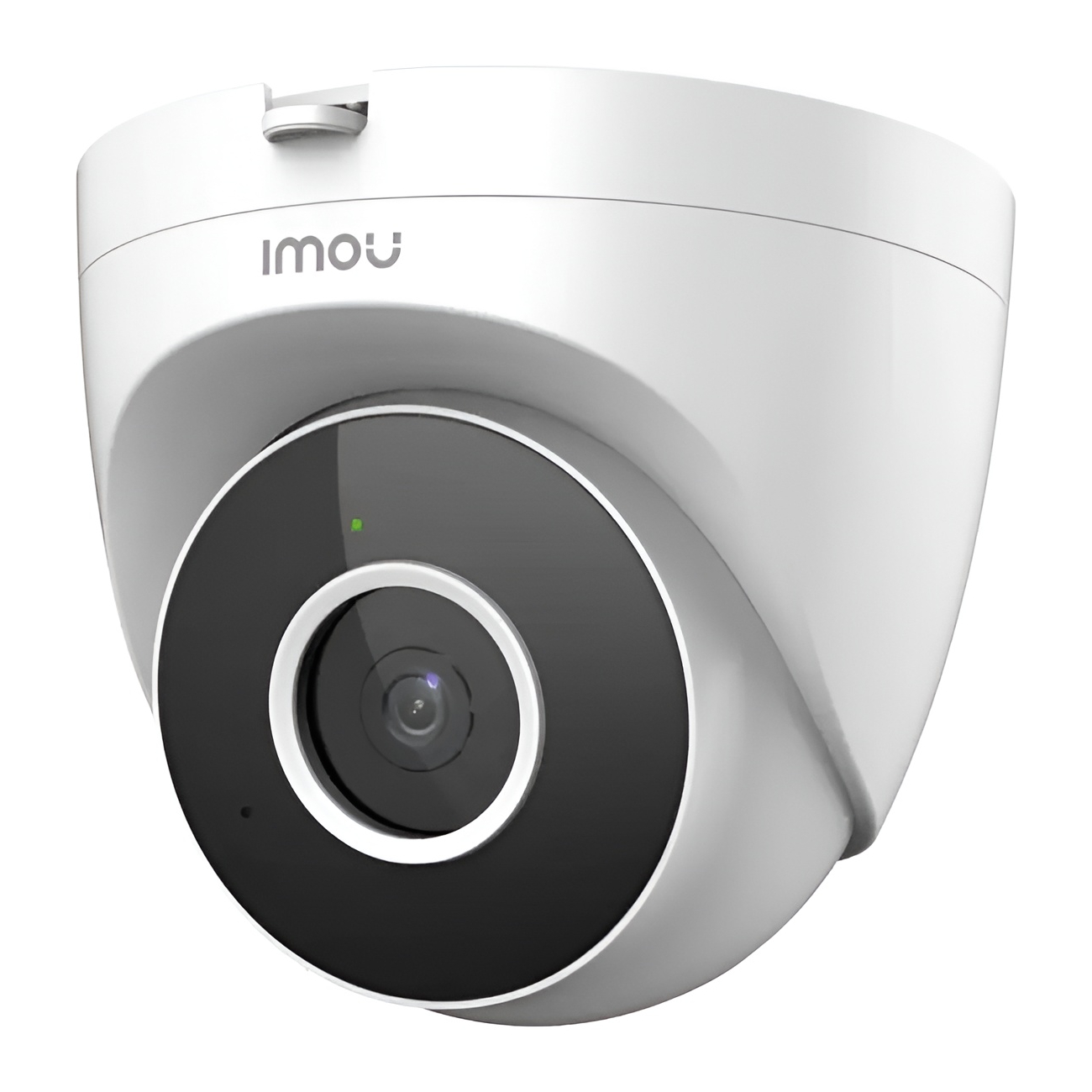
The eye-ball form is a ball seated in a base: after mounting you simply turn it towards the target and lock it, so the camera works on a ceiling, on a wall under an overhang or at an awkward angle and still keeps the horizon level. Unlike a bullet camera on a long arm, there is no lever here for a hand to grab, and the unit itself is compact at 109.9 mm across, 81.3 mm high and only 200 grams. The shape pays off at night in a way people rarely expect: the IR diodes sit behind the same glass as the lens, and with correct aiming you are less likely to catch glare from your own illumination bouncing off a nearby wall. The housing is plastic with IP67 protection, which makes it suitable for outdoor use but not vandal resistant — this is not an armoured dome, and it will not last long anywhere it can be reached. The sweet spot for mounting is 2.5 to 3 metres: high enough to stay out of reach, low enough to capture a face rather than the top of a head.
12 V power and two network options — but no PoE
The Turret SE-C draws under 3 W, runs from a 12 V adapter and supports both 2.4 GHz Wi-Fi and a wired 100 Mbps Ethernet port. Here is the detail that trips people up on their first installation: a network port does not mean PoE — no power travels along that twisted pair, and the mounting point still needs a socket. Imou does make a PoE variant of this camera (index EAP instead of EP), so if the plan is to feed the camera from a switch over a single cable, that is the model to look at rather than this one. Treat the wired option not as a substitute for power but as a cure for Wi-Fi trouble: a concrete wall between router and camera easily swallows half the signal, whereas a cable delivers a steady stream every time. Low consumption brings a side benefit as well — the camera runs comfortably from a small UPS alongside the router, so it keeps recording for several hours through a power cut.
Where this camera belongs and what it was built for
This is a short-distance camera for a controlled zone: the entrance door of a flat or office, a lobby, a corridor, the till area of a small shop, a workshop entrance, the sheltered part of a porch. In a retail space it makes sense above the till or above a shelf of expensive goods, where you need to see hands and faces two or three metres away rather than survey the whole floor. Outdoors it works thanks to IP67, but strictly as an entrance camera — under a canopy, above a door, by a wicket gate — not as a perimeter overview across tens of metres. For a large yard, a car park or a long fence it is simply the wrong tool: at more than ten metres 2 MP gives you motion and nothing else, and the budget is better spent on higher resolution from the start. Nor should it be planned for number plates, since a 2.8 mm lens with a 92-degree field exists for general scenes, not for reading small print.
How it compares with the neighbouring models in this catalogue
Its direct older sibling is the Imou Turret SE 4MP-C (IPC-T42EP-C): identical body, identical mounting, but 4 MP instead of 2 MP — twice the pixels on the same scene. Th difference pays for itself every time footage has to be zoomed, so choosing the cheaper model is only justified when distances really are short and archive space is tight. The Imou Bullet 2E (IPC-K3DP-3H0WF) costs almost the same and delivers 3 MP plus a white spotlight for colour at night, which makes it the obvious pick for an outdoor point where night colour matters. The Imou PS8D 3MP PoE (IPC-PS8DP-3V0) is also a dome in the same price band, but powered over PoE and without Wi-Fi: on a site that already has a switch and cabling, that is the more practical answer. The Turret SE-C stays a sensible buy in one specific situation — you need a simple, reliable entrance camera with human detection, there is a socket nearby, and the budget stops firmly at two thousand.
Tell us how far the point you need to watch sits from the camera, and we will say honestly whether 2 MP is enough here or whether the 4 MP version is the better starting point.
Characteristics Imou Turret SE-C
Reviews about Imou Turret SE-C from real users
No reviews found







