
 m. Сміла, Незалежності, 67г. оф, 406/6























IMOU 3MP PoE PT (3.6 MM) - PAN-TILT IP CAMERA

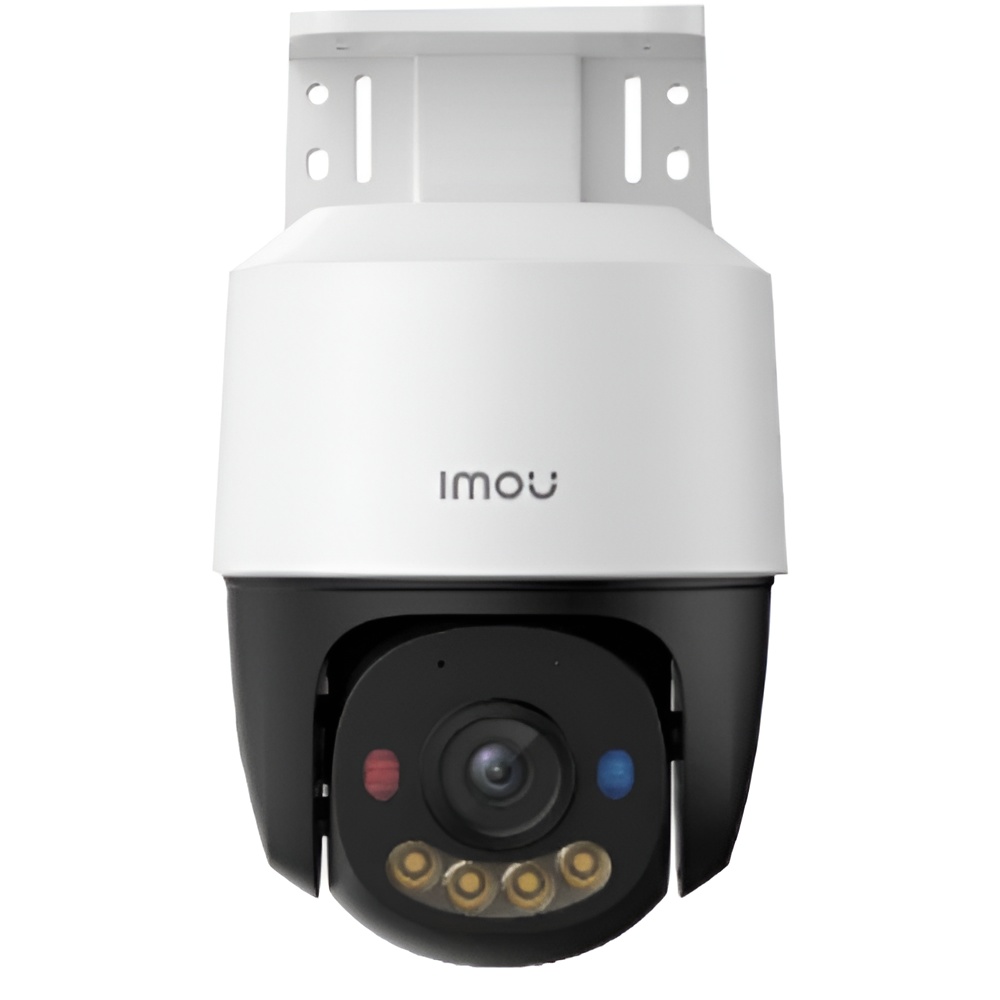
Description Imou PT PoE
A 355°/90° motorised head that replaces three fixed cameras
The motorised head turns through 355° horizontally and tilts from 0 to 90°, which lets a single unit cover ground that would otherwise need three fixed lenses. Inside the Imou Life app you store preset positions — the gate, the front door, the yard behind the house — and move between them with one tap, or let the camera walk through them on a patrol schedule. The trade-off built into every pan-tilt camera deserves saying out loud: only the sector the lens is pointed at right now gets recorded, so while the camera faces the gate, whatever happens at the back wall never reaches the archive. Treat it either as the flexible extra in a system whose perimeter is already covered by fixed cameras, or as the only camera on a site where the security job comes down to one or two directions.
3 MP, a 3.6 mm lens and a 78° angle: what the frame actually shows
The 1/3-inch sensor produces a 2304×1296 image, roughly half as many pixels again as the familiar 1080p cameras, and that margin decides whether a zoomed-in crop shows a face or a smudge. At 3.6 mm the lens is noticeably narrower than the 2.8 mm optics common in this price bracket: it takes in less width but writes more detail into every metre of distance, and the swap makes sense here precisely because the motorised head gives the lost width back. As a working rule, count on recognising a familiar face within about 8-10 metres, on a readable general view — clothing, direction of travel — out to 20-25 metres, and on licence plates only head-on and no further than 6-8 metres. Infrared illumination reaches roughly 30 metres, enough for an average suburban yard but not for a long driveway or a warehouse floor.
Colour at night, a spotlight and a 110 dB siren
After dark the camera runs in two fundamentally different ways, and the gap between them matters more than a feature list suggests. Infrared mode keeps the illumination invisible and the picture monochrome, which means the camera gives nothing away; switch the white spotlight on and the frame stays in full colour, so instead of a person in a dark jacket you get a man in a blue jacket and a red cap — the kind of detail that counts when the recording has to be shown to someone. On top of that sit two active deterrence tools: a built-in 110 dB siren and red-and-blue strobe LEDs, triggered automatically by a rule or manually from the phone. Most attempts to walk into someone else's yard end right there, because a sharp noise and a flashing light tell the visitor plainly that he has been seen. The flip side is worth planning for: in dense housing 110 dB reaches the neighbours too, so it is sensible to arm the siren only at night and only on a confirmed human detection.
Person and vehicle detection instead of an alert for every branch
The camera separates people and vehicles from everything else that moves in frame, and you can leave notifications switched on for just the categories you care about. The difference from plain motion detection shows up in the second week of ownership: a camera without analytics reacts to a swaying branch, a cloud shadow, a cat and the rain, the owner collects a hundred pushes a day, turns them all off a week later — and the system stops being a security system while the camera keeps happily recording. The same analytics also drives the head: in tracking mode the camera picks up a detected object and follows it across the zone, then returns to its home position. Do not expect perfection — at the edge of the illuminated range, or in heavy rain, the classifier does make mistakes — but false alarms drop by an order of magnitude, which is exactly what makes notifications worth reading again.
PoE 802.3af: one cable for power and data
The camera runs either on 802.3af PoE or on a separate 12 V supply, and for outdoor work the first option is almost always the easier one: a single twisted pair reaches the camera instead of a data cable plus a mains line and a socket under the eaves. When budgeting, remember that 802.3af delivers up to 15.4 W per port and that a pan-tilt camera with a spotlight draws noticeably more than a fixed one, particularly while the head is moving and the LEDs are lit: a cheap switch with a 60 W total PoE budget across eight ports will run out sooner than the arithmetic of 8×15 suggests. The metal-and-plastic body weighs 505 g at 196×159×115 mm, heavier than an ordinary turret, so the bracket and the surface under it must be rigid — a thin plastic soffit will eventually transmit vibration that shows up in the footage. IP67 sealing means the camera can be mounted in the open, with no canopy, and will take driving rain from any direction.
Storage: memory card, recorder and ONVIF
Local recording goes to a microSD card of up to 512 GB, and for one or two cameras that is the main scenario: the video stays with you, works without an internet connection and needs no subscription at all. As a rough figure, 512 GB holds several weeks of event-triggered clips, or roughly a week to ten days of continuous 3 MP H.265 footage, so anything deeper calls for a recorder. The camera speaks ONVIF, which is unusually honest for this price segment: it connects not only to an Imou NVR but to a Dahua or Hikvision recorder or a third-party VMS, handing over a full H.265 stream for the shared archive. There is also Home Assistant integration, which opens up scenarios the vendor app does not cover — switching on the yard light when a person is detected, pushing the feed to a hallway tablet, tying the camera to a smart lock. The Imou Protect cloud is optional and duplicates clips off-site, but nothing essential depends on it: card recording, alerts and live view all work with no subscription.
Where this camera belongs and what it was built for
It fits best on the yard of a private house where several directions matter at once — gate, wicket, front door, parking spot — and all of them are visible from one point on the façade or a pole. The second strong case is a small warehouse, workshop or car wash, where during the day you want to watch the work and steer the camera by hand, and at night hand the job over to person detection and the siren. Where it does not belong is a long perimeter or a driveway beyond 30 metres — 30 metres of illumination and a 78° angle will not stretch, and two fixed cameras facing each other solve that properly. It is also a poor choice as the only camera on a site with several separate zones, because it physically cannot look two ways at once, and that is where most of the disappointment comes from.
How it compares with its neighbours in this catalogue
Its closest relative here is the Imou PS8D at UAH 2,070: same 3 MP sensor, same PoE, same siren and colour night mode, but a fixed body with a wider 2.8 mm lens and a 96° angle. The UAH 1,125 gap is essentially the price of the pan-tilt mechanism — if you need one sector covered and nothing more, the PS8D is cheaper and mechanically simpler, with no moving parts to wear out. The Imou Bullet 3 PoE at UAH 1,575 goes further down, offering the same resolution without the spotlight and siren, which suits a camera meant to record a fact rather than to deter. In the other direction sits the Dahua DH-P5AS-PV at UAH 3,600: also pan-tilt, but 5 MP and Wi-Fi instead of PoE, so UAH 405 more buys sharper detail at the cost of depending on radio conditions in the yard. The Hikvision DS-2DE2C400MWG-E at UAH 7,200 is a different class of true PTZ mechanics built for years of continuous patrol, and paying more than double only makes sense where the camera is moving around the clock; for a private yard the Imou PS7F delivers about 90% of the same result for a third of the money.
If you are unsure whether one pan-tilt camera will cover your plot, send us a sketch of the yard with the entrances marked and we will advise how many cameras and which lenses close every direction without blind spots.
Characteristics Imou PT PoE
Reviews about Imou PT PoE from real users
No reviews found







