
 m. Сміла, Незалежності, 67г. оф, 406/6























HIKVISION DS-2DE2C400MWG-E (4 MP) - PoE PTZ IP CAMERA

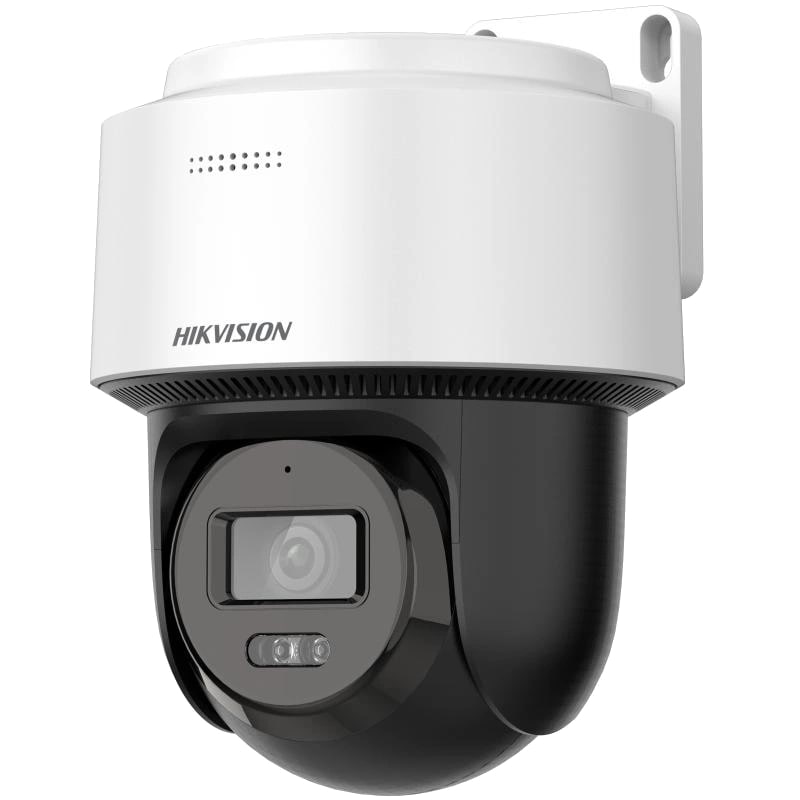
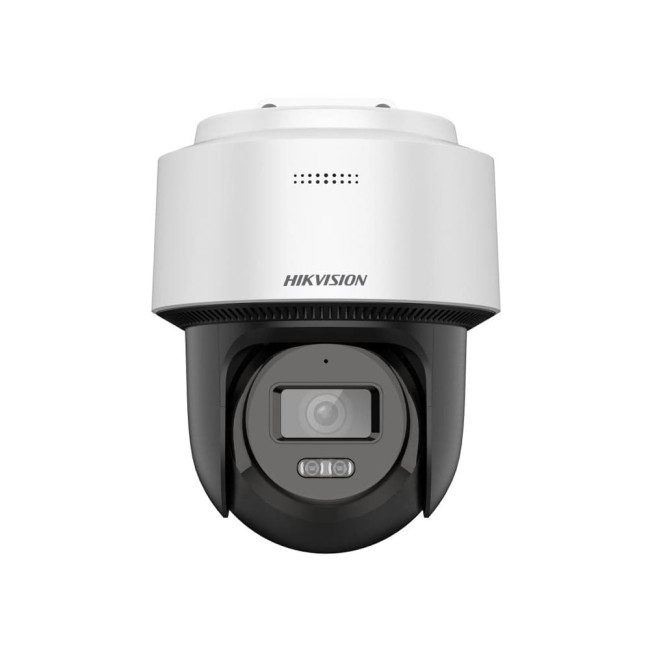
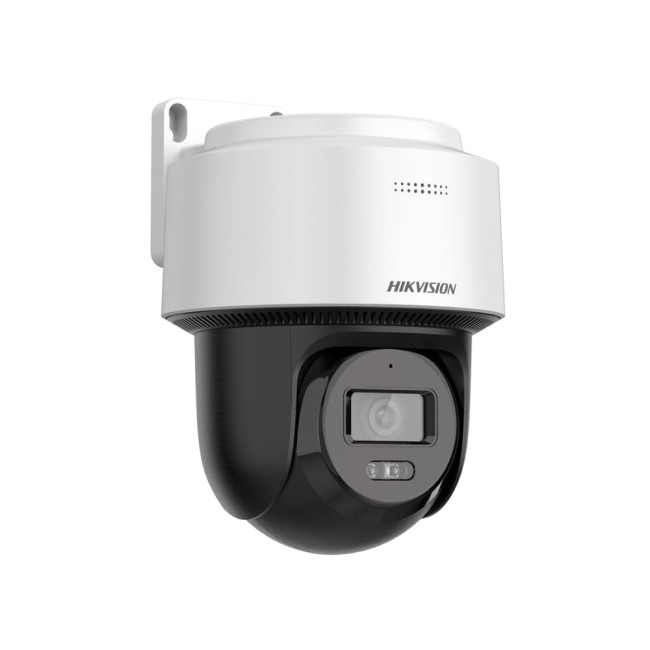
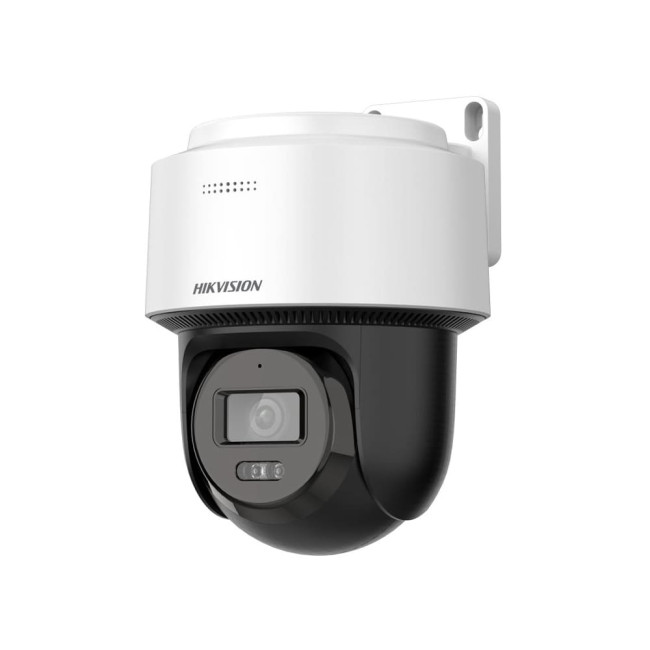


Description Hikvision DS-2DE2C400MWG-E
A 345° pan mechanism: one mounting point instead of three cameras
This model differs from an ordinary dome in a fundamental way, because its optical block moves: the mechanism pans the camera through 345° horizontally at up to 25° per second and tilts it within an 80° range at up to 20° per second. In practice one mounting point covers almost a full circle, so a camera on the corner of a house can be sent from the app to look at the side gate, then at the garage doors, then at the back yard, whereas a fixed model with a 94° angle only ever sees the sector it was aimed at during installation. The 80° tilt lets the lens look almost straight down, which matters above a porch or a front door, where a fixed lens either fills half the frame with sky or demands an angled bracket and extra adjustment. The figure of 345° rather than 360° is not marketing rounding: there is a dead sector in the pan unit where the cable leaves the housing, so during planning that sector is deliberately turned towards the wall. And the main trade-off of a moving camera should be understood before buying: at any given moment it records only the sector it is pointed at, so while you are looking at the back yard nothing that happens by the gate reaches the archive, whereas a fixed camera always records its entire field of view.
Human detection and Auto-tracking Lite: the camera follows the subject itself
The built-in analytics can tell a human figure apart from general movement, so an alarm can be limited to people rather than firing on every pixel change in the frame. Auto-tracking Lite takes that logic further: once a person is detected the camera starts turning after them and keeps them in frame until they leave the working range, after which the mechanism returns to its home position. On a private plot this produces an effect a fixed camera simply cannot deliver, because someone walking from behind the garage to the terrace stays in one continuous recording instead of appearing as fragments in two separate clips. It should not be called the professional auto-tracking of speed domes, as the Lite suffix means a simplified algorithm with no zoom changes and no handling of several targets at once, so in a crowded place the camera will jump between objects. There is an honest limitation worth knowing in advance: there is no vehicle classification here and no line-crossing or intrusion rules of the kind the 2xxx Pro series in this same catalogue provides, so for an entrance gate with the logic of recording a vehicle crossing a boundary this model is not the right tool.
Four megapixels and Smart Hybrid Light: colour footage after dark
A 1/3" sensor with 2560×1440 resolution paired with a 2.8 mm lens gives a 94° horizontal, 49° vertical and 114° diagonal field of view, so a single frame covers a typical yard while the rest of the plot is picked up by panning. The illumination is dual: 850 nm infrared LEDs work invisibly and produce a monochrome image at up to 30 metres, while white LEDs with the same reach switch on when needed and turn the picture full colour, and the camera decides for itself which mode suits the moment. The difference between those two modes is not cosmetic, because a monochrome recording shows the silhouette of a person while a colour one shows that the jacket was blue and the bicycle red, and those are exactly the details that matter when the footage has to be shown to somebody. The frame rate of 20 per second at full resolution is lower than the 25 usual for fixed models, so very fast motion close to the lens is slightly harder to step through frame by frame, although for a walking person or a car manoeuvring in a yard it is entirely sufficient. The zoom here is digital only rather than optical, so magnifying in the app merely stretches pixels, and detail that is not in the frame will not appear by turning the camera — this model is bought for breadth of view, not for reading a plate at a distance.
Two-way audio: not only watching but stopping trouble with a word
The housing contains both a microphone and a speaker, so the camera works as a two-way intercom: you hear what is happening in the yard and can answer from your phone without stepping outside, or indeed without being on the property at all. The practical value is greater than the specification suggests, because a teenager climbing over the fence or a courier leaving a parcel on the ground reacts to a human voice from the camera far faster than to the mere presence of a lens. Together with the white light this turns the camera from a passive recorder into a tool of intervention: first the light comes on, then a voice is heard, and most everyday situations end right there without anyone having to review the archive. Recorded audio is synchronised with the video and stored alongside it, which in practice often matters more than the picture, since a sentence caught on tape describes a dispute at the gate far more precisely than a silent frame. The legal side is worth considering: covert recording of other people's conversations goes beyond ordinary domestic video surveillance in a number of situations, so for a shop or an office it is sensible to mark the audio zone with a notice.
Why the -10 to +40 °C range is this model's main limitation
A moving camera fundamentally cannot match the frost resistance of a static one, because inside the housing there are motors, gearboxes and a sliding signal transfer unit, and all of these mechanical parts are sensitive both to lubricant thickening in the cold and to thermal deformation of their seats. That is why the rated range of this model is -10 to +40 °C, noticeably narrower than the -30 to +60 °C of the static outdoor cameras in this same catalogue such as the DS-2CD2343G2-LI2U or the DS-2CD1123G2-LIUF. For a Ukrainian winter this translates into very concrete planning, because January regularly drops below -10 °C, and on those days the manufacturer no longer guarantees a camera hanging on an exposed facade — what suffers first is not the sensor but the drive, which may start to stall or to whine. The practical conclusion is simple: this model belongs under an eave, under a canopy, on a balcony, at the entrance to a covered car park, in an unheated warehouse or on a terrace, in other words where there is no direct contact with freezing wind and ice build-up, and not on a bare north-facing wall. The IP66 rating handles rain and dust without question, including pressurised water jets, so the issue is temperature rather than moisture: if you need a camera that hangs in the open all winter, take a static model rated to -30 °C and add coverage with a second point.
PoE power, a local archive and integration with other systems
The camera runs either from 12 V DC drawing up to 9 W or over PoE to the 802.3af standard with a maximum of 10.5 W, so a single twisted pair carries both power and data and no mains socket is needed at the mounting point. Its appetite is noticeably larger than that of a static camera of the same resolution and that belongs in the budget: the motors draw current while moving, so on an eight-port switch with a total budget of 60-65 W four such cameras already reach the ceiling, and alongside static points a switch with headroom is the wiser buy. The microSD slot takes cards up to 512 GB, which is not a secondary detail, because if the cable to the recorder is cut the camera keeps recording locally, and with H.265 compression a card of that size covers weeks of event-based footage. Support for ONVIF profiles S, G and T together with ISAPI, SDK and ISUP means the camera fits not only a Hikvision recorder but also a third-party NVR or an open video management system, while Home Assistant support lets it join smart-home scenarios. There is a typical caveat for pan-tilt cameras in foreign systems: video and audio are picked up over ONVIF without trouble, yet pan control and auto-tracking may turn out to be unavailable or cut down in a third-party recorder, so the full feature set is more reliably reached through the manufacturer's own app.
Where to put this camera and which jobs it genuinely suits
This model is at its best where a large area has to be surveyed from one point and you periodically need to work out what exactly is going on: the yard of a private house, the apron in front of a garage, the loading area of a small warehouse, an office courtyard, a cafe terrace. The second strong scenario is a space where the ability to react actively matters, such as a small shop or a workshop where the owner can turn the camera towards a particular shelf from a phone and immediately speak to the visitor through the loudspeaker. For a stairwell or a corridor it is both excessive and vulnerable, since cameras in communal areas are most often damaged physically rather than circumvented technically, and a moving block is far easier to break than a static dome with impact-resistant glass. What should not be expected of this model is entrance control with plate reading: a 94° angle gives a general view, the zoom is digital only and there are no boundary-crossing rules here, so number plates are a job for a separate camera with narrower optics. And the most important constraint when planning a perimeter: a pan-tilt camera is never the only one on a site, because while one sector is being viewed the rest of the area is simply not recorded — it belongs as a survey point on top of two or three static cameras that record their zones continuously.
How it differs from the neighbouring Hikvision models in this catalogue
The closest relative by class in this same catalogue is the static DS-2CD2343G2-LI2U dome: the same 4 MP resolution and the same 30-metre hybrid illumination, but with full AcuSense analytics, genuine 120 dB WDR, an IP67 housing and a -30 to +60 °C range, which makes it stronger in everything except one thing — it does not move and sees only its own sector. The choice between them comes down to a simple question: if one specific zone must be recorded reliably and continuously all winter, take the static model; if a large area has to be surveyed from one point with the option of turning the lens by hand from the app, the pan-tilt version offers what a fixed camera cannot provide in principle. Among the more affordable static alternatives the catalogue offers the DS-2CD1123G2-LIUF and the DS-2CD1323G2-LIUF, which bring two megapixels instead of four but add a winter-proof housing, and the junior 1xxx line is noticeably more economical with the same hybrid illumination. If the task is a distant perimeter, a pan-tilt model with 30-metre illumination is the wrong answer anyway, and the catalogue has the DS-2CD2T43G2-4LI with an 80-metre reach in a bullet housing for exactly that. In short: this camera is bought deliberately for mobility, two-way audio and almost full-circle coverage, accepting a narrower temperature range, simplified analytics and the absence of optical zoom.
If you are not sure whether a pan-tilt camera suits your site, describe the layout to us — the size of the plot, the mounting position and whether there is a frost-protected spot under a canopy — and we will tell you where it will do more good and where two static points would serve you better.
Characteristics Hikvision DS-2DE2C400MWG-E
Reviews about Hikvision DS-2DE2C400MWG-E from real users
No reviews found







