
 m. Сміла, Незалежності, 67г. оф, 406/6























HIKVISION DS-2CD1343G2-LIUF (2 MP/4 MM) - DOME PoE IP CAMERA

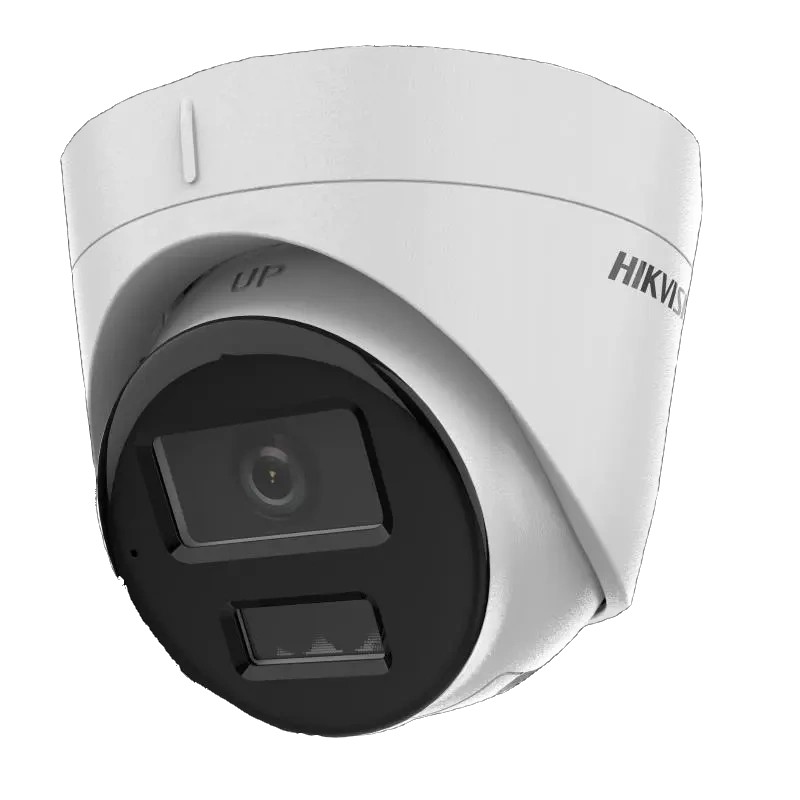
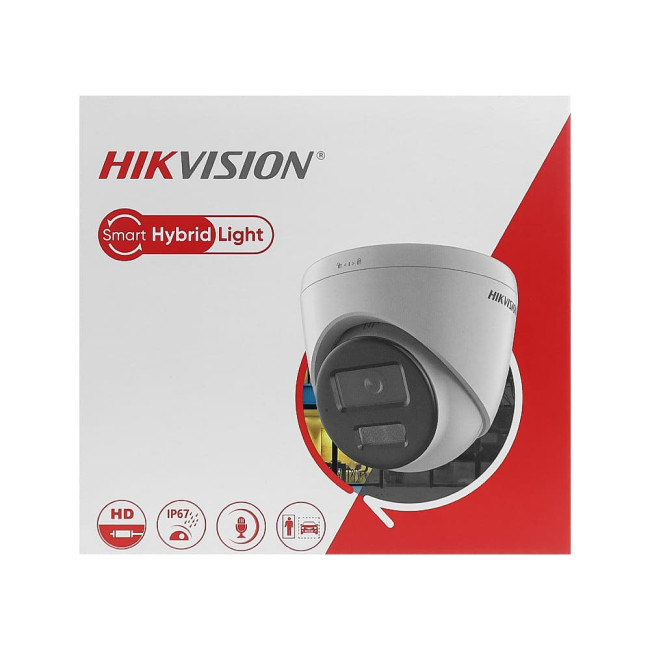
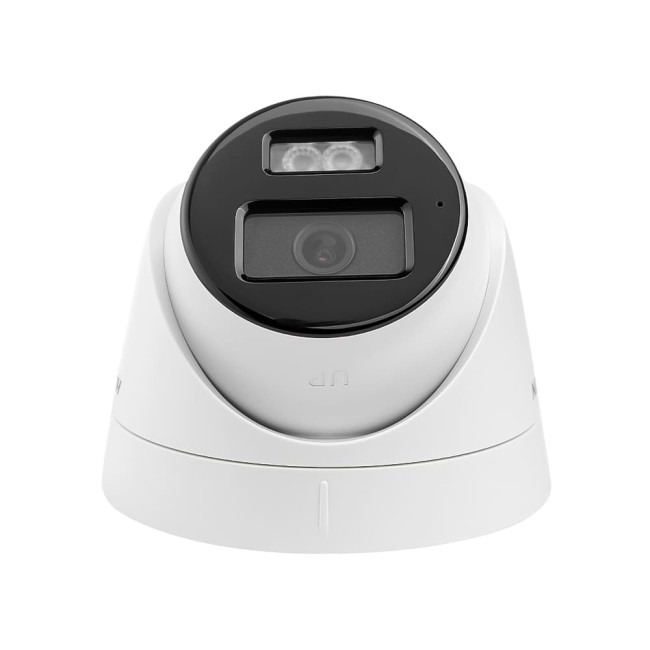
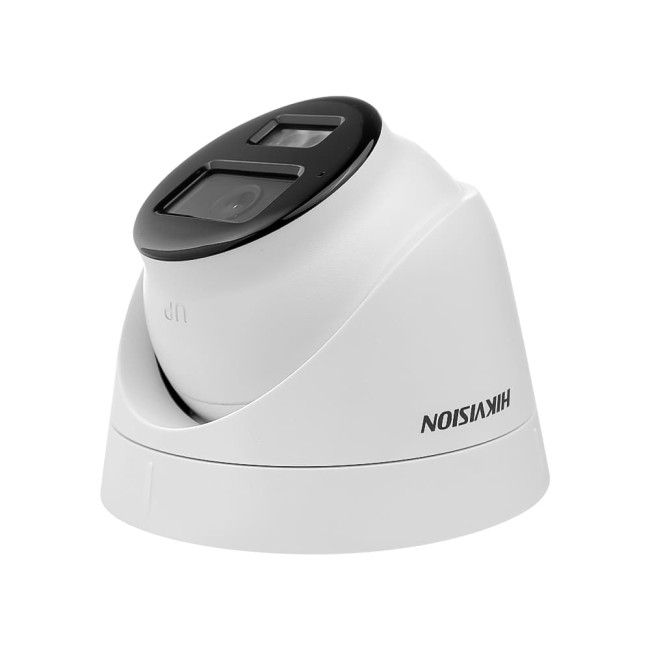


Description Hikvision DS-2CD1343G2-LIUF
Smart Hybrid Light: the camera decides when white light is needed
The LIUF index spells out the hardware: L stands for the white LED array, I for the infrared emitters, U for the built-in microphone and F for the fixed lens. In practice you get two independent night-time light sources that the camera switches between on its own analytics: in an idle scene the invisible IR array covers roughly 30 metres, and the moment a person or a vehicle enters the frame the white light of the same range comes on and the recording turns full colour. That difference is not cosmetic — a monochrome clip shows "somebody in a light jacket", a colour clip shows a man in a blue jacket and a red cap, and those are exactly the details that matter when the footage has to be shown to somebody else. Three supplement light modes are available: IR only, where the camera never gives itself away; constant white light, where video is always in colour but the camera glows like a lamp all night; and the hybrid mode, where white light fires only on an event — and that third mode is the reason people buy this model. The hybrid mode also has a side effect that often turns out to be the main one: a sudden burst of white light tells an uninvited visitor plainly that he has been seen, and a fair share of night-time visits end right there.
Four megapixels and a 4 mm lens: what actually fits in the frame
The 1/3" sensor delivers 2560×1440, roughly twice the pixel count of the common two-megapixel cameras, and that headroom is what lets you zoom into a recorded fragment instead of guessing at a face inside a blurred patch. A 4 mm lens is noticeably narrower than the usual 2.8 mm — about 78° horizontally against roughly 100-105° — so the camera covers less width, but every metre of the scene is described by more pixels. This is a deliberate trade in favour of reach: 4 mm belongs on a long driveway, a narrow path along a house, an access lane or a warehouse aisle, where you need to recognise a person at 15-20 metres rather than squeeze a whole yard into one view. If your task is the opposite — covering a square courtyard or a shop floor in one shot — this focal length will leave blind sectors at the edges, and the 2.8 mm version of the same line is the sensible pick. Note that the night-time limit is set by the illuminator, not by the sensor: beyond about 30 metres the subject is simply not lit, and extra megapixels save nothing there.
AcuSense instead of plain motion detection: G2 and G0 are different cameras
The G2 in the model code is not a housing revision but the presence of AcuSense: the camera classifies a moving object as a human or a vehicle inside its own processor, before the event ever becomes a notification. The gap against the G0 generation shows up in the second week of ownership — a camera without classification reacts to a branch, a cloud shadow, a cat and heavy rain, the owner collects dozens of night-time pushes, switches them off within a week, and from that moment the system stops being security and becomes an archive people only look at afterwards. Here you can arm alerts for people only, for vehicles only, or for both, and the same classification drives the white light, so the lamp does not flare every time wind moves a bush under the camera. Line crossing and intrusion rules are available too, which lets you describe a specific spot — the gate, the driveway entrance, the approach to a door — instead of the whole frame, so the rest of the scene generates nothing. The limits are worth knowing as well: the analytics is reliable when the object is fully visible and moving within the illuminated range, so a camera aimed at a busy street behind the fence will need zone tuning, otherwise every passing car becomes an event.
PoE 802.3af power, a metal body and IP67
The camera runs either on PoE 802.3af (class 3, up to roughly 6.5 W) or on a separate 12 V supply, and for most installations the first option is simpler: a single UTP cable carries both power and video, and no socket is needed under the eaves next to the camera. Budget the 6.5 W honestly when you size the switch — an eight-port PoE switch with a 60-65 W budget carries eight of these cameras only on paper, and in winter, when IR and white light work fifteen hours a day, consumption sits near the top of its range, so a 25-30% margin on the power budget saves a lot of trouble later. The metal housing weighs about 340 g at roughly Ø110×89 mm, so a standard bracket or direct ceiling mounting under a canopy holds it without reinforcing the base. IP67 means full dust protection and resistance to short immersion, which is what allows the camera to sit on an open facade in driving rain rather than only under a cornice. The rated -30…+60 °C range covers a Ukrainian winter too: cheap cameras limited to -10 °C often fail to start after a night-time blackout in frost, or lose focus as the optics deform with temperature.
On-board storage, H.265+ and compatibility with other vendors
The camera can record to its own microSD card — up to 256 GB is declared for this item — and that is your insurance for the moments when the recorder is switched off, the network is down, or power is missing in the part of the site where the NVR lives. A card is not a full replacement for a recorder for two reasons: its write endurance is finite and runs out sooner than owners expect, and if the camera is torn off the wall the archive leaves with it, so the primary recording still belongs on an NVR or network storage. H.265+ compression cuts the bitrate several times over H.264 on a mostly static scene, and it is the reason four megapixels do not eat the disk the way a first look at gigabytes-per-day suggests. ONVIF, RTSP and FTP support mean the camera talks not only to Hikvision recorders but to third-party NVRs and to open platforms such as Home Assistant; fine AcuSense tuning, however, will most likely still be done through the camera's own web page rather than the third-party interface. There is the vendor's cloud service for remote viewing plus push and e-mail alerts, and the built-in microphone records audio into the stream — in spaces where outsiders come and go it is worth switching that off deliberately, to avoid legal questions you do not need.
Where this camera belongs and what it was built for
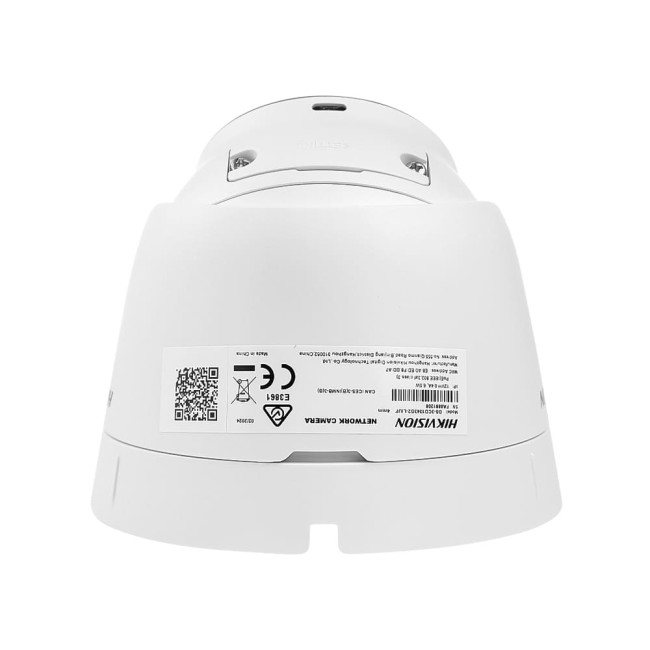
The turret design — a ball seated in the base — lets you aim the lens precisely after mounting and leaves almost no way to twist the camera by hand, unlike bullet models on a long arm that a single blow knocks off target. Combined with the 4 mm lens, that gives a clear application profile: the entrance group of a house, a long driveway, a passage between buildings, a warehouse aisle or a narrow retail floor — anywhere the scene stretches into depth rather than spreading sideways. Within the illuminated range, at roughly 15-20 metres, the frame is good enough to recognise a familiar person and describe clothing, while reading licence plates at the gate calls for even narrower optics or a dedicated camera set at a shallow angle to the direction of travel. For a large square courtyard on a single camera this model is a poor fit: the narrow angle leaves uncovered sectors at the edges, and a pair of wider cameras facing each other works far better there. Indoors it is perfectly usable — a shop, a workshop, a small office — but thirty metres of illumination is overkill in a small room, and the budget is better spent on a wider angle than on reach.
How it differs from the neighbouring Hikvision models in this catalogue
Its closest relative here is the DS-2CD1143G2-LIUF: same 4 MP sensor, same hybrid illumination, same AcuSense, but a dome housing and a 2.8 mm lens — wider coverage at the cost of reach, so take that one to cover a yard or a room as a whole and this one when the scene runs deep. The DS-2CD1043G2-LIUF is essentially the same electronics in a bullet body on a bracket: more visible from a distance, which deters by itself, but also easier to knock aside. If the budget is tight, the catalogue has the DS-2CD1341G0-I — also 4 MP and IP67, but a G0 generation with no AcuSense and no white light, meaning monochrome nights and alerts on any movement; that is a fair choice when the camera watches an enclosed yard with no trees and you want an archive rather than notifications. In the other direction sits the Pro-series DS-2CD2347G2H-LIU with 40 metres of illumination instead of 30 and more sensitive ColorVu optics — worth the step up where the scene is deeper than 30 metres or where you need colour at night without white light switching on. And if four megapixels are more than your task needs, the DS-2CD1323G2-LIUF is the 2 MP junior model with the same hybrid light and the same analytics.
If you are unsure which focal length suits your site, send us the length of the driveway, the width of the yard and the points that must always be in view, and we will work out what each camera would actually cover.
Characteristics Hikvision DS-2CD1343G2-LIUF
Reviews about Hikvision DS-2CD1343G2-LIUF from real users
No reviews found







