
 m. Сміла, Незалежності, 67г. оф, 406/6























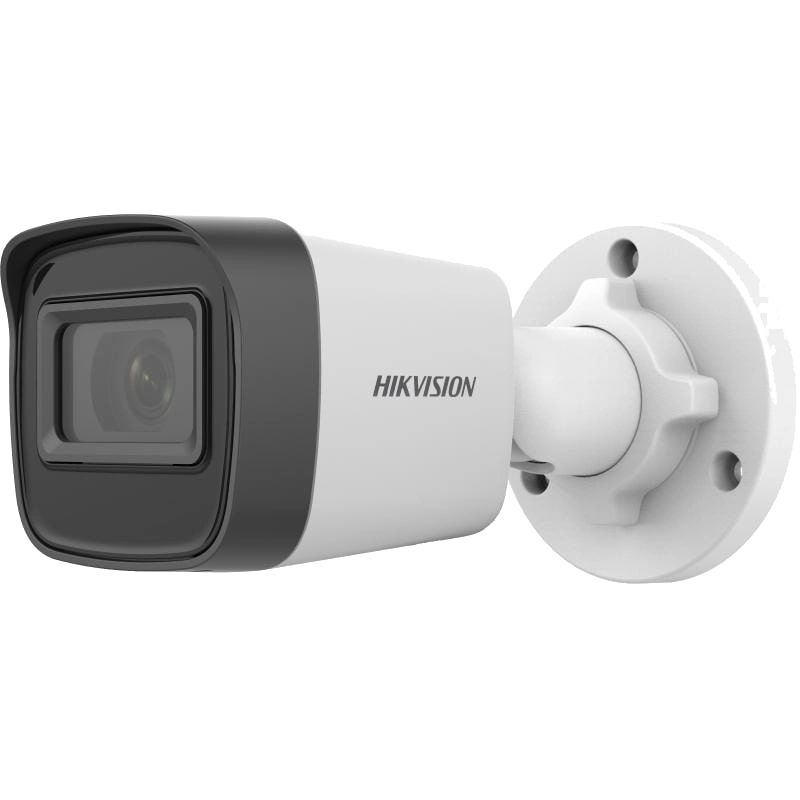
HIKVISION DS-2CD1021G0-I (2 MP/4 MM) - PoE IP CAMERA

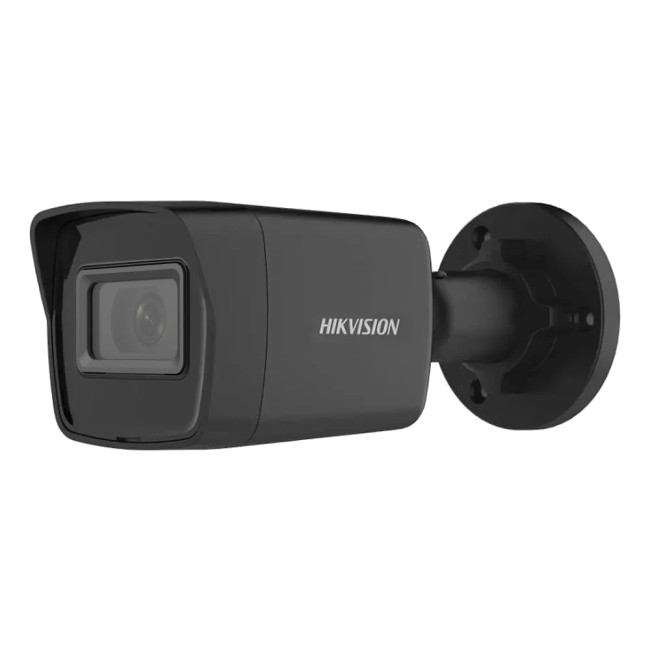


Description Hikvision DS-2CD1021G0-I
The G0 generation: a camera without analytics, and what that means daily
The G0 in the model name is not a revision number but a marker of the generation that carries no AcuSense analytics: the camera registers motion as a change of pixels and cannot tell you whether it was a person, a car or a branch. The domestic consequence is always the same, because once notifications are on, the phone starts reacting to headlight shadows, to rain inside the IR beam, to the cat and to laundry moving in the wind. Within a week those notifications get switched off, and the camera turns from a security device into a witness whose footage is consulted after the event. This is not a defect but deliberate positioning: the model is built for systems where alarms are handled by a recorder or an operator and all that is asked of the camera is an even, stable picture in the archive. If smart alerts on your phone are the point, take a G2 or G3 generation model with target classification and treat this one as a working eye inside a multi-camera system.
Two megapixels and a 4 mm lens: narrower but more detailed
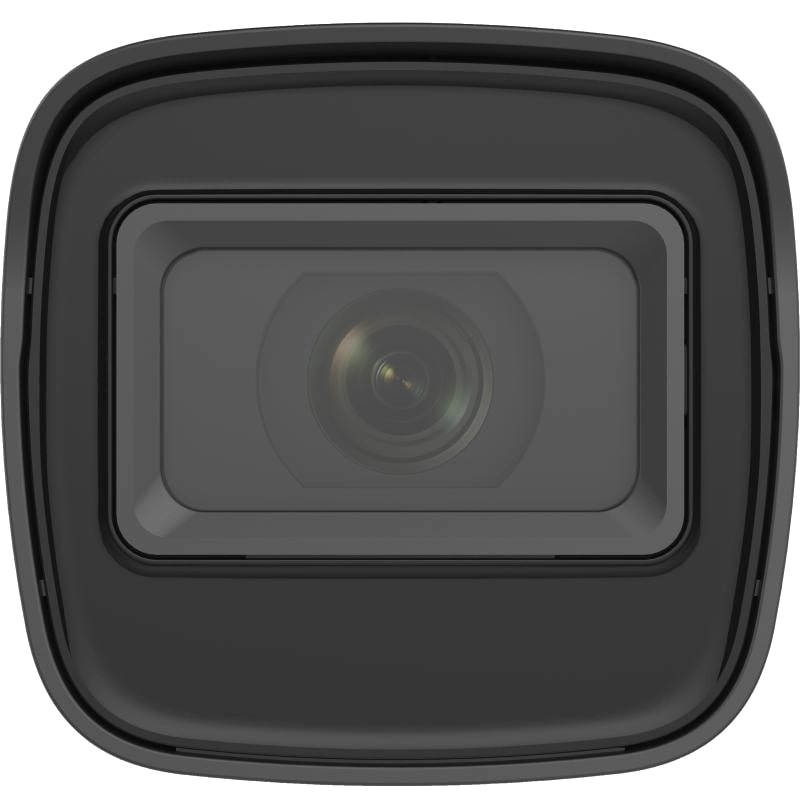
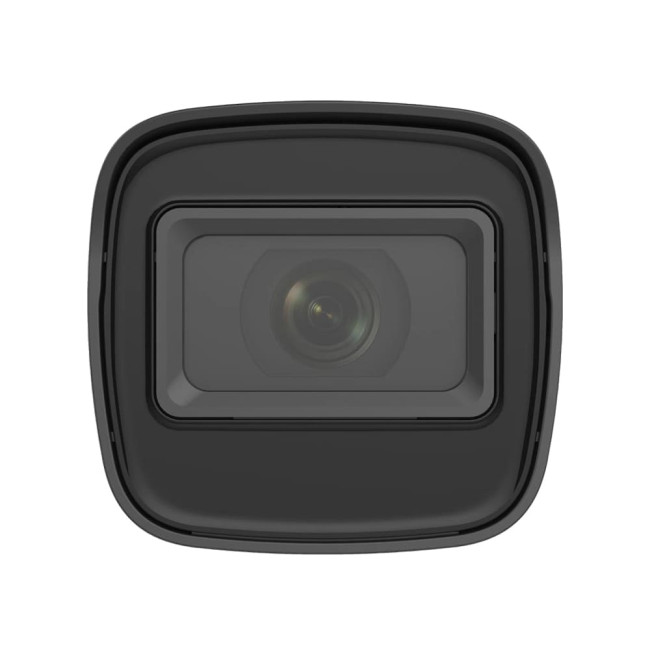
The 1/2.9-inch sensor produces 1920x1080 pixels, which is enough to keep track of a situation: you can see how many people are in frame, what they are doing, where they went and what they are wearing. The more interesting figure is the optic, because a 4 mm lens with a 94-degree field of view is narrower than the common 2.8 mm and that is a deliberate trade: you lose some periphery and gain object size at the same distance. In practice 4 mm suits a corridor, a passage between buildings, a driveway or a narrow yard — scenes that stretch away from the camera rather than spread sideways. For confident face recognition at two megapixels with this optic, plan for roughly eight to ten metres; beyond that you keep a recognisable silhouette and the event itself, but not facial features. Number plates are readable only at short range and only when the vehicle is moving slowly, so a gate where plates matter needs its own camera with a longer lens.
Infrared light to 30 metres and a monochrome night
The EXIR illuminator works in a band invisible to the eye out to 30 metres, so at night the camera draws no attention and paints no bright patch on the facade. Combined with the narrower 94-degree angle, those 30 metres are spent more efficiently than on a wide-angle model: the light is not scattered sideways but goes where the lens is pointed. The fundamental limitation is that at night you get a black-and-white image only — silhouette, direction of travel and action are visible, the colour of a jacket or a car is not. Colour is exactly what tends to be missing when footage has to be shown to somebody, since a report saying dark jacket carries far less weight than red jacket and silver saloon. One practical detail: IR diodes light up the dust, snow and rain in front of the lens, so it pays to mount the camera a little away from the wall and avoid aiming it into dense shrubs two metres ahead. If colour at night matters to you, you need a model with hybrid illumination or ColorVu, and that is the main reason to step up to a higher line.
No memory card slot: the archive exists only in the recorder
This model has no microSD slot, and the most important limitation follows from that: the camera stores nothing itself and depends entirely on the recorder or server at the other end of the cable. While the network is healthy that is no issue, but the moment a cable is cut, a switch loses power or the NVR hangs, a hole appears in the recording, whereas cameras with a card fill the gap in themselves once the link returns. For a home system with the recorder in the same building the risk is small; for a site where the camera is remote and the cable run is easy to break, it is an argument either for a model with a card or for putting the recorder somewhere protected and on backup power. There is an upside to the missing card as well: an intruder who removes the camera does not carry the footage away, because everything already sits in the recorder. Video travels over ordinary RTSP and the camera works with Hikvision recorders out of the box, while before connecting it to another brand's NVR it is worth checking compatibility with your exact model, since the protocol list in this budget line is thinner than in the Pro series.
Power, housing and mounting: 6.5 W, IP67 and 270 grams
The camera runs either from a 12 V adapter or over the network cable via PoE 802.3af, drawing about 6.5 W, which is less than most models with white light. In planning terms eight such cameras add up to roughly 55 W in total, so a modest eight-port PoE switch with a 60 to 70 W budget is sufficient and neither a heavyweight switch nor separate injectors are required. IP67 protection allows mounting in the open, including spots where rain hits the housing directly, while the -30 to +60 degree operating range covers both January frost and a baking south-facing wall in summer. The plastic body weighing 270 grams is the lightest among its neighbours here, so the camera holds on an ordinary bracket with no reinforcement of the base; the downside of plastic is that it survives impact less well than metal and yellows in the sun over the years. The manufacturer's warranty is 12 months, which again reflects the model's position as a basic workhorse rather than a solution for a critical site.
Where this camera belongs and what it was built for
The main scenario is a multi-camera system where the number of viewpoints matters more than maximum detail on each one: a warehouse perimeter, a company yard, a passage between buildings, the fence on the garden side, utility rooms and stair landings. The narrow 94 degrees and the bullet housing work well on elongated scenes — along a fence, down a corridor, over a driveway, wherever you need to see far rather than wide. As the only camera in a private house it is a weaker choice, because without target classification you get no useful notifications and without colour at night no recognisable night frame, which is precisely what a single camera is usually bought for. Nor should it go on a gate in the hope of reading plates, or into a shop floor where faces at the till must be made out. As a general-view camera in a system that already has one or two smart models on the critical points, however, it is entirely in its place and lets you cover more directions on the same budget.
How it differs from neighbouring models in this catalogue
Its closest relative is the DS-2CD1141G0-I: the same G0 generation without analytics and the same 30-metre illumination, but 4 MP instead of two and a dome housing instead of a bullet, so it is the one to take when you want a wider view under a ceiling and more pixels for digital zoom. The DS-2CD1321G0-I is the dome version of the same budget logic at 2 MP, more convenient for an indoor ceiling or a porch soffit. If the night image is what really matters, look at the DS-2CD1027G3-LIUF: the same bullet housing and the same 2 MP, but with hybrid illumination and white light, meaning colour after dark, although it too lacks people classification. The genuine step up is the DS-2CD1323G2-LIUF: 2 MP, hybrid illumination and, crucially, the G2 generation with human and vehicle detection, which is what makes notifications usable. And when the task is to identify a person in the yard at night rather than merely log movement, moving up to the 8 MP DS-2CD2083G2-LI with white light and 40 metres of illumination is well justified, while the DS-2CD1021G0-I remains the choice for points that simply need a reliable eye in the system.
Tell us how many points you need to cover and where the recorder will sit, and we will work out which directions this basic model handles well and where a camera with target classification is worth it.
Characteristics Hikvision DS-2CD1021G0-I
Reviews about Hikvision DS-2CD1021G0-I from real users
No reviews found







