
 m. Сміла, Незалежності, 67г. оф, 406/6























DAHUA DH-T5A-PV (5 MP) - WI-FI IP CAMERA WITH TWO-WAY AUDIO AND AI

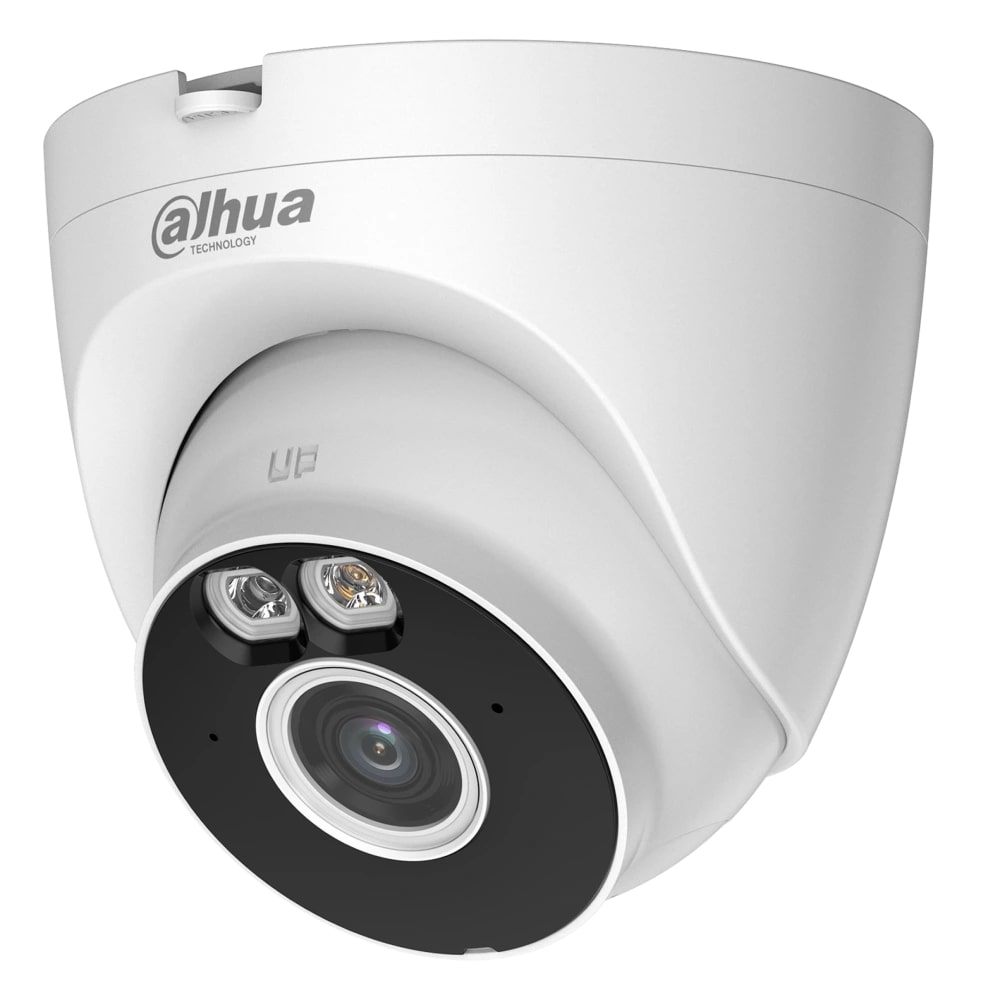
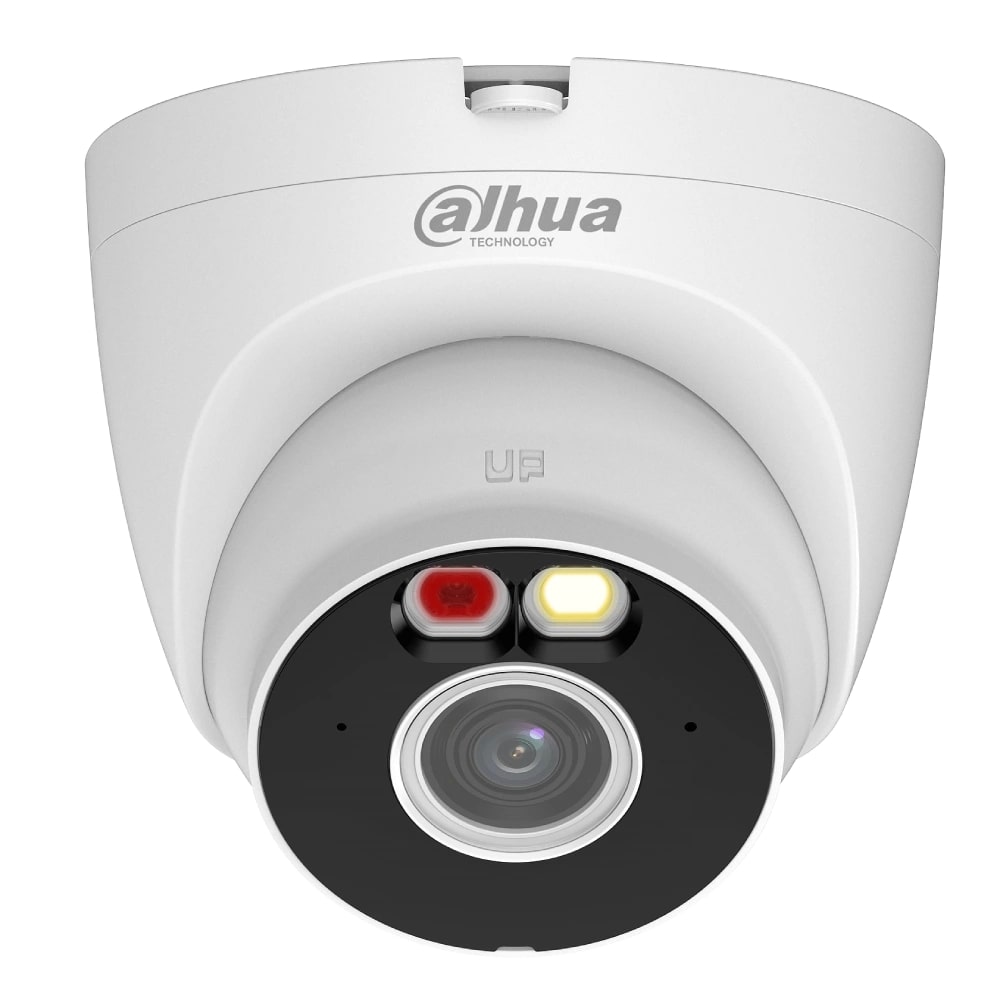
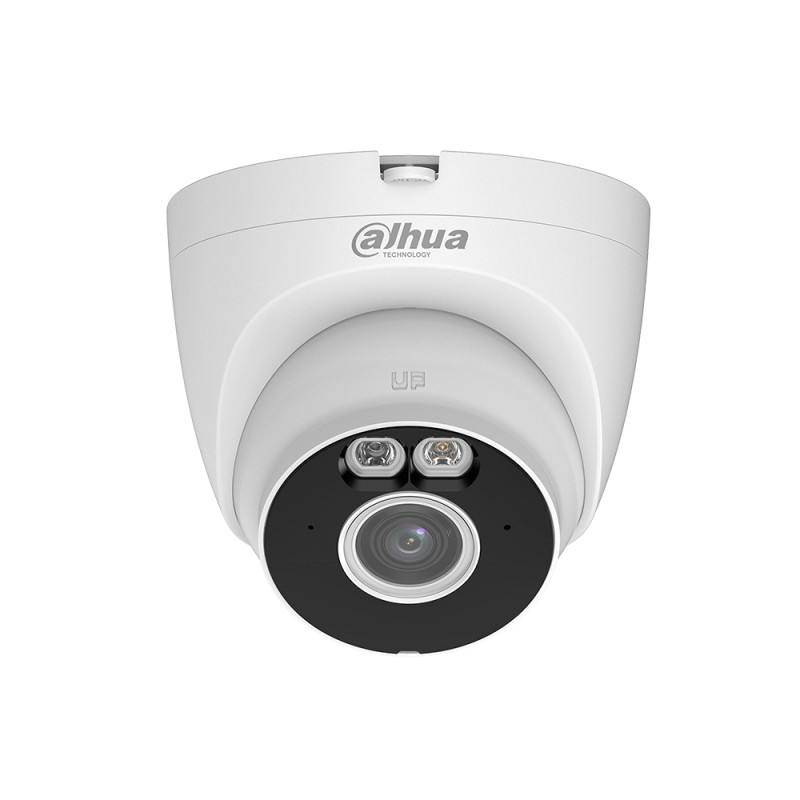
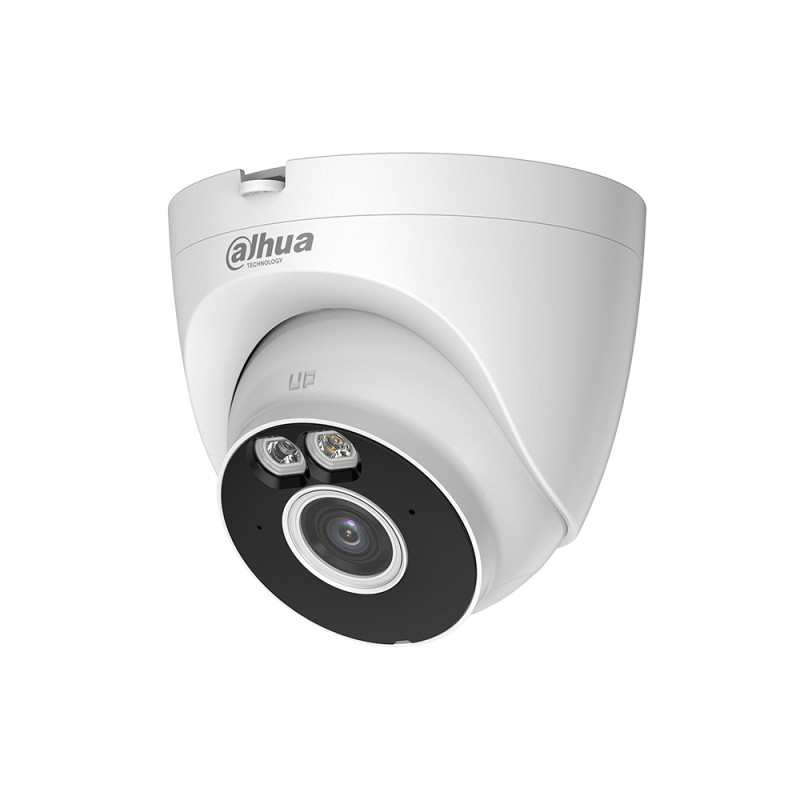


Description Dahua T5A-PV
Wireless mounting without a network cable — and where that convenience ends
The camera joins an existing Wi-Fi network, so there is no switch to buy and no twisted pair to pull to the mounting point, while the initial setup runs through Bluetooth pairing in the DMSS app — in practice only a few minutes pass between unboxing and the first live frame. The cable saving is only partial, however, and this is the one thing worth understanding before you buy: power is external 12 V DC only, PoE is not supported, so the mounting point still needs a socket or a low-voltage line run to it. Consumption is modest — 2.1 W idle and up to 7.1 W at peak, when the warm light, the siren and H.265 encoding all run at once, which works out to roughly 0.6 A on the 12 V line. An RJ-45 port (10/100) is also present on the body and it is far from redundant: if the camera sits at the far corner of the plot, or if you need continuous recording, a wire is always steadier than radio. The practical conclusion is simple — Wi-Fi removes the network cable from the equation but not the mains, so plan the installation around the nearest outlet.
Smart Dual Light: a colour night instead of a black-and-white silhouette
Illumination here comes from two different sources — a single infrared LED and a single warm white LED, each with an effective reach of up to 30 metres. In the standard night mode the invisible IR light works and the picture is monochrome; the moment the analytics classifies a person or a vehicle in the frame, the camera fires the warm light and switches to full colour. The difference between those two recordings is the difference between "a man in a dark jacket" and "a man in a blue jacket with a red backpack", and only the second description has any evidential value. Sensitivity of 0.007 lux at F1.6 means colour survives on nothing more than a neighbour's street lamp, while in total darkness (0 lux) the image exists only while the illuminator is on. There is a flip side worth knowing before installation: warm light is visible to everyone, so the camera gives away its own position and doubles as a small night lamp, and in warm weather it gathers night insects right in front of the lens — under a bedroom window that becomes annoying within a week.
5 MP and a 2.8 mm lens: what actually lands in the frame
The 1/2.7" sensor delivers 2880 × 1620 pixels at 25 frames per second — roughly twice the pixel count of the widespread 2 MP cameras, and it is that headroom that lets you zoom into an archived fragment instead of studying a blurred smear. The 2.8 mm lens with a 108° horizontal and 129° diagonal field covers a typical room, a porch, a small yard or a shop floor with one camera, but a wide angle always spreads those pixels across the whole scene, so detail falls off with distance faster than buyers expect. Dahua publishes no official DORI figures for this model, so treat distances conservatively: confident facial identification needs the person to pass within a few metres of the lens, while at the 30-metre edge of the illumination you realistically capture only presence and direction of travel. The fast F1.6 aperture and DWDR help against backlight — a bright window or driveway lamps behind a person's back, exactly the situation where an unprocessed frame turns a face into a dark blob. Zoom is digital only, meaning software enlargement of existing pixels rather than optics, so the task of reading licence plates at a gate is outside this model's reach by design and calls for a narrower lens.
AI human and vehicle detection, siren and light alarm
Object classification runs inside the camera itself: it tells a person from a vehicle as separate classes, so notifications can be limited to those two categories rather than to every pixel change in the frame. The gap against plain motion detection (which is also here, in four rectangular zones) is fundamental: without classification the owner collects dozens of night alarms from branches, shadows and insects within a week, switches notifications off, and the system stops working as security at all. The PV letters in the name stand for active deterrence — on an alarm the camera triggers its siren and light indication, and a large share of attempts to walk onto a property ends right there, because the intruder is told immediately that he has been seen. The built-in microphone and speaker provide genuine two-way talk, so you can answer a courier without opening the door or address whoever is standing at the gate. One honest limitation: animals are not among the classes, so your own dog in the yard will raise motion detection yet never be classified as an object of interest — in practice that is closer to an advantage, because human and vehicle alarms stay clean.
Wi-Fi 6, but 2.4 GHz only: what it means for link stability
The radio module follows 802.11b/g/n/ax — Wi-Fi 6 — but works exclusively in the 2.4 GHz band; 5 GHz is not supported by this model, which is worth checking against your router in advance. For an outdoor camera 2.4 GHz is arguably a benefit: the lower frequency travels through walls and floor slabs better, so a camera in the far corner of the plot has a better chance of holding the link than it would on 5 GHz. The downside of the same band is congestion — in dense housing dozens of neighbouring networks share it, and that, rather than the camera, is the usual reason video stutters. Wi-Fi 6 features such as OFDMA and scheduled transmission only materialise with a Wi-Fi 6 router; paired with an older one the camera simply behaves as an ordinary 802.11n client with no stability gain. The main stream in H.265 takes up to 4 Mbps, and if you plan continuous rather than event-based recording, it is better to run twisted pair to the camera from the start — the 10/100 port has far more than enough headroom for that bitrate.
Archive on microSD, recorder compatibility and the housing
The camera records to its own microSD card of up to 256 GB, which makes it self-sufficient: even if the router goes down, local recording continues. Archive depth is easy to estimate: at the maximum 4 Mbps a day of continuous recording consumes about 43 GB, so 256 GB covers roughly six days; on a quiet scene with a realistic 2 Mbps you get around eleven days, and in event-only mode a card lasts for months. ONVIF (profiles S, G and T) and CGI are supported, so the camera can join a third-party recorder or VMS — including the Dahua NVR21xx/NVR22xx-I2 units from this catalogue — but the siren, two-way talk and AI notifications remain functions of the DMSS app rather than of someone else's interface. The metal-and-plastic housing carries IP67, which is more than shorthand for "survives rain": the rating is proven by half an hour submerged at one metre, so wind-driven rain, icing and washing the facade with a hose all stay inside its tolerance. The -40 to +60 °C range and humidity up to 95% are a claim on genuinely exposed outdoor mounting, where cheap cameras rated from -10 °C often simply fail to boot after a January power cut until their own electronics warm them up.
Where this camera belongs, and where choosing it is a mistake
The eye-ball design — a ball seated in a fixed base — sits flush against a ceiling or a soffit, is aimed by rotating the sphere itself (360° pan, up to 78° tilt) and has no long arm that a hand can easily twist aside. Its natural places are the porch and entrance area of a house, a small yard, a terrace, the floor of a small shop, a till zone or a stockroom of a few dozen square metres: anywhere distances are short and the colour of a jacket or the lines of a face genuinely matter. The scenario where the model shows its full value is a spot where you need not only to record but to intervene — the siren and your voice through the speaker act where an ordinary camera merely registers the event. Where it does not belong: a long perimeter, a gate with licence plates, a twenty-space car park — a wide 108° combined with 5 MP physically cannot resolve readable detail at those distances, no matter how much you enlarge the frame afterwards. It also should not be placed behind glass, because the warm light bounces off the pane straight into the lens and the night frame turns into milky fog; for window observation you either move the camera outside or disable the illuminator and rely on street lighting.
How it differs from neighbouring Dahua models in this catalogue
Its closest relative is [1623] DH-P5AS-PV from the same wireless series: identical 5 MP sensor and the same active deterrence, but with a motorised pan-tilt head, auto-tracking, dual-band Wi-Fi (2.4 and 5 GHz) and red-and-blue strobe LEDs; the premium there buys the moving head rather than better image quality, and it pays off on a wide yard, whereas T5A-PV gives a steady fixed frame with no mechanics to wear out. If twisted pair already reaches the mounting point and a recorder is part of the system, wired models make more sense: [1611] DH-IPC-HDW2249T-S-IL is the same eye-ball body with Smart Dual Light and WizSense analytics running on PoE, but only 2 MP and without a siren, while [1627] DH-IPC-HDW2449TM-S-IL offers 4 MP with warm illumination, also over PoE. When deterrence is the point but the wiring exists, the catalogue has [1626] DH-IPC-PT1239H-PV — a pan-tilt model with siren and auto-tracking on PoE, albeit at 2 MP only. For maximum detail in a wired system there is [1621] DH-IPC-HDBW2849E-S-IL at 8 MP in a vandal-resistant dome, the choice where footage is later examined fragment by fragment and the housing has to survive a blow. In short: take T5A-PV when there is no network cable and nowhere to run one, you need 5 MP at short range and the ability to answer an event out loud; if the cable is there, a wired model of the same class will be steadier day to day.
If you are unsure whether your Wi-Fi will hold a camera in the far corner of the plot, tell us where the router sits and where the camera is planned, and we will advise whether to run a cable from the outset.
Characteristics Dahua T5A-PV
Reviews about Dahua T5A-PV from real users
No reviews found







