
 m. Сміла, Незалежності, 67г. оф, 406/6























DAHUA DH-P5AS-PV (5 MP) - WI-FI PTZ IP CAMERA WITH AUTO-TRACKING

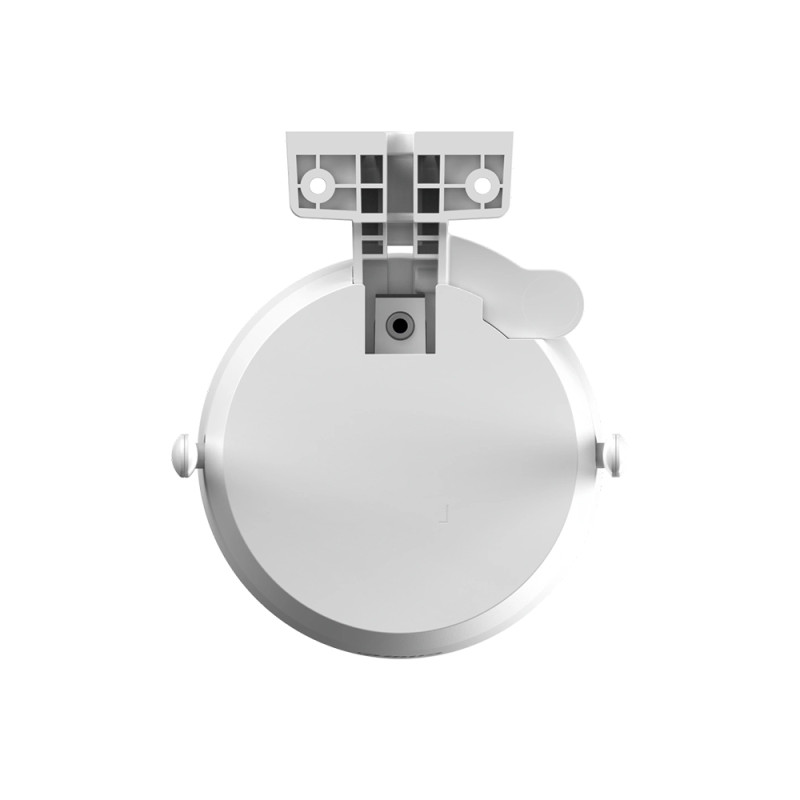


Description Dahua P5AS-PV
345 degrees of pan and 90 of tilt: how a moving camera really differs from a fixed one
The PT in the name stands for Pan-Tilt: the head rotates from 0 to 345 degrees horizontally and tilts from 0 to 90 degrees, so from a single point on a pole or a house corner it can look at the far corner of the plot and straight down at its own base. On a compact site that changes the whole design approach: instead of three fixed cameras aimed in three directions you install one moving unit, and the saving shows up not only in cameras but in cable, recorder ports and installer hours. There is one limitation of a moving head that has to be understood before buying, because no amount of configuration removes it: the camera sees only the sector it is currently pointed at, so while it watches the gate the back yard is not being recorded at all, rather than being recorded less well. Wider coverage from one point is not simultaneous coverage: while the head travels between positions, part of the area is left unwatched for several seconds, and an event that happens in another sector during those seconds simply never reaches the archive. The sound way to choose is therefore this — a PT camera buys you flexibility and reach into places a fixed lens never looks, but where a continuous synchronous archive of every direction is required, several fixed cameras remain the only correct answer and the moving camera works as a supplement to them.
Auto tracking and human/vehicle classification: how the camera decides where to look
The camera separates people and vehicles from everything else moving in the frame, and on a moving model that is not a bonus feature but a precondition for it working at all: without classification the mechanism would chase every branch, cat and headlight shadow, wear itself out turning, and be switched to manual by the owner within a week. Auto tracking works like this: when the analytics spot a person, the head follows them, keeping the subject near the centre of the frame, and returns to its programmed home position once the target is lost. In practice that yields far more useful footage than a static frame — you see not merely that someone crossed a line, but where they went, what they did on the way and which side they left by. At the same time tracking amplifies the core limitation of a moving head: while the camera escorts one person it is physically looking only at them, and the rest of the site is unobserved for that whole period. The classic two-intruder trick, where one deliberately draws the camera away, is rare in a private yard but worth planning around on a commercial site, so position the unit where its typical path has no mirrored surfaces, and point the home position at whatever direction matters most, since that is where the camera returns after every escort.
Active deterrence: red and blue flash plus a spoken warning instead of passive recording
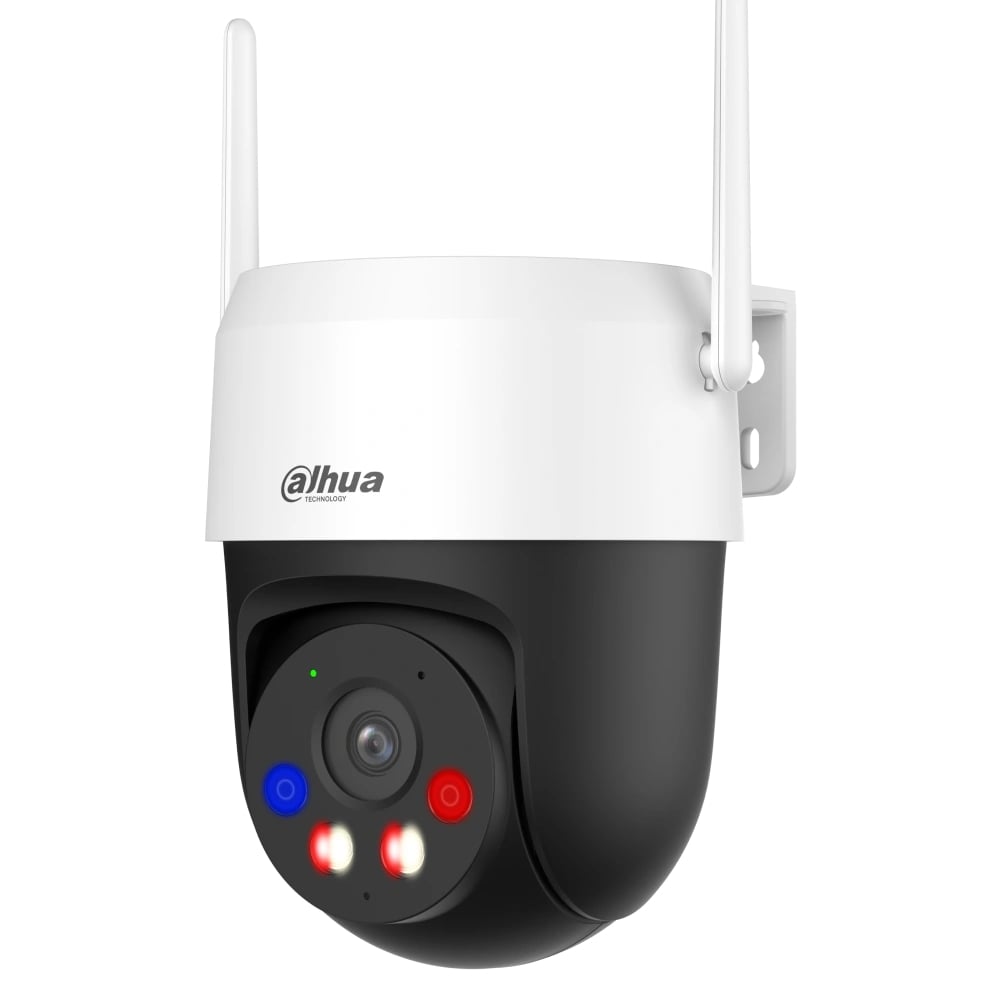
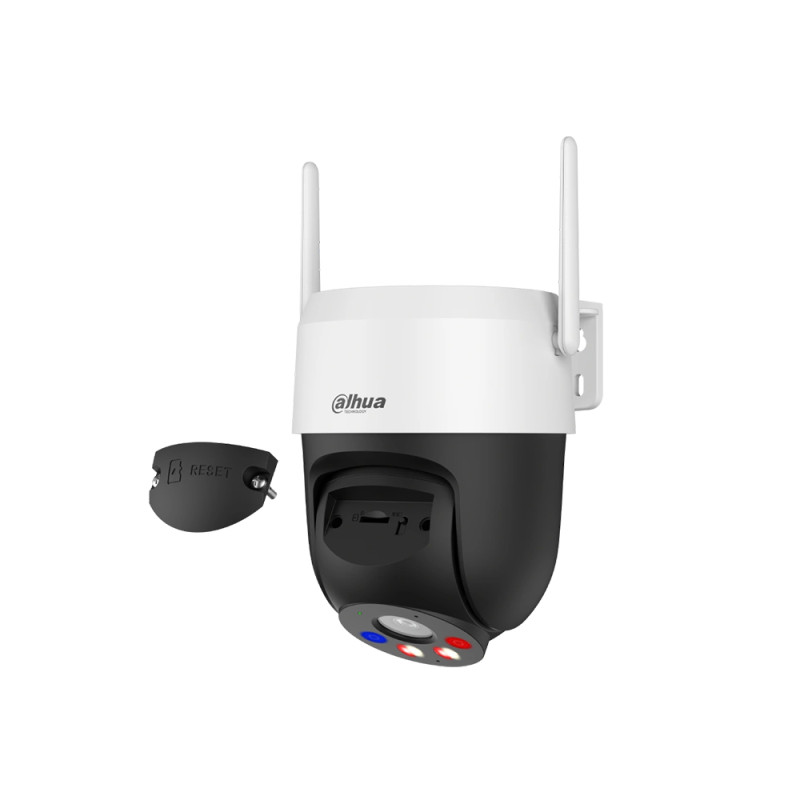
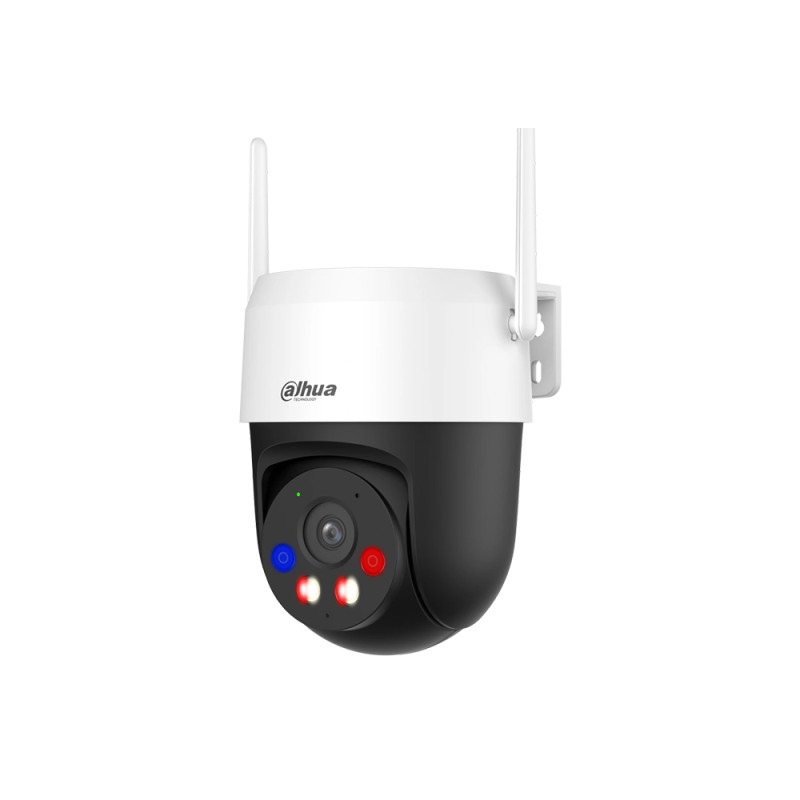
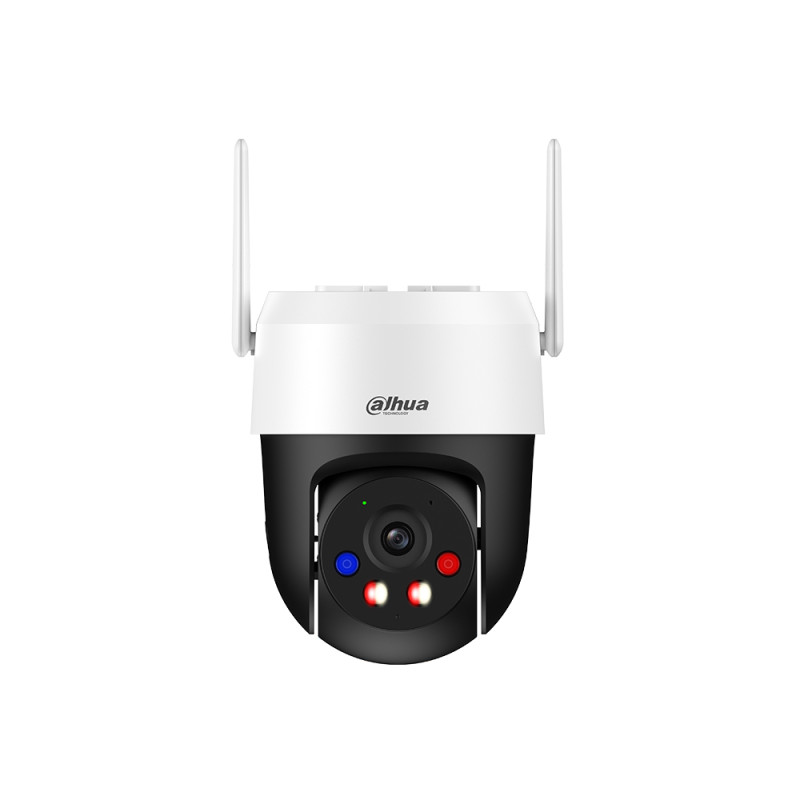
The PV suffix marks the active-deterrence version, and that is exactly what separates this camera from an ordinary pan-tilt unit. When the analytics classify a person in the frame, the camera can fire a bright red and blue strobe and simultaneously issue an audible warning through its built-in speaker, while full two-way audio lets the owner simply talk to whoever is standing at the gate straight from the app. The value here is not measured in image quality but in the incident not happening: somebody who climbs the fence and within two seconds gets a light-and-sound response plus a live human voice usually turns back, and there is no recording to analyse afterwards. The red-and-blue pattern is not a styling choice — it reads as a police beacon and works even on people who have already learned to ignore the plain white spotlights on ordinary cameras. There is a flip side worth settling before installation: in dense housing the neighbours see the light and hear the audio too, so never aim the unit at a pavement or the windows opposite, and in town the deterrence is normally restricted to night hours, otherwise daytime false triggers quickly turn into a dispute next door.
5 MP, a 4 mm lens and dual 30-metre illumination: what you actually see in the frame
The 1/2.7-inch sensor delivers a maximum of 2880 by 1620 pixels at 25 frames per second, and the fixed 4 mm F1.6 lens covers 78 degrees horizontally, 42 vertically and 92 diagonally. That 78-degree field is noticeably narrower than the 100-112 degrees typical of fixed cameras, and the choice is deliberate: a narrower lens at the same five megapixels concentrates more pixels per metre, so a face stays recognisable out to roughly 8-10 metres and clothing and behaviour can be described to about 20, instead of giving you a wide but thin panorama. The moving head is precisely what compensates for the narrow angle — the camera does not try to see everything at once, it aims itself at wherever something is happening. Illumination is dual: two multi-core illuminators carry both infrared and warm white LEDs effective to about 30 metres, so routine night recording runs on invisible infrared in black and white, and warm light switches on for an event, turning the frame colour at the moment colour matters. Sensitivity of 0.007 lux in colour and 0.0007 lux in monochrome is enough for a yard with a street lamp to be recorded in colour with no illuminator at all, while at zero light the LEDs carry the scene; a number plate at distance will not read reliably in the dark through this optic, and plate capture needs its own camera with a longer lens.
Wi-Fi 6, an RJ-45 port, ONVIF and the memory card: how footage leaves and is kept
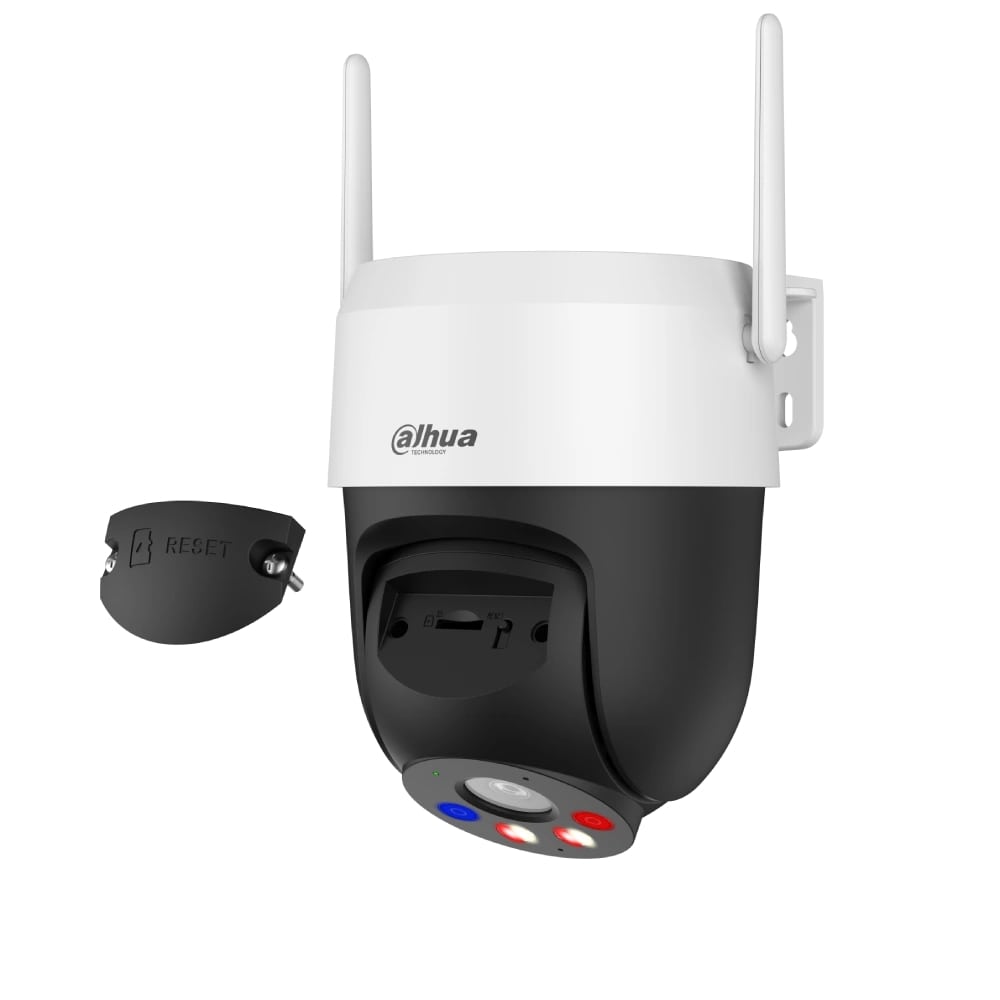
The wireless module is a current one — IEEE 802.11a/b/g/n/ac/ax across both 2.4 and 5 GHz, meaning Wi-Fi 6 with the option of moving to 5 GHz where neighbouring networks interfere less, and first-time setup is simplified by Bluetooth pairing with the phone. The camera also has a proper 10/100 Mbit RJ-45 socket, which matters more than it looks: if cable can reach the mounting point, run it, because a five-megapixel stream over Wi-Fi through two walls or a reinforced concrete slab is the most common cause of a crumbling picture and gaps in the archive, and the problem tends to surface not on day one but at the worst possible moment. ONVIF Profiles S, G and T are supported along with CGI, so the camera integrates not only with the manufacturer's app but with third-party recorders and video management platforms; it comes up natively on Dahua NVRs, and Profile G additionally gives a foreign NVR access to the recordings held on the card. The microSD slot accepts cards up to 256 GB: in H.265 a five-megapixel stream runs at roughly 4-5 Mbit/s, so a 256 GB card holds about five or six days of continuous recording, or several weeks of event-based recording. On a wireless camera that local card is doubly important, because it papers over Wi-Fi dropouts — while the link is down the footage goes to the card instead of disappearing.
12 V power with no PoE, up to 14 W draw, an IP66 shell and what that means on site
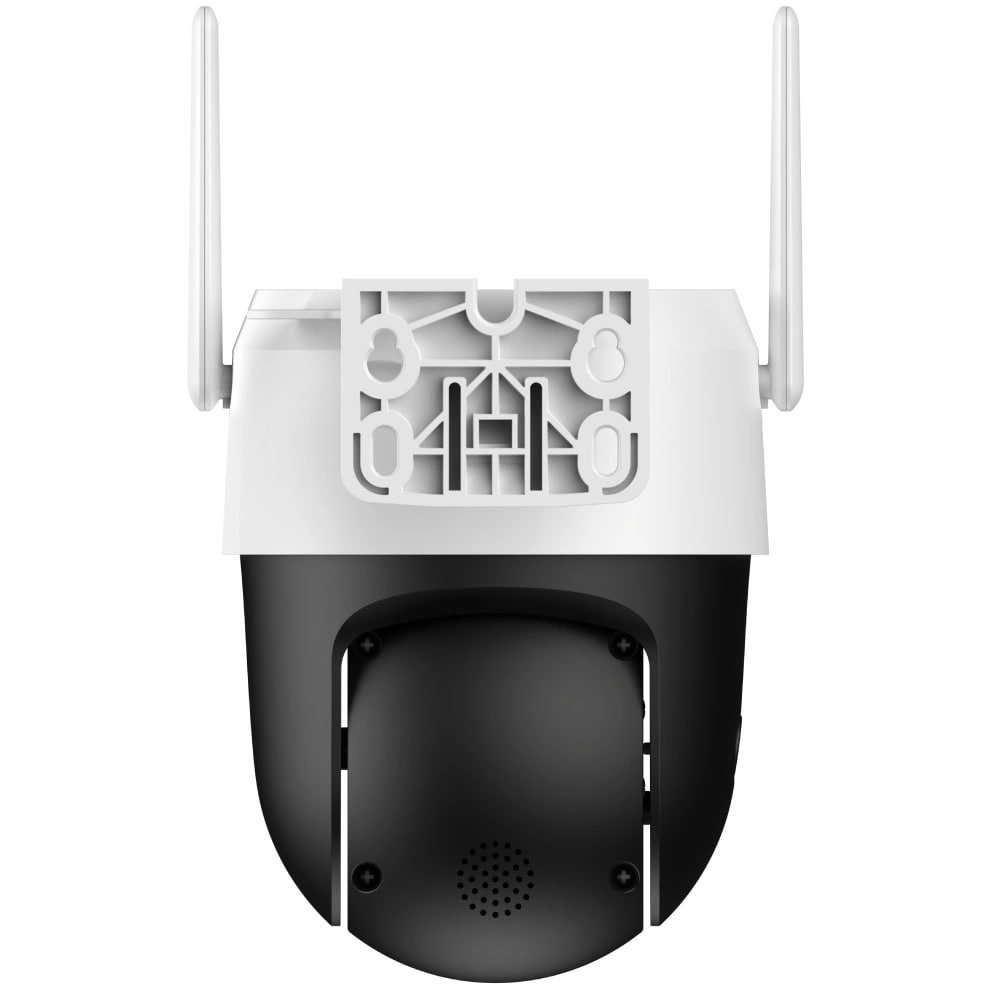
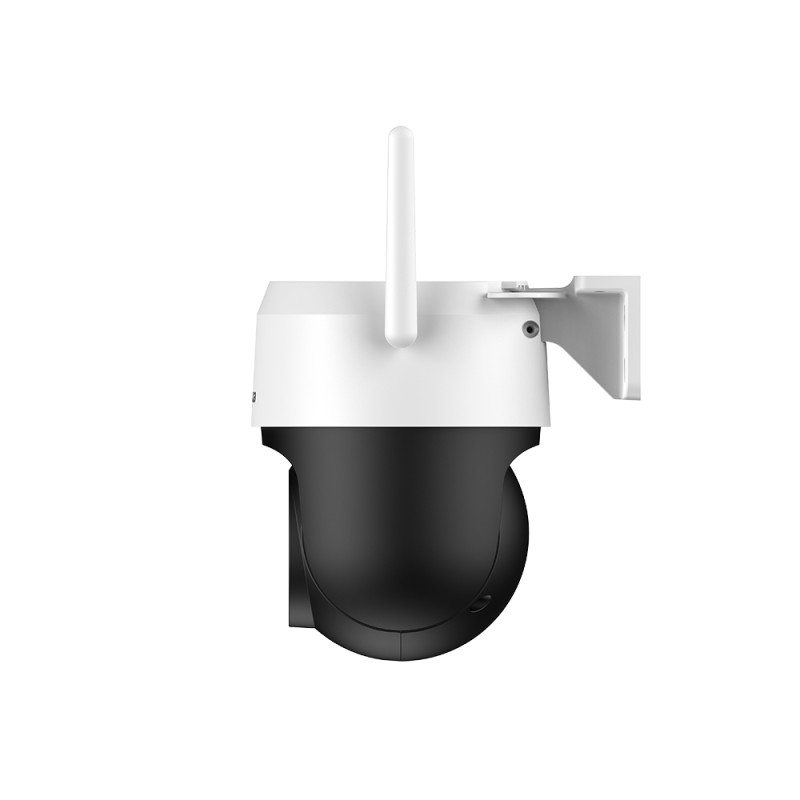
This camera is powered only by an external 12 V DC adapter — there is no PoE support here, and that is the most frequent surprise on a first installation: mains power still has to reach the mounting point even though the video travels over Wi-Fi. Idle consumption is around 2 W while the maximum is 14 W, and those 14 W appear exactly when the pan motors, the illuminator, the speaker and the Wi-Fi radio all work at once, so size the power supply and the cable run with headroom rather than to the nominal figure. The plastic housing measures roughly 125 by 110 by 140 mm and weighs 400 g, with IP66 protection — full dust sealing plus resistance to powerful water jets, which means exposed outdoor mounting but not immersion. The -30 to +55 degree operating range covers a Ukrainian winter, though it is narrower than the -40 lower limit of Dahua's wired outdoor models, and on an exposed pole in the eastern regions that margin is worth keeping in mind. One more purely mechanical point specific to moving cameras: the head needs clear space around it, so it must not go into a recess or tight under a narrow soffit, otherwise part of its travel becomes unreachable; the mechanism is also a moving part that wears over the years, whereas a fixed camera has nothing to wear out, and the warranty on this model is 12 months.
Where this camera belongs and which jobs it was built for
The natural position for the P5AS-PV is a point from which one camera has to cover several different directions: the corner of a house, a pole in the middle of a yard, the gable above an entrance, the corner of a yard with outbuildings. It handles a compact site with several zones of interest well — a yard 15-20 metres across, a plot with a garage and a side gate, a small car park in front of an office, the courtyard of a cafe with a summer terrace — and especially where cable cannot realistically be pulled to every point and wireless mounting is a genuine advantage. One particularly strong scenario is a holiday house or any property the owner visits rarely: pan and tilt, auto tracking, the light-and-sound warning and two-way audio together mean you do not just watch a visitor, you speak to them and make them leave. Where it does not belong: a long fence or driveway beyond 30 metres, where the illuminator runs out; an entrance where plates must be read in darkness; a site that needs a continuous archive of every direction at once; and any point with poor Wi-Fi coverage if no cable is planned for it. Nor should it go into dense city housing right beside the neighbours' windows, because in such a spot the very feature you are paying for will either cause a quarrel or be turned off, leaving you with an ordinary wireless camera.
How it differs from the neighbouring pan-tilt models in this catalogue
Its direct relative here is the Dahua DH-IPC-PT1239H-PV: also a moving camera with a spotlight and spoken warnings, but 2 MP instead of 5, wired only, and powered over PoE 802.3af. It is the markedly more affordable option and the more convenient one for a permanent wired install, since it needs a single cable instead of power plus Wi-Fi, but it resolves far less detail — the choice between them comes down to whether a detailed frame and wireless mounting matter more to you, or simpler powering and a lower outlay. The Dahua DH-SD2C400NA-B-PV-PRO-BE is a 4 MP moving camera with the same active deterrence but PoE powering: the option for a site where cable is already in place and nobody wants a separate adapter, and it draws less power, though it lacks Wi-Fi 6 and this model's tighter, more detailed lens. The Dahua DH-T5A-PV packs the same five-megapixel deterrence hardware into a fixed eyeball dome: if you have one specific direction to watch, it gives the same image with no moving parts to wear out and records that sector continuously instead of slaloming between presets. The Imou 3MP PoE PT is a considerably cheaper moving alternative from Dahua's budget sub-brand with three megapixels and PoE, sensible for a flat, a cottage or a small shop that needs neither 5 MP nor red-and-blue deterrence nor Wi-Fi 6, while the Hikvision DS-2DE2C400MWG-E is a 4 MP moving camera whose card in our catalogue does not list human and vehicle detection, meaning its tracking and deterrence logic will behave more crudely. In short, choose the P5AS-PV when you need circular coverage from one point, five-megapixel detail at distance, a wireless link and a light-and-sound response to an intruder all at the same time.
Tell us how many directions you need to keep in frame, how far the gate, the path and the parking space are from the camera, and whether cable can be pulled to the spot — and we will say whether one moving camera is enough here or two fixed ones would serve you better.
Characteristics Dahua P5AS-PV
Reviews about Dahua P5AS-PV from real users
No reviews found







